A French Word to Live By
Translate Jeter la pierre à quelqu’un to English
/ʒə.te la pjɛʁ a kɛl.kœ̃/
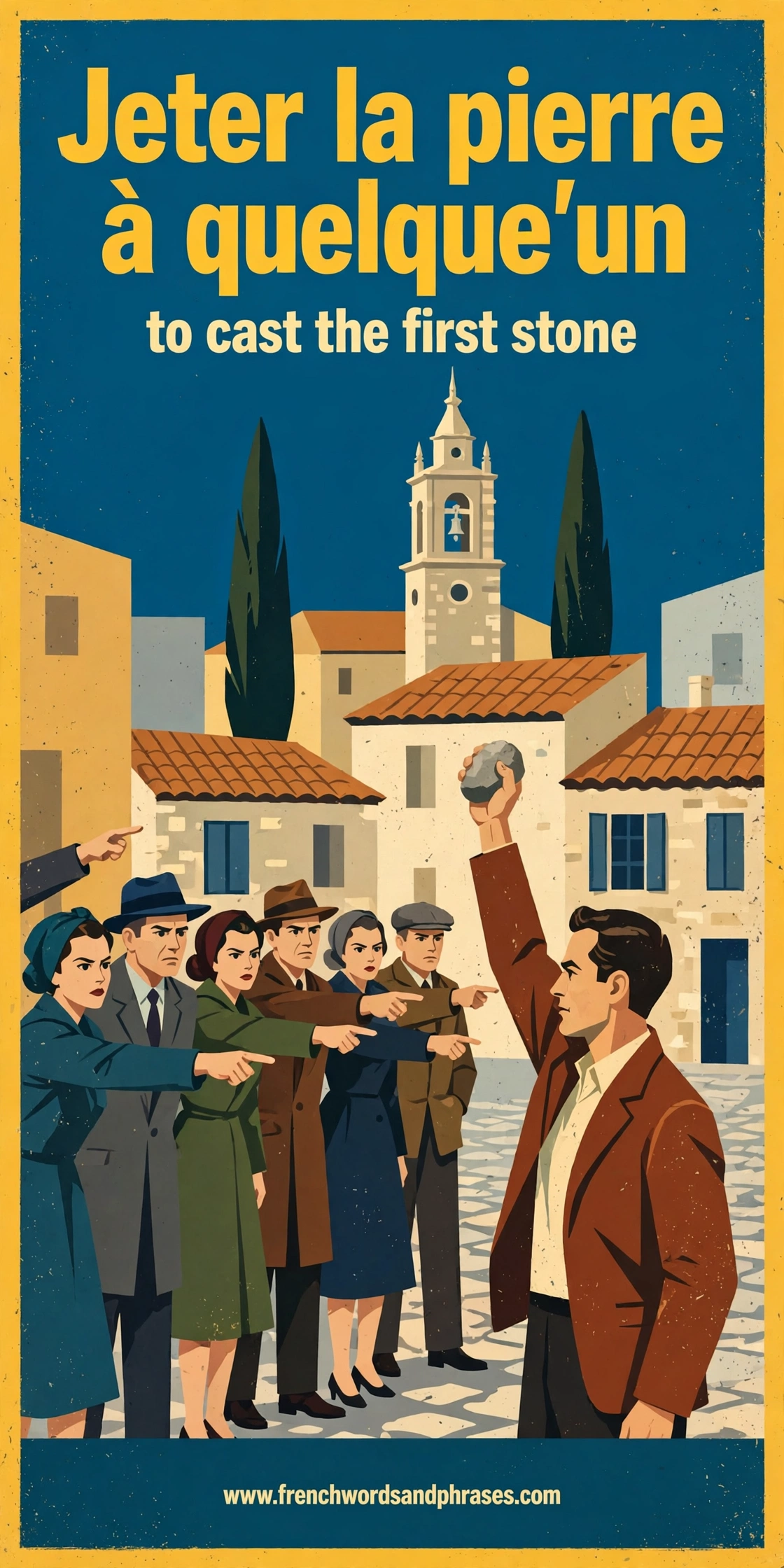
Jeter la pierre à quelqu’un means to cast the first stone — to be the first to blame or condemn someone.
The village meeting has gone quiet. Everyone knows who left the gate open and let the sheep out, and everyone is looking at the young shepherd. Then the mayor, who once lost a whole flock himself, shakes his head slowly: « Avant de lui jeter la pierre, regardons-nous un peu. »
Let’s explore how jeter la pierre à quelqu’un works in French, beginning with the whole phrase on one card.
Understanding the French Phrase Jeter la pierre à quelqu’un
Jeter la pierre à quelqu’un is a French idiomatic expression built from jeter (to throw), la pierre (the stone) and à quelqu’un (at someone). It comes straight from the Bible — « que celui qui n’a jamais péché lui jette la première pierre » — and it means to be the first to blame or condemn someone.
It means to cast the first stone — to open the attack on someone, to be the first to blame them for a fault. Nobody is throwing real stones: the stone is the accusation, and the phrase always carries a warning inside it, because in the original story the first stone could only be thrown by someone who had never done wrong himself.
Type: Idiomatic expression — blame (verb + noun + à quelqu’un)
Answers the need: Warning against being the first to condemn someone
Register: Neutral — safe in speech and writing, with a literary, biblical flavour
Strength: Serious — it questions the accuser as much as the accused
One important usage detail: the phrase very often appears in its full biblical shape, jeter la première pierre — je ne serai pas le premier à lui jeter la pierre. The person blamed always stands after à: jeter la pierre au voisin, à la direction. Turn it round and the victim speaks: se faire jeter la pierre, to be cast the first stone at, to be made the scapegoat.
Experience the Word
Jeter la pierre à quelqu’un is blame with a mirror hidden inside it — before your arm moves, the phrase asks what is in your own pockets.
Imagine the scene the phrase was born in: a crowd, stones already in their hands, and one quiet sentence that empties every fist. Two thousand years later, the same sentence still works in an office, a family, a village square.
French kept the picture because it is unforgettable. A stone is heavy; so is a judgement — the phrase makes you feel the weight of both before you throw.
How to Use Jeter la pierre à quelqu’un in French: Complete Guide
Let’s explore how jeter la pierre à quelqu’un works in French, beginning with the whole phrase on one card.
Jeter la pierre à quelqu’un at a Glance
The Whole Phrase on One Card
Real meaning, literal picture, English twin and register — jeter la pierre à quelqu’un in five lines.
| Point | Jeter la pierre à quelqu’un |
|---|---|
| What it really means | to cast the first stone — to be the first to blame or condemn someone |
| Word for word | to throw the stone at someone |
| English equivalent | to cast the first stone / to point the finger first |
| Register | neutral, with a biblical flavour — safe in speech and writing |
| Use it for | hasty blame, pile-ons, scapegoating, public judgement |
Example
Avant de lui jeter la pierre, écoutons sa version.
Before casting the first stone at him, let’s hear his side.
Word by Word: Building the Accusation
Five small pieces — take them one by one and the crowd starts to gather.
| Word | Literal meaning | Its job in the phrase |
|---|---|---|
| jeter | to throw | the verb of the throw — the same jeter as in jeter l’argent par les fenêtres |
| la | the | one particular stone, the accusation itself |
| pierre | a stone | the stone stands for the blame being hurled |
| à | at, to | aims the stone — the target follows it |
| quelqu’un | someone | the person in the middle of the crowd, the one being blamed |
Example
On jette toujours la pierre au plus faible.
People always cast the first stone at the weakest.
Quick Quiz 1
Where does jeter la pierre come from?
Reveal the answer
From the Bible — ‘let him who has never sinned cast the first stone’: only the faultless may open the attack.
Que celui qui n’a jamais péché lui jette la première pierre.
Let he who has never sinned cast the first stone at her.
When You Say It: The Blame Moments
Jeter la pierre à quelqu’un fires at moments like these — when the fingers start pointing and someone speaks up.
| Situation | Example |
|---|---|
| Defending a colleague | ne lui jetez pas la pierre, il a fait de son mieux — don’t cast the first stone at him, he did his best |
| After a public error | tout le monde lui jette la pierre — everyone is casting stones at him |
| Holding back yourself | je ne serai pas le premier à jeter la pierre — I won’t be the first to cast a stone |
| About a scapegoat | on lui a jeté la pierre pour les erreurs des autres — he got the blame for other people’s mistakes |
| In the press | les journaux lui jettent la pierre depuis lundi — the papers have been throwing stones at him since Monday |
Example
Facile de lui jeter la pierre maintenant que tout est fini.
Easy to cast the first stone at her now that it’s all over.
Make It Yours: The Stone for Every Target
Jeter is irregular in the present (je jette, with a double t) — and première pierre is the classic full form.
| Form | French | In English |
|---|---|---|
| Full biblical form | jeter la première pierre à quelqu’un | to cast the first stone at someone |
| Holding back | je ne lui jette pas la pierre | I’m not casting a stone at him |
| The victim’s side | se faire jeter la pierre | to have the first stone cast at you |
| Everyone joins in | tout le monde lui jette la pierre | everyone is throwing stones at her |
| An order to stop | ne lui jetez pas la pierre | don’t cast stones at him |
| Question | qui osera lui jeter la pierre ? | who will dare cast a stone at her? |
Example
Qui sommes-nous pour lui jeter la première pierre ?
Who are we to cast the first stone at him?
Quick Quiz 2
Which little word aims the stone at its target — à or de?
Reveal the answer
À — jeter la pierre à quelqu’un: the blamed person always follows à.
Ils ont jeté la pierre au gardien.
They cast the first stone at the caretaker.
Everyday Expressions: Building on the Stone
Jeter la pierre slots into these everyday frames — each one ready to use as it stands.
| Frame | In English |
|---|---|
| jeter la première pierre à quelqu’un | to cast the first stone at someone |
| ne jeter la pierre à personne | to cast a stone at no one — to blame nobody |
| se garder de jeter la pierre | to be careful not to cast the first stone |
| se faire jeter la pierre | to be made the scapegoat, to take the blame |
| être le premier à jeter la pierre | to be the first to point the finger |
Example
Dans cette famille, on ne jette la pierre à personne.
In this family, nobody casts stones at anyone.
Close Cousins: The Other Ways to Blame
French has a whole shelf of blaming phrases — the pierre is the solemn, biblical one; its cousins point, accuse or condemn in other keys.
| Expression | The difference |
|---|---|
| jeter la pierre à quelqu’un | to cast the first stone — solemn, and it questions the thrower too |
| montrer quelqu’un du doigt | to point the finger at someone — the gesture without the stone |
| blâmer quelqu’un | to blame someone — plain, neutral, no picture at all |
| faire un procès à quelqu’un | to put someone on trial — figuratively, a whole interrogation of blame |
| avoir un cœur de pierre | to have a heart of stone — the cold heart that never forgives, a different stone entirely |
Example
Au lieu de lui jeter la pierre, essayez de comprendre.
Instead of casting the first stone at him, try to understand.
Quick Quiz 3
Your neighbour blames everyone but never examines himself. Which phrase gently reminds him to check his own record first?
Reveal the answer
Jeter la première pierre — the full form carries the biblical condition: only the faultless may throw.
Avant de jeter la première pierre, regarde tes propres erreurs.
Before casting the first stone, look at your own mistakes.
Jeter la pierre à quelqu’un and Its Neighbours
The blame shelf around the phrase — from the accusation to the forgiveness that cancels it.
| French | In English |
|---|---|
| la pierre | the stone |
| jeter | to throw |
| blâmer | to blame |
| accuser | to accuse |
| un bouc émissaire | a scapegoat |
| pardonner | to forgive — the stone put down |
Example
Plutôt que de jeter la pierre, il a choisi de pardonner.
Rather than cast the first stone, he chose to forgive.
Watch Out: The Traps Around Jeter la pierre
The traps: a real stoning that is a different word, a missing première, and a compliment it never is.
| Trap | The truth |
|---|---|
| a real stoning is lapider | lapider is the literal, brutal act; jeter la pierre in modern French is figurative — blame, not violence |
| première often belongs | the full classic form is jeter la première pierre; dropping première is fine, but adding it is never wrong |
| it is never praise | the phrase always criticises the throwing, or reports blame — nobody is honoured by a stone |
| the thrower is on trial too | the idiom’s hidden condition: the first stone belongs to the faultless, so the phrase quietly accuses the accuser |
Example
Elle refuse de jeter la pierre : elle connaît ses propres fautes.
She refuses to cast the first stone: she knows her own faults.
Quick Quiz 4
True or false: jeter la pierre à quelqu’un describes a physical attack with real stones.
Reveal the answer
False — in modern French it is figurative: blame and condemnation. The literal act is lapider.
Les réseaux lui jettent la pierre depuis hier.
Social media has been casting stones at her since yesterday.
Jeter la pierre à quelqu’un in Everyday French: Real-Life Examples
Now that you know the word, let’s see how jeter la pierre à quelqu’un appears in everyday French.
Example 1 — At the office
Ne lui jetez pas la pierre, le dossier était impossible.
Don’t cast the first stone at him, the file was impossible.
Example 2 — Defending a friend
Je ne serai pas le premier à lui jeter la pierre.
I won’t be the first to cast a stone at her.
Example 3 — The scapegoat
On lui jette la pierre pour une erreur collective.
He’s getting the blame for a collective mistake.
Example 4 — In the family
Chez nous, on ne jette la pierre à personne.
In our family, we don’t cast stones at anyone.
Example 5 — The mayor speaks
Le maire a refusé de jeter la pierre aux jeunes.
The mayor refused to cast the first stone at the young people.
Example 6 — Quiet advice
Avant de jeter la première pierre, mets-toi à sa place.
Before casting the first stone, put yourself in his place.
Beyond Translation: The Meaning of Jeter la pierre à quelqu’un
English kept the very same picture — ‘let him who is without sin cast the first stone’ — because the scene it comes from is one of the most famous acts of mercy ever told: a crowd with stones in their hands, dispersing one by one, oldest first.
To jeter la pierre is never just to blame — it is to claim, for one dangerous second, that your own hands are clean.
That is why the French phrase so often arrives as a refusal: je ne jetterai pas la première pierre. The stone stays on the ground, and everyone walks home lighter.
How to Remember the French Phrase Jeter la pierre à quelqu’un
Remember it this way: Jeter la pierre à quelqu’un is the crowd scene from the Bible — stones in hand, and one sentence that empties every fist.
- You picture the crowd — stones ready, and the condition that stops them: only the faultless may throw first.
- You aim with à — la pierre goes à quelqu’un, and the full form adds première: la première pierre.
- You keep lapider for the real thing — jeter la pierre is blame in words, never an actual attack.
The key idea is jeter la pierre à quelqu’un means to cast the first stone — to be first to blame, with the Bible’s warning inside it.
Test Your Knowledge of Jeter la pierre à quelqu’un
Let’s see how much you’ve learned. Try answering these questions before revealing the answers.
Question 1
What does jeter la pierre à quelqu’un mean?
Reveal the answer
To cast the first stone — to be the first to blame or condemn someone.
Question 2
What is the literal, word-for-word meaning?
Reveal the answer
To throw the stone at someone — the stone stands for the accusation itself.
Question 3
How do you say ‘I won’t be the first to cast a stone at him’?
Reveal the answer
Je ne serai pas le premier à lui jeter la pierre — the full form includes la première pierre.
Question 4
What is the difference between jeter la pierre and lapider?
Reveal the answer
Lapider is literal — a real stoning. Jeter la pierre is figurative: blame and condemnation in words.
Question 5
Complete the sentence:
Que celui qui n’a jamais péché lui jette la ______ pierre. (Let he who has never sinned cast the first stone at her.)
Reveal the answer
première
Que celui qui n’a jamais péché lui jette la première pierre.
Let he who has never sinned cast the first stone at her.
Your Final Challenge
Can You Use It?
How would you say this in French?
“Don’t cast the first stone.”
Reveal the answer
Ne jette pas la première pierre.
Don’t cast the first stone.
A little French. A little curiosity. A richer everyday life.
LEARN FRENCH ONE WORD AT A TIME