A French Word to Live By
Translate Mener quelqu’un en bateau to English
/mə.ne kɛl.kœ̃ ɑ̃ ba.to/
Mener quelqu’un en bateau means to take someone for a ride — to spin them a tale and string them along.
For three weeks, your colleague has been telling the office about the investor who is about to buy the company, double everyone’s salary and move you all to the sea. Today the director asks, puzzled, what investor? The story was invented from the first coffee to the last detail — and the whole office has been sailing in it. « Il nous a menés en bateau. »
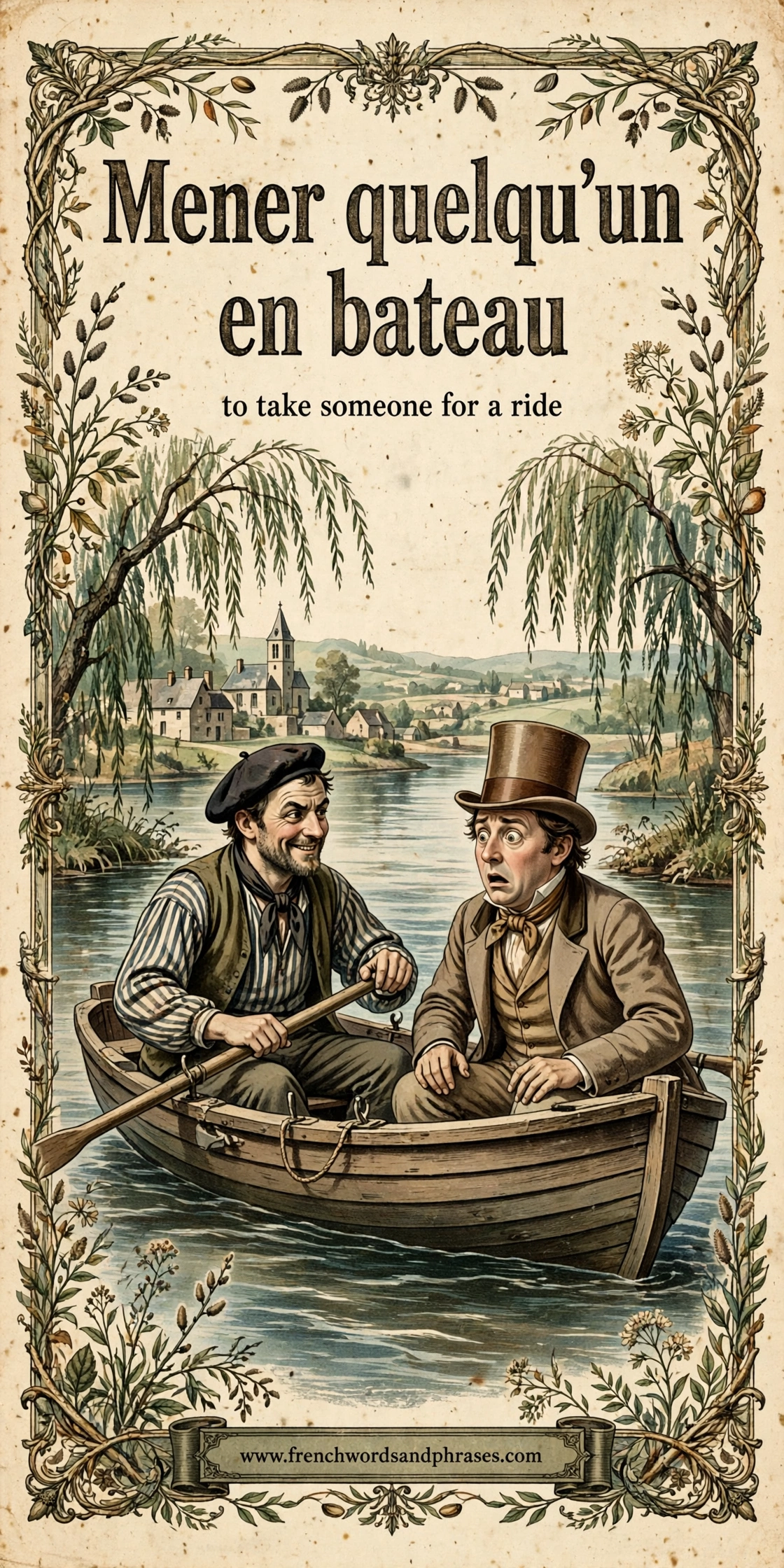
Let’s explore how mener quelqu’un en bateau works in French, beginning with the whole phrase on one card.
Understanding the French Phrase Mener quelqu’un en bateau
Mener quelqu’un en bateau is a French idiomatic expression built from mener (to lead, to take) and en bateau (in a boat). The picture is a pleasure cruise that goes nowhere: the storyteller rows, the listener enjoys the view, and the destination was never real. The phrase is the classic French verdict on being strung along by a good story.
It means to take someone for a ride — to spin them a tale, feed them an invented story and keep them believing it. Nobody is rowing anywhere: the boat is the picture of a journey with no port, a narrative that carries you pleasantly and lands you nowhere. It can be a harmless joke between friends or a serious deception, and the context sets the temperature.
Type: Idiomatic expression — deception (verb + object + en bateau)
Answers the need: Saying someone strung you along with an invented story
Register: Neutral to informal — everyday speech, humorous or reproachful
Strength: Variable — a teasing fib between friends, or a real con, by context
One important usage detail: the victim is the direct object — mener quelqu’un en bateau, il m’a mené en bateau. The victim’s own version uses se faire: se faire mener en bateau, to be taken for a ride. A close relative, monter un bateau à quelqu’un, means to cook up an elaborate story for someone — the building of the boat, so to speak, before the cruise.
Experience the Word
Mener quelqu’un en bateau is the phrase for the pleasure trip of lies — the story was comfortable, the company charming, and the shore was painted on canvas.
Imagine the uncle who swore for years that he had once played chess with a famous champion, move by move, glass in hand. The family believed every game. When the truth came out, nobody was robbed of anything but afternoons — yet the verdict was unanimous, and it involved a boat.
French forgives this deception more easily than most. The phrase blames the story, but it half-admires the rowing.
How to Use Mener quelqu’un en bateau in French: Complete Guide
Let’s explore how mener quelqu’un en bateau works in French, beginning with the whole phrase on one card.
Mener quelqu’un en bateau at a Glance
The Whole Phrase on One Card
Real meaning, literal picture, English twin and register — mener quelqu’un en bateau in five lines.
| Point | Mener quelqu’un en bateau |
|---|---|
| What it really means | to take someone for a ride — to string them along with an invented story |
| Word for word | to lead someone in a boat |
| English equivalent | to take someone for a ride / to spin someone a yarn |
| Register | neutral to informal — teasing or reproachful, by context |
| Use it for | tall tales, false promises, April fools, elaborate excuses |
Example
Ce vendeur nous a menés en bateau pendant des semaines.
That salesman took us for a ride for weeks.
Word by Word: Building the Pleasure Cruise
Three small pieces — take them one by one and the painted shore comes into view.
| Word | Literal meaning | Its job in the phrase |
|---|---|---|
| mener | to lead, to take | the guide’s verb — the storyteller holds the tiller and chooses the course |
| quelqu’un | someone | the passenger: the one who believes, waits and enjoys the view |
| en bateau | in a boat | the vessel of fiction — a trip that circles and never lands anywhere real |
Example
Arrête de me mener en bateau et dis-moi la vérité.
Stop taking me for a ride and tell me the truth.
Quick Quiz 1
In the picture inside the phrase, where does the boat actually go?
Reveal the answer
Nowhere — the cruise is the story itself: pleasant, convincing, and with no real destination.
Son histoire de trésor nous a menés en bateau tout l’été.
His treasure story took us for a ride all summer.
When You Say It: The Strung-Along Moments
Mener quelqu’un en bateau fires at moments like these — the story was good, and it was invented.
| Situation | Example |
|---|---|
| A tall tale | il nous a menés en bateau avec son histoire de champion — he took us for a ride with his champion story |
| False promises | l’agence nous mène en bateau depuis janvier — the agency has been stringing us along since January |
| An April fool | un poisson d’avril qui mène tout le bureau en bateau — an April fool that takes the whole office for a ride |
| Excuses | ces excuses, c’est nous mener en bateau — these excuses are taking us for a ride |
| The discovery | on s’est fait mener en bateau, voilà tout — we got taken for a ride, that’s all |
Example
Trois mois de promesses : ce promoteur nous a menés en bateau.
Three months of promises: that developer took us for a ride.
Make It Yours: The Cruise for Every Passenger
The victim sits right after mener — or turns the phrase around with se faire.
| Form | French | In English |
|---|---|---|
| He took me for a ride | il m’a mené en bateau | he took me for a ride |
| She strings them along | elle les mène en bateau | she takes them for a ride |
| Taking us for a ride | nous mener en bateau | to take us for a ride |
| The victim’s version | se faire mener en bateau | to be taken for a ride |
| Stop it | arrête de me mener en bateau | stop stringing me along |
| Question | tu me mènes en bateau ? | are you taking me for a ride? |
Example
Elle s’est fait mener en bateau par un faux plombier.
She got taken for a ride by a fake plumber.
Quick Quiz 2
How does the victim say ‘I was taken for a ride’ — with mener alone or with se faire?
Reveal the answer
With se faire — je me suis fait mener en bateau: the se faire construction puts you on the receiving end.
Je me suis fait mener en bateau comme un débutant.
I got taken for a ride like a beginner.
Everyday Expressions: Building on the Pleasure Cruise
Mener quelqu’un en bateau slots into these everyday frames — each one ready to use as it stands.
| Frame | In English |
|---|---|
| mener quelqu’un en bateau | to take someone for a ride |
| se faire mener en bateau | to be taken for a ride, to be strung along |
| monter un bateau à quelqu’un | to cook up an elaborate story for someone |
| un bateau | a tall tale — in slang, the story itself |
| ne pas se laisser mener en bateau | to refuse to be taken for a ride |
Example
Cette fois, je ne me laisserai pas mener en bateau.
This time, I won’t let myself be taken for a ride.
Close Cousins: The Other Tall Tales
French has a whole shelf of deception phrases — the boat is the storyteller’s one; its cousins lead by the nose, roll in flour, and tell tales by the yard.
| Expression | The difference |
|---|---|
| mener quelqu’un en bateau | to take someone for a ride — a whole invented story, enjoyed like a cruise |
| mener quelqu’un par le bout du nez | to lead someone by the nose — total control over their actions, not just their beliefs |
| se faire rouler dans la farine | to be duped, taken in — the victim’s phrase, with a dusting of ridicule |
| raconter des histoires | to tell tales — the plain version, no boat required |
| faire marcher quelqu’un | to pull someone’s leg — the light, joking end of the scale |
Example
Il ne raconte pas seulement des histoires : il mène tout le monde en bateau.
He doesn’t just tell tales: he takes everyone for a ride.
Quick Quiz 3
Which cousin means controlling everything a person does — en bateau or par le bout du nez?
Reveal the answer
Par le bout du nez — to lead by the nose is about actions and obedience. En bateau works on beliefs, with a story.
Elle mène son frère par le bout du nez depuis l’enfance.
She has led her brother by the nose since childhood.
Mener quelqu’un en bateau and Its Neighbours
The story-telling shelf around the phrase — the liar, the tale, and the passenger who believed it.
| French | In English |
|---|---|
| un mensonge | a lie |
| une histoire | a story — true or invented |
| un beau parleur | a smooth talker |
| croire | to believe — the passenger’s verb |
| se rendre compte | to realise — the moment the shore turns out painted |
| la vérité | the truth — the port that was never reached |
Example
Elle a fini par se rendre compte qu’on la menait en bateau.
She finally realised she was being taken for a ride.
Watch Out: The Traps Around Mener quelqu’un en bateau
The traps: real boat trips, the wrong passenger seat, and a leg-pull that is only a joke.
| Trap | The truth |
|---|---|
| the river trap | promener quelqu’un en bateau is a genuine boat trip — it is mener, the leading, that loads the phrase with fiction |
| the victim is direct | no à before the passenger: mener quelqu’un en bateau, il m’a mené en bateau — the person is the direct object |
| joke or con | between friends the boat is a leg-pull; from a salesman it is a con — the phrase fits both, tone decides |
| monter is building, mener is sailing | monter un bateau is inventing the story; mener en bateau is keeping someone aboard it |
Example
On nous a promenés en bateau sur la rivière, sans nous mener en bateau une seconde.
They took us for a boat trip on the river, without stringing us along for a second.
Quick Quiz 4
True or false: promener quelqu’un en bateau means exactly the same as mener quelqu’un en bateau.
Reveal the answer
False — promener en bateau is a real boat trip. Mener en bateau is the figurative cruise: an invented story.
Dimanche, ils nous promènent en bateau sur le lac.
On Sunday, they’re taking us out on the lake in a boat.
Mener quelqu’un en bateau in Everyday French: Real-Life Examples
Now that you know the word, let’s see how mener quelqu’un en bateau appears in everyday French.
Example 1 — The tall tale
Son histoire d’héritage nous a menés en bateau pendant des mois.
His inheritance story took us for a ride for months.
Example 2 — The salesman
Ce vendeur m’a mené en bateau avec ses promesses.
That salesman strung me along with his promises.
Example 3 — The suspicion
J’ai l’impression que tu me mènes en bateau.
I have the feeling you’re taking me for a ride.
Example 4 — The agency
L’agence nous mène en bateau depuis la signature.
The agency has been stringing us along since we signed.
Example 5 — The confession
On s’est fait mener en bateau comme des enfants.
We got taken for a ride like children.
Example 6 — The firm line
Assez : je ne me laisse plus mener en bateau.
Enough: I won’t be taken for a ride any more.
Beyond Translation: The Meaning of Mener quelqu’un en bateau
English takes you for a ride too — but in a car, and the phrase smells of gangsters and one-way trips. French puts you in a boat, and the deception keeps a holiday air: a smooth talker at the tiller, a story for a river, and passengers who are, half of them, enjoying themselves. That is the phrase’s precise moral temperature — annoyance, warmed by the memory of a good story.
To mener quelqu’un en bateau is to be believed beautifully — the crime is fiction, and the punishment is being found out.
Every family keeps one such captain, forgiven in advance, because his cruises are the best entertainment in the house.
How to Remember the French Phrase Mener quelqu’un en bateau
Remember it this way: Mener quelqu’un en bateau is the pleasure cruise of lies — a charming captain, a painted shore, and no port at the end.
- You picture the boat — it circles pleasantly and never lands, because the destination was invented.
- You seat the victim directly — mener quelqu’un en bateau, no à; the victim answers with se faire mener en bateau.
- You separate the boat verbs — monter un bateau is building the story, mener en bateau is keeping someone aboard it.
The key idea is mener quelqu’un en bateau means to take someone for a ride — to string them along with an invented story.
Test Your Knowledge of Mener quelqu’un en bateau
Let’s see how much you’ve learned. Try answering these questions before revealing the answers.
Question 1
What does mener quelqu’un en bateau mean?
Reveal the answer
To take someone for a ride — to spin them an invented story and keep them believing it.
Question 2
What is the literal, word-for-word meaning?
Reveal the answer
To lead someone in a boat — a pleasure cruise whose destination was never real.
Question 3
How do you say ‘he took me for a ride’?
Reveal the answer
Il m’a mené en bateau — the victim is the direct object of mener.
Question 4
What is the difference between mener quelqu’un en bateau and mener quelqu’un par le bout du nez?
Reveal the answer
Par le bout du nez controls actions — total obedience. En bateau works on beliefs: a story the victim swallows whole.
Question 5
Complete the sentence:
Elle nous a menés en ______. (She took us for a ride.)
Reveal the answer
bateau
Elle nous a menés en bateau.
She took us for a ride.
Your Final Challenge
Can You Use It?
How would you say this in French?
“He took us for a ride with his story.”
Reveal the answer
Il nous a menés en bateau avec son histoire.
He took us for a ride with his story.
A little French. A little curiosity. A richer everyday life.
LEARN FRENCH ONE WORD AT A TIME