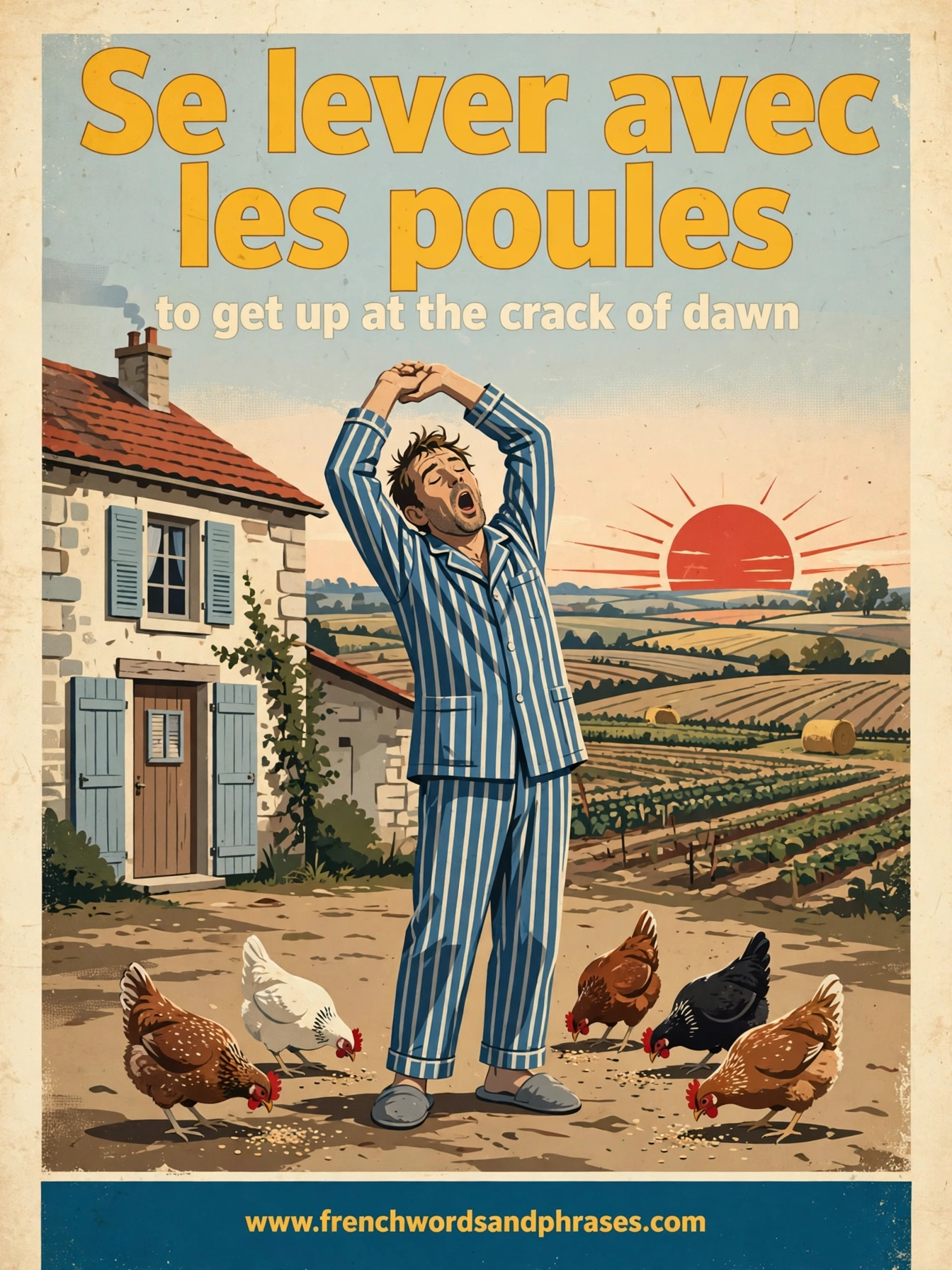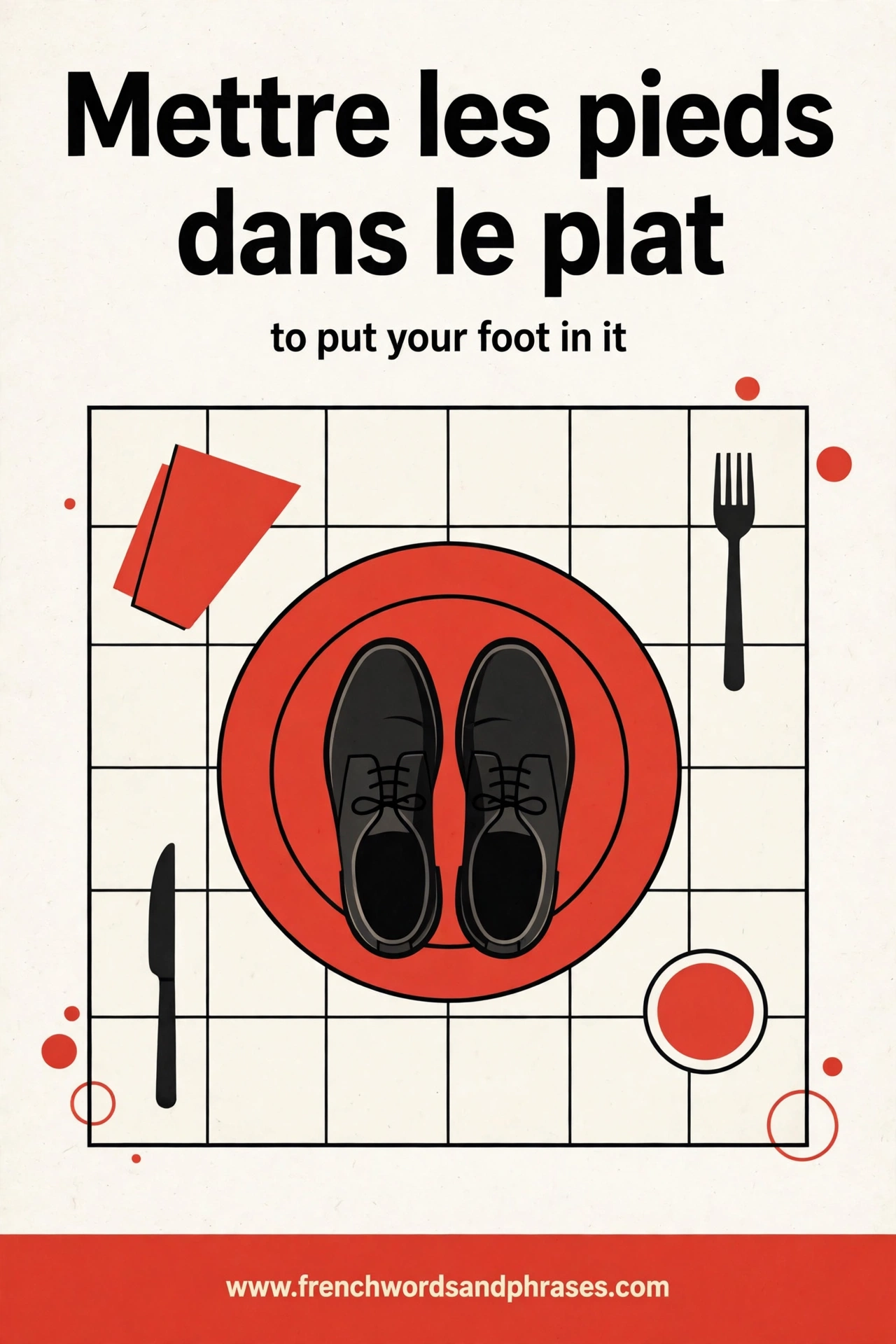
A French Word to Live By
Translate Mettre les pieds dans le plat to English
/mɛtʁ le pje dɑ̃ lə pla/
Mettre les pieds dans le plat means to put your foot in it — to blunder into the one subject you should have avoided.
Sunday lunch, the whole family in good humour — until you turn to your cousin’s husband and ask, warmly, when the baby is due. Silence. There is no baby. There was, briefly, a rumour, a hope, and a great deal of pain, and your question has stepped into all of it at once. You have not been rude, exactly. You have done something more French: « Tu as mis les pieds dans le plat. »
Let’s explore how mettre les pieds dans le plat works in French, beginning with the whole phrase on one card.
Understanding the French Phrase Mettre les pieds dans le plat
Mettre les pieds dans le plat is a French idiomatic expression built from mettre (to put), les pieds (the feet) and le plat (the dish — the serving dish at the centre of the table). The picture is a guest at a grand dinner who steps, both feet, straight into the dish everyone is about to eat from: a blunder that cannot be unseen and ruins the course for the whole table.
It means to put your foot in it — to blunder, usually in speech: to raise the forbidden subject, ask the fatal question, or name the thing everyone was politely avoiding. Nobody is standing in actual food: the plat is the picture of a shared, delicate situation, and the feet are your words arriving in the middle of it. Curiously, the phrase can also praise frankness — someone who deliberately puts their feet in the dish and finally says the awkward thing out loud.
Type: Idiomatic expression — blunders (verb + body + dish)
Answers the need: Saying someone blundered into a sensitive subject, usually by speaking
Register: Neutral to informal — everyday speech, rueful or amused
Strength: Strong but comic — a real social blunder, told with a wince and a laugh
One important usage detail: French puts both feet in — les pieds, plural, is the classic form, though you will hear mettre un pied dans le plat for a smaller slip. And watch the second sense: in meetings and politics, mettre les pieds dans le plat can be deliberate and even admired — the one person willing to raise the subject everyone else is stepping around.
Experience the Word
Mettre les pieds dans le plat is the sound of a whole table going quiet — one sentence, and every fork stops in mid-air.
Imagine the best man at the wedding, glass raised, who thanks the bride’s ‘first husband’ for coming. He meant the best man’s own first wedding. The words are out, the dish is stepped in, and no apology, however fast, can unstep it.
French is gentle with the blunderer here. The picture is so absurd — a grown person standing in the stew — that the shame dissolves into comedy before the course is over.
How to Use Mettre les pieds dans le plat in French: Complete Guide
Let’s explore how mettre les pieds dans le plat works in French, beginning with the whole phrase on one card.
Mettre les pieds dans le plat at a Glance
The Whole Phrase on One Card
Real meaning, literal picture, English twin and register — mettre les pieds dans le plat in five lines.
| Point | Mettre les pieds dans le plat |
|---|---|
| What it really means | to put your foot in it — to blunder into the sensitive subject, usually by speaking |
| Word for word | to put your feet in the dish |
| English equivalent | to put your foot in it / to put your foot in your mouth |
| Register | neutral to informal — comic, rueful, sometimes admiring |
| Use it for | fatal questions, forbidden subjects raised, awkward truths said out loud |
Example
En parlant de son ex, il a mis les pieds dans le plat.
By mentioning her ex, he really put his foot in it.
Word by Word: Building the Blunder
Four small pieces — take them one by one and watch the table go silent.
| Word | Literal meaning | Its job in the phrase |
|---|---|---|
| mettre | to put | the act itself — deliberate or not, the feet go in |
| les pieds | the feet | both feet, in the classic form: a full blunder, not a toe in the sauce |
| dans | in, into | the direction of disaster — into the middle of the dish |
| le plat | the dish | the serving dish at the table’s centre — the shared, delicate situation itself |
Example
Elle a mis les pieds dans le plat dès la première phrase.
She put her foot in it from the very first sentence.
Quick Quiz 1
What is the plat in the picture — and why does stepping in it matter?
Reveal the answer
The serving dish at the centre of the table — the course everyone shares. Feet in it ruin the meal for the whole table, exactly as a blunder ruins the moment for everyone present.
Un mot de trop, et les pieds sont dans le plat.
One word too many, and your feet are in the dish.
When You Say It: The Foot-in-It Moments
Mettre les pieds dans le plat fires at moments like these — the sentence is out, and the table knows it.
| Situation | Example |
|---|---|
| The fatal question | demander le prix du cadeau, c’est mettre les pieds dans le plat — asking the price of the gift is putting your foot in it |
| The forbidden name | il a prononcé le nom de l’ex : les pieds dans le plat — he said the ex’s name: foot in it |
| At work | parler des licenciements devant le stagiaire, quel plat ! — talking about layoffs in front of the intern, what a blunder! |
| The confession | j’ai mis les pieds dans le plat, pardon — I put my foot in it, sorry |
| Deliberate frankness | le directeur a mis les pieds dans le plat et parlé du budget — the director put his feet in the dish and raised the budget at last |
Example
Dès qu’il a parlé de l’héritage, tout le monde a compris : les pieds dans le plat.
The moment he mentioned the inheritance, everyone understood: foot in it.
Make It Yours: The Blunder for Every Guest
Mettre is irregular — and the phrase shrinks happily to just its ending.
| Form | French | In English |
|---|---|---|
| I put my foot in it | j’ai mis les pieds dans le plat | I put my foot in it |
| He blundered | il a mis les pieds dans le plat | he put his foot in it |
| The short verdict | les pieds dans le plat ! | foot in it! — the whole blunder in five words |
| One foot only | mettre un pied dans le plat | a smaller slip — one foot in the dish |
| Deliberately | mettre les pieds dans le plat volontairement | to raise the awkward subject on purpose |
| Question | j’ai mis les pieds dans le plat ? | did I put my foot in it? |
Example
À son silence, j’ai compris que j’avais mis les pieds dans le plat.
From his silence, I understood I had put my foot in it.
Quick Quiz 2
Classic form: one foot or both feet in the dish?
Reveal the answer
Both feet — les pieds, plural. Un pied dans le plat exists, but it shrinks the blunder to a slip.
Elle n’a pas fait les choses à moitié : les deux pieds dans le plat.
She didn’t do things by halves: both feet in the dish.
Everyday Expressions: Building on the Blunder
Mettre les pieds dans le plat slots into these everyday frames — each one ready to use as it stands.
| Frame | In English |
|---|---|
| mettre les pieds dans le plat | to put your foot in it |
| les pieds dans le plat | foot in it! — the short verdict |
| mettre un pied dans le plat | to make a smaller slip |
| y aller les deux pieds dans le plat | to go in with both feet — blunder or frankness, full force |
| sortir les pieds du plat | to climb out of the blunder — the apology that follows |
Example
Il y est allé les deux pieds dans le plat, sans le faire exprès.
He went in with both feet, without meaning to.
Close Cousins: The Other Social Wrecks
French has a whole shelf of blunder phrases — the plat is the speaking one; its cousins drop bricks, commit odd numbers, and say the quiet part aloud.
| Expression | The difference |
|---|---|
| mettre les pieds dans le plat | to put your foot in it — the blunder of raising the wrong subject |
| faire une gaffe | to make a blunder, to drop a clanger — the plain, general version |
| faire un impair | to commit a faux pas — the polite, society word for the same disaster |
| mettre les pieds dans le plat (délibéré) | to tackle the awkward subject head-on — the same phrase, worn as a badge of frankness |
| dire tout haut ce que tout le monde pense tout bas | to say out loud what everyone thinks quietly — the frankness spelled out |
Example
Une gaffe au dessert, un impair au café : la soirée était complète.
A clanger at dessert, a faux pas at coffee: the evening was complete.
Quick Quiz 3
Which cousin is the polite, formal word for a social blunder — une gaffe or un impair?
Reveal the answer
Un impair — literally an odd number: the society word. Une gaffe is the everyday clanger.
Même les diplomates commettent des impairs.
Even diplomats commit faux pas.
Mettre les pieds dans le plat and Its Neighbours
The blunder shelf around the phrase — the table, the subject, and the silence that follows.
| French | In English |
|---|---|
| une gaffe | a blunder, a clanger |
| un sujet délicat | a sensitive subject |
| un silence gêné | an embarrassed silence |
| s’excuser | to apologise — the way out of the dish |
| changer de sujet | to change the subject — the rescue everyone attempts |
| un repas de famille | a family meal — the blunder’s natural habitat |
Example
Après la gaffe, un silence gêné, puis quelqu’un a changé de sujet.
After the blunder, an embarrassed silence, then someone changed the subject.
Watch Out: The Traps Around Mettre les pieds dans le plat
The traps: real dishes, one foot instead of two, and frankness mistaken for a blunder.
| Trap | The truth |
|---|---|
| the kitchen trap | mettre le plat sur la table is serving dinner — the idiom needs the feet inside the dish |
| both feet, classically | les pieds is the full form; un pied halves the disaster — choose by the size of the blunder |
| not always a mistake | in a meeting, the phrase can praise the one person who finally raises the real subject |
| plat is also flat | un plat is a dish, but plat as an adjective means flat — à plat, flat out; context and the article keep them apart |
Example
Il a mis le plat sur la table, puis, en parlant, les pieds dedans.
He put the dish on the table, then, while talking, his feet in it.
Quick Quiz 4
True or false: mettre les pieds dans le plat is always an accident.
Reveal the answer
False — it can be deliberate: the brave act of raising the subject everyone was avoiding.
Le maire a mis les pieds dans le plat et parlé des dettes de la ville.
The mayor put his feet in the dish and talked about the town’s debts.
Mettre les pieds dans le plat in Everyday French: Real-Life Examples
Now that you know the word, let’s see how mettre les pieds dans le plat appears in everyday French.
Example 1 — The fatal question
En demandant son âge, il a mis les pieds dans le plat.
By asking her age, he put his foot in it.
Example 2 — The family lunch
Au repas de famille, elle a mis les pieds dans le plat avec l’héritage.
At the family lunch, she put her foot in it with the inheritance.
Example 3 — The apology
Pardon, j’ai mis les pieds dans le plat sans le savoir.
Sorry, I put my foot in it without knowing.
Example 4 — The meeting
Le comptable a mis les pieds dans le plat en parlant des salaires.
The accountant put his foot in it by talking about salaries.
Example 5 — The deliberate one
Elle a mis les pieds dans le plat exprès : il fallait parler du loyer.
She put her feet in the dish on purpose: the rent had to be discussed.
Example 6 — The wince
À peine la phrase sortie, je savais : les pieds dans le plat.
The sentence was barely out, and I knew: foot in it.
Beyond Translation: The Meaning of Mettre les pieds dans le plat
English puts its foot in its mouth — the blunder as self-harm, one person, one mouth. French puts both feet in the shared dish — the blunder as a public event: the whole table was about to eat from that plat, and now everyone must watch you climb out of it. The French picture is crueller and kinder at once: crueller, because the audience is built in; kinder, because a person standing in a stew is too funny to stay angry at.
To mettre les pieds dans le plat is to season the conversation with yourself — and occasionally, to be the only honest cook at the table.
That second life, as praise for frankness, is the phrase’s gift: the same words that forgive the blunderer can honour the brave.
How to Remember the French Phrase Mettre les pieds dans le plat
Remember it this way: Mettre les pieds dans le plat is the dinner-party disaster — both feet, one serving dish, and a table full of witnesses.
- You picture the dish — the shared plat at the centre of the table, and your words arriving in it feet first.
- You use both feet — les pieds dans le plat for the full blunder; one foot is only a slip.
- You remember the second life — said of a brave speaker, the phrase praises the one who raises the awkward subject at last.
The key idea is mettre les pieds dans le plat means to put your foot in it — to blunder into the sensitive subject, feet first.
Test Your Knowledge of Mettre les pieds dans le plat
Let’s see how much you’ve learned. Try answering these questions before revealing the answers.
Question 1
What does mettre les pieds dans le plat mean?
Reveal the answer
To put your foot in it — to blunder into the sensitive subject, usually by saying the wrong thing.
Question 2
What is the literal, word-for-word meaning?
Reveal the answer
To put your feet in the dish — the serving dish at the centre of the table, stepped into by the blunderer.
Question 3
How do you say ‘I put my foot in it’?
Reveal the answer
J’ai mis les pieds dans le plat — mettre is irregular: je mets, j’ai mis.
Question 4
What is the difference between mettre les pieds dans le plat and faire un impair?
Reveal the answer
Un impair is the polite, formal name for a social faux pas. The plat is the vivid everyday picture — and it can even praise deliberate frankness.
Question 5
Complete the sentence:
En parlant de l’ex, elle a mis les pieds dans le ______. (By mentioning the ex, she put her foot in it.)
Reveal the answer
plat
En parlant de l’ex, elle a mis les pieds dans le plat.
By mentioning the ex, she put her foot in it.
Your Final Challenge
Can You Use It?
How would you say this in French?
“He put his foot in it at dinner.”
Reveal the answer
Il a mis les pieds dans le plat pendant le dîner.
He put his foot in it at dinner.
A little French. A little curiosity. A richer everyday life.
LEARN FRENCH ONE WORD AT A TIME