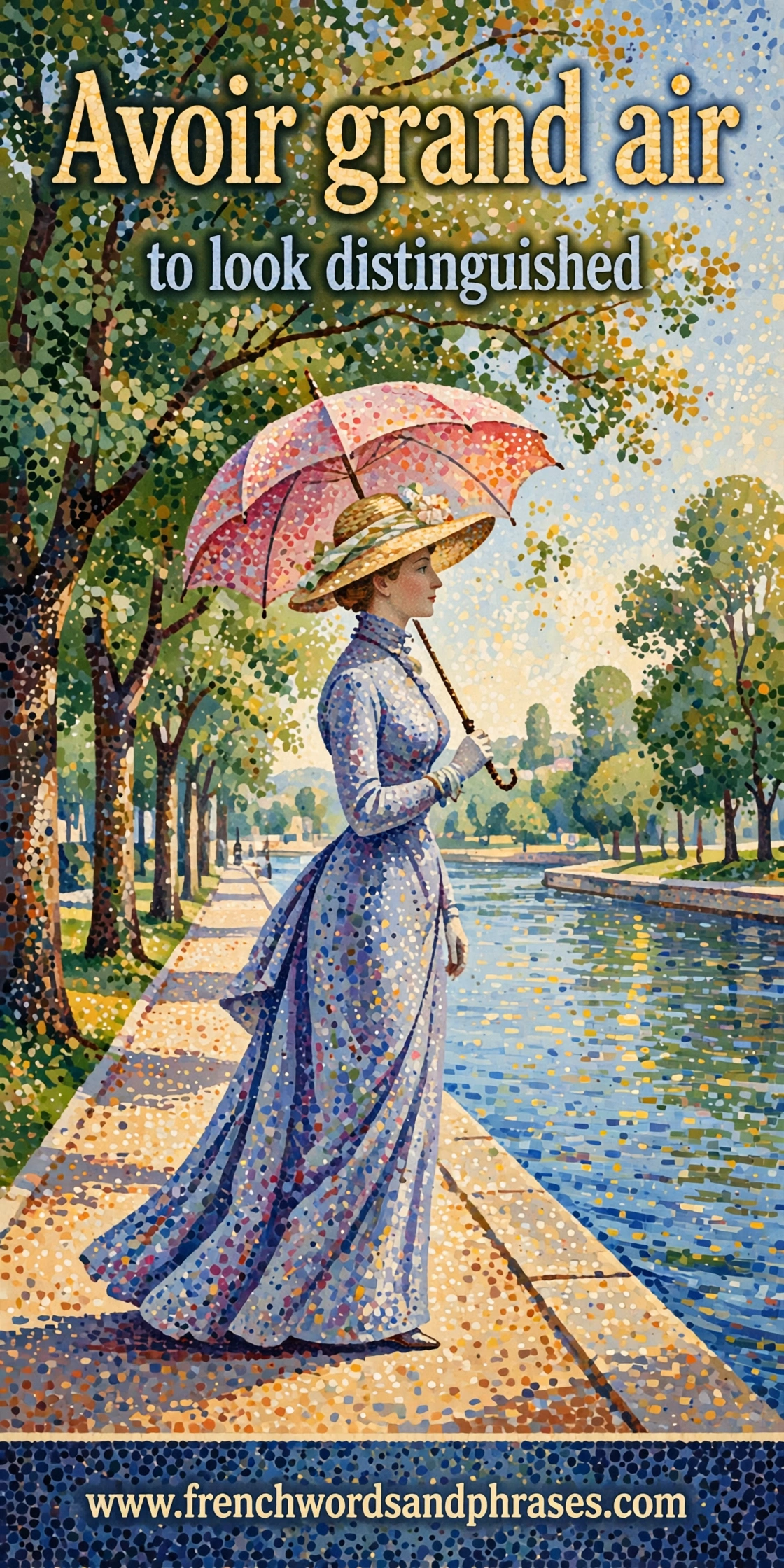
A French Word to Live By
Translate Avoir grand air to English
/a.vwaʁ ɡʁɑ̃ tɛʁ/
Avoir grand air means to look distinguished — to have an elegant, imposing bearing.
She enters the little hotel dining room in a plain dark dress, no jewellery, nothing to announce her — and yet heads turn, the waiter straightens, and the room quietly rearranges itself around her. Your companion whispers the only explanation French needs: « Elle a grand air. » She looks distinguished, and nobody can say exactly why.
Let’s explore how avoir grand air works in French, beginning with the whole phrase on one card.
Understanding the French Phrase Avoir grand air
Avoir grand air is a French idiomatic expression built from avoir (to have), grand (great, tall) and air (appearance, bearing). It praises the way a person carries themselves: an air of natural distinction that owes nothing to clothes or jewels.
It means to look distinguished — to have a noble, elegant presence that commands a room quietly. The grand in the phrase is the grand of grandeur, not of size: the person seems larger than their surroundings because their bearing fills them. French uses it of women and men alike, and almost always as a compliment.
Type: Idiomatic expression — appearance (avoir + grand + air)
Answers the need: Praising someone’s distinguished, elegant presence
Register: Neutral to refined — a compliment of the old school, still warm today
Strength: High praise — true distinction, not mere prettiness or fashion
One important usage detail: air here is not the air you breathe — it is appearance and bearing, as in avoir l’air fatigué, to look tired. But where avoir l’air needs an adjective or a noun after it, avoir grand air stands complete: the grandeur is the whole description. Keep grand before air, invariable in this phrase: elle a grand air, never grande.
Experience the Word
Avoir grand air is the compliment French pays when clothes, money and beauty have all been ruled out as explanations.
Imagine the photograph of a grandmother at twenty, in a borrowed dress, standing straighter than the mayor. Nothing in the picture is expensive, and everything in it is commanding. Families keep such photographs because they prove the family once produced someone who had grand air.
The phrase belongs to a world that judged bearing before wardrobe. It says the distinction is in the person, not on the person.
How to Use Avoir grand air in French: Complete Guide
Let’s explore how avoir grand air works in French, beginning with the whole phrase on one card.
Avoir grand air at a Glance
The Whole Phrase on One Card
Real meaning, literal picture, English twin and register — avoir grand air in five lines.
| Point | Avoir grand air |
|---|---|
| What it really means | to look distinguished — an elegant, imposing presence |
| Word for word | to have a great air — air here is bearing, not the sky |
| English equivalent | to look distinguished / to have a noble bearing |
| Register | neutral to refined — an old-school compliment |
| Use it for | entrances, portraits, grandmothers, anyone who fills a room quietly |
Example
Elle a grand air dans cette robe simple.
She looks distinguished in that plain dress.
Word by Word: Building the Distinction
Three small pieces — take them one by one and the bearing assembles itself.
| Word | Literal meaning | Its job in the phrase |
|---|---|---|
| avoir | to have | the verb of possession — distinction is something she carries with her |
| grand | great, tall | the grandeur — size of presence, not of body |
| air | appearance, bearing | the look of a person — the same air as in avoir l’air, to look |
Example
Il a grand air même en vêtements de travail.
He looks distinguished even in work clothes.
Quick Quiz 1
In avoir grand air, is air the air you breathe?
Reveal the answer
No — air here means appearance and bearing, as in avoir l’air fatigué, to look tired.
Elle a l’air fatiguée, mais elle garde grand air.
She looks tired, but she keeps her distinguished bearing.
When You Say It: The Distinguished Moments
Avoir grand air fires at moments like these — an entrance, a portrait, a presence that explains itself.
| Situation | Example |
|---|---|
| An entrance | elle entre, et tout le monde la regarde — she comes in, and everyone looks at her |
| A photograph | sur cette photo, ta grand-mère a grand air — in this photo, your grandmother looks distinguished |
| Plain clothes | même en jean, il a grand air — even in jeans, he looks distinguished |
| An elderly lady | à quatre-vingt-dix ans, elle a toujours grand air — at ninety, she still looks distinguished |
| A compliment to pay | vous avez grand air, madame — you look distinguished, madam |
Example
À son âge, elle a toujours grand air.
At her age, she still looks distinguished.
Make It Yours: The Air Family
Air builds the whole family of looks — grand air is the crown of it.
| Form | French | In English |
|---|---|---|
| Distinguished | avoir grand air | to look distinguished |
| To look (in general) | avoir l’air | to look, to seem |
| To look tired | avoir l’air fatigué | to look tired |
| A noble bearing, as a noun | un grand air | a distinguished look |
| Dignified carriage | une allure distinguée | a distinguished bearing |
| The opposite — sloppy | avoir l’air négligé | to look scruffy, unkempt |
Example
Elle a l’air fatiguée mais elle a grand air.
She looks tired, but she looks distinguished.
Quick Quiz 2
For a woman, is it elle a grand air or elle a grande air?
Reveal the answer
Elle a grand air — in this set phrase grand stays in its masculine form before air, for women and men alike.
Ma grand-mère a grand air sur toutes les photos.
My grandmother looks distinguished in every photo.
Everyday Expressions: Building on the Distinction
Avoir grand air slots into these everyday frames — each one ready to use as it stands.
| Frame | In English |
|---|---|
| elle a grand air | she looks distinguished |
| il a grand air dans son uniforme | he looks distinguished in his uniform |
| avoir grand air sans rien de spécial | to look distinguished with nothing special on |
| un homme qui a grand air | a man who looks distinguished |
| elle avait grand air le jour de son mariage | she looked distinguished on her wedding day |
Example
Il a grand air dans son uniforme d’officier.
He looks distinguished in his officer’s uniform.
Close Cousins: The Other Bearings
French has a shelf of presence phrases — grand air is the genuine distinction; its cousins dress up, stand tall or pretend.
| Expression | The difference |
|---|---|
| avoir grand air | to look distinguished — natural, quiet, the real thing |
| avoir de l’allure | to have style, to cut a fine figure — the modern, livelier cousin |
| en imposer | to be imposing, to command respect — presence with a hint of awe |
| avoir fière allure | to look splendid, to cut a proud figure — slightly literary |
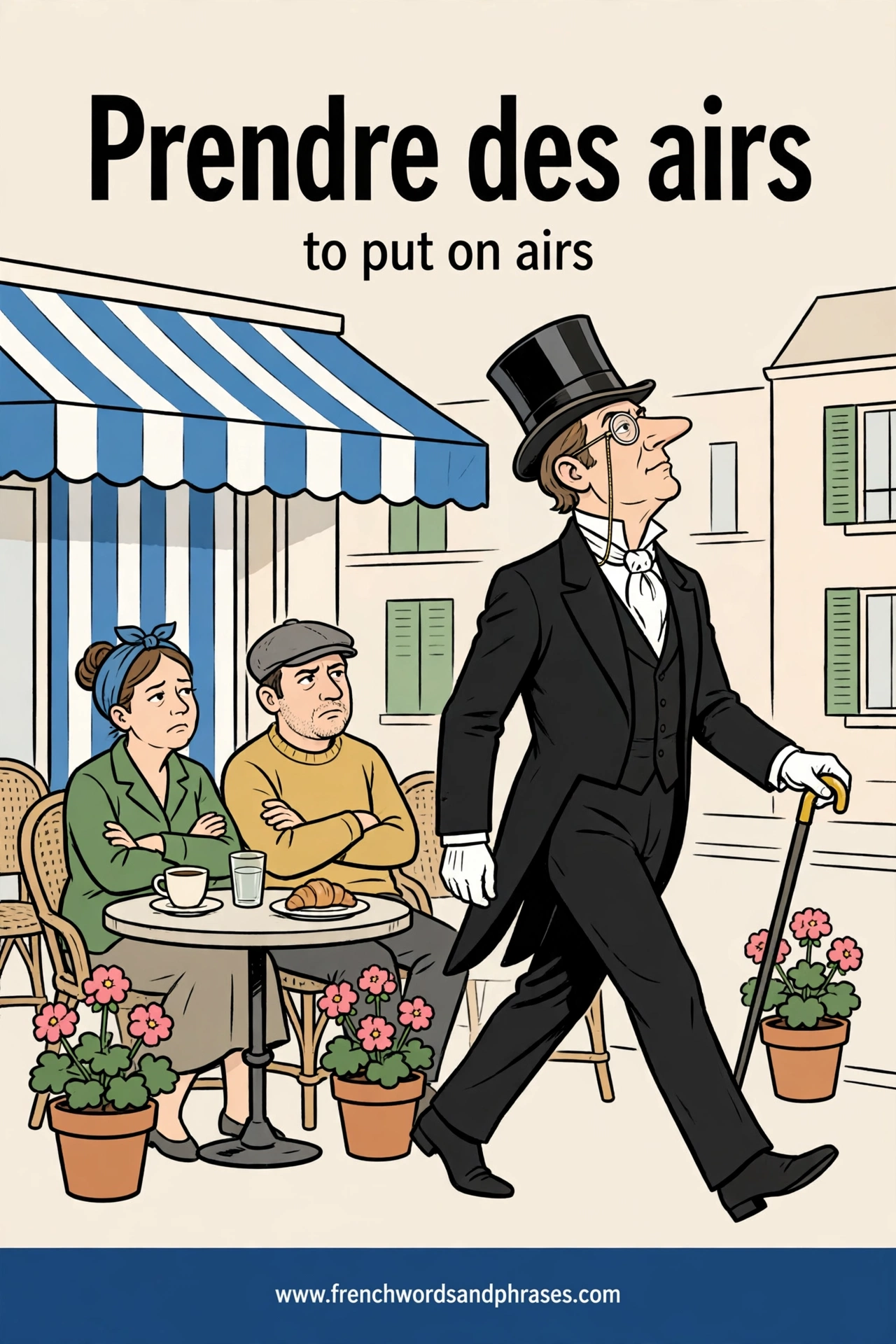
| prendre des airs | to put on airs — the pretended version, all show and no substance |
Example
Elle a de l’allure, mais sa mère a vraiment grand air.
She has style, but her mother truly looks distinguished.
Quick Quiz 3
Which cousin is the pretended distinction — avoir grand air or prendre des airs?
Reveal the answer
Prendre des airs — putting on airs is acting grand; avoir grand air is being grand without trying.
Il prend des airs, elle a grand air : la différence se voit.
He puts on airs, she looks distinguished: you can see the difference.
Avoir grand air and Its Neighbours
The presence shelf around the phrase — bearing, posture and the quiet authority they make.
| French | In English |
|---|---|
| l’allure | bearing, style, the way someone carries themselves |
| se tenir droit | to stand up straight |
| la distinction | distinction, refinement |
| un maintien | carriage, deportment |
| élégant | elegant |
| imposant | imposing |
Example
Son maintien droit et son grand air impressionnent tout le monde.
Her upright carriage and distinguished look impress everyone.
Watch Out: The Traps Around Avoir grand air
The traps: a grand that never agrees, an air that is not sky, and a compliment that is not about beauty.
| Trap | The truth |
|---|---|
| grand never agrees here | elle a grand air — the set phrase keeps grand invariable, even for a woman |
| not about height | grand air is presence, not size — a small woman can have very grand air |
| not the same as beautiful | a person can be beautiful without grand air, and have grand air without beauty — the phrase praises bearing, not features |
| do not confuse with en plein air | en plein air means outdoors, in the open air — there, air really is the sky |
Example
Petite et mince, elle a pourtant très grand air.
Small and slim, she nevertheless looks very distinguished.
Quick Quiz 4
True or false: avoir grand air means to be very tall.
Reveal the answer
False — it means to look distinguished. Grand here is grandeur of presence, not height.
Il n’est pas grand, mais il a grand air.
He isn’t tall, but he looks distinguished.
Avoir grand air in Everyday French: Real-Life Examples
Now that you know the word, let’s see how avoir grand air appears in everyday French.
Example 1 — The entrance
Elle est entrée, et tout le monde a vu qu’elle a grand air.
She came in, and everyone saw that she looks distinguished.
Example 2 — The photograph
Sur cette photo de 1950, ton grand-père a grand air.
In this photo from 1950, your grandfather looks distinguished.
Example 3 — Plain clothes
Même en tenue simple, elle a grand air.
Even in plain clothes, she looks distinguished.
Example 4 — The uniform
Il a grand air dans son uniforme.
He looks distinguished in his uniform.
Example 5 — At ninety
À quatre-vingt-dix ans, elle a toujours grand air.
At ninety, she still looks distinguished.
Example 6 — The compliment
Vous avez grand air, madame, dans cette robe.
You look distinguished, madam, in that dress.
Beyond Translation: The Meaning of Avoir grand air
English reaches for Latin — distinguished, dignified, elegant — a whole borrowed wardrobe of praise. French builds the same compliment from two of its plainest words: grand and air, great and look. The economy is the elegance: nothing in the phrase is decorated, and that is exactly what it praises — distinction that needs no decoration.
Grand air is what remains when the jewellery comes off.
It is also why the phrase has aged so gracefully: fashions date, but bearing does not.
How to Remember the French Phrase Avoir grand air
Remember it this way: Avoir grand air is the plain dress that stops the room — distinction carried in the back and the chin, not in the wardrobe.
- You picture the entrance — she wears nothing special, and the room rearranges itself: that is grand air.
- You keep grand frozen — elle a grand air, never grande, because the phrase is set in stone.
- You separate being from seeming — prendre des airs is the pretence; avoir grand air is the real thing.
The key idea is avoir grand air means to look distinguished — to have an elegant, imposing bearing.
Test Your Knowledge of Avoir grand air
Let’s see how much you’ve learned. Try answering these questions before revealing the answers.
Question 1
What does avoir grand air mean?
Reveal the answer
To look distinguished — to have an elegant, imposing bearing that commands attention quietly.
Question 2
What does air mean in this phrase?
Reveal the answer
Appearance, bearing — the same air as in avoir l’air, to look; not the air you breathe.
Question 3
How do you say ‘she looks distinguished’?
Reveal the answer
Elle a grand air — grand stays invariable in this set phrase, even for a woman.
Question 4
What is the difference between avoir grand air and prendre des airs?
Reveal the answer
Avoir grand air is genuine distinction; prendre des airs is putting on airs — the pretended version.
Question 5
Complete the sentence:
Même en jean, il a ______ air. (Even in jeans, he looks distinguished.)
Reveal the answer
grand
Même en jean, il a grand air.
Even in jeans, he looks distinguished.
Your Final Challenge
Can You Use It?
How would you say this in French?
“She looks distinguished in that plain dress.”
Reveal the answer
Elle a grand air dans cette robe simple.
She looks distinguished in that plain dress.
A little French. A little curiosity. A richer everyday life.
LEARN FRENCH ONE WORD AT A TIME