A French Word to Live By
Translate Absolu to English
/ap.sɔ.ly/
Absolu means absolute.
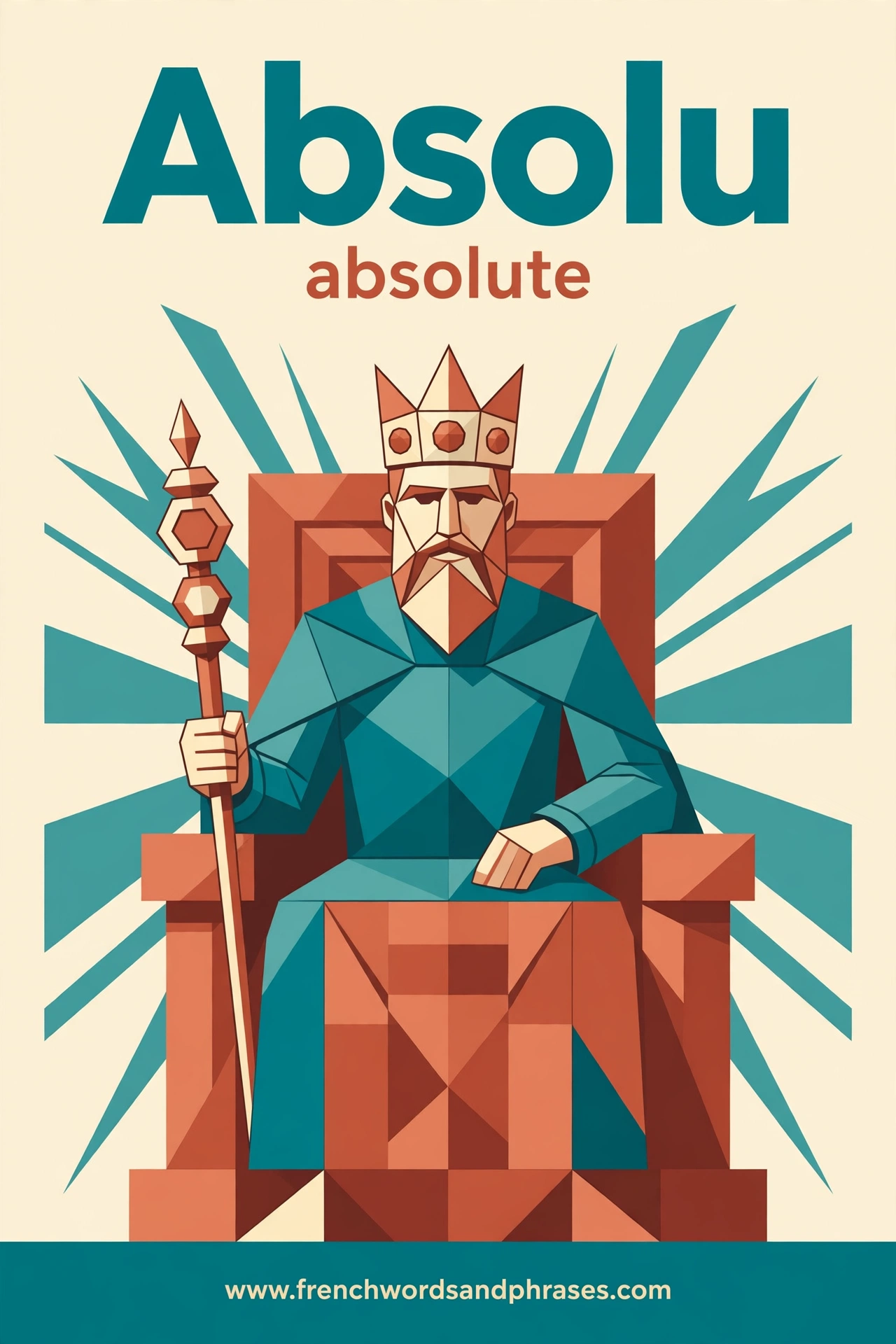
The old king raises one hand and the whole court falls silent — no vote, no appeal, no second voice. In the corner, a philosopher writes a single word in his notebook, the word for power, certainty and truth with nothing held back: absolu.
In this guide, you’ll learn what absolu means in English, how its feminine absolue is formed, where it stands in the sentence, and how it travels from royal power to mathematics — including its life as a noun, l’absolu, the Absolute of the philosophers. Explore French examples, English translations, and practice quizzes.
Understanding the French Adjective Absolu
Absolu is a French adjective of quality — the adjective of completeness without conditions. Its feminine is absolue: un pouvoir absolu, une certitude absolue. It doubles as a noun in philosophy: l’absolu, the Absolute, that which exists by itself and depends on nothing else — the sense this page keeps in its tables beside the everyday adjective.
It means absolute — total, unconditional, admitting no exception. It describes power (un pouvoir absolu, absolute power), certainty (une certitude absolue, absolute certainty), silence (un silence absolu, complete silence) and mathematics (en valeur absolue, in absolute value). As a noun, l’absolu is the philosopher’s Absolute: reality as it is in itself, beyond all relations.
Type: Adjective of quality — completeness; also a noun in philosophy
Answers the question: What is it like? — absolute, total, unconditional
Changes form: Feminine adds -e — absolu / absolue; plurals absolus / absolues
English equivalents: Absolute; total; complete; unqualified.
One important usage detail: absolu stands AFTER the noun — un silence absolu, une majorité absolue. Its natural opposite is relatif: la majorité relative is a simple majority, la majorité absolue is more than half of all the votes. And the adverb is absolument — absolutely, and also « absolutely! » as an answer.
Experience the Word
Absolu is the adjective of no loopholes — the word French uses when nothing is reserved, relativised or left to negotiate.
Imagine a concert hall in the second before the first note: three thousand people, and not one cough, not one whisper — un silence absolu, so complete it rings. That is the word’s home ground: totality you can feel.
You have not just said very or totally. You have closed every door through which an exception might slip.
How to Use Absolu in French: Complete Guide
Let’s explore how absolu works in French, beginning with the whole word on one card.
Absolu at a Glance
Before the details, here is the whole word on one card.
The Whole Word on One Card
Meaning, type, position and forms — absolu in four lines.
| Point | Absolu |
|---|---|
| Meaning | absolute — total, unconditional |
| Type | adjective of quality — completeness; noun in philosophy |
| Usual position | after the noun — un pouvoir absolu |
| Form | absolu / absolue — absolus / absolues in the plural |
Il règne un silence absolu.
An absolute silence reigns.
The Four Forms of Absolu
The feminine absolue simply adds an e — the word’s shape stays as uncompromising as its meaning.
| Form | Absolu | Example |
|---|---|---|
| Masculine singular | absolu | un pouvoir absolu — absolute power |
| Feminine singular | absolue | une certitude absolue — absolute certainty |
| Masculine plural | absolus | des pouvoirs absolus — absolute powers |
| Feminine plural | absolues | des certitudes absolues — absolute certainties |
Example
Elle a une certitude absolue dans ce dossier.
She has absolute certainty in this matter.
Quick Quiz 1
What is the feminine of absolu?
Reveal the answer
absolue
Une majorité absolue — the feminine simply adds e.
An absolute majority.
The Feminine of Absolu: Absolue, a Single E
Absolue lives in some of the word’s most official phrases — la majorité absolue, une confiance absolue — so learn the pair together.
| Situation | Example |
|---|---|
| Masculine | un silence absolu — absolute silence |
| Feminine | une confiance absolue — absolute trust |
| Why | the feminine adds -e to absolu, nothing else changes |
| The plural | add s — des confiances absolues, absolute trusts |
Example
J’ai une confiance absolue en elle.
I have absolute trust in her.
Where Absolu Goes: After the Noun
Absolu follows the noun it describes, like most French adjectives, from the throne room to the examination hall.
| Pattern | Example |
|---|---|
| After the noun | un pouvoir absolu — absolute power |
| After être | le silence est absolu — the silence is absolute |
| With an adverb | un calme presque absolu — an almost absolute calm |
| Before the noun | un absolu pouvoir — not in everyday French |
Example
Le calme est absolu dans la vallée.
The calm is absolute in the valley.
How do you say ‘absolute power’ — absolu pouvoir or pouvoir absolu?
Reveal the answer
pouvoir absolu
Absolu stands after the noun.
Absolute power.
More Absolu: Comparing with Absolu
Absolu names a limit, so comparisons are rare — but French can still approach the limit by degrees, with presque absolu doing most of the work.
| Degree | Example |
|---|---|
| As absolute as | aussi absolu que — as absolute as |
| More absolute | plus absolu — more absolute (rare) |
| Almost absolute | presque absolu — almost absolute, the usual hedge |
| The most absolute (masc.) | le plus absolu — le plus absolu des pouvoirs |
| The most absolute (fem.) | la plus absolue — la plus absolue des certitudes |
Example
Un calme presque absolu règne sur le lac.
An almost absolute calm reigns over the lake.
Everyday Expressions with Absolu
Absolu moves between politics, philosophy and the examination room — and its noun, l’absolu, waits at the end of the table.
| Expression | In English |
|---|---|
| un pouvoir absolu | absolute power |
| la majorité absolue | an absolute majority (over half of all votes) |
| un silence absolu | absolute, complete silence |
| une confiance absolue | absolute trust |
| en valeur absolue | in absolute value (mathematics) |
| l’absolu | the Absolute (philosophy — that which depends on nothing) |
Example
Les philosophes cherchent l’absolu depuis des siècles.
Philosophers have sought the Absolute for centuries.
Quick Quiz 3
What is l’absolu in philosophy?
Reveal the answer
The Absolute
L’absolu — that which exists by itself, depending on nothing else.
The Absolute.
Absolu and Its Neighbours
Absolu stands at the total end of its scale: total and complet are its allies, relatif its eternal opposite, and absolument its adverbial echo.
| French | In English |
|---|---|
| total | total, complete — un silence total |
| complet | complete, full — le calme complet |
| parfait | perfect — un calme parfait |
| inconditionnel | unconditional — un soutien inconditionnel |
| relatif | relative — the direct opposite |
| absolument | absolutely — the adverb, and a keen « absolutely! » |
Example
Rien n’est absolu, tout est relatif, dit le philosophe.
Nothing is absolute, everything is relative, says the philosopher.
Watch Out: The Traps Around Absolu
The traps here are the majority trap and the noun: elections turn on absolue versus relative, and l’absolu is a thing, not a quality.
| Trap | The truth |
|---|---|
| Two majorities | la majorité absolue = over half of ALL votes; la majorité relative = simply the most votes |
| The noun | l’absolu (m) is the philosopher’s Absolute — chercher l’absolu, to seek the Absolute |
| The feminine | absolue, with a final e — not ‘absolu’ for a feminine noun |
| The adverb | absolument = absolutely — vous avez absolument raison, you are absolutely right |
Example
Elle a gagné avec la majorité absolue des voix.
She won with an absolute majority of the votes.
How do you say ‘absolute silence’?
Reveal the answer
un silence absolu
Absolu follows the noun, masculine form for silence.
Absolute silence.
Absolu in Everyday French: Real-Life Examples
Now that you know the word, let’s see how absolu appears in everyday French.
Example 1 — Politics
Le parti a obtenu la majorité absolue.
The party won an absolute majority.
Example 2 — At the library
Je demande un silence absolu, s’il vous plaît.
I ask for absolute silence, please.
Example 3 — Trust
Elle a une confiance absolue en son équipe.
She has absolute trust in her team.
Example 4 — Mathematics
Exprime ce nombre en valeur absolue.
Express this number in absolute value.
Example 5 — History
Le roi avait un pouvoir absolu sur le pays.
The king had absolute power over the country.
Example 6 — Philosophy
Ce cours parle de la recherche de l’absolu.
This course is about the search for the Absolute.
Beyond Translation: The Meaning of Absolu
English says absolute for the meaning of absolu — from Latin absolutus, loosened from every tie. French philosophy made the noun l’absolu into one of its great quarry: the unconditioned, that which is what it is without reference to anything else, hunted by metaphysicians for centuries.
Absolu is the adjective that tolerates no footnotes.
From a king’s power to a silent room to a number stripped of its sign, it always means the same gesture: everything, entirely, without reserve.
How to Remember the French Adjective Absolu
Remember it this way: Absolu is the no-exceptions adjective — absolu for him, absolue for her, relatif its opposite, and l’absolu its philosophical noun.
- You learn the pair together — un pouvoir absolu, une certitude absolue.
- You face the opposite — absolu contre relatif, la majorité absolue contre la relative.
- You meet the noun — chercher l’absolu, le rêve des philosophes.
The key idea is absolu / absolue means total and unconditional, its opposite is relatif, and l’absolu is the Absolute.
Test Your Knowledge of Absolu
Let’s see how much you’ve learned. Try answering these questions before revealing the answers.
Question 1
What does absolu mean?
Reveal the answer
Absolute — total, unconditional, admitting no exception.
Question 2
What is the feminine of absolu?
Reveal the answer
absolue — absolu simply adds an e.
Question 3
Translate: absolute power.
Reveal the answer
Un pouvoir absolu.
Question 4
Complete the sentence:
Elle a une confiance ______ en lui.
Reveal the answer
absolue
Elle a une confiance absolue en lui.
She has absolute trust in him.
Question 5
How do you say ‘an absolute majority’?
Reveal the answer
la majorité absolue — over half of all the votes, not merely the most.
Your Final Challenge
Can You Use It?
How would you say this in French?
“An absolute silence reigns in the valley.”
Reveal the answer
Un silence absolu règne dans la vallée.
An absolute silence reigns in the valley.
A little French. A little curiosity. A richer everyday life.
LEARN FRENCH ONE WORD AT A TIME