A French Word to Live By
How to Conjugate Absenter in French
/ap.sɑ̃.te/
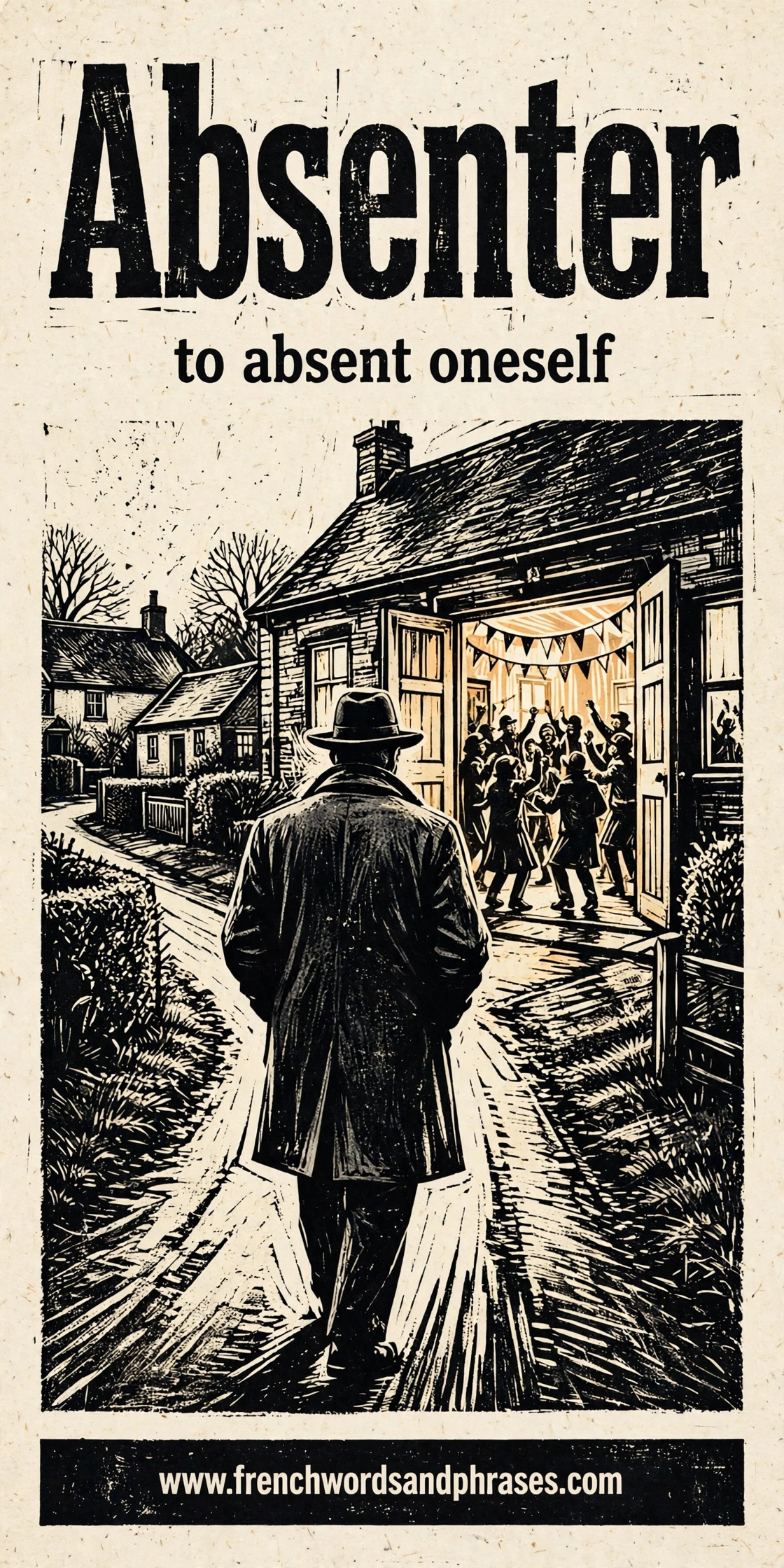
Absenter — in real life s’absenter — means to absent oneself: to go out, to be away for a while.
A note on a desk saying back in an hour, a chair empty at the meeting, a shopkeeper stepping out for an appointment — absenter, as s’absenter, is the polite verb of temporary absence: not gone, not vanished, just away, with every intention of returning.
In this guide, you’ll learn how to conjugate absenter in all the major French tenses and moods. Explore complete conjugation tables, French examples, English translations, and practice quizzes.
Understanding the French Verb Absenter
Absenter is a regular French verb belonging to the first group of verbs, those ending in-er.
It means to absent oneself. It is the standard polite formula for short, legitimate absences: employees s’absentent for appointments, shopkeepers for an errand, officials for a ceremony. Unlike partir or disparaître, s’absenter promises a return — the absence is measured in minutes or hours, and usually announced in advance.
Verb classification: First group (-er)
Auxiliary verb: Avoir
Past participle: absenté
Present participle: absentant
English equivalents: To absent oneself, to go out, to be away; s’absenter une heure — to go out for an hour; je m’absente un instant — I will be away for a moment; l’absence — absence; absent — absent; l’absentéisme — absenteeism.
One important detail: the plain verb absenter barely exists on its own — the living form is the reflexive s’absenter, conjugated with être and the participle agreeing: je m’absente, elle s’est absentée une heure, ils se sont absentés. The tables on this page show the plain -er verb underneath; in real sentences, dress it with its pronoun and être. Its family is the vocabulary of every school and office: l’absence, absent, and the disapproving l’absentéisme — absenteeism, absence become a habit.
Experience the Word
S’absenter is the verb of the courteous disappearance — away, but accounted for; absent, but expected back.
Imagine a small bakery at seven in the morning. The baker’s wife pins a card to the door: « Je m’absente une heure — le pain est au four d’à côté. » Nobody is surprised, nobody is worried: the verb has done its work, turning an empty shop into a explained, temporary, almost neighbourly event.
The shop is empty. She has absented herself — elle s’est absentée — and the card on the door is her presence, holding the fort.
How to Conjugate Absenter: Complete French Conjugation Guide
Let’s explore every major conjugation of absenter, beginning with the indicative mood.
How to Conjugate Absenter in the Indicative Mood
The indicative mood is used to express facts, observations, actions, and events.
How to Conjugate Absenter in the Present Tense (Présent)
Used for actions happening now, habitual actions, and general truths.
| Subject | Conjugation |
|---|---|
| je | absente |
| tu | absentes |
| il / elle | absente |
| nous | absentons |
| vous | absentez |
| ils / elles | absentent |
Example
Le directeur s’absente souvent le vendredi.
The manager is often away on Fridays.
Quick Quiz 1
Complete the sentence:
Nous nous ______ demain matin pour un rendez-vous.
Reveal the answer
absenterons
Nous nous absenterons demain matin pour un rendez-vous.
We will be away tomorrow morning for an appointment.
How to Conjugate Absenter in the Passé Composé
Used for completed actions in the past. Absenter takes the auxiliary verb avoir.
| Subject | Conjugation |
|---|---|
| j’ | ai absenté |
| tu | as absenté |
| il / elle | a absenté |
| nous | avons absenté |
| vous | avez absenté |
| ils / elles | ont absenté |
Example
Elle s’est absentée une heure pour un rendez-vous.
She went out for an hour for an appointment.
How to Conjugate Absenter in the Imparfait (Imperfect Tense)
Used for habitual past actions, descriptions, and ongoing situations in the past.
| Subject | Conjugation |
|---|---|
| je | absentais |
| tu | absentais |
| il / elle | absentait |
| nous | absentions |
| vous | absentiez |
| ils / elles | absentaient |
Example
Il s’absentait chaque été pendant un mois.
He used to be away for a month every summer.
Quick Quiz 2
Choose the correct form:
She stepped out for an hour.
Elle ______ une heure. (s’est absentée / a absenté)
Reveal the answer
s’est absentée
Elle s’est absentée une heure.
The living verb is reflexive, s’absenter, and takes être.
How to Conjugate Absenter in the Plus-que-parfait
Used to describe an action that had already been completed before another past event.
| Subject | Conjugation |
|---|---|
| j’ | avais absenté |
| tu | avais absenté |
| il / elle | avait absenté |
| nous | avions absenté |
| vous | aviez absenté |
| ils / elles | avaient absenté |
Example
Elle s’était absentée quand le colis est arrivé.
She had gone out when the parcel arrived.
How to Conjugate Absenter in the Passé Simple
Primarily used in formal writing, literature, and historical narratives. It is rarely used in everyday conversation.
| Subject | Conjugation |
|---|---|
| je | absentai |
| tu | absentas |
| il / elle | absenta |
| nous | absentâmes |
| vous | absentâtes |
| ils / elles | absentèrent |
Example
Le gardien s’absenta cinq minutes, et le chat s’échappa.
The caretaker was away for five minutes, and the cat escaped.
How to Conjugate Absenter in the Passé Antérieur
A literary tense used to express an action completed immediately before another past action, generally in the passé simple.
| Subject | Conjugation |
|---|---|
| j’ | eus absenté |
| tu | eus absenté |
| il / elle | eut absenté |
| nous | eûmes absenté |
| vous | eûtes absenté |
| ils / elles | eurent absenté |
Example
Dès qu’il se fut absenté, la réunion commença sans lui.
As soon as he had left, the meeting began without him.
How to Conjugate Absenter in the Future Tense (Futur Simple)
Used to describe actions that will take place in the future.
| Subject | Conjugation |
|---|---|
| je | absenterai |
| tu | absenteras |
| il / elle | absentera |
| nous | absenterons |
| vous | absenterez |
| ils / elles | absenteront |
Example
Je m’absenterai demain après-midi.
I will be away tomorrow afternoon.
How to Conjugate Absenter in the Futur Antérieur (Future Perfect)
Used for an action that will have been completed before a particular point in the future.
| Subject | Conjugation |
|---|---|
| j’ | aurai absenté |
| tu | auras absenté |
| il / elle | aura absenté |
| nous | aurons absenté |
| vous | aurez absenté |
| ils / elles | auront absenté |
Example
Quand tu reviendras, elle se sera absentée depuis longtemps.
When you come back, she will have been gone a long time.
How to Conjugate Absenter in the Near Future (Futur Proche)
Used to describe something that is going to happen soon. Formed with aller + infinitive.
| Subject | Conjugation |
|---|---|
| je | vais absenter |
| tu | vas absenter |
| il / elle | va absenter |
| nous | allons absenter |
| vous | allez absenter |
| ils / elles | vont absenter |
Example
Je vais m’absenter quelques minutes.
I am going to step out for a few minutes.
How to Conjugate Absenter in the Conditional Mood
The conditional mood expresses what would happen under certain circumstances. It is also frequently used to make polite requests or express wishes.
How to Conjugate Absenter in the Present Conditional
| Subject | Conjugation |
|---|---|
| je | absenterais |
| tu | absenterais |
| il / elle | absenterait |
| nous | absenterions |
| vous | absenteriez |
| ils / elles | absenteraient |
Example
Sans ce dossier, il ne s’absenterait pas aujourd’hui.
Without this file, he would not be away today.
How to Conjugate Absenter in the Past Conditional
| Subject | Conjugation |
|---|---|
| j’ | aurais absenté |
| tu | aurais absenté |
| il / elle | aurait absenté |
| nous | aurions absenté |
| vous | auriez absenté |
| ils / elles | auraient absenté |
Example
Elle se serait absentée si elle avait pu.
She would have gone away if she had been able to.
Absenter in the Literary Past Conditional Form
This less common literary form uses the imperfect subjunctive of avoir.
| Subject | Conjugation |
|---|---|
| j’ | eusse absenté |
| tu | eusses absenté |
| il / elle | eût absenté |
| nous | eussions absenté |
| vous | eussiez absenté |
| ils / elles | eussent absenté |
Example
Le veilleur se fût absenté sans la tempête de neige.
The watchman would have been away but for the snowstorm.
How to Conjugate Absenter in the Subjunctive Mood
The subjunctive is used to express wishes, emotions, doubts, necessity, and uncertainty. It frequently follows expressions such as il faut que (it is necessary that) or bien que (although).
How to Conjugate Absenter in the Present Subjunctive
| Subject | Conjugation |
|---|---|
| que je | absente |
| que tu | absentes |
| qu’il / qu’elle | absente |
| que nous | absentions |
| que vous | absentiez |
| qu’ils / qu’elles | absentent |
Example
Il faut que je m’absente une heure.
I must go out for an hour.
Quick Quiz 3
Complete the sentence using the subjunctive:
Il faut que vous vous ______ avant la réunion.
Reveal the answer
absentiez
Il faut que vous vous absentiez avant la réunion.
You must step out before the meeting.
How to Conjugate Absenter in the Imperfect Subjunctive
A literary tense, rarely encountered in modern spoken French.
| Subject | Conjugation |
|---|---|
| que je | absentasse |
| que tu | absentasses |
| qu’il / qu’elle | absentât |
| que nous | absentassions |
| que vous | absentassiez |
| qu’ils / qu’elles | absentassent |
Example
On ne pensait pas qu’elle s’absentât si souvent.
Nobody thought she would be away so often.
How to Conjugate Absenter in the Pluperfect Subjunctive
A literary construction used to express an action completed before another past action.
| Subject | Conjugation |
|---|---|
| que j’ | eusse absenté |
| que tu | eusses absenté |
| qu’il / qu’elle | eût absenté |
| que nous | eussions absenté |
| que vous | eussiez absenté |
| qu’ils / qu’elles | eussent absenté |
Example
On regrettait qu’il se fût absenté pendant la visite.
People regretted that he had been away during the visit.
How to Conjugate Absenter in the Past Subjunctive
| Subject | Conjugation |
|---|---|
| que j’ | aie absenté |
| que tu | aies absenté |
| qu’il / qu’elle | ait absenté |
| que nous | ayons absenté |
| que vous | ayez absenté |
| qu’ils / qu’elles | aient absenté |
Example
Je suis étonné qu’elle se soit absentée sans prévenir.
I am surprised she went out without warning anyone.
How to Conjugate Absenter in the Imperative
The imperative is used to give commands, instructions, invitations, or suggestions. Subject pronouns are omitted.
How to Conjugate Absenter in the Present Imperative
| Person | Conjugation |
|---|---|
| (tu) | absente |
| (nous) | absentons |
| (vous) | absentez |
Example
Absente-toi discrètement si l’appel dure.
Slip away discreetly if the call goes on.
Quick Quiz 4
How would you say Slip away discreetly (tu form)?
Reveal the answer
Absente-toi discrètement !
French Participles of Absenter
Participles are verb forms that can be used in compound tenses and other grammatical constructions.
Present Participle of Absenter
absentant
En s’absentant souvent, il a manqué la décision.
By being away so often, he missed the decision.
Past Participle of Absenter
absenté
Absentée au moment du vote, la députée n’a pas pu voter.
Away at the moment of the vote, the deputy could not vote.
Absenter in Everyday French: Real-Life Examples
Now that you know the conjugations, let’s see how absenter appears in everyday French.
Example 1 — Present
Le directeur s’absente le vendredi.
The manager is away on Fridays.
Example 2 — Passé composé
Elle s’est absentée une heure.
She went out for an hour.
Example 3 — Imparfait
Il s’absentait chaque été.
He used to be away every summer.
Example 4 — Future
Je m’absenterai demain.
I will be away tomorrow.
Example 5 — Conditional
Elle s’absenterait si elle pouvait.
She would go away if she could.
Example 6 — Imperative
Absente-toi discrètement !
Slip away discreetly!
Beyond Translation: The Meaning of Absenter
English absent is an adjective that occasionally verbs itself, stiffly; French s’absenter is the natural, everyday way to be properly away — the formula on a thousand shop doors and office notes.
It is absence with good manners.
To s’absenter is to be gone on the record: announced, explained and temporary — the exact opposite of its disreputable cousin, l’absentéisme, absence that has stopped bothering to explain itself.
How to Remember the French Verb Absenter
Remember it this way: Absenter is about the card on the shop door — away for an hour, back soon.
- The living form is reflexive: s’absenter, with être — elle s’est absentée une heure.
- It promises a return: measured in minutes or hours, and usually announced — je m’absente un instant.
- Regular -er underneath: j’absente, nous absentons, past participle absenté; family: l’absence, absent, l’absentéisme.
The key idea is the card on the shop door — away for an hour, back soon.
Test Your Knowledge of Absenter
Let’s see how much you’ve learned. Try answering these questions before revealing the answers.
Question 1
How is absenter actually used in real French?
Reveal the answer
Reflexively, as s’absenter — je m’absente un instant, with être in compound tenses: elle s’est absentée.
Question 2
How do you say She went out for an hour in French?
Reveal the answer
Elle s’est absentée une heure.
Question 3
Translate: I will be away tomorrow afternoon.
Reveal the answer
Je m’absenterai demain après-midi.
Question 4
What is the past participle of absenter?
Reveal the answer
Absenté — agreeing in the reflexive: absentée, absentés, absentées.
Question 5
Complete the sentence:
Il faut que je m’______ une heure.
Reveal the answer
absente
Il faut que je m’absente une heure.
I must go out for an hour.
Your Final Challenge
Can You Use It?
How would you say this in French?
She went out for an hour, and the card on the door guarded the shop better than a lock.
Reveal the answer
Elle s’est absentée une heure, et la carte sur la porte a gardé la boutique mieux qu’une serrure.
She went out for an hour, and the card on the door guarded the shop better than a lock.
A little French. A little curiosity. A richer everyday life.
LEARN FRENCH ONE WORD AT A TIME