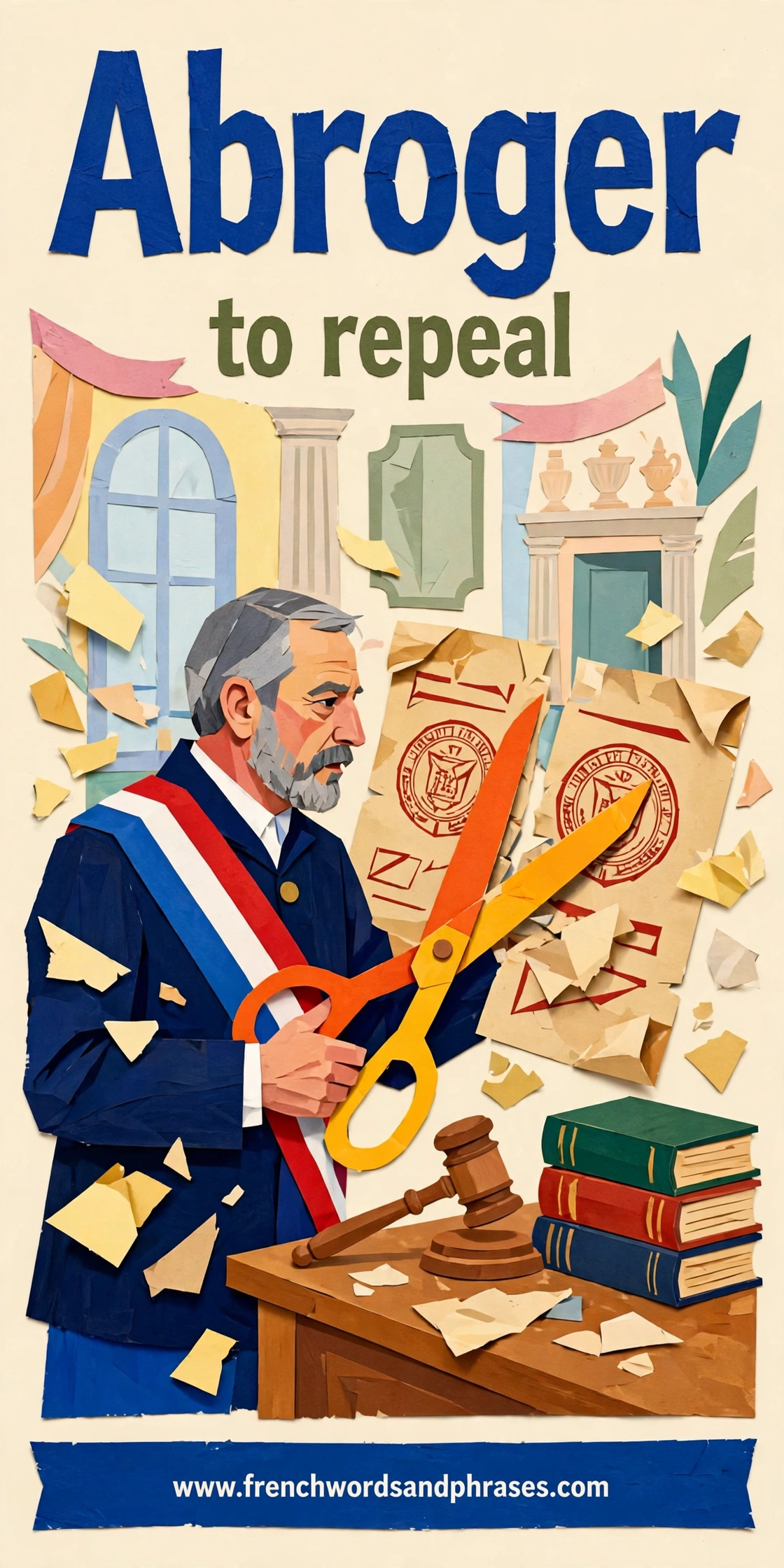
A French Word to Live By
How to Conjugate Abroger in French
/a.bʁɔ.ʒe/
Abroger means to repeal — to strike a law, a decree or a rule officially from the books.
A parliament voting a law out of existence, a council sweeping away a forgotten regulation, a king revoking an edict — abroger is the verb of unmaking rules: the solemn reverse of voting them in.
In this guide, you’ll learn how to conjugate abroger in all the major French tenses and moods. Explore complete conjugation tables, French examples, English translations, and practice quizzes.
Understanding the French Verb Abroger
Abroger is a regular French verb belonging to the first group of verbs, those ending in-er.
It means to repeal. It is a verb of parliaments, councils and governments: laws, decrees, regulations and treaties are abrogés when a newer text replaces them or a vote strikes them down. A law that is simply ignored is not abrogée — abroger is the formal act that erases it from the legal order.
Verb classification: First group (-er)
Auxiliary verb: Avoir
Past participle: abrogé
Present participle: abrogeant
English equivalents: To repeal, to annul, to revoke (a law, a decree); abroger une loi — to repeal a law; abroger un décret — to revoke a decree; l’abrogation — the repeal; une loi abrogée — a repealed law.
One important detail: abroger is a -ger verb, and its g must stay soft. Before a or o it grows an e to protect the sound: nous abrogeons, j’abrogeais, en abrogeant, nous abrogeâmes. Before e or i nothing changes: j’abroge, nous abrogions, vous abrogiez. The noun of the family is a ceremony in itself: l’abrogation — and its most famous hour in French history is a revocation, la révocation de l’édit de Nantes in 1685.
Experience the Word
Abroger is the verb of the eraser in the law book — power used not to write a rule, but to unwrite one.
Imagine a clerk in a ministry, opening a register of regulations from 1890. Half of them govern things that no longer exist — horse-drawn cabs, gas lamps, telegram tariffs. One by one, a decree abroge them, and the old pages, legally alive until this morning, become history.
Nothing was built or banned. A law has been unmade — abrogée — and the book is lighter by a century.
How to Conjugate Abroger: Complete French Conjugation Guide
Let’s explore every major conjugation of abroger, beginning with the indicative mood.
How to Conjugate Abroger in the Indicative Mood
The indicative mood is used to express facts, observations, actions, and events.
How to Conjugate Abroger in the Present Tense (Présent)
Used for actions happening now, habitual actions, and general truths.
| Subject | Conjugation |
|---|---|
| je | abroge |
| tu | abroges |
| il / elle | abroge |
| nous | abrogeons |
| vous | abrogez |
| ils / elles | abrogent |
Example
Le parlement abroge les lois devenues inutiles.
Parliament repeals laws that have become useless.
Quick Quiz 1
Complete the sentence:
Nous ______ les vieux décrets.
Reveal the answer
abrogeons
Nous abrogeons les vieux décrets.
We are repealing the old decrees — the g grows an e before o.
How to Conjugate Abroger in the Passé Composé
Used for completed actions in the past. Abroger takes the auxiliary verb avoir.
| Subject | Conjugation |
|---|---|
| j’ | ai abrogé |
| tu | as abrogé |
| il / elle | a abrogé |
| nous | avons abrogé |
| vous | avez abrogé |
| ils / elles | ont abrogé |
Example
Le gouvernement a abrogé cette taxe l’an dernier.
The government repealed this tax last year.
How to Conjugate Abroger in the Imparfait (Imperfect Tense)
Used for habitual past actions, descriptions, and ongoing situations in the past.
| Subject | Conjugation |
|---|---|
| je | abrogeais |
| tu | abrogeais |
| il / elle | abrogeait |
| nous | abrogions |
| vous | abrogiez |
| ils / elles | abrogeaient |
Example
Chaque année, la commission abrogeait des règlements oubliés.
Every year, the commission used to repeal forgotten regulations.
Quick Quiz 2
Choose the correct form:
The council repealed this rule.
Le conseil ______ ce règlement. (a abrogé / est abrogé)
Reveal the answer
a abrogé
Le conseil a abrogé ce règlement.
Abroger takes avoir.
How to Conjugate Abroger in the Plus-que-parfait
Used to describe an action that had already been completed before another past event.
| Subject | Conjugation |
|---|---|
| j’ | avais abrogé |
| tu | avais abrogé |
| il / elle | avait abrogé |
| nous | avions abrogé |
| vous | aviez abrogé |
| ils / elles | avaient abrogé |
Example
Ils avaient abrogé l’ancien décret avant la réforme.
They had repealed the old decree before the reform.
How to Conjugate Abroger in the Passé Simple
Primarily used in formal writing, literature, and historical narratives. It is rarely used in everyday conversation.
| Subject | Conjugation |
|---|---|
| je | abrogeai |
| tu | abrogeas |
| il / elle | abrogea |
| nous | abrogeâmes |
| vous | abrogeâtes |
| ils / elles | abrogeèrent |
Example
L’assemblée abrogea la loi en une seule séance.
The assembly repealed the law in a single sitting.
How to Conjugate Abroger in the Passé Antérieur
A literary tense used to express an action completed immediately before another past action, generally in the passé simple.
| Subject | Conjugation |
|---|---|
| j’ | eus abrogé |
| tu | eus abrogé |
| il / elle | eut abrogé |
| nous | eûmes abrogé |
| vous | eûtes abrogé |
| ils / elles | eurent abrogé |
Example
Quand le roi eut abrogé l’édit, le peuple se révolta.
When the king had repealed the edict, the people revolted.
How to Conjugate Abroger in the Future Tense (Futur Simple)
Used to describe actions that will take place in the future.
| Subject | Conjugation |
|---|---|
| je | abrogerai |
| tu | abrogeras |
| il / elle | abrogera |
| nous | abrogerons |
| vous | abrogerez |
| ils / elles | abrogeront |
Example
Le conseil abrogera ce règlement dès janvier.
The council will repeal this rule in January.
How to Conjugate Abroger in the Futur Antérieur (Future Perfect)
Used for an action that will have been completed before a particular point in the future.
| Subject | Conjugation |
|---|---|
| j’ | aurai abrogé |
| tu | auras abrogé |
| il / elle | aura abrogé |
| nous | aurons abrogé |
| vous | aurez abrogé |
| ils / elles | auront abrogé |
Example
À la fin de la session, ils auront abrogé dix lois.
By the end of the session, they will have repealed ten laws.
How to Conjugate Abroger in the Near Future (Futur Proche)
Used to describe something that is going to happen soon. Formed with aller + infinitive.
| Subject | Conjugation |
|---|---|
| je | vais abroger |
| tu | vas abroger |
| il / elle | va abroger |
| nous | allons abroger |
| vous | allez abroger |
| ils / elles | vont abroger |
Example
Le ministre va abroger le décret cette semaine.
The minister is going to repeal the decree this week.
How to Conjugate Abroger in the Conditional Mood
The conditional mood expresses what would happen under certain circumstances. It is also frequently used to make polite requests or express wishes.
How to Conjugate Abroger in the Present Conditional
| Subject | Conjugation |
|---|---|
| je | abrogerais |
| tu | abrogerais |
| il / elle | abrogerait |
| nous | abrogerions |
| vous | abrogeriez |
| ils / elles | abrogeraient |
Example
Nous abrogerions cette règle si nous pouvions.
We would repeal this rule if we could.
How to Conjugate Abroger in the Past Conditional
| Subject | Conjugation |
|---|---|
| j’ | aurais abrogé |
| tu | aurais abrogé |
| il / elle | aurait abrogé |
| nous | aurions abrogé |
| vous | auriez abrogé |
| ils / elles | auraient abrogé |
Example
Elle aurait abrogé la loi sans l’opposition du sénat.
She would have repealed the law without the senate’s opposition.
Abroger in the Literary Past Conditional Form
This less common literary form uses the imperfect subjunctive of avoir.
| Subject | Conjugation |
|---|---|
| j’ | eusse abrogé |
| tu | eusses abrogé |
| il / elle | eût abrogé |
| nous | eussions abrogé |
| vous | eussiez abrogé |
| ils / elles | eussent abrogé |
Example
Le prince eût abrogé l’édit sans les conseils de sa mère.
The prince would have repealed the edict without his mother’s advice.
How to Conjugate Abroger in the Subjunctive Mood
The subjunctive is used to express wishes, emotions, doubts, necessity, and uncertainty. It frequently follows expressions such as il faut que (it is necessary that) or bien que (although).
How to Conjugate Abroger in the Present Subjunctive
| Subject | Conjugation |
|---|---|
| que je | abroge |
| que tu | abroges |
| qu’il / qu’elle | abroge |
| que nous | abrogions |
| que vous | abrogiez |
| qu’ils / qu’elles | abrogent |
Example
Il faut que le parlement abroge cette loi injuste.
Parliament must repeal this unjust law.
Quick Quiz 3
Complete the sentence using the subjunctive:
Il faut que vous ______ ce décret avant janvier.
Reveal the answer
abrogiez
Il faut que vous abrogiez ce décret avant janvier.
You must repeal this decree before January.
How to Conjugate Abroger in the Imperfect Subjunctive
A literary tense, rarely encountered in modern spoken French.
| Subject | Conjugation |
|---|---|
| que je | abrogasse |
| que tu | abrogasses |
| qu’il / qu’elle | abrogât |
| que nous | abrogassions |
| que vous | abrogassiez |
| qu’ils / qu’elles | abrogassent |
Example
On doutait que le roi abrogeât son propre édit.
People doubted the king would repeal his own edict.
How to Conjugate Abroger in the Pluperfect Subjunctive
A literary construction used to express an action completed before another past action.
| Subject | Conjugation |
|---|---|
| que j’ | eusse abrogé |
| que tu | eusses abrogé |
| qu’il / qu’elle | eût abrogé |
| que nous | eussions abrogé |
| que vous | eussiez abrogé |
| qu’ils / qu’elles | eussent abrogé |
Example
On disait que l’assemblée eût abrogé la taxe dès 1789.
People said the assembly had repealed the tax as early as 1789.
How to Conjugate Abroger in the Past Subjunctive
| Subject | Conjugation |
|---|---|
| que j’ | aie abrogé |
| que tu | aies abrogé |
| qu’il / qu’elle | ait abrogé |
| que nous | ayons abrogé |
| que vous | ayez abrogé |
| qu’ils / qu’elles | aient abrogé |
Example
Je suis surpris qu’ils aient abrogé le décret si vite.
I am surprised they repealed the decree so quickly.
How to Conjugate Abroger in the Imperative
The imperative is used to give commands, instructions, invitations, or suggestions. Subject pronouns are omitted.
How to Conjugate Abroger in the Present Imperative
| Person | Conjugation |
|---|---|
| (tu) | abroge |
| (nous) | abrogeons |
| (vous) | abrogez |
Example
Abrogeons les règles qui ne servent plus à rien !
Let us repeal the rules that no longer serve any purpose!
Quick Quiz 4
How would you say Repeal this law (tu form)?
Reveal the answer
Abroge cette loi !
French Participles of Abroger
Participles are verb forms that can be used in compound tenses and other grammatical constructions.
Present Participle of Abroger
abrogeant
En abrogeant l’ancien décret, le ministre a ouvert la voie à la réforme.
By repealing the old decree, the minister opened the way to reform.
Past Participle of Abroger
abrogé
Abrogée en 1905, la loi n’a jamais été remplacée.
Repealed in 1905, the law was never replaced.
Abroger in Everyday French: Real-Life Examples
Now that you know the conjugations, let’s see how abroger appears in everyday French.
Example 1 — Present
Le parlement abroge les lois inutiles.
Parliament repeals the useless laws.
Example 2 — Passé composé
Le gouvernement a abrogé cette taxe.
The government repealed this tax.
Example 3 — Imparfait
La commission abrogeait les vieux règlements.
The commission used to repeal the old regulations.
Example 4 — Future
Le conseil abrogera ce règlement.
The council will repeal this rule.
Example 5 — Conditional
Nous abrogerions cette règle volontiers.
We would gladly repeal this rule.
Example 6 — Imperative
Abrogez les lois injustes !
Repeal the unjust laws!
Beyond Translation: The Meaning of Abroger
English repeal is its exact partner — both verbs live in parliaments and law reports, and both name the rarest act of power: deleting your own rules.
Every legal system needs an eraser.
French makes the act a noun of ceremony — l’abrogation — and history remembers the famous ones: the abrogation of an edict can exile a whole population, as the Protestants of 1685 learned.
How to Remember the French Verb Abroger
Remember it this way: Abroger is about the eraser in the law book — and the g that grows an e to stay soft.
- A -ger verb: the g grows an e before a and o — nous abrogeons, j’abrogeais, en abrogeant.
- Its objects are written rules only: une loi, un décret, un règlement — never people.
- Regular endings otherwise: j’abroge, nous abrogeons, past participle abrogé, noun l’abrogation.
The key idea is the eraser in the law book — and the g that grows an e to stay soft.
Test Your Knowledge of Abroger
Let’s see how much you’ve learned. Try answering these questions before revealing the answers.
Question 1
Why is it nous abrogeons and not nous abrogons?
Reveal the answer
The -ger rule — g grows an e before o to keep its soft sound: nous abrogeons, j’abrogeais.
Question 2
How do you say Parliament repeals the useless laws in French?
Reveal the answer
Le parlement abroge les lois inutiles.
Question 3
Translate: The government repealed this tax last year.
Reveal the answer
Le gouvernement a abrogé cette taxe l’an dernier.
Question 4
What is the past participle of abroger?
Reveal the answer
Abrogé.
Question 5
Complete the sentence:
Il faut que le parlement ______ cette loi injuste.
Reveal the answer
abroge
Il faut que le parlement abroge cette loi injuste.
Parliament must repeal this unjust law.
Your Final Challenge
Can You Use It?
How would you say this in French?
Parliament repeals the dead laws one by one, and the code grows lighter every year.
Reveal the answer
Le parlement abroge les lois mortes une à une, et le code devient plus léger chaque année.
Parliament repeals the dead laws one by one, and the code grows lighter every year.
A little French. A little curiosity. A richer everyday life.
LEARN FRENCH ONE WORD AT A TIME