A French Word to Live By
How to Conjugate Abouter in French
/a.bu.te/
Abouter means to join end to end — to butt two pieces together, end against end, so that they make one longer whole.
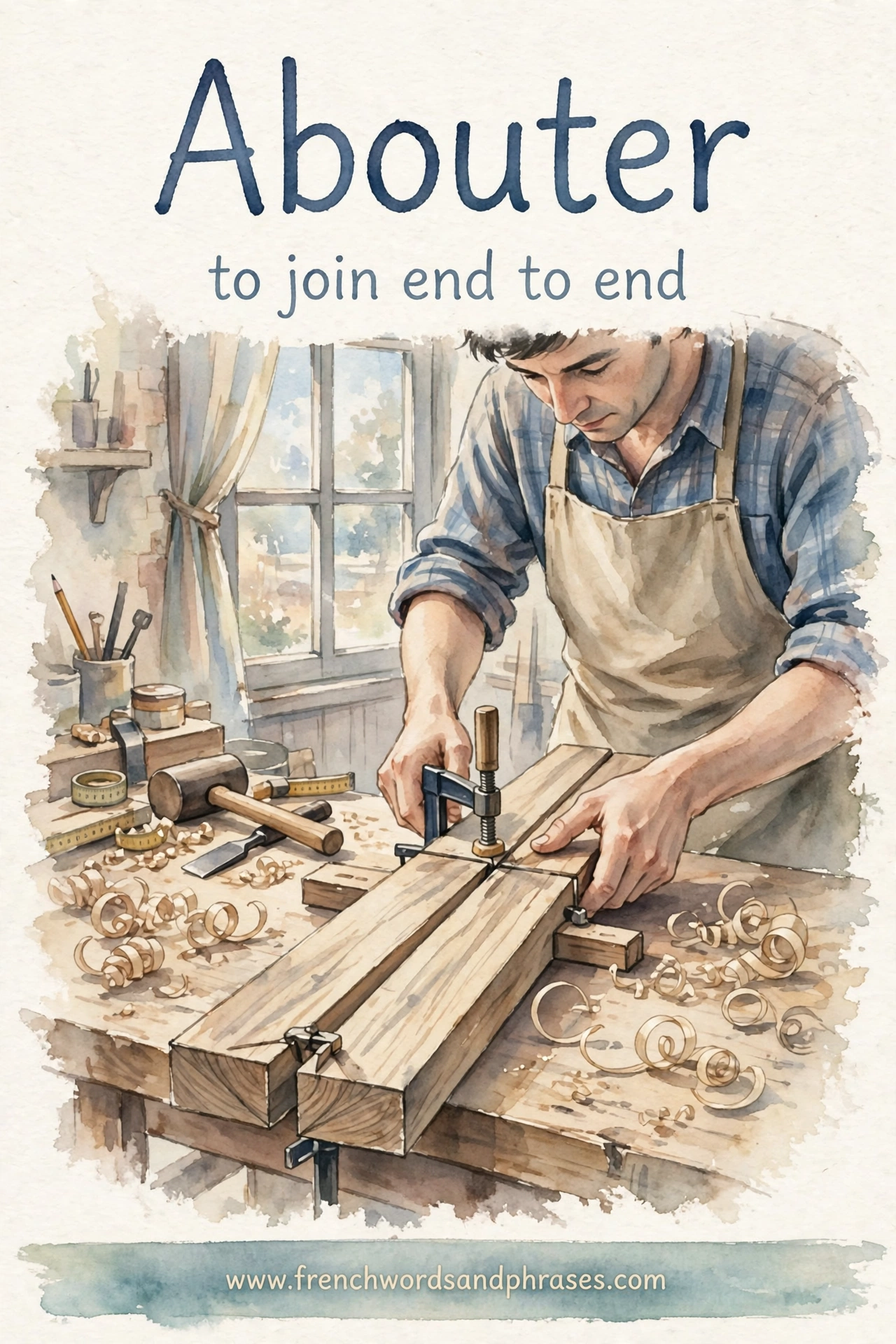
Two planks laid tip to tip on a carpenter’s bench, two lengths of rope, two pipes meeting in a trench — abouter is the joiner’s verb of the end-to-end joint: nothing overlaps, the ends simply meet and become one.
In this guide, you’ll learn how to conjugate abouter in all the major French tenses and moods. Explore complete conjugation tables, French examples, English translations, and practice quizzes.
Understanding the French Verb Abouter
Abouter is a regular French verb belonging to the first group of verbs, those ending in-er.
It means to join end to end. It is commonly used in carpentry, plumbing, ropemaking and engineering, wherever two pieces are joined without overlap: the joint is neat, economical and only as strong as its fastening. Where aboutir finishes journeys and arguments, abouter finishes planks.
Verb classification: First group (-er)
Auxiliary verb: Avoir
Past participle: abouté
Present participle: aboutant
English equivalents: To join end to end, to butt together; abouter deux planches — to butt two planks end to end; abouter des tuyaux — to join pipes end to end; un about — an end, a butt end; un assemblage en about — a butt joint.
One important detail: abouter is built on un about — the end, the butt of a piece of wood or rope — and it must not be confused with its near-twin aboutir, which means to lead to an outcome. Abouter is physical and technical: carpenters, plumbers and rope-makers aboutent des planches, des tuyaux, des cordages. It is a regular -er verb with avoir, and its kingdom is the workshop, not the office.
Experience the Word
Abouter is the verb of the honest joint — two ends, one meeting, no overlap and no disguise.
Imagine a carpenter short of one long plank. He takes two shorter boards, squares their ends, and les aboute — tip to tip on the bench — until the bench holds a single length of wood, the seam fine as a hair.
Nothing has been hidden or doubled. The ends have been joined — aboutés — and the plank is whole.
How to Conjugate Abouter: Complete French Conjugation Guide
Let’s explore every major conjugation of abouter, beginning with the indicative mood.
How to Conjugate Abouter in the Indicative Mood
The indicative mood is used to express facts, observations, actions, and events.
How to Conjugate Abouter in the Present Tense (Présent)
Used for actions happening now, habitual actions, and general truths.
| Subject | Conjugation |
|---|---|
| je | aboute |
| tu | aboutes |
| il / elle | aboute |
| nous | aboutons |
| vous | aboutez |
| ils / elles | aboutent |
Example
Le menuisier aboute deux planches pour le plateau.
The joiner joins two planks end to end for the top.
Quick Quiz 1
Complete the sentence:
Nous ______ les tuyaux sur toute la longueur.
Reveal the answer
aboutons
Nous aboutons les tuyaux sur toute la longueur.
We join the pipes end to end along the whole length.
How to Conjugate Abouter in the Passé Composé
Used for completed actions in the past. Abouter takes the auxiliary verb avoir.
| Subject | Conjugation |
|---|---|
| j’ | ai abouté |
| tu | as abouté |
| il / elle | a abouté |
| nous | avons abouté |
| vous | avez abouté |
| ils / elles | ont abouté |
Example
Ils ont abouté les tuyaux sur toute la longueur du jardin.
They joined the pipes end to end along the whole garden.
How to Conjugate Abouter in the Imparfait (Imperfect Tense)
Used for habitual past actions, descriptions, and ongoing situations in the past.
| Subject | Conjugation |
|---|---|
| je | aboutais |
| tu | aboutais |
| il / elle | aboutait |
| nous | aboutions |
| vous | aboutiez |
| ils / elles | aboutaient |
Example
On aboutait les cordages à la main, autrefois.
People used to join ropes end to end by hand.
Quick Quiz 2
Choose the correct form:
She had butted the two pieces together.
Elle ______ les deux morceaux. (a abouté / est abouté)
Reveal the answer
a abouté
Elle a abouté les deux morceaux.
Abouter takes avoir.
How to Conjugate Abouter in the Plus-que-parfait
Used to describe an action that had already been completed before another past event.
| Subject | Conjugation |
|---|---|
| j’ | avais abouté |
| tu | avais abouté |
| il / elle | avait abouté |
| nous | avions abouté |
| vous | aviez abouté |
| ils / elles | avaient abouté |
Example
Elle avait abouté les deux morceaux avant le collage.
She had butted the two pieces together before gluing.
How to Conjugate Abouter in the Passé Simple
Primarily used in formal writing, literature, and historical narratives. It is rarely used in everyday conversation.
| Subject | Conjugation |
|---|---|
| je | aboutai |
| tu | aboutas |
| il / elle | abouta |
| nous | aboutâmes |
| vous | aboutâtes |
| ils / elles | aboutèrent |
Example
Le plombier abouta les tuyaux en une heure.
The plumber joined the pipes end to end in an hour.
How to Conjugate Abouter in the Passé Antérieur
A literary tense used to express an action completed immediately before another past action, generally in the passé simple.
| Subject | Conjugation |
|---|---|
| j’ | eus abouté |
| tu | eus abouté |
| il / elle | eut abouté |
| nous | eûmes abouté |
| vous | eûtes abouté |
| ils / elles | eurent abouté |
Example
Quand il eut abouté les planches, il les serra dans l’étau.
When he had joined the planks end to end, he clamped them in the vice.
How to Conjugate Abouter in the Future Tense (Futur Simple)
Used to describe actions that will take place in the future.
| Subject | Conjugation |
|---|---|
| je | abouterai |
| tu | abouteras |
| il / elle | aboutera |
| nous | abouterons |
| vous | abouterez |
| ils / elles | abouteront |
Example
Nous abouterons ces deux pièces demain.
We will join these two pieces end to end tomorrow.
How to Conjugate Abouter in the Futur Antérieur (Future Perfect)
Used for an action that will have been completed before a particular point in the future.
| Subject | Conjugation |
|---|---|
| j’ | aurai abouté |
| tu | auras abouté |
| il / elle | aura abouté |
| nous | aurons abouté |
| vous | aurez abouté |
| ils / elles | auront abouté |
Example
À midi, ils auront abouté tous les tuyaux du chantier.
By noon, they will have joined all the pipes on the site end to end.
How to Conjugate Abouter in the Near Future (Futur Proche)
Used to describe something that is going to happen soon. Formed with aller + infinitive.
| Subject | Conjugation |
|---|---|
| je | vais abouter |
| tu | vas abouter |
| il / elle | va abouter |
| nous | allons abouter |
| vous | allez abouter |
| ils / elles | vont abouter |
Example
Le menuisier va abouter les deux planches.
The joiner is going to join the two planks end to end.
How to Conjugate Abouter in the Conditional Mood
The conditional mood expresses what would happen under certain circumstances. It is also frequently used to make polite requests or express wishes.
How to Conjugate Abouter in the Present Conditional
| Subject | Conjugation |
|---|---|
| je | abouterais |
| tu | abouterais |
| il / elle | abouterait |
| nous | abouterions |
| vous | abouteriez |
| ils / elles | abouteraient |
Example
On abouterait les pièces si elles avaient la même épaisseur.
We would join the pieces end to end if they were the same thickness.
How to Conjugate Abouter in the Past Conditional
| Subject | Conjugation |
|---|---|
| j’ | aurais abouté |
| tu | aurais abouté |
| il / elle | aurait abouté |
| nous | aurions abouté |
| vous | auriez abouté |
| ils / elles | auraient abouté |
Example
Il aurait abouté les cordes sans cette coupure.
He would have joined the ropes end to end if not for that cut.
Abouter in the Literary Past Conditional Form
This less common literary form uses the imperfect subjunctive of avoir.
| Subject | Conjugation |
|---|---|
| j’ | eusse abouté |
| tu | eusses abouté |
| il / elle | eût abouté |
| nous | eussions abouté |
| vous | eussiez abouté |
| ils / elles | eussent abouté |
Example
L’ouvrier eût abouté les planches sans la panne de la scie.
The workman would have joined the planks end to end without the saw’s breakdown.
How to Conjugate Abouter in the Subjunctive Mood
The subjunctive is used to express wishes, emotions, doubts, necessity, and uncertainty. It frequently follows expressions such as il faut que (it is necessary that) or bien que (although).
How to Conjugate Abouter in the Present Subjunctive
| Subject | Conjugation |
|---|---|
| que je | aboute |
| que tu | aboutes |
| qu’il / qu’elle | aboute |
| que nous | aboutions |
| que vous | aboutiez |
| qu’ils / qu’elles | aboutent |
Example
Il faut que tu aboutes les pièces bien droit.
You must butt the pieces together good and straight.
Quick Quiz 3
Complete the sentence using the subjunctive:
Le plan exige que vous ______ les tuyaux sans soudure.
Reveal the answer
aboutiez
Le plan exige que vous aboutiez les tuyaux sans soudure.
The plan requires you to join the pipes end to end without welding.
How to Conjugate Abouter in the Imperfect Subjunctive
A literary tense, rarely encountered in modern spoken French.
| Subject | Conjugation |
|---|---|
| que je | aboutasse |
| que tu | aboutasses |
| qu’il / qu’elle | aboutât |
| que nous | aboutassions |
| que vous | aboutassiez |
| qu’ils / qu’elles | aboutassent |
Example
Le plan exigeait qu’on aboutât les tuyaux sans soudure.
The plan required the pipes to be joined end to end without welding.
How to Conjugate Abouter in the Pluperfect Subjunctive
A literary construction used to express an action completed before another past action.
| Subject | Conjugation |
|---|---|
| que j’ | eusse abouté |
| que tu | eusses abouté |
| qu’il / qu’elle | eût abouté |
| que nous | eussions abouté |
| que vous | eussiez abouté |
| qu’ils / qu’elles | eussent abouté |
Example
On vérifia qu’il eût abouté chaque morceau correctement.
They checked that he had joined each piece end to end correctly.
How to Conjugate Abouter in the Past Subjunctive
| Subject | Conjugation |
|---|---|
| que j’ | aie abouté |
| que tu | aies abouté |
| qu’il / qu’elle | ait abouté |
| que nous | ayons abouté |
| que vous | ayez abouté |
| qu’ils / qu’elles | aient abouté |
Example
Je suis content que vous ayez abouté les planches si proprement.
I am glad you joined the planks end to end so neatly.
How to Conjugate Abouter in the Imperative
The imperative is used to give commands, instructions, invitations, or suggestions. Subject pronouns are omitted.
How to Conjugate Abouter in the Present Imperative
| Person | Conjugation |
|---|---|
| (tu) | aboute |
| (nous) | aboutons |
| (vous) | aboutez |
Example
Aboute les deux pièces et serre-les fort !
Butt the two pieces together and clamp them tight!
Quick Quiz 4
How would you say Butt the two pieces together (tu form)?
Reveal the answer
Aboute les deux pièces !
French Participles of Abouter
Participles are verb forms that can be used in compound tenses and other grammatical constructions.
Present Participle of Abouter
aboutant
En aboutant les planches, il obtient un plateau d’un seul tenant.
By joining the planks end to end, he gets a top in one single piece.
Past Participle of Abouter
abouté
Aboutées avec soin, les pièces ne font qu’une.
Joined end to end with care, the pieces form a single whole.
Abouter in Everyday French: Real-Life Examples
Now that you know the conjugations, let’s see how abouter appears in everyday French.
Example 1 — Present
Le menuisier aboute deux planches.
The joiner joins two planks end to end.
Example 2 — Passé composé
Ils ont abouté les tuyaux.
They joined the pipes end to end.
Example 3 — Imparfait
On aboutait les cordages à la main.
People used to join ropes end to end by hand.
Example 4 — Future
Nous abouterons ces pièces demain.
We will join these pieces end to end tomorrow.
Example 5 — Conditional
On abouterait les pièces si elles s’ajustaient.
We would join the pieces if they fitted.
Example 6 — Imperative
Aboute les pièces bien droit !
Butt the pieces together good and straight!
Beyond Translation: The Meaning of Abouter
English joiners say to butt — and French abouter is the same gesture wearing overalls: un about is the butt end of the piece itself.
Two ends meet, and the seam tells the truth.
Beware its elegant twin: aboutir ends arguments and journeys, but only abouter ends a plank. One letter separates the workshop from the philosophy seminar.
How to Remember the French Verb Abouter
Remember it this way: Abouter is about two planks tip to tip on the bench — the honest joint.
- Built on un about, a butt end: abouter = to join end to end, in wood, pipe and rope.
- Not aboutir: aboutir leads to an outcome; abouter joins physical pieces.
- Regular -er with avoir: j’aboute, nous aboutons, past participle abouté.
The key idea is two planks tip to tip on the bench — the honest joint.
Test Your Knowledge of Abouter
Let’s see how much you’ve learned. Try answering these questions before revealing the answers.
Question 1
What does un about mean, and how does it explain abouter?
Reveal the answer
An end, a butt end — abouter is to join two pieces by those ends, end to end.
Question 2
How do you say They joined the pipes end to end in French?
Reveal the answer
Ils ont abouté les tuyaux.
Question 3
Translate: The joiner joins two planks end to end.
Reveal the answer
Le menuisier aboute deux planches.
Question 4
What is the past participle of abouter?
Reveal the answer
Abouté.
Question 5
Complete the sentence:
Il faut que tu ______ les pièces bien droit.
Reveal the answer
aboutes
Il faut que tu aboutes les pièces bien droit.
You must butt the pieces together good and straight.
Your Final Challenge
Can You Use It?
How would you say this in French?
The joiner joins the two planks end to end, and the top is a single piece.
Reveal the answer
Le menuisier aboute les deux planches, et le plateau ne fait qu’un.
The joiner joins the two planks end to end, and the top is a single piece.
A little French. A little curiosity. A richer everyday life.
LEARN FRENCH ONE WORD AT A TIME