A French Word to Live By
Translate Abondamment to English
/a.bɔ̃.da.mɑ̃/
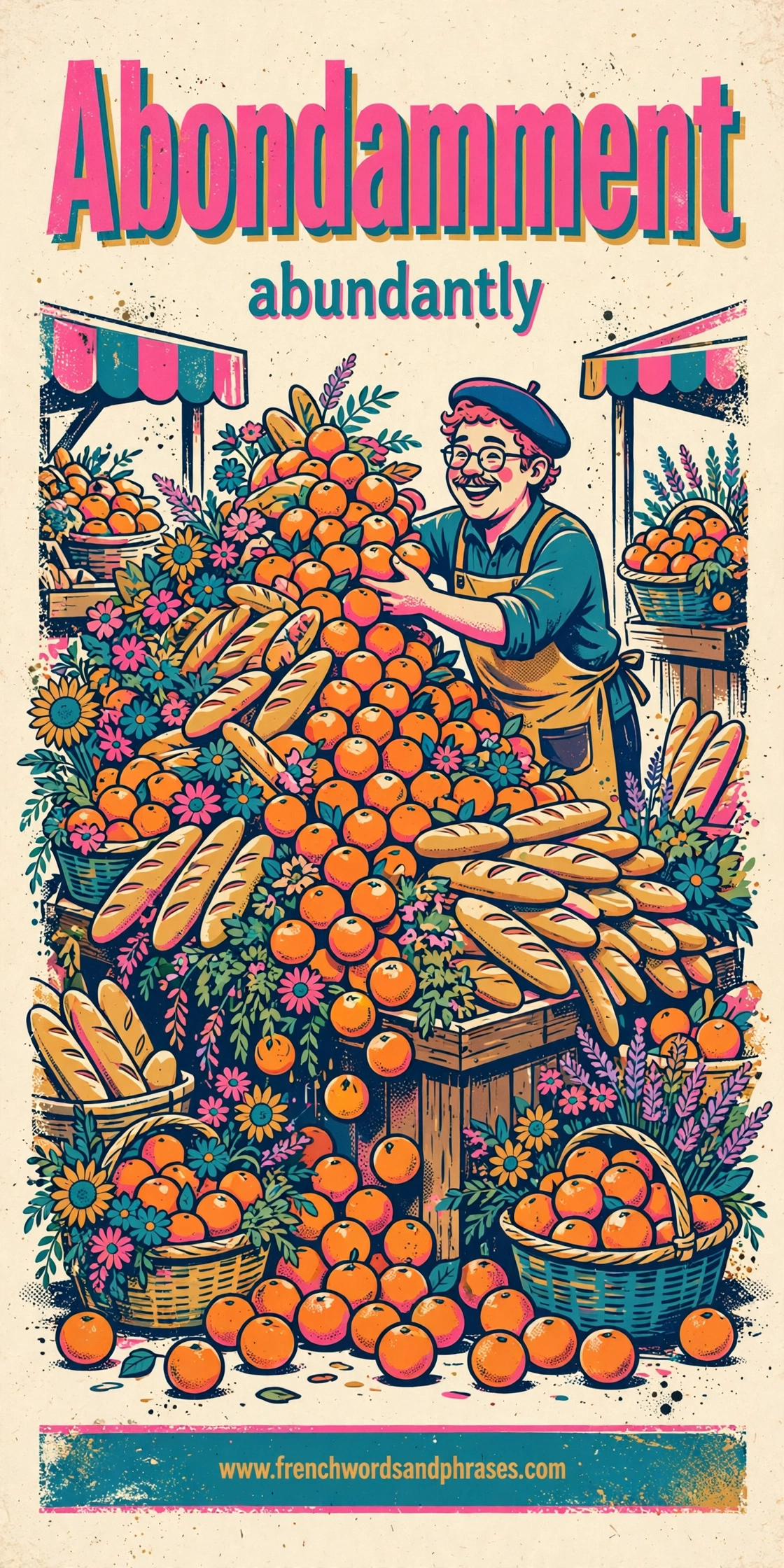
Abondamment means abundantly.
The market gardener walks the rows at dawn, hose in hand, while the lettuces open like green roses after the rain. « Arrose abondamment, » says the old notice on the shed door — water abundantly, generously, without counting the drops. That is the spirit of the word: plenty, given freely.
In this guide, you’ll learn what abondamment means in English, why it is spelled with -amment, the verbs it loves to accompany, and the horrifying near-twin it must never be confused with. Explore French examples, English translations, and practice quizzes.
Understanding the French Adverb Abondamment
Abondamment is a French adverb of quantity and manner. It is built from the adjective abondant (abundant): adjectives ending in -ant form their adverb in -amment, so abondant gives abondamment — spelled with an a, and said as if the ending were -emment’s twin.
It means abundantly — in large quantity, plentifully, more than enough. It describes how things are given, poured, served or produced: arroser abondamment (to water generously), un livre abondamment illustré (a richly illustrated book), des preuves qui abondent… with the adverb, the plenty is in the action itself.
Type: Adverb of quantity and manner — plenty in the action
Answers the question: How much / how? — in abundance, generously
Changes form: Never — abondamment is invariable
English equivalents: Abundantly; plentifully; richly.
One important usage detail: the spelling — abondamment keeps the a of abondant in its ending, -amment, even though the ending sounds exactly like -emment. All adjectives in -ant do this: élégant gives élégamment. Write the a, and you will never be wrong with this family.
Experience the Word
Abondamment is the adverb of the generous hand — the watering can tipped right over, the plate filled twice, the book stuffed with pictures.
Imagine the Provençal garden in August: tomatoes red on every branch, basil at every step, and the gardener smiling — « cette année, le jardin a abondamment produit ».
You have not just said a lot. You have said plenty, freely given, more than enough.
How to Use Abondamment in French: Complete Guide
Let’s explore how abondamment works in French, beginning with the whole word on one card.
Abondamment at a Glance
Before the details, here is the whole word on one card.
The Whole Word on One Card
Meaning, type, position and form — abondamment in four lines.
| Point | Abondamment |
|---|---|
| Meaning | abundantly, plentifully |
| Type | adverb of quantity and manner |
| Usual position | after the verb it describes |
| Form | invariable — never changes |
Example
Arrosez abondamment les jeunes plants.
Water the young plants abundantly.
Where Abondamment Goes in the Sentence
Abondamment follows its verb like a shadow of plenty, and it slips neatly between an auxiliary and a past participle.
| Situation | Pattern |
|---|---|
| After the verb | verb + abondamment — il pleut abondamment |
| With a compound tense | auxiliary + abondamment + participle — le jardin a abondamment fleuri |
| Before a past participle used as adjective | abondamment + participle — un texte abondamment illustré |
| Head of the sentence | Abondamment, + sentence — Abondamment, on a arrosé les rosiers |
Example
Le potager a abondamment produit cette année.
The vegetable garden produced abundantly this year.
Quick Quiz 1
Why is abondamment spelled with an a in -amment and not -emment?
Reveal the answer
Because it is built on abondant — adjectives in -ant form their adverbs in -amment.
Un jardin abondant, arrosé abondamment.
An abundant garden, watered abundantly.
Abondamment at Work: Gardens, Tables and Books
Wherever plenty flows — water, food, pictures, proof — abondamment is the word that measures the generosity.
| Situation | Example |
|---|---|
| In the garden | Arrosez abondamment après la plantation. |
| At the table | Elle s’est servie abondamment de salade. |
| In a book | Un roman abondamment illustré pour les enfants. |
| In an argument | Une thèse abondamment documentée. |
| In the rain | Il a plu abondamment pendant la nuit. |
Example
Le livre est abondamment illustré de photos anciennes.
The book is richly illustrated with old photographs.
Abondamment and Its Neighbours
The adverbs of quantity line up from barely to overflowing. Abondamment stands near the generous end.
| French | In English |
|---|---|
| peu | little, not much |
| assez | enough, fairly |
| beaucoup | a lot, much |
| généreusement | generously (of a giver’s spirit) |
| abondamment | abundantly (plenty in the thing itself) |
Example
Il a beaucoup plu, et le jardin a abondamment fleuri.
It rained a lot, and the garden flowered abundantly.
Quick Quiz 2
Complete the sentence:
Après la sécheresse, il a enfin plu ______. (abundantly)
Reveal the answer
abondamment
Après la sécheresse, il a enfin plu abondamment.
After the drought, it finally rained abundantly.
The Family Behind Abondamment: Abondant
One root, four jobs: the verb abonder, the adjective abondant, the noun abondance and our adverb.
| French | In English |
|---|---|
| abonder | to abound — les fleurs abondent au printemps |
| abondant / abondante | abundant (adjective) — une récolte abondante |
| l’abondance | abundance — vivre dans l’abondance |
| abondamment | abundantly |
Example
Dans l’abondance du jardin, les abeilles abondent.
In the garden’s abundance, the bees abound.
Abondamment or Beaucoup?
Both talk about quantity, but beaucoup counts and abondamment overflows. The difference is one of flavour.
| Aspect | The Difference |
|---|---|
| Job | beaucoup measures how much; abondamment describes the manner — plentifully, richly |
| Position | beaucoup stands before de + noun (beaucoup d’eau); abondamment never does |
| Tone | beaucoup is neutral and everyday; abondamment is fuller, more written |
| A safe rule | For counting things, use beaucoup; for rich, generous flow, abondamment |
Example
Il y a beaucoup de fleurs, abondamment ouvertes au soleil.
There are lots of flowers, abundantly open to the sun.
Quick Quiz 3
Which family member is the noun: abondance or abondamment?
Reveal the answer
abondance — vivre dans l’abondance, to live in abundance. Abondamment is the adverb.
L’abondance de la récolte a surpris tout le village.
The abundance of the harvest surprised the whole village.
Abondamment with Participles: The Written Style
In books, catalogues and essays, abondamment loves to stand before a past participle and certify the richness of the result.
| French | In English |
|---|---|
| abondamment illustré | richly illustrated |
| abondamment documenté | extensively documented |
| abondamment garni | generously filled, lavishly stocked |
| abondamment cité | widely quoted |
| abondamment arrosé | thoroughly watered |
Example
Un catalogue abondamment illustré de gravures anciennes.
A catalogue richly illustrated with old engravings.
Watch Out: The Traps Around Abondamment
The traps: the horrifying twin, the a that must not become an e, and a quantity word put where a counting word belongs.
| Mistake | Correct French |
|---|---|
| Confusing it with abominablement | abominablement = abominably (horror); abondamment = abundantly (plenty) |
| Spelling it « abondemment » | abondamment — the a of abondant stays |
| Saying « abondamment de fleurs » | beaucoup de fleurs — abondamment never stands before de + noun |
| Expecting agreement: « des roses abondammentes » | adverbs never agree — des roses abondamment ouvertes |
Example
Le repas était abondamment servi — et heureusement pas abominablement salé.
The meal was abundantly served — and luckily not abominably salty.
Quick Quiz 4
Translate: Water the roses abundantly.
Reveal the answer
Arrose abondamment les rosiers.
The classic gardening instruction — the adverb follows the verb.
Abondamment in Everyday French: Real-Life Examples
Now that you know the word, let’s see how abondamment appears in everyday French.
Example 1 — In the garden
Arrosez abondamment les tomates le soir.
Water the tomatoes abundantly in the evening.
Example 2 — At the table
Les invités se sont servis abondamment.
The guests helped themselves abundantly.
Example 3 — In a book
Ce guide est abondamment illustré.
This guide is richly illustrated.
Example 4 — Weather
Il a plu abondamment toute la journée.
It rained abundantly all day.
Example 5 — In an essay
Elle a abondamment cité les grands auteurs.
She quoted the great authors abundantly.
Example 6 — Harvest
Les pommiers ont abondamment produit cette année.
The apple trees produced abundantly this year.
Beyond Translation: The Meaning of Abondamment
Gardeners know this word in their hands before they know it in their heads: arroser abondamment is printed on seed packets and plant labels all over France, the two-word promise that thirsty roots will be properly drowned.
To do something abondamment is to refuse to count.
Beaucoup measures; abondamment pours. It is the adverb of the open hand and the full table — plenty not as a number, but as a manner of giving.
How to Remember the French Adverb Abondamment
Remember it this way: Abondamment means abundantly — plenty in the action itself, from watering a garden to illustrating a book.
- You keep the a of abondant — abondamment, jamais « abondemment ».
- You hear the gardener — arrosez abondamment les jeunes plants.
- You dodge the twin — abominablement is horror, abondamment is plenty.
The key idea is abondamment = abundantly, the adverb of the generous hand.
Test Your Knowledge of Abondamment
Let’s see how much you’ve learned. Try answering these questions before revealing the answers.
Question 1
What does abondamment mean?
Reveal the answer
Abundantly — in large quantity, plentifully, more than enough.
Question 2
How is abondamment spelled at the end — and why?
Reveal the answer
-amment, with an a — because it is built on the adjective abondant; adjectives in -ant give adverbs in -amment.
Question 3
Translate: It rained abundantly all night.
Reveal the answer
Il a plu abondamment toute la nuit.
Question 4
Can abondamment stand before de + a noun, like beaucoup?
Reveal the answer
No — beaucoup de fleurs is correct; abondamment only ever describes a verb or a participle.
Question 5
Complete the sentence:
Arrosez ______ les rosiers. (abundantly)
Reveal the answer
abondamment
Arrosez abondamment les rosiers.
Water the roses abundantly.
Your Final Challenge
Can You Use It?
How would you say this in French?
“The garden produced abundantly this year.”
Reveal the answer
Le jardin a abondamment produit cette année.
The garden produced abundantly this year.
A little French. A little curiosity. A richer everyday life.
LEARN FRENCH ONE WORD AT A TIME