A French Word to Live By
How to Conjugate Lire in French
/liʁ/
Lire means to read.
A book can open a whole world. You open a novel on a quiet evening, you read a letter from a friend, or you glance at a sign in a new city — that is lire.
In this guide, you’ll learn how to conjugate lire in all the major French tenses and moods. Explore complete conjugation tables, French examples, English translations, and practice quizzes.
Understanding the French Verb Lire
Lire is an irregular French verb belonging to the third group of verbs, those ending in -re.
It means to read. It is commonly used for books, newspapers, letters, and screens — anything written that you take in with your eyes — and also for reading signs, maps, and even the expression on a face.
Verb classification: Third group (irregular -re verb)
Auxiliary verb: Avoir
Past participle: lu
Present participle: lisant
English equivalents: To read.
One important spelling detail: the stem changes in the present tense — je lis, nous lisons, ils lisent — and the passé simple takes a circumflex on the first-person plural, nous lûmes.
Experience the Word
Lire is more than looking at words. It is entering another world, one page at a time, and letting a story or an idea take hold of you.
Imagine a quiet evening by the fire. You open a novel, the room fades away, and for an hour you live somewhere else entirely.
You have not just looked at a page. You have read.
How to Conjugate Lire: Complete French Conjugation Guide
Let’s explore every major conjugation of lire, beginning with the indicative mood.
How to Conjugate Lire in the Indicative Mood
The indicative mood is used to express facts, observations, actions, and events.
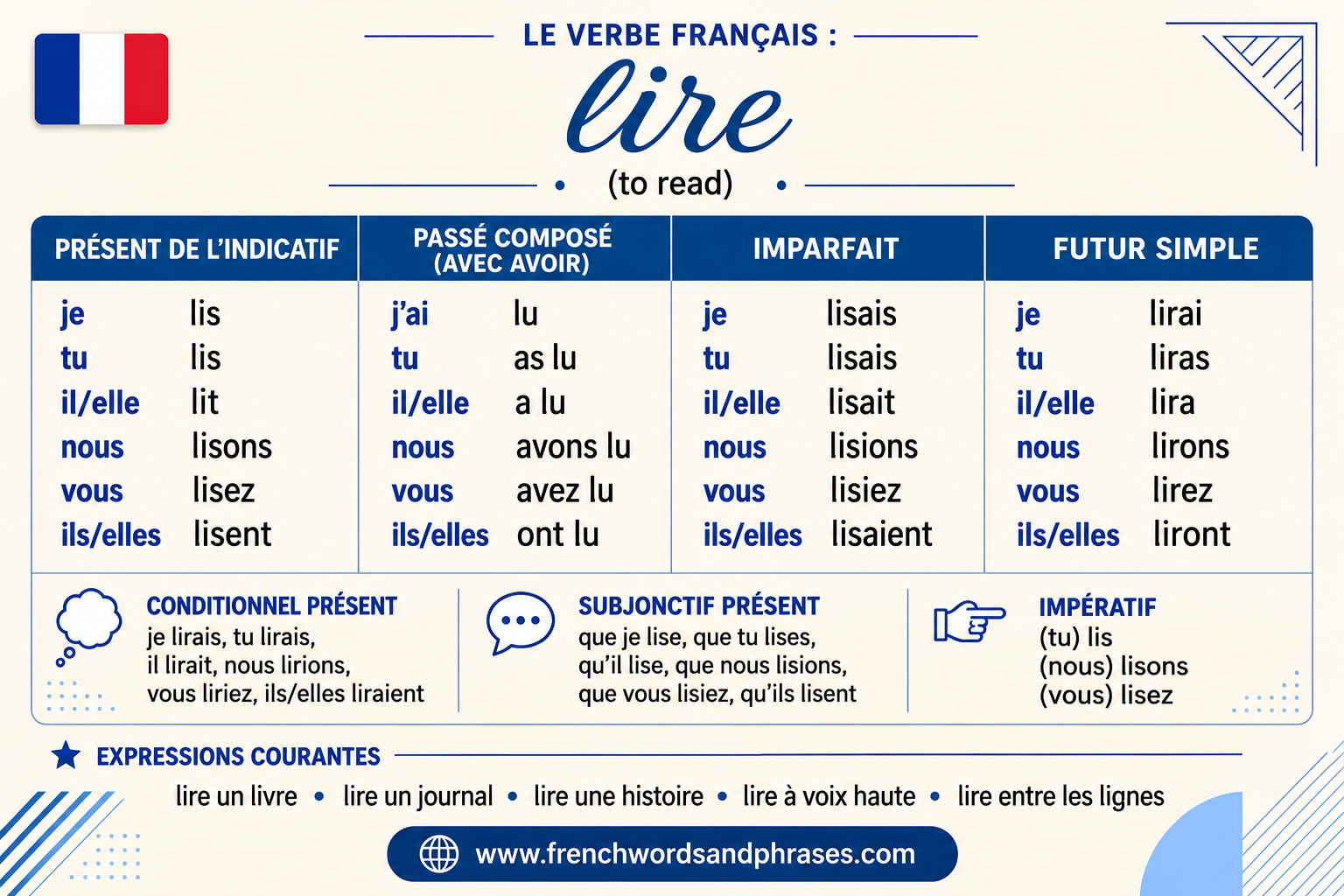
How to Conjugate Lire in the Present Tense (Présent)
Used for actions happening now, habitual actions, and general truths.
| Subject | Conjugation |
|---|---|
| je | lis |
| tu | lis |
| il / elle | lit |
| nous | lisons |
| vous | lisez |
| ils / elles | lisent |
Example
Je lis un roman passionnant.
I am reading a fascinating novel.
Quick Quiz 1
Complete the sentence:
Nous ______ le journal chaque matin.
Reveal the answer
lisons
Nous lisons le journal chaque matin.
We read the newspaper every morning.
How to Conjugate Lire in the Passé Composé
Used for completed actions in the past. Lire takes the auxiliary verb avoir.
| Subject | Conjugation |
|---|---|
| j’ | ai lu |
| tu | as lu |
| il / elle | a lu |
| nous | avons lu |
| vous | avez lu |
| ils / elles | ont lu |
Example
J’ai lu ce livre en deux jours.
I read this book in two days.
How to Conjugate Lire in the Imparfait (Imperfect Tense)
Used for habitual past actions, descriptions, and ongoing situations in the past.
| Subject | Conjugation |
|---|---|
| je | lisais |
| tu | lisais |
| il / elle | lisait |
| nous | lisions |
| vous | lisiez |
| ils / elles | lisaient |
Example
Quand j’étais enfant, je lisais tous les soirs.
When I was a child, I read every evening.
Quick Quiz 2
Choose the correct form:
When we were children, we used to read every evening.
Quand nous étions enfants, nous ______ tous les soirs.
Reveal the answer
lisions
Quand nous étions enfants, nous lisions tous les soirs.
How to Conjugate Lire in the Plus-que-parfait
Used to describe an action that had already been completed before another past event.
| Subject | Conjugation |
|---|---|
| j’ | avais lu |
| tu | avais lu |
| il / elle | avait lu |
| nous | avions lu |
| vous | aviez lu |
| ils / elles | avaient lu |
Example
J’avais déjà lu ce roman avant le film.
I had already read this novel before the film.
How to Conjugate Lire in the Passé Simple
Primarily used in formal writing, literature, and historical narratives. It is rarely used in everyday conversation.
| Subject | Conjugation |
|---|---|
| je | lus |
| tu | lus |
| il / elle | lut |
| nous | lûmes |
| vous | lûtes |
| ils / elles | lurent |
Example
Il lut la lettre en silence.
He read the letter in silence.
How to Conjugate Lire in the Passé Antérieur
A literary tense used to express an action completed immediately before another past action, generally in the passé simple.
| Subject | Conjugation |
|---|---|
| j’ | eus lu |
| tu | eus lu |
| il / elle | eut lu |
| nous | eûmes lu |
| vous | eûtes lu |
| ils / elles | eurent lu |
Example
Dès qu’il eut lu le message, il répondit.
As soon as he had read the message, he replied.
How to Conjugate Lire in the Future Tense (Futur Simple)
Used to describe actions that will take place in the future.
| Subject | Conjugation |
|---|---|
| je | lirai |
| tu | liras |
| il / elle | lira |
| nous | lirons |
| vous | lirez |
| ils / elles | liront |
Example
Demain, je lirai le dernier chapitre.
Tomorrow, I will read the last chapter.
How to Conjugate Lire in the Futur Antérieur (Future Perfect)
Used for an action that will have been completed before a particular point in the future.
| Subject | Conjugation |
|---|---|
| j’ | aurai lu |
| tu | auras lu |
| il / elle | aura lu |
| nous | aurons lu |
| vous | aurez lu |
| ils / elles | auront lu |
Example
À midi, j’aurai déjà lu le journal.
By noon, I will already have read the newspaper.
How to Conjugate Lire in the Near Future (Futur Proche)
Used to describe something that is going to happen soon. Formed with aller + infinitive.
| Subject | Conjugation |
|---|---|
| je | vais lire |
| tu | vas lire |
| il / elle | va lire |
| nous | allons lire |
| vous | allez lire |
| ils / elles | vont lire |
Example
Je vais lire un peu avant de dormir.
I am going to read a little before going to sleep.
How to Conjugate Lire in the Conditional Mood
The conditional mood expresses what would happen under certain circumstances. It is also frequently used to make polite requests or express wishes.
How to Conjugate Lire in the Present Conditional
| Subject | Conjugation |
|---|---|
| je | lirais |
| tu | lirais |
| il / elle | lirait |
| nous | lirions |
| vous | liriez |
| ils / elles | liraient |
Example
Je lirais plus si j’avais le temps.
I would read more if I had the time.
How to Conjugate Lire in the Past Conditional
| Subject | Conjugation |
|---|---|
| j’ | aurais lu |
| tu | aurais lu |
| il / elle | aurait lu |
| nous | aurions lu |
| vous | auriez lu |
| ils / elles | auraient lu |
Example
J’aurais lu ce livre si tu me l’avais donné.
I would have read this book if you had given it to me.
Lire in the Literary Past Conditional Form
This less common literary form uses the imperfect subjunctive of avoir.
| Subject | Conjugation |
|---|---|
| j’ | eusse lu |
| tu | eusses lu |
| il / elle | eût lu |
| nous | eussions lu |
| vous | eussiez lu |
| ils / elles | eussent lu |
Example
Il eût lu davantage s’il avait pu.
He would have read more if he had been able to.
How to Conjugate Lire in the Subjunctive Mood
The subjunctive is used to express wishes, emotions, doubts, necessity, and uncertainty. It frequently follows expressions such as il faut que (it is necessary that) or bien que (although).
How to Conjugate Lire in the Present Subjunctive
| Subject | Conjugation |
|---|---|
| que je | lise |
| que tu | lises |
| qu’il / qu’elle | lise |
| que nous | lisions |
| que vous | lisiez |
| qu’ils / qu’elles | lisent |
Example
Il faut que je lise ce rapport avant demain.
I need to read this report before tomorrow.
Quick Quiz 3
Complete the sentence using the subjunctive:
Il faut que nous ______ ce rapport.
Reveal the answer
lisions
Il faut que nous lisions ce rapport.
We need to read this report.
How to Conjugate Lire in the Imperfect Subjunctive
A literary tense, rarely encountered in modern spoken French.
| Subject | Conjugation |
|---|---|
| que je | lusse |
| que tu | lusses |
| qu’il / qu’elle | lût |
| que nous | lussions |
| que vous | lussiez |
| qu’ils / qu’elles | lussent |
Example
Il souhaitait qu’elle lût ce poème à voix haute.
He wished that she would read this poem aloud.
How to Conjugate Lire in the Pluperfect Subjunctive
A literary construction used to express an action completed before another past action.
| Subject | Conjugation |
|---|---|
| que j’ | eusse lu |
| que tu | eusses lu |
| qu’il / qu’elle | eût lu |
| que nous | eussions lu |
| que vous | eussiez lu |
| qu’ils / qu’elles | eussent lu |
Example
Il regrettait que nous eussions lu si peu de livres.
He regretted that we had read so few books.
How to Conjugate Lire in the Past Subjunctive
| Subject | Conjugation |
|---|---|
| que j’ | aie lu |
| que tu | aies lu |
| qu’il / qu’elle | ait lu |
| que nous | ayons lu |
| que vous | ayez lu |
| qu’ils / qu’elles | aient lu |
Example
Je suis heureux que tu aies lu ce roman.
I am happy that you read this novel.
How to Conjugate Lire in the Imperative
The imperative is used to give commands, instructions, invitations, or suggestions. Subject pronouns are omitted.
How to Conjugate Lire in the Present Imperative
| Person | Conjugation |
|---|---|
| (tu) | lis |
| (nous) | lisons |
| (vous) | lisez |
Example
Lis ce livre, il est excellent !
Read this book, it is excellent!
Quick Quiz 4
How would you say Read this book! (tu form)?
Reveal the answer
Lis ce livre !
French Participles of Lire
Participles are verb forms that can be used in compound tenses and other grammatical constructions.
Present Participle of Lire
lisant
En lisant le journal, j’ai appris la nouvelle.
While reading the newspaper, I learned the news.
Past Participle of Lire
lu
Nous avons lu trois romans cet été.
We read three novels this summer.
Lire in Everyday French: Real-Life Examples
Now that you know the conjugations, let’s see how lire appears in everyday French.
Example 1 — Present
Je lis le journal chaque matin.
I read the newspaper every morning.
Example 2 — Passé composé
Nous avons lu ce roman en vacances.
We read this novel on holiday.
Example 3 — Imparfait
Elle lisait toujours avant de dormir.
She always read before going to sleep.
Example 4 — Future
Ils liront le menu avant de commander.
They will read the menu before ordering.
Example 5 — Conditional
Je lirais plus de poésie si j’avais le temps.
I would read more poetry if I had the time.
Example 6 — Subjunctive
Bien que nous lisions beaucoup, nous achetons encore des livres.
Although we read a lot, we still buy books.
Beyond Translation: The Meaning of Lire
English has one word, read, for the meaning of lire. But the French word also covers reading a situation, a map, or a face — understanding something by looking at it closely.
Reading is understanding.
To lire is to take words in and make sense of them. It evokes curiosity, quiet attention, and the pleasure of discovering something new.
How to Remember the French Verb Lire
Remember it this way: Lire is about taking in words and making sense of them.
- You open a book on a rainy afternoon — you lisez.
- You check the train timetable on the platform — tu lis les horaires.
- You glance at a letter and understand the news — tu lis entre les lignes.
The key idea is taking in words and making sense of them.
Test Your Knowledge of Lire
Let’s see how much you’ve learned. Try answering these questions before revealing the answers.
Question 1
What auxiliary verb is used with lire in compound tenses?
Reveal the answer
Avoir
Question 2
How do you say I will read in French?
Reveal the answer
Je lirai.
Question 3
Translate: We read three novels this summer.
Reveal the answer
Nous avons lu trois romans cet été.
Question 4
What is the present participle of lire?
Reveal the answer
Lisant.
Question 5
Complete the sentence:
Si j’avais le temps, je ______ plus.
Reveal the answer
lirais
Si j’avais le temps, je lirais plus.
If I had the time, I would read more.
Your Final Challenge
Can You Use It?
How would you say this in French?
“Tomorrow, I want to read the last chapter of this novel.”
Reveal the answer
Demain, je veux lire le dernier chapitre de ce roman.
Tomorrow, I want to read the last chapter of this novel.
A little French. A little curiosity. A richer everyday life.
LEARN FRENCH ONE WORD AT A TIME