A French Word to Live By
Translate Abêtissement to English
/a.be.tis.mɑ̃/
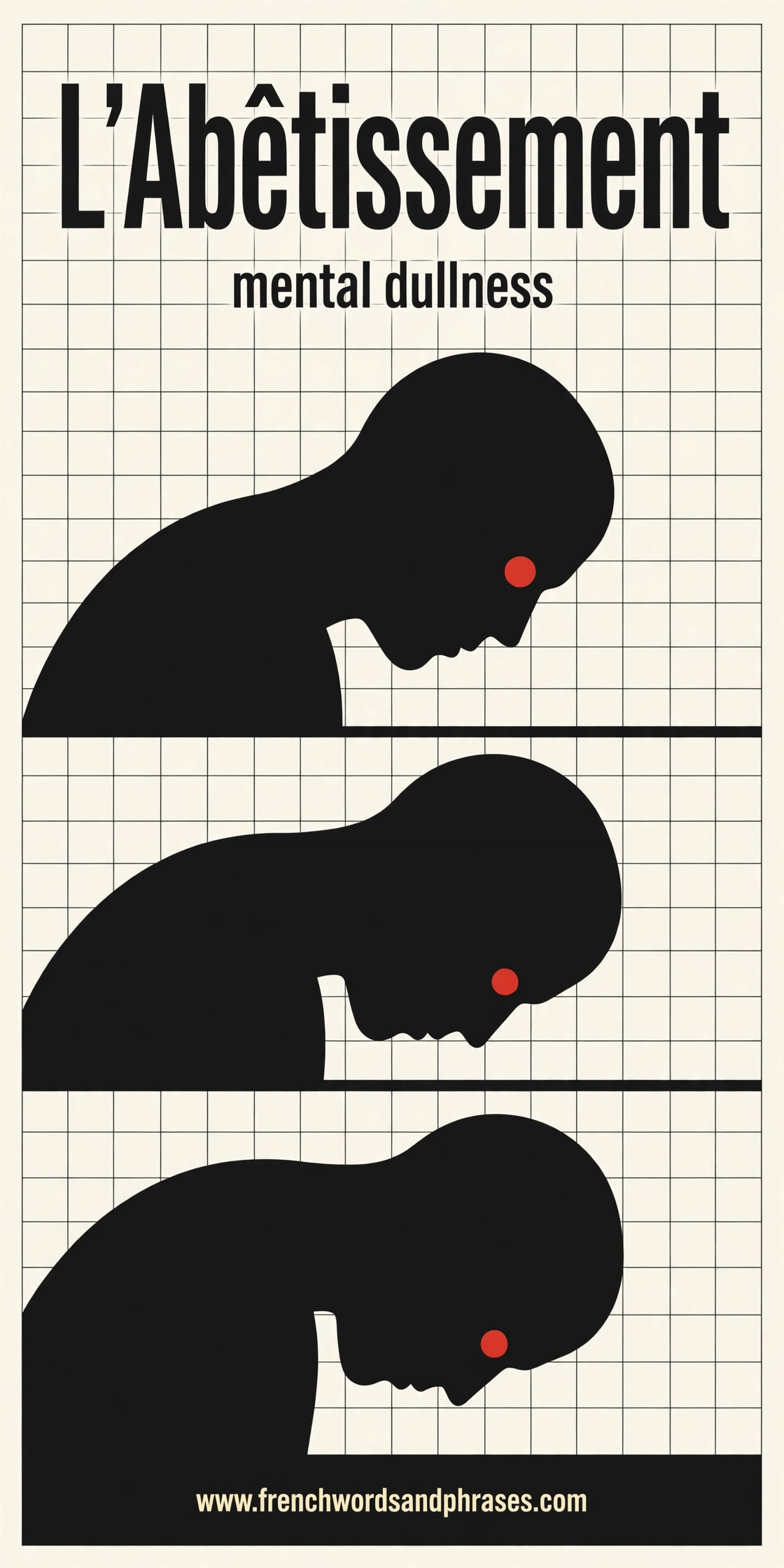
L’abêtissement means mental dulling, stupefaction.
Hours of noise, heat and mindless routine have done their slow work: the eyes glaze, the thoughts thicken, and even simple sums feel heavy. French has a blunt, honest word for that dulling of the mind — l’abêtissement.
In this guide, you’ll learn what abêtissement means in English, how to use it with its articles, how to form its plural, and how it appears in everyday French. Explore French examples, English translations, and practice quizzes.
Understanding the French Noun Abêtissement
Abêtissement is a masculine French noun, learned with its article: l’abêtissement, un abêtissement — vowel start, so le shrinks to l’. It is built on bête (stupid, beast-like) with the prefix a- and the noun ending -issement: the process of being made dull.
It means mental dulling, stupefaction — the state of a mind grown heavy and slow, or the process that makes it so: exhaustion, routine, noise, propaganda, too much screen. The verb of the family is abêtir, to make stupid, to dull. French writers reach for abêtissement when they criticise whatever stupefies a public: « l’abêtissement des esprits », the dumbing-down of minds.
Gender: Masculine
Definite article: l’ — l’abêtissement (mental dulling)
Indefinite article: un — un abêtissement (a dulling)
Plural: les abêtissements (rare — usually uncountable)
Family verb: abêtir — to dull, to make stupid
English equivalents: Mental dulling, stupefaction, dumbing-down.
One important usage detail: abêtissement is almost always a critic’s word, aimed at a cause — la fatigue, la routine, la propagande. Note the circumflex: abêtissement keeps the ê of bête, and so does the verb abêtir. The tone is strong, closer to « stupefaction » than to a gentle « tiredness ».
Experience the Word
Abêtissement is more than an insult. It is a diagnosis French essayists have aimed at every age: the factory bell, the endless meeting, the glowing screen at midnight — whatever sands the edge off a waking mind.
Imagine the long train journey in a stifling carriage, the same announcement for the tenth time, the thoughts slowing like honey in winter — and then, at the window, a field of sunflowers, and the mind shaking itself awake.
You have not just learned a heavy word. You have named the fog — the first step out of it.
How to Use Abêtissement in French: Complete Guide
Let’s explore how abêtissement works in French, beginning with its articles — masculine, vowel first, so l’ and un.
Abêtissement with the Definite Article (L’, Les)
Abêtissement begins with a vowel, so le shrinks to l’ — l’abêtissement caused by fatigue.
| Form | French |
|---|---|
| Masculine singular | l’abêtissement |
| Plural | les abêtissements |
Example
L’abêtissement le gagne après dix heures de bruit.
Mental dulling overcomes him after ten hours of noise.
Abêtissement with the Indefinite Article (Un, Des)
Used for a dulling in general — un abêtissement, a heaviness of mind.
| Form | French |
|---|---|
| Masculine singular | un abêtissement |
| Plural | des abêtissements |
Example
Un abêtissement étrange pèse sur toute l’assemblée.
A strange mental dulling weighs on the whole assembly.
Causes of Abêtissement
Fatigue, noise and routine — the vocabulary of the dulled mind.
| French | In English |
|---|---|
| la fatigue | tiredness, fatigue |
| la routine | routine |
| le bruit | noise |
| la chaleur | heat |
| l’ennui | boredom |
| les écrans | screens |
Example
La fatigue et le bruit mènent à l’abêtissement.
Fatigue and noise lead to mental dulling.
Quick Quiz 1
Complete the sentence:
______ abêtissement des esprits inquiète les enseignants.
Reveal the answer
L’
L’abêtissement des esprits inquiète les enseignants.
The dumbing-down of minds worries teachers — le becomes l’ before a vowel.
The Plural of Abêtissement
Abêtissement adds an -s in the plural, though the word is usually uncountable — les abêtissements is rare.
| Number | French |
|---|---|
| Singular | l’abêtissement |
| Plural | les abêtissements |
Example
Les abêtissements quotidiens finissent par émousser l’esprit.
Daily dullings end up blunting the mind.
Abêtissement with Possessive Adjectives (Mon, Ton, Son…)
Possessives agree with the noun: abêtissement is masculine, so it takes mon, ton, son.
| Owner | French |
|---|---|
| my | mon abêtissement |
| your (tu) | ton abêtissement |
| his / her | son abêtissement |
| our | notre abêtissement |
| your (vous) | votre abêtissement |
| their | leur abêtissement |
Example
Il secoue la tête pour chasser son abêtissement.
He shakes his head to drive away his mental dulling.
Quick Quiz 2
Complete the sentence:
______ abêtissement vient de la chaleur et du bruit. (His)
Reveal the answer
Son
Son abêtissement vient de la chaleur et du bruit.
His mental dulling comes from the heat and the noise.
Abêtissement with Demonstrative Adjectives (Cet, Ces)
Used to point: cet abêtissement — cet, not ce, because the noun begins with a vowel.
| Form | French |
|---|---|
| Masculine singular | cet abêtissement |
| Plural | ces abêtissements |
Example
Cet abêtissement général vient d’un manque de sommeil.
This general mental dulling comes from a lack of sleep.
Abêtissement with Adjectives
Adjectives agree with the masculine noun: un abêtissement profond, général, passager.
| Adjective | With Abêtissement |
|---|---|
| profond (deep) | un abêtissement profond |
| général (general) | un abêtissement général |
| passager (temporary) | un abêtissement passager |
| complet (complete) | un abêtissement complet |
| progressif (gradual) | un abêtissement progressif |
Example
Après la réunion interminable, un abêtissement complet régnait dans la salle.
After the endless meeting, a complete mental dulling reigned in the room.
Quick Quiz 3
Complete the sentence:
C’est un abêtissement ______, ça passera avec du repos. (temporary)
Reveal the answer
passager
C’est un abêtissement passager, ça passera avec du repos.
It is a temporary dulling; it will pass with rest.
Everyday Expressions with Abêtissement
Fogged minds and critics — the abêtissement phrases of daily life.
| Expression | In English |
|---|---|
| l’abêtissement des esprits | the dumbing-down of minds |
| tomber dans l’abêtissement | to sink into stupefaction |
| lutter contre l’abêtissement | to fight against mental dulling |
| un abêtissement collectif | a collective dumbing-down |
| sortir de son abêtissement | to shake off one’s dulling |
| abêtir quelqu’un | to dull someone’s mind |
Example
Lire chaque jour, c’est lutter contre l’abêtissement.
Reading every day is fighting against mental dulling.
Words from the Same Family as Abêtissement
Beasts, dullness and waking up — the words that travel with abêtissement.
| French | In English |
|---|---|
| bête | stupid; a beast |
| abêtir | to dull, to make stupid |
| abêti | dulled, stupefied |
| l’esprit | the mind, spirit |
| émousser | to blunt |
| se réveiller | to wake up, to snap out of it |
Example
Abêti par la chaleur, il finit par se réveiller en sursaut.
Dulled by the heat, he finally wakes with a start.
Quick Quiz 4
What verb belongs to the same family?
Reveal the answer
Abêtir — to dull, to make stupid; abêtissement is the state it produces.
La routine abêtit, la lecture réveille.
Routine dulls; reading wakes you up.
Abêtissement in Everyday French: Real-Life Examples
Now that you know the word, let’s see how abêtissement appears in everyday French.
Example 1 — After work
Le soir, un abêtissement complet l’empêche de lire une page.
In the evening, a complete mental dulling stops him reading a single page.
Example 2 — A criticism
L’auteur dénonce l’abêtissement des esprits par les écrans.
The author denounces the dumbing-down of minds by screens.
Example 3 — Heat
La canicule provoque un abêtissement général dans les bureaux.
The heatwave causes a general mental dulling in the offices.
Example 4 — Recovery
Une sieste suffit à chasser son abêtissement.
A nap is enough to chase away his dulling.
Example 5 — Routine
Attention à la routine : elle mène doucement à l’abêtissement.
Beware of routine: it leads gently to mental dulling.
Example 6 — A warning
Il refuse l’abêtissement et s’inscrit à un cours du soir.
He refuses mental dulling and signs up for an evening class.
Beyond Translation: The Meaning of Abêtissement
Abêtissement is built on bête — the beast — and it carries an old French fear: that a human mind, unexercised, slides back towards the animal. Essayists from the Enlightenment onward have wielded the word against whatever they thought was stupefying their century. Its bluntness is the point: where English says « dumbing-down », French names a fall from mind to beast.
To say abêtissement is to accuse whatever is sanding the edge off our minds.
It evokes the glazed eye and the endless scroll, the stifling room and the tenth identical announcement — and, by contrast, the cold water, the good book and the walk that bring a mind back to itself.
How to Remember the French Noun Abêtissement
Remember it this way: Abêtissement is mental dulling — find bête inside it: the mind going beast-heavy and slow, with the ê keeping its circumflex.
- You spot the root — bête, the beast: l’abêtissement rend l’esprit bête.
- You pair the verb — abêtir quelqu’un, produire un abêtissement.
- You remember the vowel — l’abêtissement, cet abêtissement, son abêtissement.
The key idea is bête → abêtissement, the mind gone dull.
Test Your Knowledge of Abêtissement
Let’s see how much you’ve learned. Try answering these questions before revealing the answers.
Question 1
What is l’abêtissement?
Reveal the answer
Mental dulling, stupefaction — the state of a mind grown heavy and slow, and the process that causes it.
Question 2
Is abêtissement masculine or feminine?
Reveal the answer
Masculine — l’abêtissement, un abêtissement.
Question 3
Translate: The dumbing-down of minds worries teachers.
Reveal the answer
L’abêtissement des esprits inquiète les enseignants.
Question 4
Which word hides inside abêtissement?
Reveal the answer
Bête — stupid, beast-like; the ê and its circumflex survive in abêtissement and abêtir.
Question 5
Complete the sentence:
______ abêtissement vient du manque de sommeil. (This)
Reveal the answer
Cet
Cet abêtissement vient du manque de sommeil.
This mental dulling comes from lack of sleep — cet, because abêtissement begins with a vowel.
Your Final Challenge
Can You Use It?
How would you say this in French?
“Reading every day fights against mental dulling.”
Reveal the answer
Lire chaque jour, c’est lutter contre l’abêtissement.
Reading every day fights against mental dulling.
A little French. A little curiosity. A richer everyday life.
LEARN FRENCH ONE WORD AT A TIME