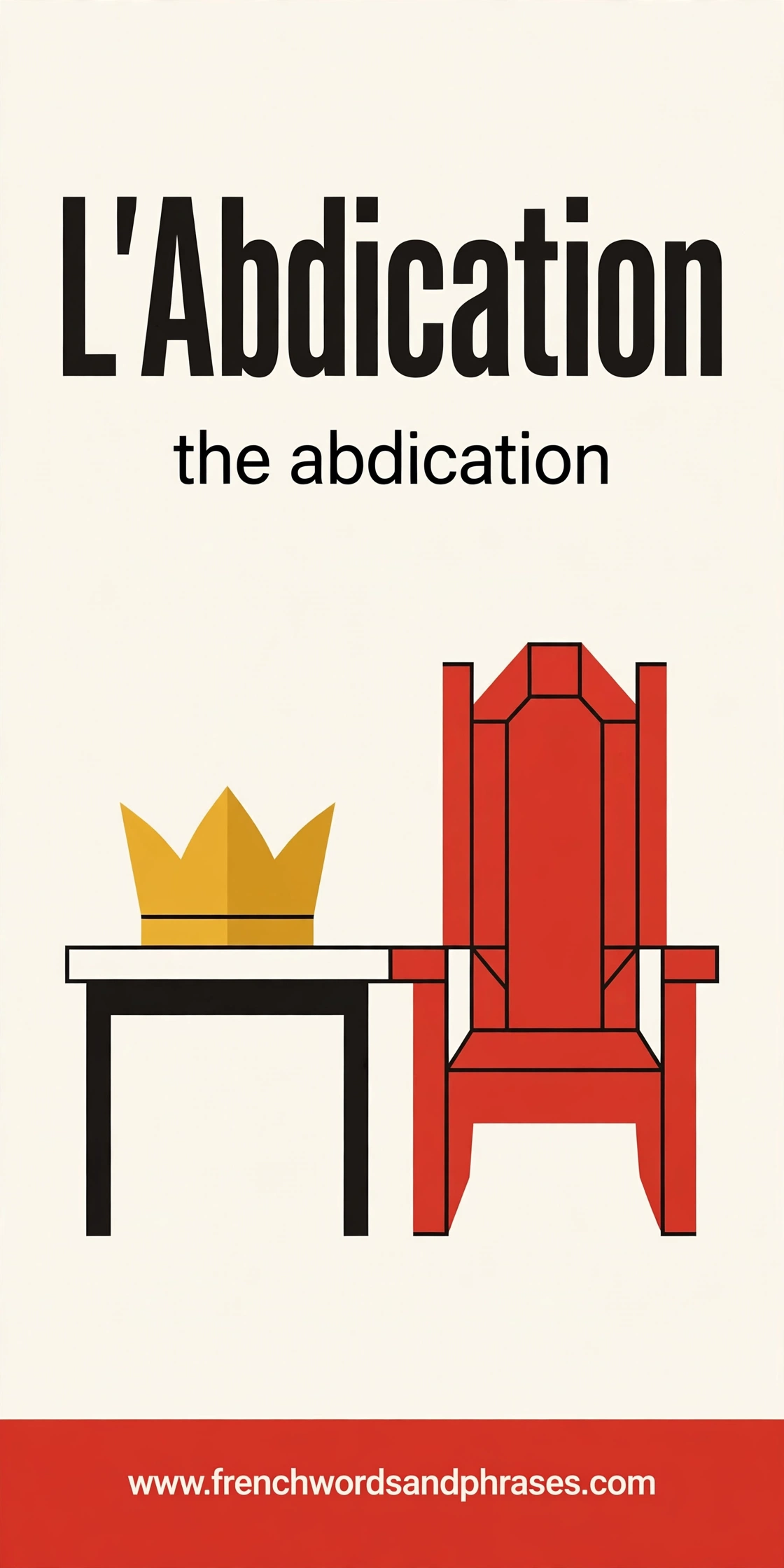
A French Word to Live By
How to Conjugate Abdiquer in French
/ab.di.ke/
Abdiquer means to abdicate — to lay down a throne, a duty or a responsibility, formally and for good, and walk away from the power one held.
A king signing away his crown, a champion giving up the title, a parent who stops even trying to impose bedtime — abdiquer is the verb of the great renunciation: whatever authority, right or duty is surrendered, it is surrendered in writing, in public, and forever.
In this guide, you’ll learn how to conjugate abdiquer in all the major French tenses and moods. Explore complete conjugation tables, French examples, English translations, and practice quizzes.
Understanding the French Verb Abdiquer
Abdiquer is a regular French verb belonging to the first group of verbs, those ending in-er.
It means to abdicate, to renounce. It is commonly used of monarchs and popes laying down their office, of champions surrendering a title, and in everyday moral language for anyone who gives up on a duty: abdiquer ses responsabilités is a reproach, abdiquer devant l’obstacle is to quit at the first fence — while abdiquer le trône remains the stuff of history books.
Verb classification: First group (-er)
Auxiliary verb: Avoir
Past participle: abdiqué
Present participle: abdiquant
English equivalents: To abdicate, to renounce, to give up; abdiquer le trône — to abdicate the throne; abdiquer ses responsabilités — to give up one’s responsibilities; abdiquer devant les difficultés — to give in before difficulties; l’abdication — abdication.
One important detail: abdiquer keeps its qu in every form — j’abdique, nous abdiquons, j’abdiquais, j’abdiquerai — the u is never dropped and never becomes a c, because in French qu is a single sound, /k/, whatever follows it. The verb is a perfectly regular -er in behaviour; only the spelling of its stem, abdiqu-, reminds you of Latin abdicare, to disown by proclamation — which is exactly what an abdication is.
Experience the Word
Abdiquer is the verb of the signed surrender — the crown on the cushion, the pen laid down, the door closed on power with one’s own hand.
Imagine an old king in a cold palace, reading the document his ministers have prepared. His hand does not tremble. He signs, rises, and walks out a private citizen for the first time in sixty years — il a abdiqué, he has abdicated, and the bells that ring that afternoon are already ringing for somebody else.
He has not been defeated or deposed. He has renounced — abdiqué — by his own signature, and the throne stands empty behind him.
How to Conjugate Abdiquer: Complete French Conjugation Guide
Let’s explore every major conjugation of abdiquer, beginning with the indicative mood.
How to Conjugate Abdiquer in the Indicative Mood
The indicative mood is used to express facts, observations, actions, and events.
How to Conjugate Abdiquer in the Present Tense (Présent)
Used for actions happening now, habitual actions, and general truths.
| Subject | Conjugation |
|---|---|
| je | abdique |
| tu | abdiques |
| il / elle | abdique |
| nous | abdiquons |
| vous | abdiquez |
| ils / elles | abdiquent |
Example
Le vieux roi abdique en faveur de son fils.
The old king is abdicating in favour of his son.
Quick Quiz 1
Complete the sentence:
Nous refusons d’______ nos responsabilités.
Reveal the answer
abdiquer
Nous refusons d’abdiquer nos responsabilités.
We refuse to give up our responsibilities.
How to Conjugate Abdiquer in the Passé Composé
Used for completed actions in the past. Abdiquer takes the auxiliary verb avoir.
| Subject | Conjugation |
|---|---|
| j’ | ai abdiqué |
| tu | as abdiqué |
| il / elle | a abdiqué |
| nous | avons abdiqué |
| vous | avez abdiqué |
| ils / elles | ont abdiqué |
Example
Le champion a abdiqué son titre après dix ans de règne.
The champion gave up his title after ten years of reigning.
How to Conjugate Abdiquer in the Imparfait (Imperfect Tense)
Used for habitual past actions, descriptions, and ongoing situations in the past.
| Subject | Conjugation |
|---|---|
| je | abdiquais |
| tu | abdiquais |
| il / elle | abdiquait |
| nous | abdiquions |
| vous | abdiquiez |
| ils / elles | abdiquaient |
Example
Autrefois, les rois abdiquaient rarement de leur vivant.
In the old days, kings rarely abdicated during their lifetime.
Quick Quiz 2
Choose the correct form:
The champion gave up his title.
Le champion ______ son titre. (a abdiqué / est abdiqué)
Reveal the answer
a abdiqué
Le champion a abdiqué son titre.
Abdiquer takes avoir.
How to Conjugate Abdiquer in the Plus-que-parfait
Used to describe an action that had already been completed before another past event.
| Subject | Conjugation |
|---|---|
| j’ | avais abdiqué |
| tu | avais abdiqué |
| il / elle | avait abdiqué |
| nous | avions abdiqué |
| vous | aviez abdiqué |
| ils / elles | avaient abdiqué |
Example
Elle avait abdiqué toute responsabilité dans cette affaire.
She had renounced all responsibility in this matter.
How to Conjugate Abdiquer in the Passé Simple
Primarily used in formal writing, literature, and historical narratives. It is rarely used in everyday conversation.
| Subject | Conjugation |
|---|---|
| je | abdiquai |
| tu | abdiquas |
| il / elle | abdiqua |
| nous | abdiquâmes |
| vous | abdiquâtes |
| ils / elles | abdiquèrent |
Example
En 1936, Édouard VIII abdiqua pour épouser la femme qu’il aimait.
In 1936, Edward VIII abdicated to marry the woman he loved.
How to Conjugate Abdiquer in the Passé Antérieur
A literary tense used to express an action completed immediately before another past action, generally in the passé simple.
| Subject | Conjugation |
|---|---|
| j’ | eus abdiqué |
| tu | eus abdiqué |
| il / elle | eut abdiqué |
| nous | eûmes abdiqué |
| vous | eûtes abdiqué |
| ils / elles | eurent abdiqué |
Example
Quand le roi eut abdiqué, le prince monta sur le trône.
When the king had abdicated, the prince ascended the throne.
How to Conjugate Abdiquer in the Future Tense (Futur Simple)
Used to describe actions that will take place in the future.
| Subject | Conjugation |
|---|---|
| je | abdiquerai |
| tu | abdiqueras |
| il / elle | abdiquera |
| nous | abdiquerons |
| vous | abdiquerez |
| ils / elles | abdiqueront |
Example
Il n’abdiquera jamais devant la difficulté.
He will never give in before difficulty.
How to Conjugate Abdiquer in the Futur Antérieur (Future Perfect)
Used for an action that will have been completed before a particular point in the future.
| Subject | Conjugation |
|---|---|
| j’ | aurai abdiqué |
| tu | auras abdiqué |
| il / elle | aura abdiqué |
| nous | aurons abdiqué |
| vous | aurez abdiqué |
| ils / elles | auront abdiqué |
Example
À la fin de l’année, la reine aura abdiqué depuis six mois.
By the end of the year, the queen will have abdicated six months earlier.
How to Conjugate Abdiquer in the Near Future (Futur Proche)
Used to describe something that is going to happen soon. Formed with aller + infinitive.
| Subject | Conjugation |
|---|---|
| je | vais abdiquer |
| tu | vas abdiquer |
| il / elle | va abdiquer |
| nous | allons abdiquer |
| vous | allez abdiquer |
| ils / elles | vont abdiquer |
Example
On murmure que le directeur va abdiquer ses fonctions.
It is rumoured that the director is going to give up his post.
How to Conjugate Abdiquer in the Conditional Mood
The conditional mood expresses what would happen under certain circumstances. It is also frequently used to make polite requests or express wishes.
How to Conjugate Abdiquer in the Present Conditional
| Subject | Conjugation |
|---|---|
| je | abdiquerais |
| tu | abdiquerais |
| il / elle | abdiquerait |
| nous | abdiquerions |
| vous | abdiqueriez |
| ils / elles | abdiqueraient |
Example
À sa place, j’abdiquerais avant le scandale.
In his place, I would abdicate before the scandal.
How to Conjugate Abdiquer in the Past Conditional
| Subject | Conjugation |
|---|---|
| j’ | aurais abdiqué |
| tu | aurais abdiqué |
| il / elle | aurait abdiqué |
| nous | aurions abdiqué |
| vous | auriez abdiqué |
| ils / elles | auraient abdiqué |
Example
Le ministre aurait abdiqué plus tôt s’il avait pu.
The minister would have stepped down sooner if he could have.
Abdiquer in the Literary Past Conditional Form
This less common literary form uses the imperfect subjunctive of avoir.
| Subject | Conjugation |
|---|---|
| j’ | eusse abdiqué |
| tu | eusses abdiqué |
| il / elle | eût abdiqué |
| nous | eussions abdiqué |
| vous | eussiez abdiqué |
| ils / elles | eussent abdiqué |
Example
Le roi eût abdiqué sans l’intervention de ses conseillers.
The king would have abdicated without his advisers’ intervention.
How to Conjugate Abdiquer in the Subjunctive Mood
The subjunctive is used to express wishes, emotions, doubts, necessity, and uncertainty. It frequently follows expressions such as il faut que (it is necessary that) or bien que (although).
How to Conjugate Abdiquer in the Present Subjunctive
| Subject | Conjugation |
|---|---|
| que je | abdique |
| que tu | abdiques |
| qu’il / qu’elle | abdique |
| que nous | abdiquions |
| que vous | abdiquiez |
| qu’ils / qu’elles | abdiquent |
Example
Le peuple exige que le tyran abdique.
The people demand that the tyrant abdicate.
Quick Quiz 3
Complete the sentence using the subjunctive:
Le peuple exige que vous ______ avant le printemps.
Reveal the answer
abdiquiez
Le peuple exige que vous abdiquiez avant le printemps.
The people demand that you abdicate before spring.
How to Conjugate Abdiquer in the Imperfect Subjunctive
A literary tense, rarely encountered in modern spoken French.
| Subject | Conjugation |
|---|---|
| que je | abdiquasse |
| que tu | abdiquasses |
| qu’il / qu’elle | abdiquât |
| que nous | abdiquassions |
| que vous | abdiquassiez |
| qu’ils / qu’elles | abdiquassent |
Example
Personne ne s’attendait à ce qu’il abdiquât si jeune.
Nobody expected him to abdicate so young.
How to Conjugate Abdiquer in the Pluperfect Subjunctive
A literary construction used to express an action completed before another past action.
| Subject | Conjugation |
|---|---|
| que j’ | eusse abdiqué |
| que tu | eusses abdiqué |
| qu’il / qu’elle | eût abdiqué |
| que nous | eussions abdiqué |
| que vous | eussiez abdiqué |
| qu’ils / qu’elles | eussent abdiqué |
Example
On admirait que la reine eût abdiqué avec tant de dignité.
People admired that the queen had abdicated with such dignity.
How to Conjugate Abdiquer in the Past Subjunctive
| Subject | Conjugation |
|---|---|
| que j’ | aie abdiqué |
| tque u | aies abdiqué |
| qu’il / qu’elle | ait abdiqué |
| que nous | ayons abdiqué |
| que vous | ayez abdiqué |
| qu’ils / qu’elles | aient abdiqué |
Example
Il est rare qu’un champion ait abdiqué en pleine gloire.
It is rare for a champion to have given up his title at the height of his glory.
How to Conjugate Abdiquer in the Imperative
The imperative is used to give commands, instructions, invitations, or suggestions. Subject pronouns are omitted.
How to Conjugate Abdiquer in the Present Imperative
| Person | Conjugation |
|---|---|
| (tu) | abdique |
| (nous) | abdiquons |
| (vous) | abdiquez |
Example
Abdiquez, sire, avant qu’il soit trop tard !
Abdicate, sire, before it is too late!
Quick Quiz 4
How would you say Do not give in at the first obstacle (tu form)?
Reveal the answer
N’abdique pas devant le premier obstacle !
French Participles of Abdiquer
Participles are verb forms that can be used in compound tenses and other grammatical constructions.
Present Participle of Abdiquer
abdiquant
En abdiquant, le roi a choisi l’amour contre la couronne.
By abdicating, the king chose love over the crown.
Past Participle of Abdiquer
abdiqué
Abdiquée par son père, la couronne passa au jeune prince.
Renounced by her father, the crown passed to the young prince.
Abdiquer in Everyday French: Real-Life Examples
Now that you know the conjugations, let’s see how abdiquer appears in everyday French.
Example 1 — Present
Le roi abdique en faveur de son fils.
The king is abdicating in favour of his son.
Example 2 — Passé composé
Le champion a abdiqué son titre hier.
The champion gave up his title yesterday.
Example 3 — Imparfait
Les rois abdiquaient rarement de leur vivant.
Kings rarely abdicated during their lifetime.
Example 4 — Future
Il n’abdiquera jamais devant la difficulté.
He will never give in before difficulty.
Example 5 — Conditional
À sa place, j’abdiquerais avant le scandale.
In his place, I would abdicate before the scandal.
Example 6 — Imperative
N’abdique pas devant le premier obstacle !
Do not give in at the first obstacle!
Beyond Translation: The Meaning of Abdiquer
English abdicate is the same Latin word, abdicare — to disown by formal proclamation — and both languages keep its ceremonial weight: one abdicates a throne, a title, a responsibility, never a sandwich.
Abdiquer is surrender with paperwork.
That is why French uses it as a reproach in ordinary life — tu as abdiqué said to a parent who has stopped parenting is not about crowns at all: it is about a duty formally, shamefully, laid down.
How to Remember the French Verb Abdiquer
Remember it this way: Abdiquer is about the king’s signature — the crown laid down by his own hand.
- Qu never changes: j’abdique, nous abdiquons, j’abdiquerai — qu is one sound, /k/, in every form.
- A formal, final surrender: abdiquer le trône, abdiquer ses responsabilités, abdiquer devant l’obstacle.
- Regular -er: j’abdique, nous abdiquons, past participle abdiqué, noun l’abdication.
The key idea is the king’s signature — the crown laid down by his own hand.
Test Your Knowledge of Abdiquer
Let’s see how much you’ve learned. Try answering these questions before revealing the answers.
Question 1
What happens to the qu of abdiquer in nous abdiquons and j’abdiquerai?
Reveal the answer
Nothing — qu stays in every form: abdique, abdiquons, abdiquerai; it is a single sound, /k/.
Question 2
How do you say In 1936, Edward VIII abdicated to marry the woman he loved in French?
Reveal the answer
En 1936, Édouard VIII abdiqua pour épouser la femme qu’il aimait.
Question 3
Translate: The people demand that the tyrant abdicate.
Reveal the answer
Le peuple exige que le tyran abdique.
Question 4
What is the past participle of abdiquer?
Reveal the answer
Abdiqué.
Question 5
Complete the sentence:
Il n’______ jamais devant la difficulté.
Reveal the answer
abdiquera
Il n’abdiquera jamais devant la difficulté.
He will never give in before difficulty.
Your Final Challenge
Can You Use It?
How would you say this in French?
The king abdicates the crown, but he never abdicates his dignity.
Reveal the answer
Le roi abdique la couronne, mais il n’abdique jamais sa dignité.
The king abdicates the crown, but he never abdicates his dignity.
A little French. A little curiosity. A richer everyday life.
LEARN FRENCH ONE WORD AT A TIME