A French Word to Live By
Translate Collège to English
/kɔ.lɛʒ/
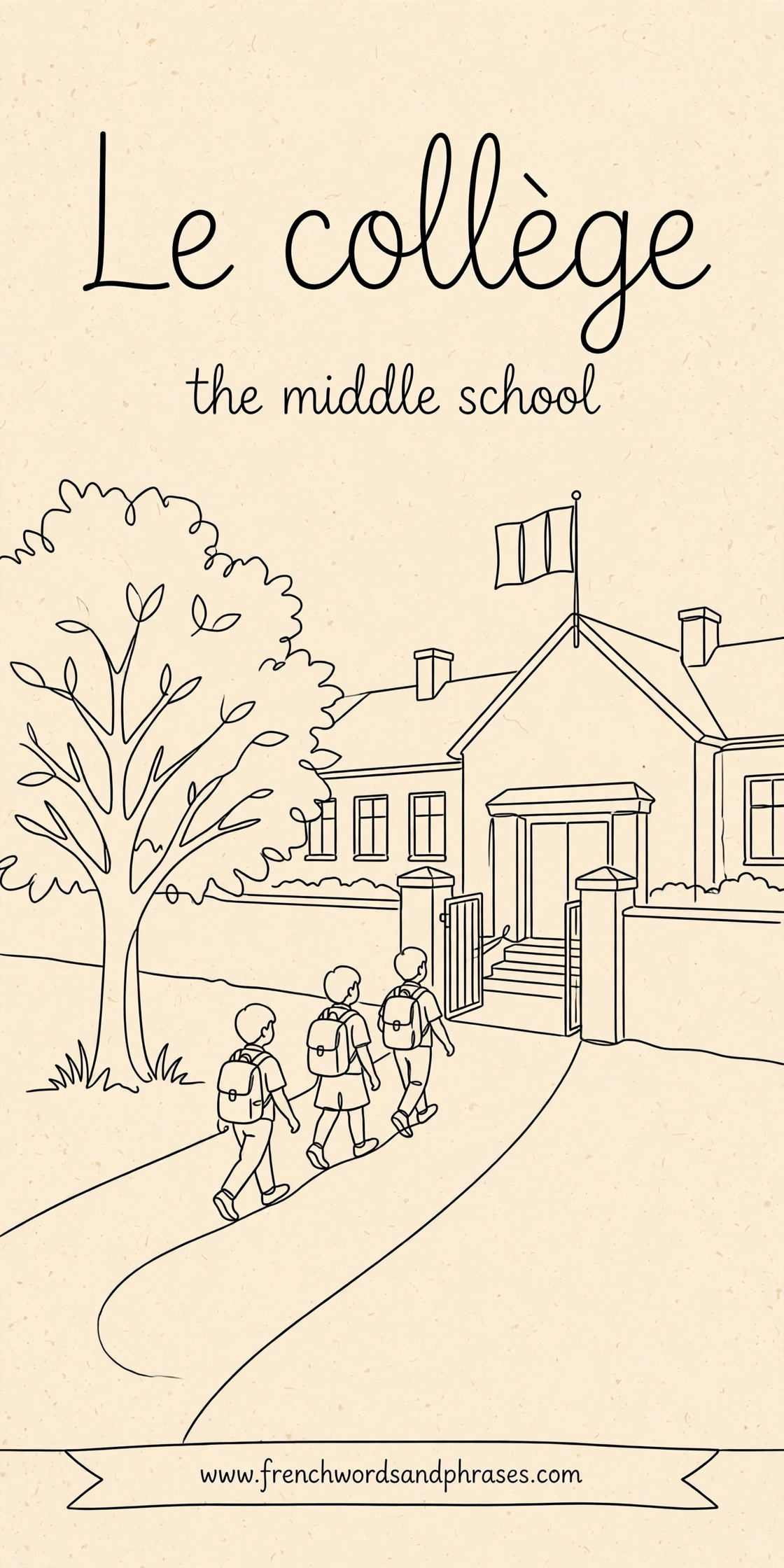
Le collège means the middle school.
Half past eight, the courtyard fills with eleven-year-olds carrying enormous satchels. A bell rings, lines form, and the day begins — bienvenue au collège.
In this guide, you’ll learn what collège means in English, how to use it with its articles, how to form its plural, and how it appears in everyday French. Explore French examples, English translations, and practice quizzes.
Understanding the French Noun Collège
Collège is a masculine French noun, learned with its article: le collège, un collège. It is a famous false friend: it looks like the English « college », but it names a school for much younger pupils.
It means the middle school — in France, the school children attend from about eleven to fifteen, between l’école primaire and le lycée. The four classes are la sixième, la cinquième, la quatrième and la troisième, and at the end pupils pass their first national exam, le brevet. University, in French, is l’université — never le collège.
Gender: Masculine
Definite article: le — le collège (the middle school)
Indefinite article: un — un collège (a middle school)
Plural: les collèges
The trap: Collège = middle school (ages 11–15). University is l’université
English equivalents: The middle school; the junior high school.
One important usage detail: when a French teenager says « je suis au collège », they are eleven to fifteen years old — do not picture a university campus. The school ladder runs: école primaire (primary), collège (middle school), lycée (high school), then université. And the pupils of a collège are called les collégiens and les collégiennes.
Experience the Word
Collège is more than a school. It is the great crossing of French childhood: the first timetable with a different teacher for every subject, the first bus ride alone, the first real exam at the end of troisième.
Imagine the rentrée: a new satchel, a courtyard full of strangers who will become your best friends, and your name called out in front of everyone — « sixième B, par ici ! »
You have not just changed schools. You have become a collégien — un pas de géant, a giant step.
How to Use Collège in French: Complete Guide
Let’s explore how collège works in French, beginning with its articles — and keep the université for much later.
Collège with the Definite Article (Le, Les)
Used for the middle school everyone in the conversation knows — the one your child attends.
| Form | French |
|---|---|
| Singular | le collège |
| Plural | les collèges |
Example
Le collège de ma fille est à dix minutes à pied.
My daughter’s middle school is ten minutes away on foot.
Collège with the Indefinite Article (Un, Des)
Used for a middle school in general — un collège, any middle school at all.
| Form | French |
|---|---|
| Singular | un collège |
| Plural | des collèges |
Example
Un nouveau collège ouvre dans le quartier en septembre.
A new middle school is opening in the neighbourhood in September.
At the Collège: Words of School Life
Classes, bells and the brevet — the vocabulary that surrounds the collège.
| French | In English |
|---|---|
| la sixième | the first year of middle school |
| la troisième | the last year of middle school |
| le brevet | the middle-school diploma exam |
| le collégien | the middle-school pupil (a boy) |
| la collégienne | the middle-school pupil (a girl) |
| la cantine | the school canteen |
Example
Les collégiens passent le brevet à la fin de la troisième.
Middle-school pupils take the brevet at the end of the final year.
Quick Quiz 1
Complete the sentence:
Mon fils a douze ans, il est au ______.
Reveal the answer
collège
Mon fils a douze ans, il est au collège.
My son is twelve, he is at middle school — at twelve, a French child is a collégien, not a student.
The Plural of Collège
Collège adds an -s in the plural — les collèges, the middle schools of a town or a region.
| Number | French |
|---|---|
| Singular | le collège |
| Plural | les collèges |
Example
Les collèges du département reçoivent de nouveaux ordinateurs.
The middle schools of the department are receiving new computers.
Collège with Possessive Adjectives (Mon, Ton, Son…)
Possessives agree with the noun: collège is masculine, so it takes mon, ton, son in the singular.
| Owner | French |
|---|---|
| my | mon collège |
| your (tu) | ton collège |
| his / her | son collège |
| our | notre collège |
| your (vous) | votre collège |
| their | leur collège |
Example
Son collège organise un voyage en Angleterre cette année.
His middle school is organising a trip to England this year.
Quick Quiz 2
Complete the sentence:
______ collège est juste à côté du parc. (Our)
Reveal the answer
Notre
Notre collège est juste à côté du parc.
Our middle school is right next to the park.
Collège with Demonstrative Adjectives (Ce, Ces)
Used to point: ce collège, this middle school — this one here.
| Form | French |
|---|---|
| Singular | ce collège |
| Plural | ces collèges |
Example
Ce collège a une excellente équipe de sport.
This middle school has an excellent sports team.
Collège with Adjectives
Adjectives agree with collège: masculine forms, grand stays grand, nouvelle would need a feminine noun.
| Adjective | With Collège |
|---|---|
| grand (big) | un grand collège |
| nouveau (new) | un nouveau collège |
| public (state) | un collège public |
| privé (private) | un collège privé |
| petit (small) | un petit collège |
Example
C’est un collège public de huit cents élèves.
It is a state middle school with eight hundred pupils.
Quick Quiz 3
Complete the sentence:
Elle entre dans un ______ collège en septembre. (new)
Reveal the answer
nouveau
Elle entre dans un nouveau collège en septembre.
She is starting at a new middle school in September — nouveau, masculine, before the noun.
Everyday Expressions with Collège
School runs and first exams — the collège phrases of daily life.
| Expression | In English |
|---|---|
| être au collège | to be at middle school |
| entrer au collège | to start middle school |
| la rentrée au collège | the start of the middle-school year |
| un élève de collège | a middle-school pupil |
| le collège de secteur | the catchment-area middle school |
| passer le brevet | to take the brevet exam |
Example
Cette année, elle passe le brevet à la fin du collège.
This year, she is taking the brevet at the end of middle school.
Words from the Same Family as Collège
Schools and schooling — the words that travel with collège.
| French | In English |
|---|---|
| l’école primaire | primary school |
| le lycée | high school, sixth-form college |
| l’université | the university |
| le collégien | the middle-school pupil |
| l’élève | the pupil |
| étudier | to study |
Example
Après le collège, les élèves continuent au lycée.
After middle school, pupils move on to high school.
Quick Quiz 4
What comes AFTER le collège in France?
Reveal the answer
Le lycée — high school, from about fifteen to eighteen, ending with the baccalauréat.
Après le collège, je vais au lycée.
After middle school, I’m going to high school.
Collège in Everyday French: Real-Life Examples
Now that you know the word, let’s see how collège appears in everyday French.
Example 1 — The school run
Les enfants partent au collège à huit heures moins le quart.
The children leave for middle school at quarter to eight.
Example 2 — A new start
Ma fille entre au collège cette année, elle est un peu nerveuse.
My daughter is starting middle school this year; she is a little nervous.
Example 3 — The exam year
En troisième, les élèves du collège passent le brevet.
In the final year, middle-school pupils take the brevet.
Example 4 — Talking about work
Il enseigne les mathématiques dans un collège de Lyon.
He teaches mathematics at a middle school in Lyon.
Example 5 — Catchment areas
Ce collège accueille les enfants de trois villages.
This middle school takes the children of three villages.
Example 6 — The trap avoided
Non, pas l’université — mon fils a treize ans, il est au collège.
No, not university — my son is thirteen, he is at middle school.
Beyond Translation: The Meaning of Collège
The collège is where France becomes France for its children: the same four years, the same classes — sixième, cinquième, quatrième, troisième — the same brevet at the end, from Lille to Marseille. The republic built the collège unique, one single middle school for everyone, so that the baker’s daughter and the doctor’s son would sit in the same classroom.
To say collège is to name the school where a whole generation grows up together.
It evokes the ringing bell and the enormous satchel, the cantine trays and the first love letters — and a false friend that shrinks a university down to a schoolyard.
How to Remember the French Noun Collège
Remember it this way: Collège is the middle school for eleven- to fifteen-year-olds — university is l’université, a completely different word.
- You are twelve — le collège, de la sixième à la troisième.
- You are sixteen — le lycée, jusqu’au baccalauréat.
- You are twenty — l’université, jamais le collège.
The key idea is collège = middle school, université = university.
Test Your Knowledge of Collège
Let’s see how much you’ve learned. Try answering these questions before revealing the answers.
Question 1
What does le collège mean in English?
Reveal the answer
The middle school — the school for ages eleven to fifteen, not a university college.
Question 2
How do you say « the university » in French?
Reveal the answer
L’université — after le lycée, never le collège.
Question 3
Translate: My daughter is at middle school.
Reveal the answer
Ma fille est au collège.
Question 4
What is le brevet?
Reveal the answer
The national exam taken at the end of collège, in troisième, at about fifteen.
Question 5
Complete the sentence:
Les élèves entrent au ______ à onze ans.
Reveal the answer
collège
Les élèves entrent au collège à onze ans.
Pupils start middle school at eleven.
Your Final Challenge
Can You Use It?
How would you say this in French?
“The middle school opens its doors at eight o’clock.”
Reveal the answer
Le collège ouvre ses portes à huit heures.
The middle school opens its doors at eight o’clock.
A little French. A little curiosity. A richer everyday life.
LEARN FRENCH ONE WORD AT A TIME