A French Word to Live By
Translate Fillette to English
/fi.jɛt/
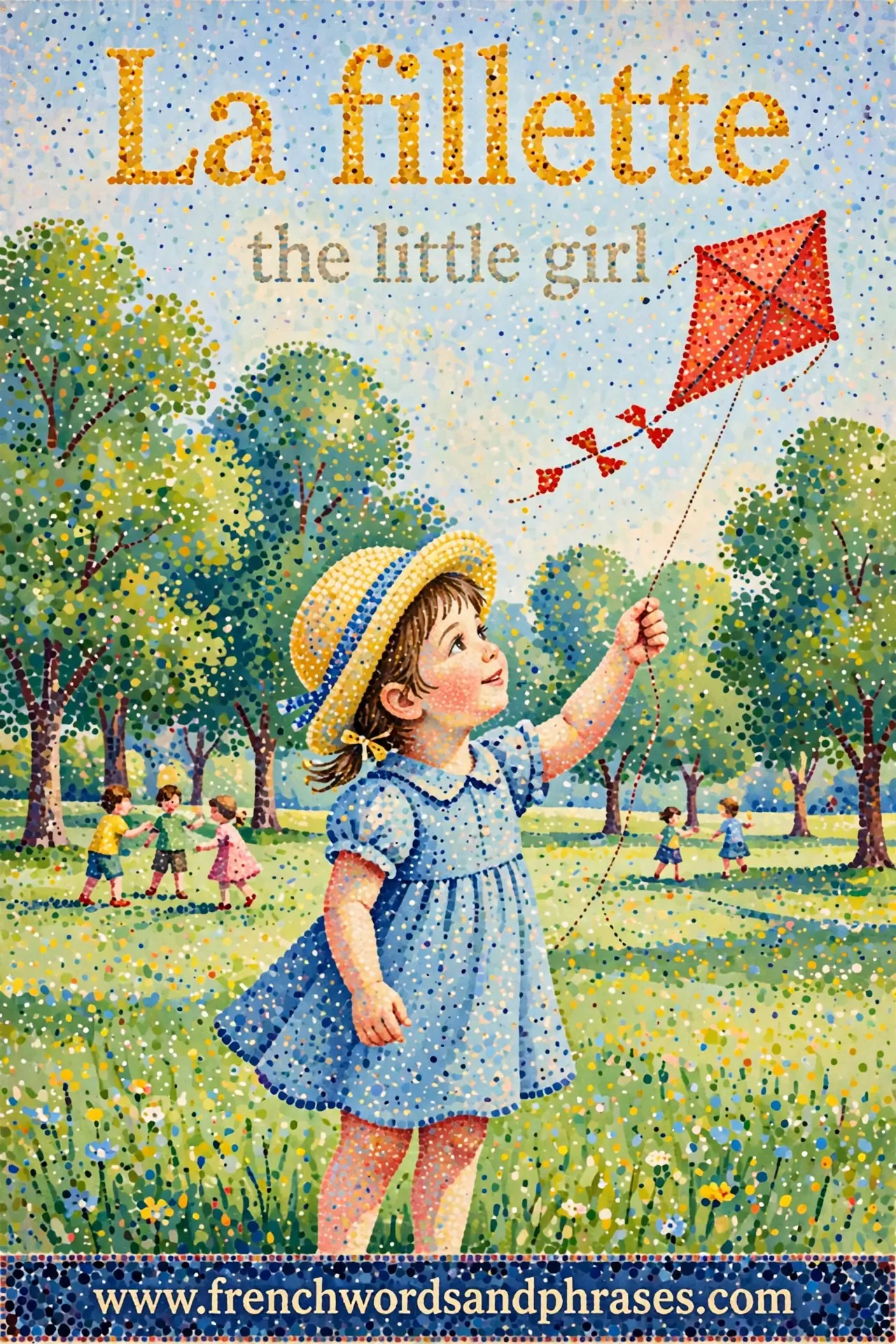
La fillette means the little girl.
A skipping rope turns on the pavement, two plaits bounce, and a small voice counts to a hundred without missing a beat: la fillette.
In this guide, you’ll learn what fillette means in English, how to use it with its articles, how to form its plural, and how it appears in everyday French. Explore French examples, English translations, and practice quizzes.
Understanding the French Noun Fillette
Fillette is a feminine French noun, learned with its article: la fillette, une fillette. It is la fille (the girl) dressed in the diminutive ending -ette: a fillette is not just a girl but a little girl, said with affection.
It means the little girl — a young girl, roughly between toddler and early teens, seen through fond adult eyes. Where la fille is the plain, factual word, la fillette adds smallness and tenderness: it is the word of stories, grandparents and newspaper reports about a child.
Gender: Feminine
Definite article: la — la fillette (the little girl)
Indefinite article: une — une fillette (a little girl)
Plural: les fillettes
Built from: fille + the diminutive ending -ette: a little girl, said with affection
English equivalents: The little girl.
One important usage detail: fillette is affectionate and slightly old-fashioned — perfect in stories and descriptions, but a real ten-year-old may prefer to be called simply une fille. For a boy, there is no matching -ette word: a little boy is un petit garçon.
Experience the Word
Fillette is more than a child. She is the heroine of a thousand French stories — red coat in the woods, basket in hand, braver than she looks.
Imagine the village square: a fillette in a blue dress chasing pigeons, ice cream on her chin, laughing at absolutely nothing, the way only the very young can.
You have not just seen a child. You have seen childhood itself — la fillette, small and unstoppable.
How to Use Fillette in French: Complete Guide
Let’s explore how fillette works in French, beginning with its articles — la fillette, une fillette.
Fillette with the Definite Article (La, Les)
Used for the little girl everyone in the conversation knows — the one at the gate.
| Form | French |
|---|---|
| Feminine singular | la fillette |
| Plural | les fillettes |
Example
La fillette aux nattes joue dans la cour de l’école.
The little girl with the plaits is playing in the schoolyard.
Fillette with the Indefinite Article (Une, Des)
Used for a little girl in general — the opening words of many a story.
| Form | French |
|---|---|
| Feminine singular | une fillette |
| Plural | des fillettes |
Example
Une fillette de six ans traverse le parc avec son chien.
A six-year-old little girl crosses the park with her dog.
Childhood: Words around the Fillette
Plaits, skipping ropes and schoolyards — the vocabulary of the fillette.
| French | In English |
|---|---|
| les nattes | the plaits, the braids |
| la corde à sauter | the skipping rope |
| la poupée | the doll |
| la cour | the playground, the yard |
| le cartable | the schoolbag |
| jouer | to play |
Example
La fillette range sa poupée dans son cartable.
The little girl puts her doll away in her schoolbag.
Quick Quiz 1
What does the ending -ette add to fille to make fillette?
Reveal the answer
Smallness and affection — a fillette is a little girl, seen fondly.
La fillette est une petite fille.
The fillette is a little girl.
The Plural of Fillette
Fillette adds an -s in the plural — les fillettes, a whole class of them.
| Number | French |
|---|---|
| Singular | la fillette |
| Plural | les fillettes |
Example
Les fillettes chantent une chanson à la fête de l’école.
The little girls sing a song at the school fair.
Fillette with Possessive Adjectives (Ma, Ta, Sa…)
Possessives agree with the noun: fillette is feminine, so it takes ma, ta, sa.
| Owner | French |
|---|---|
| my | ma fillette |
| your (tu) | ta fillette |
| his / her | sa fillette |
| our | notre fillette |
| your (vous) | votre fillette |
| their | leur fillette |
Example
Ma fillette adore les histoires avant de dormir.
My little girl loves stories before bed.
Quick Quiz 2
Complete the sentence:
______ fillette a perdu sa poupée au parc. (Their)
Reveal the answer
Leur
Leur fillette a perdu sa poupée au parc.
Their little girl lost her doll in the park.
Fillette with Demonstrative Adjectives (Cette, Ces)
Used to point: cette fillette, the one waving from the window.
| Form | French |
|---|---|
| Feminine singular | cette fillette |
| Plural | ces fillettes |
Example
Cette fillette dessine mieux que tous ses camarades.
This little girl draws better than all her classmates.
Fillette with Adjectives
Adjectives agree with the feminine noun: petit becomes petite, sage stays sage.
| Adjective | With Fillette |
|---|---|
| petit (little) | une fillette petite |
| sage (well-behaved) | une fillette sage |
| joyeux (cheerful) | une fillette joyeuse |
| curieux (curious) | une fillette curieuse |
| gentil (kind) | une fillette gentille |
Example
C’est une fillette curieuse qui pose mille questions.
She is a curious little girl who asks a thousand questions.
Quick Quiz 3
Complete the sentence:
Une fillette très ______ écoute l’histoire sans bouger. (well-behaved)
Reveal the answer
sage
Une fillette très sage écoute l’histoire sans bouger.
A very well-behaved little girl listens to the story without moving — sage is the same for girls and boys.
Everyday Expressions with Fillette
Stories, school and play — the fillette phrases of daily life.
| Expression | In English |
|---|---|
| une petite fillette | a little girl (doubly small, doubly fond) |
| la fillette aux nattes | the little girl with the plaits |
| une fillette de six ans | a six-year-old girl |
| jouer comme une fillette | to play like a little girl |
| raconter une histoire à une fillette | to tell a little girl a story |
| la fillette du voisin | the neighbour’s little girl |
Example
Chaque soir, il raconte une histoire à sa fillette.
Every evening, he tells his little girl a story.
Words from the Same Family as Fillette
Girls, boys and children — the words that travel with fillette.
| French | In English |
|---|---|
| la fille | the girl; the daughter |
| le garçon | the boy |
| le petit garçon | the little boy |
| l’enfant | the child |
| la fillette des bois | the little girl of the woods (story language) |
| grandir | to grow up |
Example
La fille grandit vite: hier une fillette, aujourd’hui une jeune fille.
The girl grows up fast: yesterday a little girl, today a young lady.
Quick Quiz 4
How do you say a little boy in French?
Reveal the answer
Un petit garçon — there is no -ette word for boys; petit does the work.
Le petit garçon joue avec la fillette.
The little boy is playing with the little girl.
Fillette in Everyday French: Real-Life Examples
Now that you know the word, let’s see how fillette appears in everyday French.
Example 1 — In the park
Une fillette fait de la corde à sauter près du banc.
A little girl is skipping near the bench.
Example 2 — A description
La fillette aux cheveux bouclés habite au bout de la rue.
The little girl with the curly hair lives at the end of the street.
Example 3 — Bedtime
La fillette écoute son histoire puis s’endort aussitôt.
The little girl listens to her story, then falls asleep at once.
Example 4 — At school
Les fillettes de la classe préparent une danse.
The little girls in the class are preparing a dance.
Example 5 — A question
Cette fillette pose des questions sur tout.
This little girl asks questions about everything.
Example 6 — Growing up
Notre fillette grandit trop vite, disent les grands-parents.
Our little girl is growing up too fast, say the grandparents.
Beyond Translation: The Meaning of Fillette
Fillette is the word of French storytelling: open a children’s book and the heroine is une fillette — the little girl with the red hood walking to her grandmother’s, the fillette who talks to wolves and owls. The diminutive -ette is French’s built-in tenderness, and fillette carries it perfectly: adults use it when their hearts are in their voices. Journalists use it too, for the child at the centre of a story, because it makes every reader protective at once.
To say fillette is to shrink the word fille until it fits in a story.
It evokes plaits and skipping ropes, a hand held crossing the road, and a small voice asking why, why, why.
How to Remember the French Noun Fillette
Remember it this way: Fillette is the little girl — la fille plus the tender little ending -ette: la fillette.
- You see the child — la fillette, petite, aux nattes.
- You feel the ending — -ette rend le mot plus petit et plus doux.
- You match the pair — la fillette et le petit garçon.
The key idea is la fillette — fille in miniature, with affection.
Test Your Knowledge of Fillette
Let’s see how much you’ve learned. Try answering these questions before revealing the answers.
Question 1
Is fillette masculine or feminine?
Reveal the answer
Feminine — la fillette, une fillette.
Question 2
What is the plain word for a girl, without the diminutive?
Reveal the answer
La fille — fillette is its little, affectionate form.
Question 3
Translate: The little girl is playing in the garden.
Reveal the answer
La fillette joue dans le jardin.
Question 4
How do you say a little boy?
Reveal the answer
Un petit garçon — boys have no -ette form.
Question 5
Complete the sentence:
______ fillette dessine un château sur son cahier.
Reveal the answer
La
La fillette dessine un château sur son cahier.
The little girl is drawing a castle in her exercise book.
Your Final Challenge
Can You Use It?
How would you say this in French?
“The little girl tells a story to her doll.”
Reveal the answer
La fillette raconte une histoire à sa poupée.
The little girl tells a story to her doll.
A little French. A little curiosity. A richer everyday life.
LEARN FRENCH ONE WORD AT A TIME