A French Word to Live By
Translate Thé to English
/te/
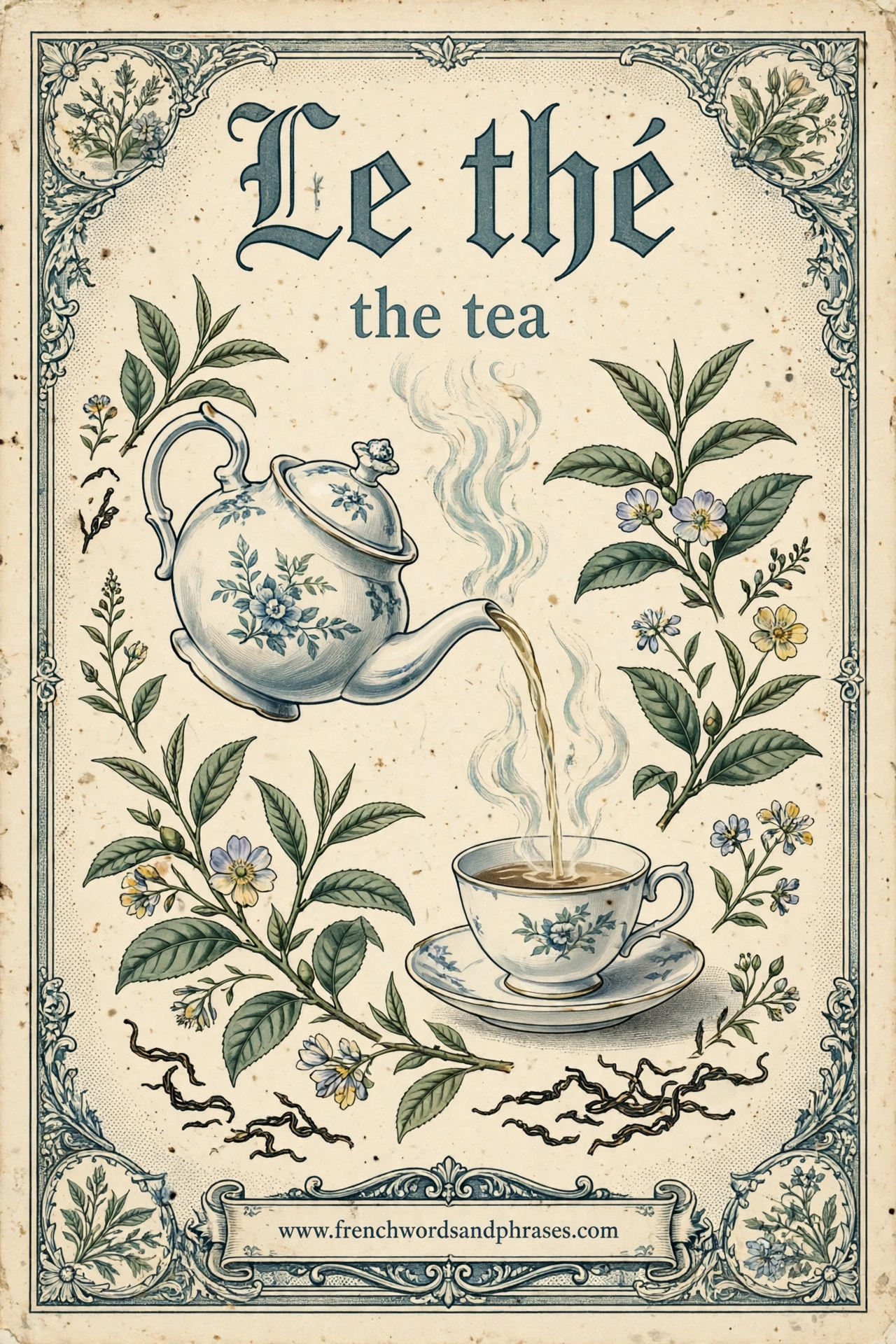
Le thé means the tea.
The kettle hums, the leaves swirl in the glass teapot and turn the water amber, and the whole kitchen slows down for five quiet minutes. It is time for le thé.
In this guide, you’ll learn what thé means in English, how to use it with its articles, how to form its plural, and how it appears in everyday French. Explore French examples, English translations, and practice quizzes.
Understanding the French Noun Thé
Thé is a masculine French noun. It is learned together with its article: le thé, un thé. Like lait, it is a mass noun, so for a serving you will often hear the partitive or a measure: du thé, une tasse de thé.
It means the tea — the drink made by pouring hot water over leaves in la théière (the teapot). France drinks le thé vert (green tea), le thé noir (black tea) and the beloved thé à la menthe (mint tea), served sweet in small glasses in North African tradition.
Gender: Masculine
Definite article: le — le thé (the tea)
Indefinite article: un — un thé (a tea)
Plural: les thés — used for types of tea
Partitive: du thé — some tea
English equivalents: The tea; tea.
One friendly detail: French borrowed the English phrase and bent it — ce n’est pas ma tasse de thé, it’s not my cup of tea, is understood everywhere, even if purists prefer ce n’est pas mon truc. And note that le thé is also the afternoon moment itself: prendre le thé, to have tea.
Experience the Word
Thé is more than a hot drink. It is a pause with a handle — the five minutes when the kettle, the cup and the quiet all arrive together.
Imagine a Parisian salon de thé: little cakes under glass domes, a silver teapot, and conversations that unhurriedly last the whole afternoon.
You have not just drunk tea. You have taken a pause — le thé, the French way of stopping time.
How to Use Thé in French: Complete Guide
Let’s explore how thé works in French, beginning with its articles — and the many colours tea can be.
Thé with the Definite Article (Le, Les)
Used for the tea in front of you — and for tea in general, as in « le thé est prêt ».
| Form | French |
|---|---|
| Singular | le thé |
| Plural | les thés (types of tea) |
Example
Le thé est prêt, viens t’asseoir.
The tea is ready, come and sit down.
Thé with the Partitive and Indefinite Articles (Du, Un)
Du thé for some tea; un thé when you order one in a café.
| Form | French |
|---|---|
| Partitive | du thé |
| Indefinite singular | un thé |
| Plural | des thés |
Example
Je prendrai un thé au citron, s’il vous plaît.
I’ll have a lemon tea, please.
Choosing Your Thé: Kinds of Tea
Green, black or mint — the tea vocabulary of the menu.
| French | In English |
|---|---|
| le thé vert | green tea |
| le thé noir | black tea |
| le thé à la menthe | mint tea |
| le thé glacé | iced tea |
| le thé au citron | lemon tea |
| le thé aux fruits rouges | red berry tea |
Example
Leur thé à la menthe est célèbre dans tout le quartier.
Their mint tea is famous throughout the neighbourhood.
Quick Quiz 1
Complete the sentence:
Le soir, elle boit ______ avant de lire. (some tea)
Reveal the answer
du thé
Le soir, elle boit du thé avant de lire.
In the evening, she drinks tea before reading — du thé, the partitive.
The Plural of Thé
Thé adds an -s for types and varieties: les thés du monde.
| Number | French |
|---|---|
| Singular | le thé |
| Plural | les thés |
Example
Cette boutique vend des thés du monde entier.
This shop sells teas from all over the world.
Thé with Possessive Adjectives (Mon, Ton, Son…)
Possessives agree with the noun: thé is masculine, so it takes mon, ton, son.
| Owner | French |
|---|---|
| my | mon thé |
| your (tu) | ton thé |
| his / her | son thé |
| our | notre thé |
| your (vous) | votre thé |
| their | leur thé |
Example
Mon thé préféré est le thé vert au jasmin.
My favourite tea is green tea with jasmine.
Quick Quiz 2
Complete the sentence:
______ thé est trop chaud, attends une minute. (Your — to a friend)
Reveal the answer
Ton
Ton thé est trop chaud, attends une minute.
Your tea is too hot, wait a minute.
Thé with Demonstrative Adjectives (Ce, Ces)
Used to point: ce thé, this tea here.
| Form | French |
|---|---|
| Singular | ce thé |
| Plural | ces thés |
Example
Ce thé à la menthe me rappelle le Maroc.
This mint tea reminds me of Morocco.
Thé with Adjectives
Adjectives agree with thé, masculine: chaud, fort, léger.
| Adjective | With Thé |
|---|---|
| chaud (hot) | un thé chaud |
| fort (strong) | un thé fort |
| léger (light, weak) | un thé léger |
| sucré (sweetened) | un thé sucré |
| glacé (iced) | un thé glacé |
Example
Après la marche, un thé chaud fait du bien.
After the walk, a hot tea does you good.
Quick Quiz 3
Complete the sentence:
En été, je préfère le thé ______. (iced)
Reveal the answer
glacé
En été, je préfère le thé glacé.
In summer, I prefer iced tea.
Everyday Expressions with Thé
Teapots, tea rooms and teatime — the thé phrases of daily life.
| Expression | In English |
|---|---|
| une tasse de thé | a cup of tea |
| prendre le thé | to have tea, to take tea |
| un salon de thé | a tea room |
| l’heure du thé | teatime |
| un thé dansant | a tea dance |
| ce n’est pas ma tasse de thé | it’s not my cup of tea |
Example
On prend le thé chez grand-mère à quatre heures.
We have tea at grandmother’s at four o’clock.
Words from the Same Family as Thé
Teapots, spoons and infusions — the words that travel with thé.
| French | In English |
|---|---|
| la théière | the teapot |
| le sachet de thé | the tea bag |
| la cuillère à thé | the teaspoon |
| infuser | to brew, to infuse |
| la tisane | herbal tea |
| le théier | the tea plant |
Example
Laisse infuser le thé trois minutes dans la théière.
Let the tea brew for three minutes in the teapot.
Quick Quiz 4
What is un salon de thé?
Reveal the answer
A tea room — a quiet café specialising in teas and cakes.
Ce salon de thé sert des thés du monde entier.
This tea room serves teas from all over the world.
Thé in Everyday French: Real-Life Examples
Now that you know the word, let’s see how thé appears in everyday French.
Example 1 — Ordering
Un thé vert et un café, s’il vous plaît.
A green tea and a coffee, please.
Example 2 — At home
Je mets l’eau à chauffer pour le thé.
I’m putting the water on to heat for the tea.
Example 3 — Mint tea
Le thé à la menthe se verse de haut, comme au Maroc.
Mint tea is poured from a height, as in Morocco.
Example 4 — A preference
Elle préfère le thé sans sucre.
She prefers tea without sugar.
Example 5 — Teatime
À cinq heures, on prend le thé en famille.
At five o’clock, we have tea as a family.
Example 6 — Too strong
Ce thé est trop fort pour moi.
This tea is too strong for me.
Beyond Translation: The Meaning of Thé
Tea reached France in the 1600s and never quite beat coffee at home — but it carved out its own refined world: the salon de thé, the great Parisian tea houses, the mint tea poured from high above the glass to make it foam. Thé even hides in the language of measure: a cuillère à thé, a teaspoon, sits in every French kitchen drawer.
To say thé is to call a pause into the middle of the day.
Steam, leaves and five quiet minutes — France may run on coffee, but it rests on thé.
How to Remember the French Noun Thé
Remember it this way: Thé is the tea — masculine, poured as du thé, and ordered in a café as un thé.
- You order one — un thé, s’il vous plaît.
- You pour some — du thé pour tout le monde.
- You pick a colour — thé vert, thé noir, thé à la menthe.
The key idea is le thé, du thé, un thé — one word for leaf, drink and pause.
Test Your Knowledge of Thé
Let’s see how much you’ve learned. Try answering these questions before revealing the answers.
Question 1
How do you say a tea when ordering in French?
Reveal the answer
Un thé — un thé vert, un thé au citron.
Question 2
Is thé masculine or feminine?
Reveal the answer
Masculine — le thé, du thé.
Question 3
Translate: She drinks mint tea.
Reveal the answer
Elle boit du thé à la menthe.
Question 4
What is la théière?
Reveal the answer
The teapot — where the thé infuses before serving.
Question 5
Complete the sentence:
Je voudrais ______ à la menthe, s’il vous plaît.
Reveal the answer
un thé
Je voudrais un thé à la menthe, s’il vous plaît.
I would like a mint tea, please.
Your Final Challenge
Can You Use It?
How would you say this in French?
“She prefers tea without sugar.”
Reveal the answer
Elle préfère le thé sans sucre.
She prefers tea without sugar.
A little French. A little curiosity. A richer everyday life.
LEARN FRENCH ONE WORD AT A TIME