A French Word to Live By
Translate Lait to English
/lɛ/
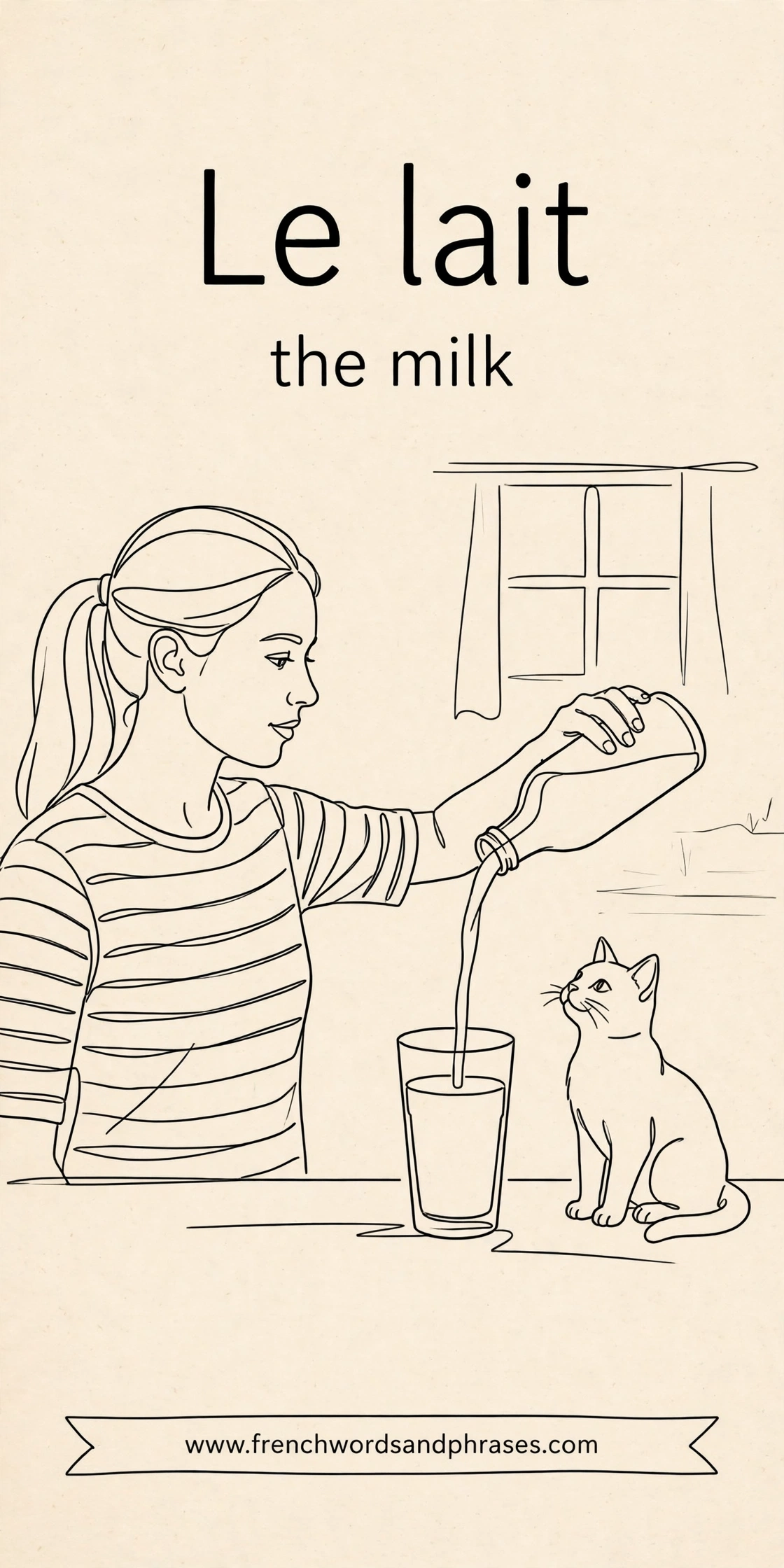
Le lait means the milk.
The bottle is still cold from the doorstep, the top is thick with cream, and the cat is already watching from the doorway. Morning would not be morning without le lait.
In this guide, you’ll learn what lait means in English, how to use it with its articles, how to form its plural, and how it appears in everyday French. Explore French examples, English translations, and practice quizzes.
Understanding the French Noun Lait
Lait is a masculine French noun. It is learned together with its article: le lait, un lait. Milk is a mass noun, so day to day you meet it with the partitive: du lait — some milk, milk in general.
It means the milk — the white drink from la vache (the cow) that goes into coffee, onto cereal and into a hundred sauces. At the shop you choose between lait entier (whole milk), lait demi-écrémé (semi-skimmed) and lait écrémé (skimmed), sold by la bouteille or la brique (the carton).
Gender: Masculine
Definite article: le — le lait (the milk)
Indefinite article: un — un lait (a milk, a type of milk)
Plural: les laits — used for types of milk
Partitive: du lait — some milk, the everyday form
English equivalents: The milk; milk.
One important usage detail: because lait is uncountable, French reaches for the partitive — je bois du lait, I drink milk; tu veux du lait ?, do you want some milk? The plain un lait appears when milk is counted as a serving or a type: un lait d’amande, an almond milk.
Experience the Word
Lait is more than a drink. It is the café au lait of a slow morning, the béchamel of a family gratin, the glass held out to a child before bed.
Imagine the dairy aisle of a French supermarket: whole rows of laits — entier, demi-écrémé, écrémé, de chèvre, d’amande — each with its loyal followers.
You have not just poured a drink. You have kept a small daily ritual — le verre de lait du soir.
How to Use Lait in French: Complete Guide
Let’s explore how lait works in French, beginning with its articles — and with the partitive du lait, the form you will use most.
Lait with the Definite Article (Le, Les)
Used for the milk everyone can see — the bottle in the fridge — and for milk in general.
| Form | French |
|---|---|
| Singular | le lait |
| Plural | les laits (types of milk) |
Example
Le lait est dans le frigo, à côté du beurre.
The milk is in the fridge, next to the butter.
Lait with the Partitive and Indefinite Articles (Du, Un)
Du lait for some milk; un lait for one type or one serving.
| Form | French |
|---|---|
| Partitive | du lait |
| Indefinite singular | un lait |
| Plural | des laits (different milks) |
Example
Tu veux du lait dans ton café ?
Do you want some milk in your coffee?
Choosing Your Lait: Kinds of Milk
Whole, skimmed or almond — the milk vocabulary of the supermarket shelf.
| French | In English |
|---|---|
| le lait entier | whole milk |
| le lait demi-écrémé | semi-skimmed milk |
| le lait écrémé | skimmed milk |
| le lait de vache | cow’s milk |
| le lait d’amande | almond milk |
| le lait en poudre | powdered milk |
Example
Elle ne boit que du lait d’amande dans son thé.
She only drinks almond milk in her tea.
Quick Quiz 1
Complete the sentence:
Le matin, je bois ______ avec mes céréales. (some milk)
Reveal the answer
du lait
Le matin, je bois du lait avec mes céréales.
In the morning, I drink milk with my cereal — du lait, the partitive, for an uncountable amount.
The Plural of Lait
Lait adds an -s for types: les laits végétaux, plant milks.
| Number | French |
|---|---|
| Singular | le lait |
| Plural | les laits |
Example
Les laits végétaux sont de plus en plus populaires.
Plant milks are more and more popular.
Lait with Possessive Adjectives (Mon, Ton, Son…)
Possessives agree with the noun: lait is masculine, so it takes mon, ton, son.
| Owner | French |
|---|---|
| my | mon lait |
| your (tu) | ton lait |
| his / her | son lait |
| our | notre lait |
| your (vous) | votre lait |
| their | leur lait |
Example
Le chat a bu tout mon lait !
The cat has drunk all my milk!
Quick Quiz 2
Complete the sentence:
______ lait est frais, il vient de la ferme. (Our)
Reveal the answer
Notre
Notre lait est frais, il vient de la ferme.
Our milk is fresh, it comes from the farm.
Lait with Demonstrative Adjectives (Ce, Ces)
Used to point: ce lait, this milk here.
| Form | French |
|---|---|
| Singular | ce lait |
| Plural | ces laits |
Example
Ce lait a un goût bizarre, vérifie la date.
This milk tastes strange, check the date.
Lait with Adjectives
Adjectives agree with lait, masculine: frais, chaud, froid.
| Adjective | With Lait |
|---|---|
| frais (fresh) | du lait frais |
| chaud (hot) | du lait chaud |
| froid (cold) | du lait froid |
| entier (whole) | du lait entier |
| tourné (gone off) | du lait tourné |
Example
Un verre de lait froid, c’est parfait après le sport.
A glass of cold milk is perfect after sport.
Quick Quiz 3
Complete the sentence:
Elle réchauffe du lait ______ pour le bébé. (hot — think of the adjective’s place)
Reveal the answer
chaud
Elle réchauffe du lait chaud pour le bébé.
She is warming some hot milk for the baby.
Everyday Expressions with Lait
Coffee, bedtime and one famous short temper — the lait phrases of daily life.
| Expression | In English |
|---|---|
| un café au lait | a coffee with milk, a latte |
| les dents de lait | milk teeth, baby teeth |
| un cochon de lait | a suckling pig |
| être soupe au lait | to be quick-tempered, to flare up easily |
| le lait de poule | eggnog |
| boire du petit-lait | to lap something up, to be delighted |
Example
Mon petit frère a perdu sa première dent de lait.
My little brother has lost his first milk tooth.
Words from the Same Family as Lait
Dairies, cream and butter — the words that travel with lait.
| French | In English |
|---|---|
| la laiterie | the dairy |
| le laitier | the milkman |
| laitier (adjective) | dairy, milk (as in produits laitiers) |
| la crème | the cream |
| le beurre | the butter |
| la vache | the cow |
Example
Les produits laitiers sont dans le rayon frais.
Dairy products are in the chilled aisle.
Quick Quiz 4
What are les dents de lait?
Reveal the answer
Baby teeth, milk teeth — the first teeth a child loses.
Elle a perdu deux dents de lait cette année.
She has lost two milk teeth this year.
Lait in Everyday French: Real-Life Examples
Now that you know the word, let’s see how lait appears in everyday French.
Example 1 — At breakfast
Il verse du lait froid sur ses céréales.
He pours cold milk over his cereal.
Example 2 — At the café
Un café au lait et un croissant, s’il vous plaît.
A coffee with milk and a croissant, please.
Example 3 — Shopping
N’oublie pas le lait demi-écrémé au supermarché.
Don’t forget the semi-skimmed milk at the supermarket.
Example 4 — Bedtime
La petite boit un verre de lait chaud avant de dormir.
The little girl drinks a glass of warm milk before sleeping.
Example 5 — Gone off
Ce lait a tourné, ne le bois pas.
This milk has gone off, don’t drink it.
Example 6 — Baking
Ajoute un peu de lait à la pâte à crêpes.
Add a little milk to the pancake batter.
Beyond Translation: The Meaning of Lait
Lait runs deep in French kitchens: the béchamel and the gratin dauphinois, the chocolat chaud of childhood, the café au lait served in a bowl at breakfast. The language keeps it close too — baby teeth are dents de lait, eggnog is lait de poule, hen’s milk, and a person who flares up in a second is soupe au lait, milk soup, quick to boil over.
To say lait is to pour a little of the farm into everyday life.
One word, one bottle on the doorstep — and a whole countryside of cows, dairies and morning rituals behind it.
How to Remember the French Noun Lait
Remember it this way: Lait is the milk — masculine, and almost always met as du lait, some milk, because you pour it rather than count it.
- You pour it — du lait, never a bare lait for an amount.
- You choose it — lait entier, demi-écrémé, écrémé.
- You lose them young — les dents de lait, your baby teeth.
The key idea is le lait, du lait — the partitive is its home.
Test Your Knowledge of Lait
Let’s see how much you’ve learned. Try answering these questions before revealing the answers.
Question 1
How do you ask for some milk in French?
Reveal the answer
Du lait — the partitive, because milk is uncountable.
Question 2
Is lait masculine or feminine?
Reveal the answer
Masculine — le lait, du lait.
Question 3
Translate: He drinks a glass of milk.
Reveal the answer
Il boit un verre de lait.
Question 4
What is le lait demi-écrémé?
Reveal the answer
Semi-skimmed milk — halfway between lait entier and lait écrémé.
Question 5
Complete the sentence:
Tu mets ______ dans ton café ?
Reveal the answer
du lait
Tu mets du lait dans ton café ?
Do you put milk in your coffee?
Your Final Challenge
Can You Use It?
How would you say this in French?
“He drinks a glass of milk before bed.”
Reveal the answer
Il boit un verre de lait avant de se coucher.
He drinks a glass of milk before bed.
A little French. A little curiosity. A richer everyday life.
LEARN FRENCH ONE WORD AT A TIME