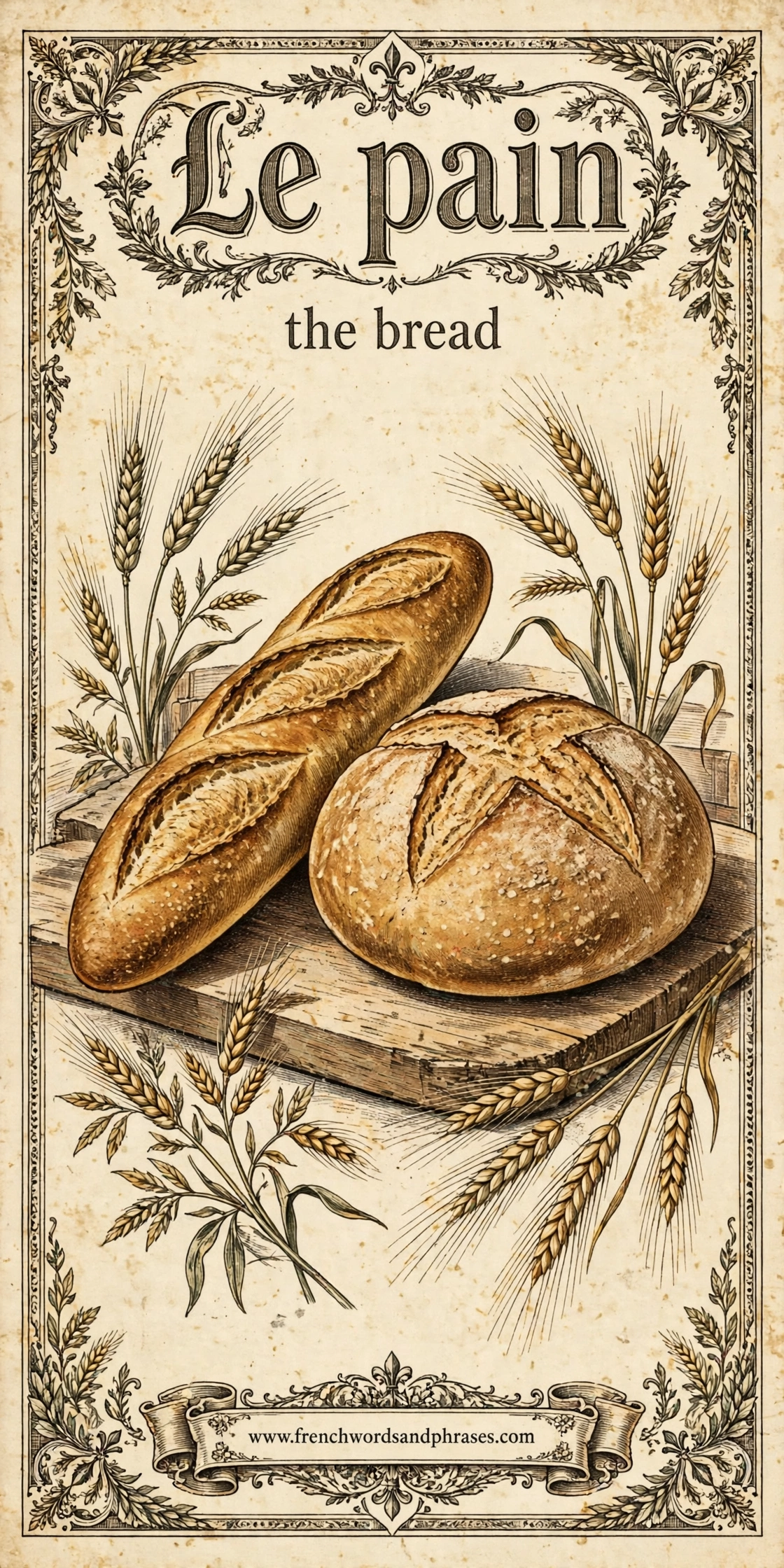
A French Word to Live By
Translate Pain to English
/pɛ̃/
Le pain means the bread.
Eight in the morning, and the queue is already out of the boulangerie door — workers, grandmothers, a boy with coins clutched in his fist. Everyone is here for the same warm, crackling treasure: le pain.
In this guide, you’ll learn what pain means in English, how to use it with its articles, how to form its plural, and how it appears in everyday French. Explore French examples, English translations, and practice quizzes.
Understanding the French Noun Pain
Pain is a masculine French noun, learned with its article: le pain, un pain. One French word covers both English ideas: le pain is bread in general, and un pain can be a whole loaf. It is also the classic mass noun — for « some bread », French reaches for the partitive: du pain.
It means the bread — the baked staple of every French table, from la baguette at breakfast to the slice that wipes the plate clean at dinner. The French buy it fresh, often twice a day, from la boulangerie, and a meal without pain is barely a meal at all. Beyond the table, pain stands for a living itself: gagner son pain, to earn one’s bread.
Gender: Masculine
Definite article: le — le pain (the bread)
Indefinite article: un — un pain (a loaf of bread)
Partitive: du pain — some bread, bread in general
Plural: les pains — the loaves
English equivalents: The bread; a loaf.
One important usage detail: at the table you ask for du pain — some bread — never « un pain », which would mean a whole loaf. And to buy it, the verb is priceless: you go chez le boulanger, and a baguette that is baked dark and crisp is bien cuite; soft and pale, pas trop cuite.
Experience the Word
Pain is more than a food. It is the rhythm of the French day — the morning baguette under one arm, the torn crust eaten on the walk home, the basket that is never empty at lunch.
Imagine the boulangerie at dawn: the smell of warm crust drifting into the street, the baker flour-white, and your baguette still crackling as it cools in your hand.
You have not just bought bread. You have kept a ritual — le pain quotidien, the daily bread.
How to Use Pain in French: Complete Guide
Let’s explore how pain works in French, beginning with its articles — including the partitive du pain, some bread.
Pain with the Definite Article (Le, Les)
Used for the bread everyone means — the one on the table, the one from the baker’s.
| Form | French |
|---|---|
| Masculine singular | le pain |
| Plural | les pains |
Example
Le pain est encore chaud, il sort du four.
The bread is still warm; it has just come out of the oven.
Pain with the Indefinite Article (Un, Des)
Un pain is a whole loaf — the big round country loaf you buy entire.
| Form | French |
|---|---|
| Masculine singular | un pain |
| Plural | des pains |
Example
Elle achète un pain de campagne pour le week-end.
She is buying a country loaf for the weekend.
Pain with the Partitive Article (Du)
For bread as a substance — some bread, any bread — French uses du pain.
| Form | French |
|---|---|
| Some bread | du pain |
| No bread (after a negative) | pas de pain |
| A lot of bread | beaucoup de pain |
Example
Passe-moi du pain, s’il te plaît.
Pass me some bread, please.
Quick Quiz 1
At the table, you want some bread. Complete the sentence:
Je voudrais ______, s’il vous plaît.
Reveal the answer
du pain
Je voudrais du pain, s’il vous plaît.
I would like some bread, please — du, the partitive, for a portion of bread.
The Plural of Pain
Pain adds an -s in the plural — les pains, the loaves lined up at the baker’s.
| Number | French |
|---|---|
| Singular | le pain / un pain |
| Plural | les pains / des pains |
Example
Les pains chauds sortent du four à sept heures.
The warm loaves come out of the oven at seven o’clock.
Pain with Possessive Adjectives (Mon, Ton, Son…)
Possessives agree with the noun: pain is masculine, so it takes mon, ton, son.
| Owner | French |
|---|---|
| my | mon pain |
| your (tu) | ton pain |
| his / her | son pain |
| our | notre pain |
| your (vous) | votre pain |
| their | leur pain |
Example
Il trempe son pain dans la soupe.
He dips his bread in the soup.
Quick Quiz 2
Complete the sentence:
Elle coupe ______ pain en tranches épaisses. (her)
Reveal the answer
son
Elle coupe son pain en tranches épaisses.
She cuts her bread into thick slices.
Pain with Demonstrative Adjectives (Ce, Ces)
Used to point: ce pain, this loaf — the one you want at the baker’s.
| Form | French |
|---|---|
| Masculine singular | ce pain |
| Plural | ces pains |
Example
Je voudrais ce pain-là, le grand rond.
I would like that loaf, the big round one.
Pain with Adjectives
Adjectives agree with pain: frais, chaud, dur — bread has a life cycle everyone knows.
| Adjective | With Pain |
|---|---|
| frais (fresh) | du pain frais |
| chaud (warm) | du pain chaud |
| dur (stale, hard) | du pain dur |
| complet (wholemeal) | du pain complet |
| grillé (toasted) | du pain grillé |
Example
Rien ne vaut du pain frais le matin.
Nothing beats fresh bread in the morning.
Quick Quiz 3
Complete the sentence:
Ce pain est trop ______ pour le manger. (stale)
Reveal the answer
dur
Ce pain est trop dur pour le manger.
This bread is too stale to eat — yesterday’s pain becomes dur.
Everyday Expressions with Pain
Loaves, livings and lost causes — the pain phrases of daily life.
| Expression | In English |
|---|---|
| gagner son pain | to earn one’s living, to earn a crust |
| le pain quotidien | the daily bread |
| être au pain sec | to be on bread and water (a punishment) |
| ça ne mange pas de pain | it costs nothing to try, no harm in it |
| long comme un jour sans pain | endless, as long as a day without bread |
| le pain maison | home-made bread |
Example
Il gagne son pain comme chauffeur de taxi.
He earns his living as a taxi driver.
Words from the Same Family as Pain
Bakers, crumbs and sandwiches — the words that travel with pain.
| French | In English |
|---|---|
| la boulangerie | the bakery |
| le boulanger | the baker (a man) |
| la baguette | the baguette, the French stick |
| la mie | the soft inside of the bread, the crumb |
| la croûte | the crust |
| la chapelure | breadcrumbs (for cooking) |
Example
La boulangerie vend des pains de toutes sortes.
The bakery sells breads of every kind.
Quick Quiz 4
What does « gagner son pain » mean?
Reveal the answer
To earn one’s living — bread standing for everything a wage buys.
Elle gagne son pain en écrivant des livres.
She earns her living by writing books.
Pain in Everyday French: Real-Life Examples
Now that you know the word, let’s see how pain appears in everyday French.
Example 1 — At the bakery
Je voudrais un pain complet et une baguette, s’il vous plaît.
I would like a wholemeal loaf and a baguette, please.
Example 2 — At the table
Passe-moi du pain pour saucer mon assiette.
Pass me some bread to mop up my plate.
Example 3 — In the morning
Le pain grillé avec du beurre, c’est mon petit déjeuner préféré.
Toast with butter is my favourite breakfast.
Example 4 — Talking about work
Il gagne son pain comme maçon.
He earns his living as a builder.
Example 5 — A complaint
Le pain d’hier est déjà dur.
Yesterday’s bread is already stale.
Example 6 — Baking at home
Le dimanche, nous faisons notre pain maison.
On Sundays, we make our own home-made bread.
Beyond Translation: The Meaning of Pain
Bread is sacred in France — almost literally. By law, a boulangerie may only call itself that if the bread is made on the premises from raw dough, and the classic baguette has protected rules of its own. In 2022, UNESCO placed the baguette’s culture on its heritage list. And etiquette has its rules too: bread goes directly on the table, never on a plate, and it is torn, never cut with a knife.
To say pain is to name the food France built its days around.
It evokes the dawn queue at the boulangerie and the torn crust on the walk home — the loaf that is at once breakfast, tool and tradition.
How to Remember the French Noun Pain
Remember it this way: Pain is the bread — masculine, a loaf when you count it (un pain), and « some bread » when you eat it (du pain).
- You buy a loaf — un pain, le pain de campagne.
- You eat a portion — du pain, passe-moi du pain.
- You earn a living — gagner son pain, bread as wages.
The key idea is le pain, du pain — the bread, some bread.
Test Your Knowledge of Pain
Let’s see how much you’ve learned. Try answering these questions before revealing the answers.
Question 1
How do you ask for some bread at the table?
Reveal the answer
Du pain — the partitive: « Passe-moi du pain, s’il te plaît. »
Question 2
What does un pain mean on its own?
Reveal the answer
A loaf — one whole bread, like un pain de campagne.
Question 3
Translate: The bread is still warm.
Reveal the answer
Le pain est encore chaud.
Question 4
Is pain masculine or feminine?
Reveal the answer
Masculine — le pain, un pain.
Question 5
Complete the sentence:
Je voudrais ______ pour mon assiette. (some bread)
Reveal the answer
du pain
Je voudrais du pain pour mon assiette.
I would like some bread for my plate.
Your Final Challenge
Can You Use It?
How would you say this in French?
“Pass me some bread, please.”
Reveal the answer
Passe-moi du pain, s’il te plaît.
Pass me some bread, please.
A little French. A little curiosity. A richer everyday life.
LEARN FRENCH ONE WORD AT A TIME