A French Word to Live By
Translate Été to English
/e.te/
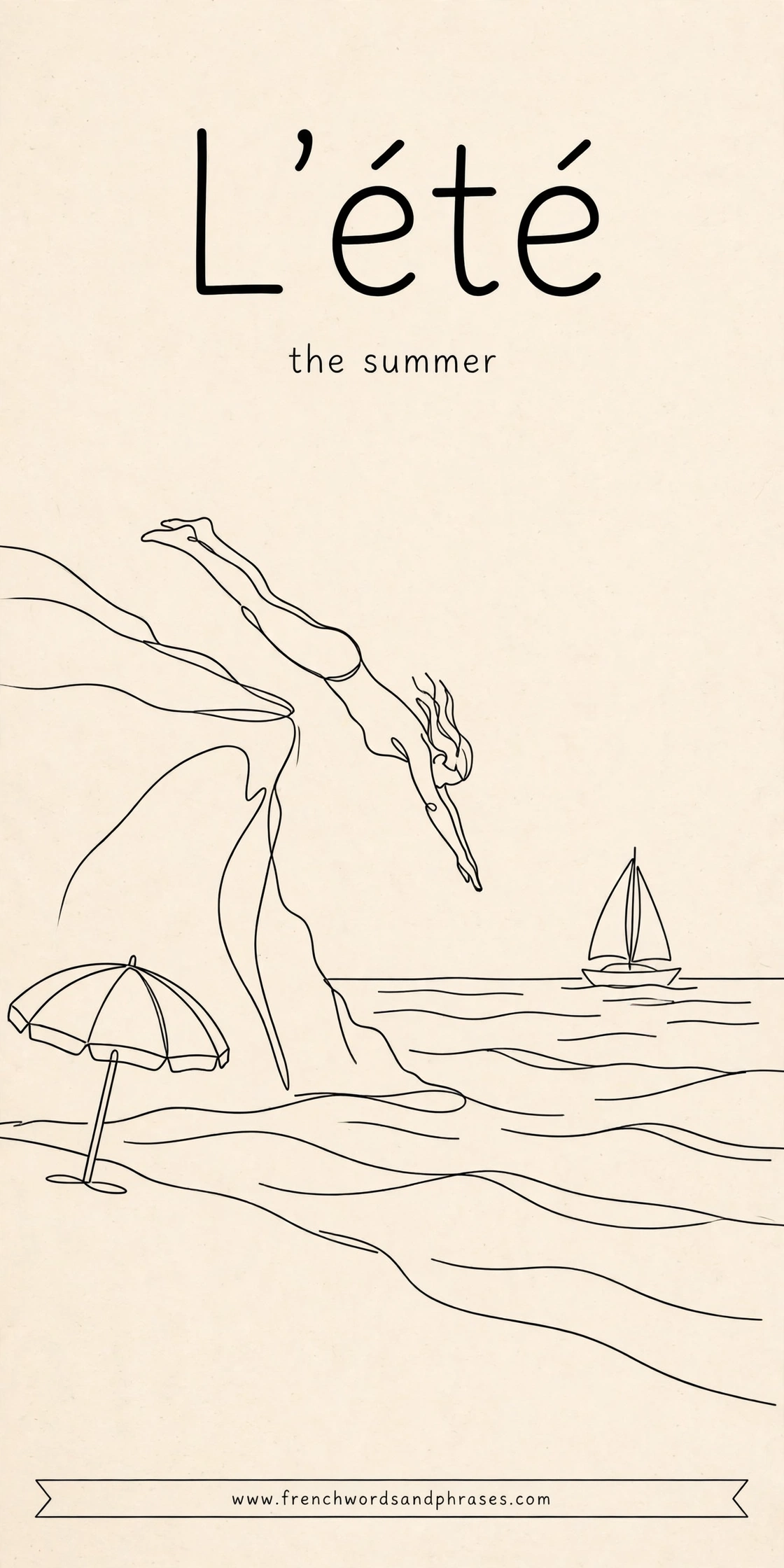
L’été means the summer.
The shutters are open at dawn, the cicadas are already singing in the pines, and the whole village smells of warm stone and lavender. School is finished, the days are endless — l’été has taken over.
In this guide, you’ll learn what été means in English, how to use it with its articles, how to form its plural, and how it appears in everyday French. Explore French examples, English translations, and practice quizzes.
Understanding the French Noun Été
Été is a masculine French noun. Because it begins with a vowel, the article shrinks: l’été, never « le été ». With the indefinite article it stays simple: un été. Beware a famous trap: été is also the past participle of être (j’ai été, I have been) — same spelling, completely different word.
It means the summer — the hot season between le printemps and l’automne, from June to September. In France, été means les grandes vacances (the long school holidays), the exodus to the sea and the countryside, and village festivals under the plane trees. The very hottest days have their own word: la canicule, the heatwave.
Gender: Masculine
Definite article: l’ — l’été (the summer), because of the opening vowel
Indefinite article: un — un été (a summer)
Plural: les étés
Key phrase: en été — in summer
English equivalents: The summer; summertime.
One important usage detail: for « in summer », French says en été — en, like en automne and en hiver, but not like au printemps. And when you talk about last summer or next summer, the article often disappears: l’été dernier, l’été prochain.
Experience the Word
Été is more than a season. It is the great pause of French life — whole cities emptying in August, shops closing for a month, and time itself slowing down in the heat.
Imagine a village square at nine in the evening: still light, still warm, children on bicycles, old men playing pétanque, and dinner only just beginning.
You have not just reached the hot months. You have slowed down — la douceur de vivre, the sweetness of living.
How to Use Été in French: Complete Guide
Let’s explore how été works in French, beginning with its articles — and that apostrophe: l’été.
Été with the Definite Article (L’, Les)
Été begins with a vowel, so le becomes l’ — l’été, the summer everyone means.
| Form | French |
|---|---|
| Masculine singular | l’été |
| Plural | les étés |
Example
L’été commence le vingt et un juin.
Summer begins on the twenty-first of June.
Été with the Indefinite Article (Un, Des)
Used for a summer in general — un été chaud, a hot summer.
| Form | French |
|---|---|
| Masculine singular | un été |
| Plural | des étés |
Example
Nous avons passé un été magnifique en Provence.
We spent a magnificent summer in Provence.
The Four Seasons
Été and its three companions — with the little word each one takes for « in ».
| French | In English |
|---|---|
| le printemps | the spring — au printemps |
| l’été | the summer — en été |
| l’automne | the autumn — en automne |
| l’hiver | the winter — en hiver |
| la saison | the season |
| les vacances | the holidays |
Example
En été, les jours sont longs et chauds.
In summer, the days are long and hot.
Quick Quiz 1
Complete the sentence:
______ été, nous allons à la mer.
Reveal the answer
En
En été, nous allons à la mer.
In summer, we go to the seaside — en été, but au printemps.
The Plural of Été
Été adds an -s in the plural — les étés, the summers of your life.
| Number | French |
|---|---|
| Singular | l’été |
| Plural | les étés |
Example
Les étés de mon enfance passaient au bord de la mer.
The summers of my childhood were spent by the sea.
Été with Possessive Adjectives (Mon, Ton, Son…)
A vowel-start bonus: été is masculine and begins with a vowel, so mon, ton, son fit it perfectly.
| Owner | French |
|---|---|
| my | mon été |
| your (tu) | ton été |
| his / her | son été |
| our | notre été |
| your (vous) | votre été |
| their | leur été |
Example
Mon été commence par une semaine à la campagne.
My summer begins with a week in the countryside.
Quick Quiz 2
Complete the sentence:
C’est ______ premier été en France. (my)
Reveal the answer
mon
C’est mon premier été en France.
It is my first summer in France.
Été with Demonstrative Adjectives (Cet, Ces)
Used to point at a particular summer: cet été — cet, because été begins with a vowel.
| Form | French |
|---|---|
| Masculine singular | cet été |
| Plural | ces étés |
Example
Cet été, la famille loue une maison près de la plage.
This summer, the family is renting a house near the beach.
Été with Adjectives
Adjectives agree with été: chaud, ensoleillé, caniculaire — summers have temperatures.
| Adjective | With Été |
|---|---|
| chaud (hot) | un été chaud |
| ensoleillé (sunny) | un été ensoleillé |
| pluvieux (rainy) | un été pluvieux |
| long (long) | un long été |
| caniculaire (scorching) | un été caniculaire |
Example
Un été chaud et sec arrive sur la région.
A hot, dry summer is arriving in the region.
Quick Quiz 3
Complete the sentence:
Nous avons eu un été très ______ l’année dernière. (hot)
Reveal the answer
chaud
Nous avons eu un été très chaud l’année dernière.
We had a very hot summer last year.
Everyday Expressions with Été
Heatwaves and long holidays — the été phrases of daily life.
| Expression | In English |
|---|---|
| en été | in summer |
| l’été dernier | last summer |
| l’été prochain | next summer |
| les grandes vacances | the long summer holidays |
| la canicule | the heatwave |
| un job d’été | a summer job |
Example
L’été dernier, nous avons visité la Bretagne.
Last summer, we visited Brittany.
Words from the Same Family as Été
Sun, heat and holidays — the words that travel with été.
| French | In English |
|---|---|
| estival | summer, of summer (an adjective) |
| l’estivant | the summer holidaymaker |
| le soleil | the sun |
| la chaleur | the heat |
| la plage | the beach |
| bronzer | to sunbathe, to get a tan |
Example
Les estivants arrivent au village en juillet.
The summer holidaymakers arrive in the village in July.
Quick Quiz 4
What is la canicule?
Reveal the answer
The heatwave — the stretch of scorching days in the middle of summer.
Pendant la canicule, on ferme les volets.
During the heatwave, we close the shutters.
Été in Everyday French: Real-Life Examples
Now that you know the word, let’s see how été appears in everyday French.
Example 1 — Making plans
En été, nous partons trois semaines dans le Sud.
In summer, we go away for three weeks in the South.
Example 2 — Talking about the weather
Cet été est le plus chaud depuis dix ans.
This summer is the hottest for ten years.
Example 3 — At the beach
L’été, les enfants passent la journée à la plage.
In summer, the children spend the day at the beach.
Example 4 — A summer job
Mon fils cherche un job d’été à la boulangerie.
My son is looking for a summer job at the bakery.
Example 5 — In the garden
Les tomates rougissent en plein été.
The tomatoes ripen in the middle of summer.
Example 6 — Looking back
L’été prochain, nous irons en Italie.
Next summer, we will go to Italy.
Beyond Translation: The Meaning of Été
Summer in France is an institution. Since 1936, when paid holidays were won for every worker, the country has organised itself around les grandes vacances — and the great migration south even has traffic names: the juillettistes leave in July, the aoûtiens in August. Whole villages in the South double in size, and Paris famously empties.
To say été is to name the season France plans its whole year around.
It evokes the shuttered heat of noon and the long light of evening, lavender fields and market squares — summer not as weather, but as a way of life.
How to Remember the French Noun Été
Remember it this way: Été is the summer — masculine, with an apostrophe (l’été), and it pairs with en: en été, in summer.
- You name the season — l’été, between le printemps and l’automne.
- You say when — en été, like en automne and en hiver.
- You dodge the trap — j’ai été is « I have been », not summer at all.
The key idea is l’été — en été, in summer.
Test Your Knowledge of Été
Let’s see how much you’ve learned. Try answering these questions before revealing the answers.
Question 1
How do you say in summer in French?
Reveal the answer
En été — en for été, automne and hiver; au for printemps.
Question 2
Why do we write l’été and not le été?
Reveal the answer
Because été begins with a vowel — le shrinks to l’ before a vowel sound.
Question 3
Translate: Last summer, we went to the sea.
Reveal the answer
L’été dernier, nous sommes allés à la mer.
Question 4
What are les grandes vacances?
Reveal the answer
The long summer holidays — the school break of July and August.
Question 5
Complete the sentence:
______ été, il fait très chaud dans le Sud.
Reveal the answer
En
En été, il fait très chaud dans le Sud.
In summer, it is very hot in the South.
Your Final Challenge
Can You Use It?
How would you say this in French?
“In summer, the children play outside.”
Reveal the answer
En été, les enfants jouent dehors.
In summer, the children play outside.
A little French. A little curiosity. A richer everyday life.
LEARN FRENCH ONE WORD AT A TIME