A French Word to Live By
Translate Rouge to English
/ʁuʒ/
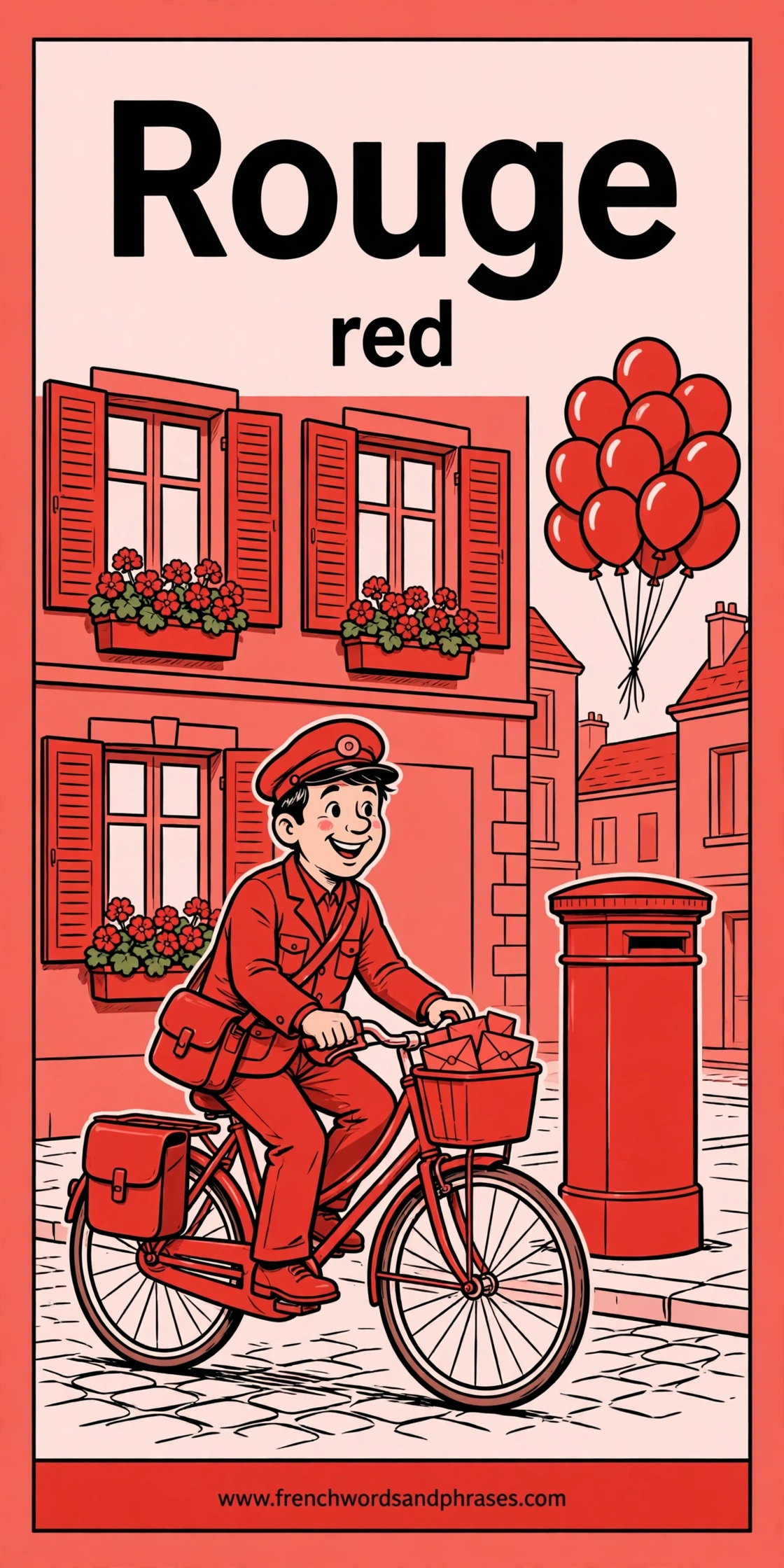
Rouge means red.
A vineyard in October, rows of vines turning scarlet under a low sun, and a farmhouse door painted the exact red of the wine in the cellar below. In France, red is never just a colour — it is wine and earth, flags and letterboxes, the cross on the pharmacy and the light that stops the traffic. French calls all of it rouge.
In this guide, you’ll learn what rouge means in English, why it never changes between masculine and feminine, where colour adjectives stand in the sentence, and how le rouge becomes the name of the colour itself. Explore French examples, English translations, and practice quizzes.
Understanding the French Adjective Rouge
Rouge is a French adjective of colour — the first colour most learners meet. It already ends in -e, so it is invariable between masculine and feminine: un vin rouge, une robe rouge — one form for everyone, with only the plural adding an s. As a noun, le rouge is the colour red itself.
It means red — the colour of wine, blood, ripe tomatoes and the French letterbox. It describes clothes (une jupe rouge, a red skirt), nature (des feuilles rouges, red leaves), wine above all (un verre de rouge, a glass of red) and faces that blush: rouge de honte, red with embarrassment.
Type: Adjective of colour
Answers the question: What colour is it? — red
Changes form: No change for gender — rouge for masculine and feminine; only the plural adds an s: rouges
English equivalents: Red.
One important usage detail: rouge is invariable for gender — une voiture rouge, never ‘rougée’. Like all colour adjectives, it stands after the noun. And two everyday gifts: un feu rouge is a red traffic light, and un verre de rouge is a glass of red wine.
Experience the Word
Rouge is the adjective of the vineyard and the bistro — the colour poured into glasses, painted on doors and worn, in France, with total confidence.
Imagine a market in Provence in July: pyramids of tomatoes, strings of peppers, geraniums on every windowsill above the street. The whole scene is arguing in one colour, and the word for it never changes its shape: rouge, rouge, rouge.
You have not just named a colour. You have pointed at the warmest, boldest corner of the French palette.
How to Use Rouge in French: Complete Guide
Let’s explore how Rouge works in French, beginning with the whole word on one card.
Rouge at a Glance
Before the details, here is the whole word on one card.
The Whole Word on One Card
Meaning, type, position and forms — rouge in four lines.
| Point | Rouge |
|---|---|
| Meaning | red |
| Type | Adjective of colour |
| Usual position | after the noun — une robe rouge |
| Form | rouge for everyone — rouges in the plural |
Example
C’est une robe rouge.
It’s a red dress.
The Four Forms of Rouge
Here is one of the easiest agreements in French: rouge already ends in -e, so masculine and feminine are identical. Only the plural adds an s.
| Form | Rouge | Example |
|---|---|---|
| Masculine singular | rouge | un vin rouge — a red wine |
| Feminine singular | rouge | une robe rouge — a red dress |
| Masculine plural | rouges | des vins rouges — red wines |
| Feminine plural | rouges | des robes rouges — red dresses |
Example
J’aime ce vin rouge et ces robes rouges.
I like this red wine and these red dresses.
Quick Quiz 1
Does rouge change for a feminine noun?
Reveal the answer
No
Un vin rouge, une robe rouge — the form is identical.
A red wine, a red dress.
The Feminine of Rouge: Nothing Changes
Most adjectives build their feminine by adding an e. Rouge was born with one, so the feminine has nothing to add — un mur rouge, une porte rouge, the same word throughout.
| Situation | Example |
|---|---|
| Masculine | un pull rouge — a red jumper |
| Feminine | une jupe rouge — identical |
| Why | rouge already ends in -e, so the feminine adds nothing |
| The plural | add s — des fleurs rouges, red flowers |
Example
Elle porte une jupe rouge et un pull rouge.
She is wearing a red skirt and a red jumper.
Where Rouge Goes: After the Noun
Rouge follows the noun it describes, like most French adjectives, and it is perfectly at home after être.
| Pattern | Example |
|---|---|
| After the noun | une voiture rouge — a red car |
| After être | le ciel est rouge ce soir — the sky is red tonight |
| As a noun | le rouge — the colour red |
| Before the noun | une rouge voiture — not in everyday French |
Example
Le feu est rouge, les voitures s’arrêtent.
The light is red, the cars are stopping.
Quick Quiz 2
How do you say ‘a red car’ — une rouge voiture or une voiture rouge?
Reveal the answer
une voiture rouge
Colour adjectives stand after the noun.
A red car.
More Rouge: Comparing with Rouge
Rouge compares the regular way, with plus, moins and aussi.
| Degree | Example |
|---|---|
| As red as | aussi rouge que — as red as |
| More red | plus rouge — more red |
| Less red | moins rouge — less red |
Example
Cette tomate est plus rouge que l’autre.
This tomato is redder than the other one.
Everyday Expressions with Rouge
The phrases French actually reaches for when rouge comes up in conversation.
| Expression | In English |
|---|---|
| un feu rouge | a red traffic light |
| un verre de rouge | a glass of red (wine) |
| le vin rouge | red wine |
| rouge de honte | red with embarrassment, blushing with shame |
| un poisson rouge | a goldfish (literally, a red fish) |
| la Croix-Rouge | the Red Cross |
Example
Au feu rouge, le cycliste s’arrête.
At the red light, the cyclist stops.
Quick Quiz 3
What does un feu rouge mean?
Reveal the answer
A red traffic light
Le feu rouge est passé au vert.
The red light turned green.
Rouge and Its Neighbours
The words that live closest to rouge — near-synonyms, partners and opposites.
| French | In English |
|---|---|
| rosé | pinkish, rosé — the lighter neighbour, and a wine |
| bordeaux | burgundy, claret red — the deep wine red |
| écarlate | scarlet — the bright, literary red |
| vermeil | vermilion, gilded silver — the rich old word |
| roux | red-haired, russet — for hair and autumn leaves |
| pourpre | purple-red, crimson — the solemn neighbour |
Example
Elle a les cheveux roux et une robe écarlate.
She has red hair and a scarlet dress.
Watch Out: The Traps Around Rouge
The mistakes learners make with rouge — each one easy to avoid once seen.
| Trap | The truth |
|---|---|
| No feminine form | never ‘rougée’ — une robe rouge, with the same word |
| Hair is roux | red hair is roux, not rouge: elle est rousse, she is a redhead |
| As a noun | le rouge is the colour — and un rouge is also a lipstick in a shop |
| Agreement | only the plural changes: des tomates rouges, with an s |
Example
Ses cheveux sont roux, pas rouges.
Her hair is red (roux), not rouge.
Quick Quiz 4
How do you say ‘red flowers’?
Reveal the answer
des fleurs rouges
Rouge adds only an s in the plural.
Red flowers.
Rouge in Everyday French: Real-Life Examples
Now that you know the word, let’s see how rouge appears in everyday French.
Example 1 — At the market
Ces tomates sont bien rouges, je vais en prendre un kilo.
These tomatoes are nice and red, I’ll take a kilo.
Example 2 — Clothes
Elle porte une robe rouge magnifique.
She is wearing a magnificent red dress.
Example 3 — Traffic
Le feu est rouge, attends le vert.
The light is red, wait for the green.
Example 4 — Wine
Un verre de rouge avec le fromage, s’il vous plaît.
A glass of red with the cheese, please.
Example 5 — Nature
En automne, les feuilles deviennent rouges et dorées.
In autumn, the leaves turn red and golden.
Example 6 — Embarrassment
Il est devenu rouge de honte.
He went red with embarrassment.
Beyond Translation: The Meaning of Rouge
English says red for the meaning of rouge — but in France the word is poured, worn and planted everywhere: the red of the wine list, the red of the letterbox, the little red rosette of the Légion d’honneur.
To say rouge in French is to reach for the colour of appetite and celebration.
And because the word never changes, it teaches the learner a gentle first lesson: French agreement has holidays too, and rouge — like orange and rose — has taken its holiday in advance by ending in -e.
How to Remember the French Adjective Rouge
Remember it this way: Rouge is the friendly colour adjective — one form for him and her, an s for the plural, and its place quietly behind the noun.
- You see one form for everyone — un vin rouge, une robe rouge.
- You add only an s in the plural — des fleurs rouges.
- You keep hair apart — red hair is roux, not rouge.
The key idea is rouge never changes for gender, only adds an s in the plural, and red hair is roux.
Test Your Knowledge of Rouge
Let’s see how much you’ve learned. Try answering these questions before revealing the answers.
Question 1
What does rouge mean?
Reveal the answer
Red — the colour of wine, tomatoes and letterboxes.
Question 2
What is the feminine of rouge?
Reveal the answer
rouge — identical. The word already ends in -e.
Question 3
Translate: a red dress.
Reveal the answer
Une robe rouge.
Question 4
Complete the sentence:
Le feu est ______ , les voitures s’arrêtent.
Reveal the answer
rouge
Le feu est rouge, les voitures s’arrêtent.
The light is red, the cars are stopping.
Question 5
How do you describe red hair in French?
Reveal the answer
roux (feminine rousse) — rouge is for things, roux is for hair.
Your Final Challenge
Can You Use It?
How would you say this in French?
“She is wearing a red dress and black shoes.”
Reveal the answer
Elle porte une robe rouge et des chaussures noires.
She is wearing a red dress and black shoes.
A little French. A little curiosity. A richer everyday life.
LEARN FRENCH ONE WORD AT A TIME