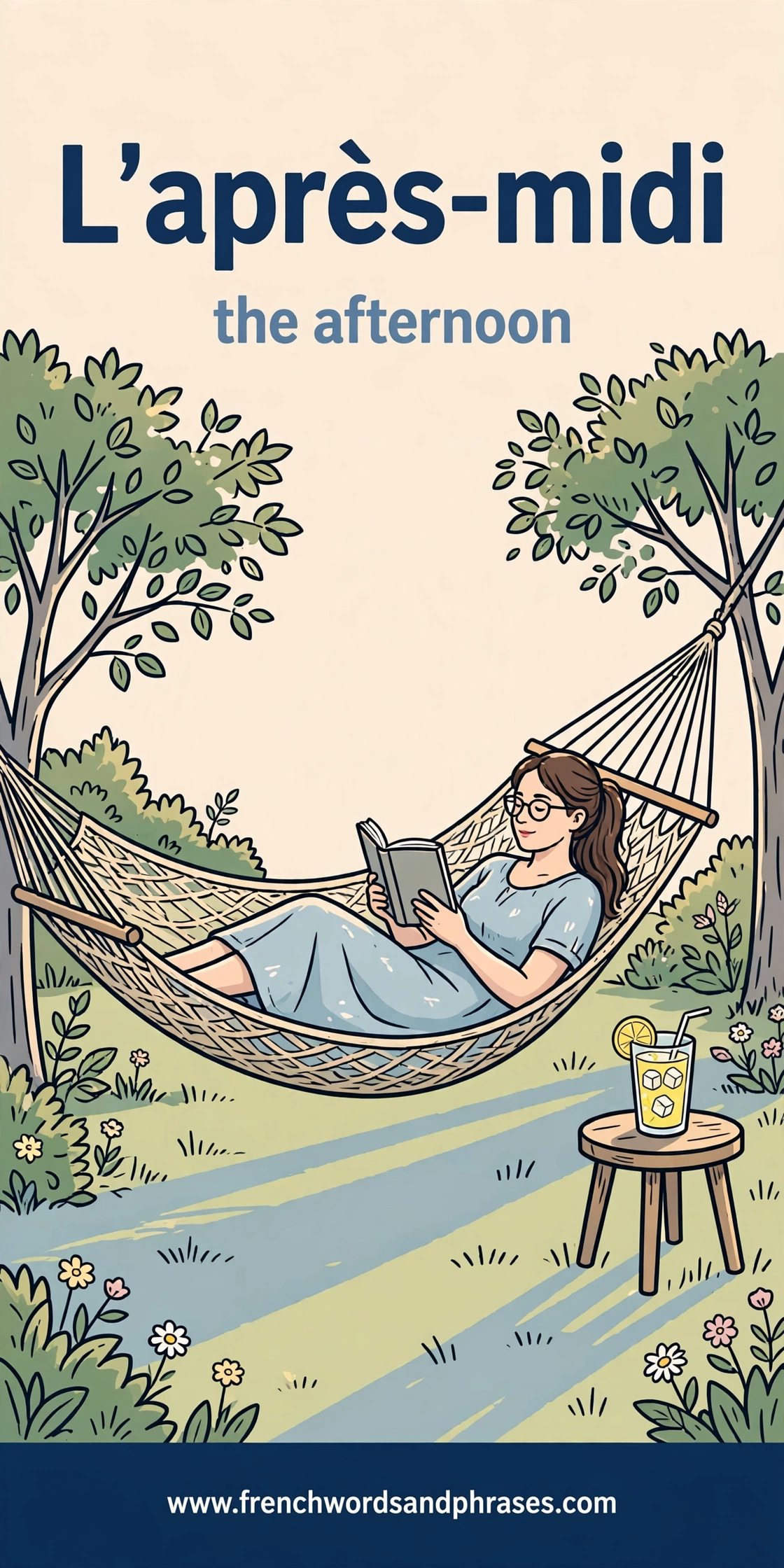
A French Word to Live By
Translate Après-midi to English
/a.pʁɛ.mi.di/
L’après-midi means the afternoon.
Lunch is over, the shutters are half closed against the sun, and the town slows to a gentle walk — it is l’après-midi, the long golden half of the French day.
In this guide, you’ll learn what après-midi means in English, how to use it with its articles, how to form its plural, and how it appears in everyday French. Explore French examples, English translations, and practice quizzes.
Understanding the French Noun Après-midi
Après-midi is a French compound noun of variable gender — both le and la are heard, though masculine is the most common today: l’après-midi, un après-midi. It joins après (after) and midi (midday, noon): literally, the time « after noon ». It begins with a vowel, so the article shrinks to l’.
It means the afternoon — the part of the day between lunch and the evening. In France it holds its own rituals: le goûter (the four o’clock snack), the children’s return from school, the long light of summer evenings approaching. To arrange something in the afternoon, you say dans l’après-midi or simply cet après-midi (this afternoon).
Gender: Masculine most often (feminine is also accepted)
Definite article: l’ — l’après-midi (the afternoon), because it starts with a vowel
Indefinite article: un — un après-midi (an afternoon); une is also heard
Plural: les après-midi — completely invariable: des après-midi, never « après-midis »
Built from: après (after) + midi (midday, noon)
English equivalents: The afternoon.
One important usage detail: après-midi never takes an -s — des après-midi ensoleillés, with the adjective agreeing but the noun unchanged. And the word works as a time expression on its own: cet après-midi (this afternoon), demain après-midi (tomorrow afternoon), hier après-midi (yesterday afternoon).
Experience the Word
Après-midi is more than a time of day. In France it has a flavour — the slow hours after lunch, the heat shimmering on the square, the cafés refilling as the shadows lengthen.
Imagine a village at three o’clock in August: the shops are shut for the pause, a cat sleeps on a warm step, and nothing in the world seems to be in a hurry.
You have not just passed some hours. You have lived the slow half of the day — la douceur de l’après-midi.
How to Use Après-midi in French: Complete Guide
Let’s explore how après-midi works in French, beginning with its articles — and meet one of the great invariable nouns of the language.
Après-midi with the Definite Article (L’, Les)
Après-midi begins with a vowel, so le and la both shrink to l’ — l’après-midi, the afternoon.
| Form | French |
|---|---|
| Singular | l’après-midi |
| Plural | les après-midi |
Example
L’après-midi est ensoleillé, allons nous promener.
The afternoon is sunny; let’s go for a walk.
Après-midi with the Indefinite Article (Un, Des)
Used for an afternoon in general — un après-midi, one afternoon among others.
| Form | French |
|---|---|
| Singular | un après-midi |
| Plural | des après-midi |
Example
Nous avons passé un après-midi entier au bord du lac.
We spent a whole afternoon by the lake.
The Parts of the Day: Words around Après-midi
Morning, noon and evening — the vocabulary of the après-midi’s neighbours.
| French | In English |
|---|---|
| le matin | the morning |
| midi | midday, noon |
| le soir | the evening |
| le goûter | the afternoon snack |
| la sieste | the nap, the siesta |
| le crépuscule | dusk, twilight |
Example
Après le déjeuner, l’après-midi commence par une courte sieste.
After lunch, the afternoon begins with a short nap.
Quick Quiz 1
Complete the sentence:
Je te téléphone cet ______ vers trois heures.
Reveal the answer
après-midi
Je te téléphone cet après-midi vers trois heures.
I’ll call you this afternoon around three o’clock — cet, because après-midi begins with a vowel.
The Plural of Après-midi
Après-midi is invariable: the plural looks exactly like the singular — des après-midi.
| Number | French |
|---|---|
| Singular | l’après-midi |
| Plural | les après-midi |
Example
Les après-midi d’été sont longs et chauds dans le Sud.
Summer afternoons are long and hot in the South.
Après-midi with Possessive Adjectives (Mon, Ton, Son…)
Après-midi begins with a vowel, so it takes mon, ton, son — mon après-midi — whatever its gender.
| Owner | French |
|---|---|
| my | mon après-midi |
| your (tu) | ton après-midi |
| his / her | son après-midi |
| our | notre après-midi |
| your (vous) | votre après-midi |
| their | leur après-midi |
Example
Mon après-midi est libre, on peut se voir quand tu veux.
My afternoon is free; we can meet whenever you like.
Quick Quiz 2
Complete the sentence:
______ après-midi, nous allons au marché. (This)
Reveal the answer
Cet
Cet après-midi, nous allons au marché.
This afternoon, we’re going to the market — cet, because of the opening vowel.
Après-midi with Demonstrative Adjectives (Cet, Ces)
Used to point in time: cet après-midi, this afternoon; ces après-midi, these afternoons.
| Form | French |
|---|---|
| Singular | cet après-midi |
| Plural | ces après-midi |
Example
Ces après-midi de vacances passent trop vite.
These holiday afternoons go by too quickly.
Après-midi with Adjectives
The noun never changes, but the adjective agrees (masculine by default): un après-midi ensoleillé, un après-midi chargé.
| Adjective | With Après-midi |
|---|---|
| ensoleillé (sunny) | un après-midi ensoleillé |
| chargé (busy) | un après-midi chargé |
| libre (free) | un après-midi libre |
| long (long) | un long après-midi |
| pluvieux (rainy) | un après-midi pluvieux |
Example
Un après-midi pluvieux est parfait pour lire au coin du feu.
A rainy afternoon is perfect for reading by the fire.
Quick Quiz 3
True or false: the plural of après-midi is « des après-midis ».
Reveal the answer
False — après-midi is invariable: des après-midi, with no -s anywhere.
Tous les après-midi, elle fait une promenade.
Everyday Expressions with Après-midi
Snacks, naps and arrangements — the après-midi phrases of daily life.
| Expression | In English |
|---|---|
| cet après-midi | this afternoon |
| demain après-midi | tomorrow afternoon |
| dans l’après-midi | during the afternoon, later today |
| en début d’après-midi | in the early afternoon |
| l’après-midi libre | the afternoon off |
Example
Le colis arrivera dans l’après-midi, entre deux et quatre heures.
The parcel will arrive during the afternoon, between two and four o’clock.
Words from the Same Family as Après-midi
Time, days and light — the words that travel with après-midi.
| French | In English |
|---|---|
| après | after |
| midi | midday, noon; also the South of France |
| la journée | the day, the whole day |
| le déjeuner | lunch |
| le goûter | the afternoon snack |
| demain | tomorrow |
Example
Le déjeuner se termine, et l’après-midi s’étire devant nous.
Lunch is ending, and the afternoon stretches out before us.
Quick Quiz 4
What is le goûter?
Reveal the answer
The afternoon snack — the four o’clock ritual of French children in the middle of l’après-midi.
Après l’école, les enfants prennent leur goûter.
After school, the children have their afternoon snack.
Après-midi in Everyday French: Real-Life Examples
Now that you know the word, let’s see how après-midi appears in everyday French.
Example 1 — Making plans
On se voit cet après-midi au café de la place ?
Shall we meet this afternoon at the café on the square?
Example 2 — The weather
L’après-midi sera chaud et ensoleillé.
The afternoon will be hot and sunny.
Example 3 — Work
J’ai une réunion tout l’après-midi.
I have a meeting all afternoon.
Example 4 — Children
Les enfants jouent dans le jardin pendant l’après-midi.
The children play in the garden during the afternoon.
Example 5 — Rest
Le dimanche après-midi, grand-père fait toujours une sieste.
On Sunday afternoons, Grandpa always has a nap.
Example 6 — Shopping
Les magasins rouvrent en début d’après-midi.
The shops reopen in the early afternoon.
Beyond Translation: The Meaning of Après-midi
The après-midi has a protected place in French life: in much of the country, lunch ends and the world pauses — shops pull down their shutters, villages go quiet, and the afternoon begins with a slowness that visitors find either maddening or magical. Schoolchildren mark it with le goûter, workers with the long light after the pause, and everyone with the knowledge that the day, at midi, turned a corner.
To say après-midi is to name the day’s long, golden second act.
It evokes shutters half closed against the heat, the four o’clock snack, and summer evenings that seem to begin at noon and never quite end.
How to Remember the French Noun Après-midi
Remember it this way: Après-midi is the afternoon — après (after) plus midi (noon) — and the whole word is invariable.
- You picture it — après midi, after noon, the afternoon.
- You write the plural — des après-midi, no -s, ever.
- You point at today — cet après-midi, this afternoon.
The key idea is après-midi — after noon, and never an -s.
Test Your Knowledge of Après-midi
Let’s see how much you’ve learned. Try answering these questions before revealing the answers.
Question 1
Is après-midi invariable?
Reveal the answer
Yes — the plural is des après-midi, exactly like the singular.
Question 2
How do you say « this afternoon »?
Reveal the answer
Cet après-midi — cet, because the word begins with a vowel.
Question 3
Translate: Tomorrow afternoon, we are going to the beach.
Reveal the answer
Demain après-midi, nous allons à la plage.
Question 4
What two words build après-midi?
Reveal the answer
Après (after) and midi (noon) — the time after midday.
Question 5
Complete the sentence:
Les ______ de juillet sont très chauds. (afternoons)
Reveal the answer
après-midi
Les après-midi de juillet sont très chauds.
July afternoons are very hot — no -s on après-midi.
Your Final Challenge
Can You Use It?
How would you say this in French?
“We are meeting this afternoon at the café.”
Reveal the answer
Nous nous retrouvons cet après-midi au café.
We are meeting this afternoon at the café.
A little French. A little curiosity. A richer everyday life.
LEARN FRENCH ONE WORD AT A TIME