A French Word to Live By
Translate Xénon to English
/ɡze.nɔ̃/
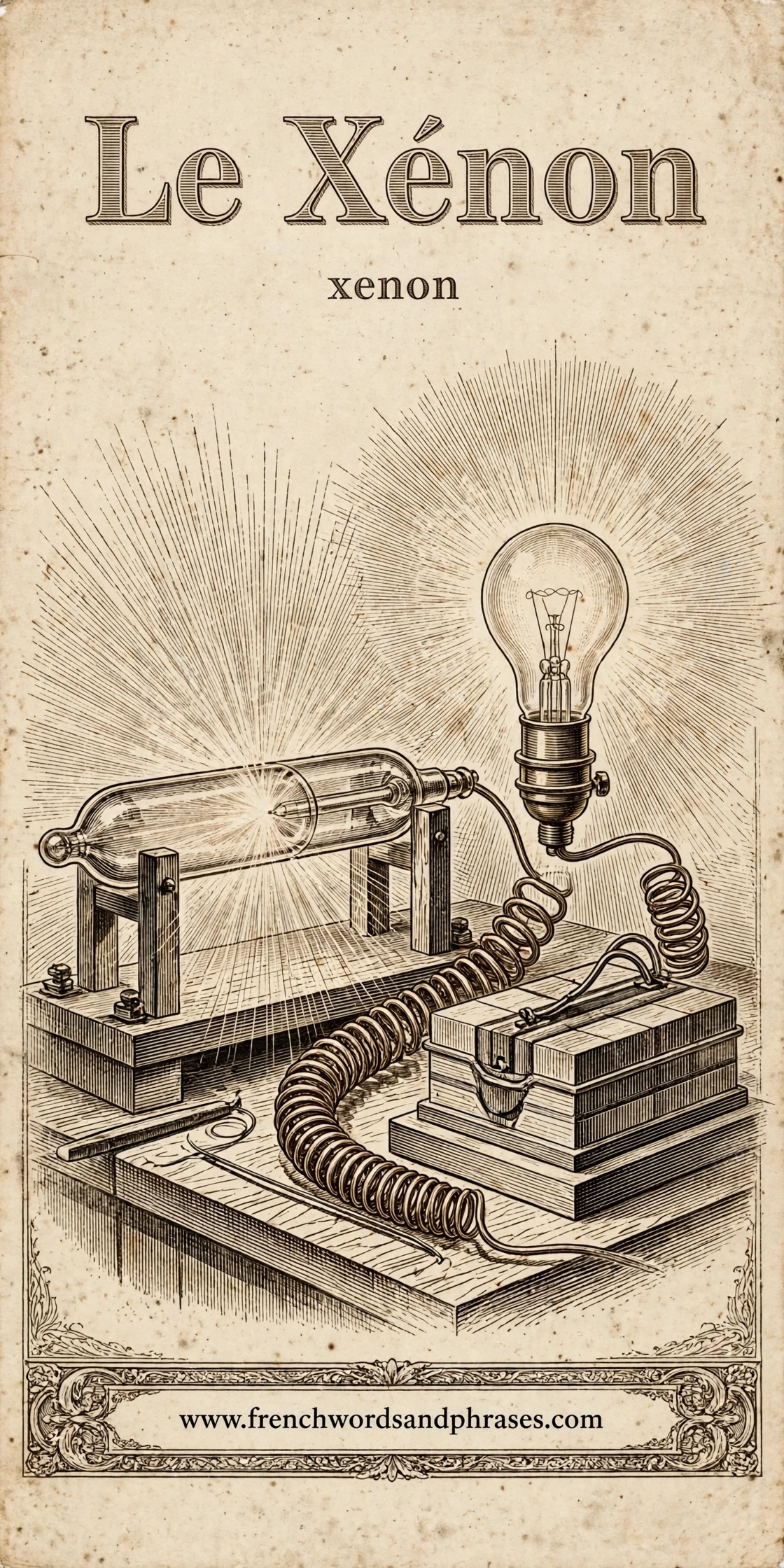
Le xénon means xenon.
Night falls on the motorway. Ahead, two beams cut the darkness with a cold blue-white light, brighter than any lamp of the old yellow kind. That light burns with a rare and silent gas — le xénon.
In this guide, you’ll learn what xénon means in English, how to use it with its articles, how to form its plural, and how it appears in everyday French. Explore French examples, English translations, and practice quizzes.
Understanding the French Noun Xénon
Xénon is a masculine French noun. It is learned together with its article: le xénon. Its name comes from the Greek xenos, the stranger — the strange gas nobody expected to find hiding in the air.
It means xenon — a noble gas, chemical symbol Xe, present in tiny traces in the air we breathe. Sealed inside a lamp or a car headlight, it glows with an intense blue-white light when electricity passes through it, which is why French drivers know it above all in one phrase: les phares au xénon, xenon headlights.
Gender: Masculine
Definite article: le — le xénon (the xenon)
Indefinite article: un — rarely used; xénon names a substance, usually just le xénon
Plural: les xénons (rare)
English equivalents: Xenon (symbol Xe); a noble gas.
One important usage detail: xénon almost always works as a label after au — des phares au xénon, une lampe au xénon. And listen to the first letter: the X sounds like « gz », so xénon begins with a hard, buzzing sound.
Experience the Word
Xénon is more than a gas. It is the stranger in the air — invisible, odourless, and suddenly brilliant when the current strikes.
Imagine the dark country road: your headlights open a tunnel of white light, and the signs flare blue as you pass. That is xénon at work.
You have not just filled a lamp. You have bottled a stranger.
How to Use Xénon in French: Complete Guide
Let’s explore how xénon works in French, beginning with its articles.
Xénon with the Definite Article (Le, Les)
Used for the gas itself — the substance in the lamp, the element on the chart.
| Number | French |
|---|---|
| Singular | le xénon |
| Plural | les xénons |
Example
Le xénon est un gaz noble très rare.
Xenon is a very rare noble gas.
Xénon with the Indefinite Article (Un, Des)
The indefinite article is rare with a substance, but it appears when one lamp or tube filled with the gas is meant.
| Number | French |
|---|---|
| Singular | un xénon |
| Plural | des xénons |
Example
On a installé un xénon dans le projecteur.
A xenon lamp was installed in the projector.
Xénon, the Stranger Gas
A rare gas with a Greek name — the phrases that pin it down.
| French | In English |
|---|---|
| un gaz noble | a noble gas |
| un gaz rare | a rare gas |
| les phares au xénon | xenon headlights |
| une lampe au xénon | a xenon lamp |
| un tube au xénon | a xenon tube |
Example
Ses phares au xénon éclairent toute la route.
Its xenon headlights light up the whole road.
Quick Quiz 1
What are les phares au xénon?
Reveal the answer
Xenon headlights — car headlights whose lamps are filled with xenon gas.
Les phares au xénon sont très puissants.
Xenon headlights are very powerful.
The Plural of Xénon
The plural exists — les xénons — but it is rare: nature holds only one xenon, so French mostly keeps it singular.
| Number | French |
|---|---|
| Singular | le xénon |
| Plural | les xénons |
Example
On classe le xénon parmi les gaz nobles.
Xenon is classed among the noble gases.
Xénon with Possessive Adjectives (Mon, Ton, Son…)
Possessives agree with the noun, not with the owner — and xénon is masculine, so it takes mon, ton, son.
| Owner | French |
|---|---|
| my | mon xénon |
| your (tu) | ton xénon |
| his / her | son xénon |
| our | notre xénon |
| your (vous) | votre xénon |
| their | leur xénon |
Example
Il a changé son xénon, le phare gauche ne marchait plus.
He changed his xenon lamp; the left headlight no longer worked.
Quick Quiz 2
Complete the sentence:
Les ______ au xénon éclairent très bien la nuit.
Reveal the answer
phares
Les phares au xénon éclairent très bien la nuit.
Xenon headlights light the road very well at night.
Xénon with Demonstrative Adjectives (Ce, Ces)
Used to point: this xenon here, those xenons there.
| Number | French |
|---|---|
| Singular | ce xénon |
| Plural | ces xénons |
Example
Ce xénon donne une lumière blanche et froide.
This xenon gives a white, cold light.
Xénon with Adjectives
Adjectives agree with xénon, masculine — rare, pur, inerte, the words of the chemistry lesson.
| Adjective | With Xénon |
|---|---|
| rare (rare) | un xénon rare |
| pur (pure) | du xénon pur |
| inerte (inert) | le xénon inerte |
| noble (noble) | le xénon, gaz noble |
| lumineux (luminous) | un xénon lumineux |
Example
Le xénon pur ne réagit presque jamais.
Pure xenon almost never reacts.
Quick Quiz 3
Complete the sentence:
Le xénon est un gaz ______, il ne réagit pas. (inert)
Reveal the answer
inerte
Le xénon est un gaz inerte, il ne réagit pas.
Xenon is an inert gas, it does not react.
Everyday Expressions with Xénon
On the road and in the laboratory, these are the xénon phrases.
| Expression | In English |
|---|---|
| les phares au xénon | xenon headlights |
| une lampe au xénon | a xenon lamp |
| un gaz noble | a noble gas |
| un gaz rare | a rare gas |
| le symbole Xe | the symbol Xe |
| présent dans l’air | present in the air |
Example
Cette voiture a des phares au xénon.
This car has xenon headlights.
Words from the Same Family as Xénon
Gases, lamps and headlights — the words that travel with xénon.
| French | In English |
|---|---|
| le gaz | the gas |
| la lampe | the lamp |
| le phare | the headlight |
| le néon | neon |
| l’hélium | helium |
| l’argon | argon |
Example
Le néon et le xénon sont des gaz nobles.
Neon and xenon are noble gases.
Quick Quiz 4
Why is xenon called the stranger gas?
Reveal the answer
Its name — it comes from the Greek xenos, the stranger, an unexpected gas found hiding in the air.
Le xénon se cachait dans l’air.
The xenon was hiding in the air.
Xénon in Everyday French: Real-Life Examples
Now that you know the word, let’s see how xénon appears in everyday French.
Example 1 — On the road
Les phares au xénon éclairent mieux la nuit.
Xenon headlights light the road better at night.
Example 2 — At the garage
Il faut changer la lampe au xénon du phare droit.
The xenon lamp in the right headlight needs changing.
Example 3 — In science class
Le xénon est un gaz noble, comme l’hélium.
Xenon is a noble gas, like helium.
Example 4 — At the cinema
Le projecteur utilise une lampe au xénon très puissante.
The projector uses a very powerful xenon lamp.
Example 5 — A small quantity
Il y a très peu de xénon dans l’air.
There is very little xenon in the air.
Example 6 — Buying a car
Ce modèle a des phares au xénon de série.
This model has xenon headlights as standard.
Beyond Translation: The Meaning of Xénon
Every French schoolchild meets the noble gases as a quiet family at the edge of the chemistry chart — and xénon is the shyest of them, named by its discoverers for the Greek word for stranger.
To say xénon is to give the invisible a name.
It evokes the blue-white beam on a night road, the cinema projector’s fierce little sun, the trace of gas in every breath of air — a stranger that was among us all along.
How to Remember the French Noun Xénon
Remember it this way: Xénon is the stranger gas — masculine, with le, symbol Xe, famous for its headlights.
- You name the family — le xénon is un gaz noble, like helium and neon.
- You drive at night — les phares au xénon light the road.
- You remember the Greek — xenos, the stranger hiding in the air.
The key idea is les phares au xénon, and xenos the stranger.
Test Your Knowledge of Xénon
Let’s see how much you’ve learned. Try answering these questions before revealing the answers.
Question 1
Is xénon masculine or feminine?
Reveal the answer
Masculine — le xénon.
Question 2
What is the chemical symbol of xenon?
Reveal the answer
Xe.
Question 3
Translate: This car has xenon headlights.
Reveal the answer
Cette voiture a des phares au xénon.
Question 4
What kind of gas is xenon?
Reveal the answer
A noble gas — un gaz noble, rare and inert.
Question 5
Complete the sentence:
Le xénon vient du grec xenos, qui veut dire ______.
Reveal the answer
étranger
Le xénon vient du grec xenos, qui veut dire étranger.
Xenon comes from the Greek xenos, which means stranger.
Your Final Challenge
Can You Use It?
How would you say this in French?
“Xenon headlights light up the whole road.”
Reveal the answer
Les phares au xénon éclairent toute la route.
Xenon headlights light up the whole road.
A little French. A little curiosity. A richer everyday life.
LEARN FRENCH ONE WORD AT A TIME