A French Word to Live By
Translate Vouloir le beurre et l’argent du beurre to English
/vu.lwaʁ lə bœʁ e laʁ.ʒɑ̃ dy bœʁ/
Vouloir le beurre et l’argent du beurre means to want the butter and the money for the butter — to want it both ways, to have your cake and eat it.
Your neighbour is selling his old bicycle. He wants the full price in cash by Friday — and he also wants to keep borrowing the bicycle every weekend for his trips to the market. His buyer laughs and shakes his head: you cannot sell a thing and keep using it. In French, the whole impossible order fits in one market phrase: « Il veut le beurre et l’argent du beurre. »
Let’s explore how vouloir le beurre et l’argent du beurre works in French, beginning with the whole phrase on one card.
Understanding the French Phrase Vouloir le beurre et l’argent du beurre
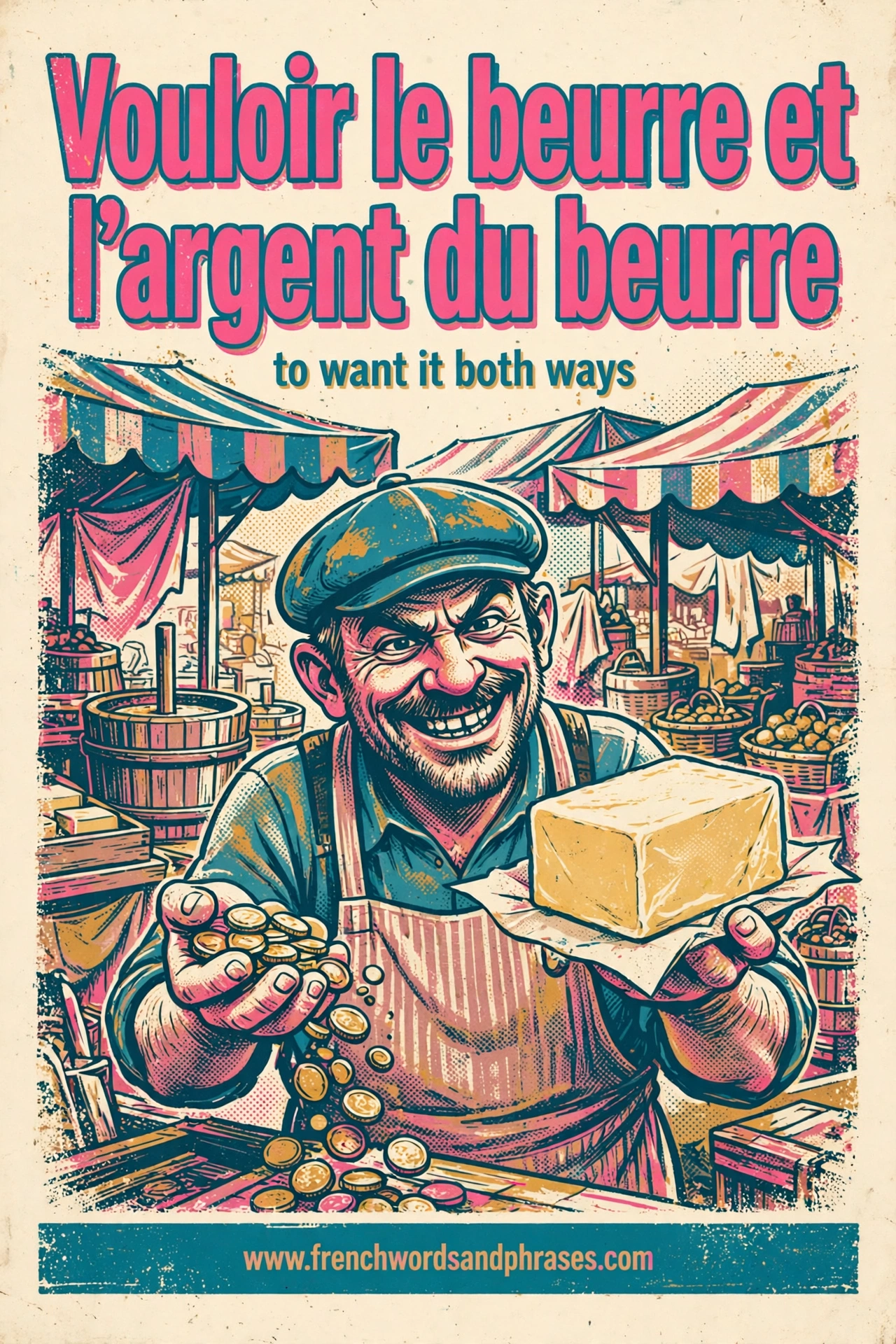
Vouloir le beurre et l’argent du beurre is a French idiomatic expression built from vouloir (to want), le beurre (the butter) and l’argent du beurre (the money the butter was sold for). The picture is a market stall: the farmer sells the butter, pockets the money — and then wants the butter back on his own table too. Two gains, one butter, impossible.
It means to want it both ways — to want two advantages that cancel each other out, to have your cake and eat it. Nobody is churning anything: the butter is whatever was given up, and the money is what it was exchanged for. The phrase is the standard French reply to any demand that tries to keep both sides of a bargain.
Type: Idiomatic expression — greed and logic (vouloir + two nouns)
Answers the need: Saying someone wants two incompatible advantages at once
Register: Neutral to informal — proverbial, often said with a smile or a sigh
Strength: Firm — not a mild wish, but an impossible double demand
One important usage detail: the phrase very often appears in the negative, as a law of life — on ne peut pas avoir le beurre et l’argent du beurre, you can’t have it both ways. A longer, joking version adds a third impossible item: le beurre, l’argent du beurre et le sourire de la crémière — the butter, the money, and the dairymaid’s smile.
Experience the Word
Vouloir le beurre et l’argent du beurre is the market’s answer to every impossible demand — economics taught with a dairy product and a grin.
Imagine the student who wants the top mark without the revision, the employee who wants the promotion and the quiet life, the city that wants the tourists and the empty streets. Each one is standing at the same stall, asking the farmer to sell the butter and serve it too.
French proverb-wisdom is rarely abstract. It prefers a stall, a coin and a pat of butter: things you can count, and cannot have twice.
How to Use Vouloir le beurre et l’argent du beurre in French: Complete Guide
Let’s explore how vouloir le beurre et l’argent du beurre works in French, beginning with the whole phrase on one card.
Vouloir le beurre et l’argent du beurre at a Glance
The Whole Phrase on One Card
Real meaning, literal picture, English twin and register — vouloir le beurre et l’argent du beurre in five lines.
| Point | Vouloir le beurre et l’argent du beurre |
|---|---|
| What it really means | to want it both ways — two advantages that cancel each other out |
| Word for word | to want the butter and the money for the butter |
| English equivalent | to have your cake and eat it / to want it both ways |
| Register | neutral to informal — proverbial, smiling or exasperated |
| Use it for | impossible demands, double standards, bargains someone wants twice |
Example
Il veut une promotion sans responsabilités : le beurre et l’argent du beurre.
He wants a promotion with no responsibilities: to have it both ways.
Word by Word: Building the Impossible Bargain
Four small pieces — take them one by one and the stallholder starts shaking his head.
| Word | Literal meaning | Its job in the phrase |
|---|---|---|
| vouloir | to want | the wanting itself — the phrase lives in this verb’s forms, or in avoir for the proverb |
| le beurre | the butter | the goods — what was sold, spent or given up |
| et | and | the impossible little word: both, at once |
| l’argent du beurre | the money for the butter | the price received for the goods — the second gain that excludes the first |
Example
Tu veux le beurre et l’argent du beurre, c’est impossible.
You want it both ways — it’s impossible.
Quick Quiz 1
Why can’t the farmer have both the butter and the money for the butter?
Reveal the answer
Because the money exists only if the butter is sold — each gain cancels the other; that is the whole logic of the phrase.
Vendre le beurre ou le manger : il faut choisir.
Sell the butter or eat it: you have to choose.
When You Say It: The Both-Ways Moments
Vouloir le beurre et l’argent du beurre fires at moments like these — someone is asking for two things that exclude each other.
| Situation | Example |
|---|---|
| At work | il veut le salaire sans les horaires : le beurre et l’argent du beurre — he wants the salary without the hours: both ways |
| In a sale | elle veut vendre la voiture et la garder le week-end — she wants to sell the car and keep it at weekends |
| In politics | promettre moins d’impôts et plus de services, c’est vouloir le beurre et l’argent du beurre — promising lower taxes and more services is wanting it both ways |
| With children | tu veux le dessert et garder ta part pour demain — you want the pudding and to keep your share for tomorrow |
| In love | il veut la liberté et une promesse éternelle — he wants freedom and an eternal promise |
Example
On ne peut pas avoir le beurre et l’argent du beurre, il faut choisir.
You can’t have it both ways, you have to choose.
Make It Yours: The Impossible Bargain for Every Wanter
Vouloir carries the phrase — and the proverb form switches to avoir for the law of life.
| Form | French | In English |
|---|---|---|
| He wants it both ways | il veut le beurre et l’argent du beurre | he wants it both ways |
| She wants it both ways | elle veut le beurre et l’argent du beurre | she wants it both ways |
| The law of life | on ne peut pas avoir le beurre et l’argent du beurre | you can’t have it both ways |
| The short version | le beurre et l’argent du beurre | both ways — the whole demand in six words |
| The joking extension | et le sourire de la crémière | and the dairymaid’s smile — a third impossible gain |
| Question | tu veux le beurre et l’argent du beurre ? | do you want it both ways? |
Example
Le beurre, l’argent du beurre et le sourire de la crémière : il ne demande pas grand-chose !
The butter, the money for the butter and the dairymaid’s smile: he’s not asking for much!
Quick Quiz 2
Which verb carries the famous negative proverb — vouloir or avoir?
Reveal the answer
Avoir — on ne peut pas avoir le beurre et l’argent du beurre: you cannot have both. Vouloir names the wish; avoir states the law.
Il veut tout avoir, mais on ne peut pas tout avoir.
He wants to have everything, but you can’t have everything.
Everyday Expressions: Building on the Impossible Bargain
Vouloir le beurre et l’argent du beurre slots into these everyday frames — each one ready to use as it stands.
| Frame | In English |
|---|---|
| vouloir le beurre et l’argent du beurre | to want it both ways |
| on ne peut pas avoir le beurre et l’argent du beurre | you can’t have your cake and eat it |
| le beurre et l’argent du beurre | both sides of the bargain — the short form |
| vouloir tout avoir | to want to have everything — the plain summary |
| il faut choisir | you have to choose — the answer the phrase always implies |
Example
Entre la mer et la montagne, il faut choisir : pas de beurre et d’argent du beurre.
Between the sea and the mountains, you have to choose: no having it both ways.
Close Cousins: The Other Impossible Wishes
French has a whole shelf of both-ways phrases — the butter is the market one; its cousins guard doors, keep coats dry, and want everything at once.
| Expression | The difference |
|---|---|
| vouloir le beurre et l’argent du beurre | to want it both ways — the sold goods and their price together |
| ménager la chèvre et le chou | to keep both sides happy — to spare the goat and the cabbage: diplomacy, not greed |
| vouloir tout et son contraire | to want everything and its opposite — the plain, proverb-free version |
| être à la fois au four et au moulin | to be in two places at once — the oven and the mill: about presence, not profit |
| tout vouloir, tout de suite | to want everything, right now — impatience rather than contradiction |
Example
Le maire essaie de ménager la chèvre et le chou entre les deux quartiers.
The mayor is trying to keep both districts happy at once.
Quick Quiz 3
A negotiator keeps two angry camps both satisfied. Le beurre et l’argent du beurre or ménager la chèvre et le chou?
Reveal the answer
Ménager la chèvre et le chou — sparing both the goat and the cabbage is diplomacy. The beurre is about one person’s impossible double gain.
Bon diplomate, il a ménagé la chèvre et le chou.
A good diplomat, he kept both sides happy.
Vouloir le beurre et l’argent du beurre and Its Neighbours
The market shelf around the phrase — the goods, the coin, and the stallholder who says no.
| French | In English |
|---|---|
| le beurre | butter |
| l’argent | money — and also silver |
| la crémière | the dairymaid — of the joking third demand |
| un marché | a market, a bargain |
| choisir | to choose — the only honest exit |
| tout vouloir | to want everything |
Example
Au marché de la vie, il faut souvent choisir.
At life’s market, you often have to choose.
Watch Out: The Traps Around Vouloir le beurre et l’argent du beurre
The traps: real butter, the avoir form hiding inside the proverb, and a goat that is not greed.
| Trap | The truth |
|---|---|
| the dairy trap | acheter du beurre is shopping — the idiom needs the butter and its money wanted together, by the same person |
| vouloir becomes avoir | the negative proverb runs on avoir: on ne peut pas avoir le beurre… — quoting it with vouloir sounds off |
| not simple greed | wanting a lot is not the phrase — the two gains must exclude each other logically |
| the crémière is a joke | the dairymaid’s smile is a humorous extension, not part of the classic phrase — add it only for a laugh |
Example
Elle a acheté du beurre au marché, sans vouloir l’argent du beurre.
She bought some butter at the market, without wanting the money for the butter too.
Quick Quiz 4
True or false: the phrase criticises anyone who wants a lot.
Reveal the answer
False — it criticises wanting two gains that cancel each other out, like the sold butter and its price.
Vouloir beaucoup, c’est permis ; vouloir l’impossible, non.
Wanting a lot is allowed; wanting the impossible is not.
Vouloir le beurre et l’argent du beurre in Everyday French: Real-Life Examples
Now that you know the word, let’s see how vouloir le beurre et l’argent du beurre appears in everyday French.
Example 1 — At work
Il veut le beurre et l’argent du beurre : le poste sans les réunions.
He wants it both ways: the job without the meetings.
Example 2 — The bicycle sale
Tu vends ton vélo, mais tu ne peux pas avoir le beurre et l’argent du beurre.
You’re selling your bike, but you can’t have it both ways.
Example 3 — The family verdict
Elle veut le beurre, l’argent du beurre et le sourire de la crémière.
She wants the butter, the money for the butter, and the dairymaid’s smile.
Example 4 — The budget debate
Moins d’impôts et plus d’hôpitaux ? Le beurre et l’argent du beurre.
Lower taxes and more hospitals? Having it both ways.
Example 5 — The child’s wish
Tu veux manger ton gâteau et le garder pour demain : impossible.
You want to eat your cake and keep it for tomorrow: impossible.
Example 6 — The plain law
On ne peut pas avoir le beurre et l’argent du beurre.
You can’t have your cake and eat it.
Beyond Translation: The Meaning of Vouloir le beurre et l’argent du beurre
English bakes a cake for its impossible wish; French churns butter. The cake proverb complains about eating; the butter proverb complains about selling — the French version is a merchant’s lesson, not a glutton’s. Behind it stands the whole honour of the market stall: a bargain is a bargain, and what has been sold is gone.
To vouloir le beurre et l’argent du beurre is to try to be paid twice for the same thing — and the stallholder’s headshake is the oldest economics in France.
The joking third item, the dairymaid’s smile, shows the phrase is loved as much as quoted: French speakers embroider it the way you only embroider family property.
How to Remember the French Phrase Vouloir le beurre et l’argent du beurre
Remember it this way: Vouloir le beurre et l’argent du beurre is the market stall of impossible wishes — the butter is sold, the coin is pocketed, and someone still wants breakfast.
- You picture the stall — one pat of butter, one coin, and a customer trying to leave with both.
- You learn the law with avoir — on ne peut pas avoir le beurre et l’argent du beurre.
- You keep the joke in reserve — et le sourire de la crémière, for the truly shameless demands.
The key idea is vouloir le beurre et l’argent du beurre means to want it both ways — the butter and the money it was sold for.
Test Your Knowledge of Vouloir le beurre et l’argent du beurre
Let’s see how much you’ve learned. Try answering these questions before revealing the answers.
Question 1
What does vouloir le beurre et l’argent du beurre mean?
Reveal the answer
To want it both ways — to want two advantages that cancel each other out, like the sold butter and its price.
Question 2
What is the literal, word-for-word meaning?
Reveal the answer
To want the butter and the money for the butter — the goods and their price, demanded together.
Question 3
How do you say ‘you can’t have it both ways’?
Reveal the answer
On ne peut pas avoir le beurre et l’argent du beurre — the proverb form runs on avoir, not vouloir.
Question 4
What is the difference between this phrase and ménager la chèvre et le chou?
Reveal the answer
Ménager la chèvre et le chou is diplomacy — keeping two opposing sides happy. The beurre is one person’s impossible double gain.
Question 5
Complete the sentence:
On ne peut pas avoir le beurre et l’______ du beurre. (You can’t have it both ways.)
Reveal the answer
argent
On ne peut pas avoir le beurre et l’argent du beurre.
You can’t have it both ways.
Your Final Challenge
Can You Use It?
How would you say this in French?
“You can’t have it both ways.”
Reveal the answer
On ne peut pas avoir le beurre et l’argent du beurre.
You can’t have it both ways.
A little French. A little curiosity. A richer everyday life.
LEARN FRENCH ONE WORD AT A TIME