A French Word to Live By
Translate Vis-à-vis de to English
/vi.za.vi də/
Vis-à-vis de means in relation to / towards.
Two café terraces face each other across a narrow street in Arles, and the waiters wave to each other between services. In the estate agent’s window between them, a card reads: « Appartement calme, sans vis-à-vis » — a quiet flat, not overlooked. Vis-à-vis begins as face-to-face; vis-à-vis de stretches that facing into a stance: how you stand in relation to someone, and what you owe them.
Let’s explore how vis-à-vis de works in French, beginning with the whole phrase on one card.
Understanding the French Preposition Vis-à-vis de
Vis-à-vis de is a French compound preposition of relation — vis-à-vis (face to face) + de. It is followed by a noun or pronoun, and it states a stance: responsibilities, attitudes and positions held in relation to someone. Without de, vis-à-vis keeps its literal face-to-face sense.
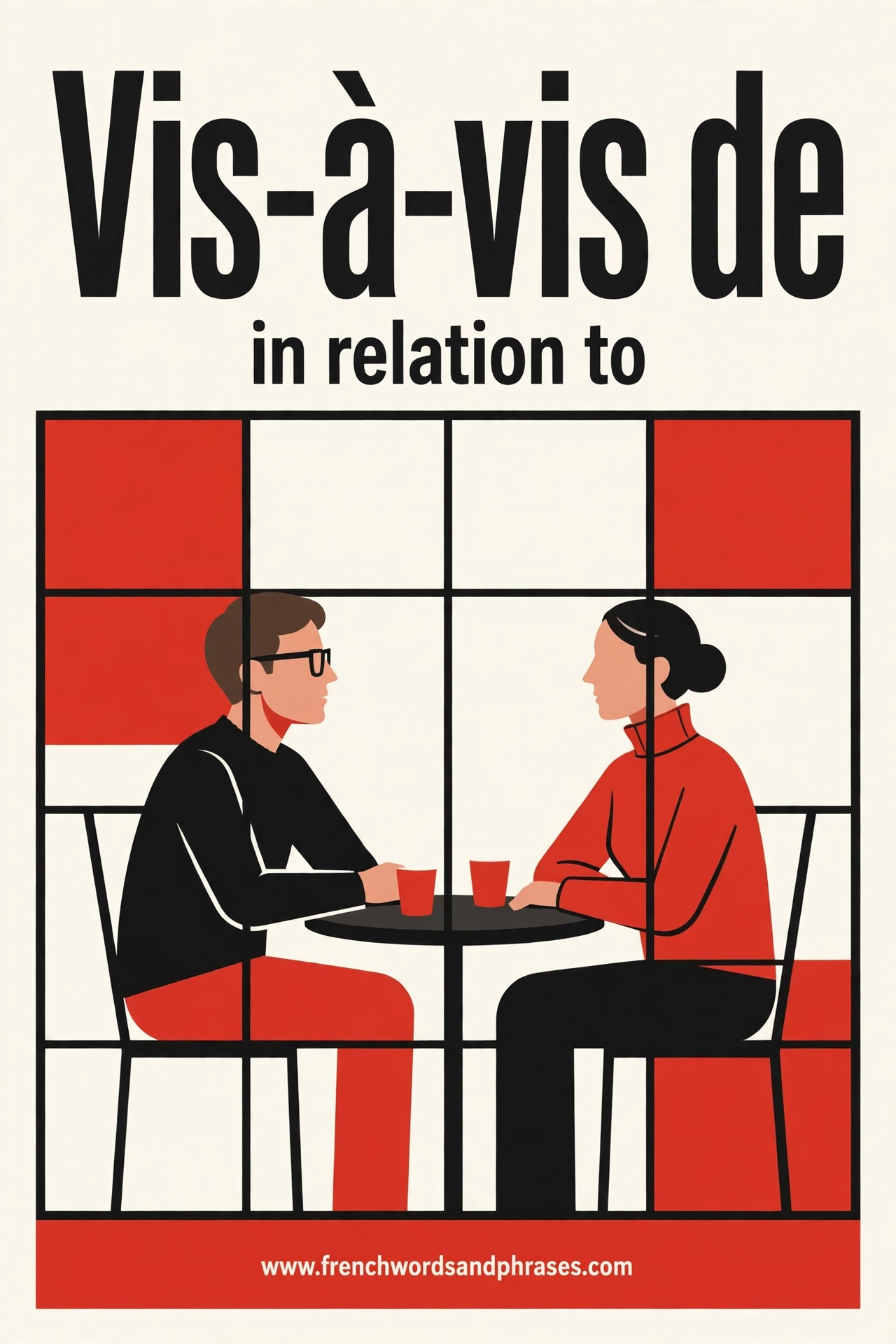
It means in relation to, towards. Picture two people seated face to face across a table: everything between them — duty, honesty, patience — is vis-à-vis. French uses that picture for the abstract facing too: your position vis-à-vis des clients is the face you present to them.
Type: Compound preposition — relation and stance
Answers the question: Vis-à-vis de qui / quoi ? — In relation to whom / what?
What follows it: A noun or pronoun: vis-à-vis des clients, vis-à-vis de lui — de + les = des
Watch the pair: vis-à-vis de (in relation to — a stance) vs vis-à-vis alone (opposite, facing — the flat across the street)
One important usage detail: vis-à-vis often appears without de in modern French — vis-à-vis des enfants is common alongside vis-à-vis de + noun — but the de form is the full preposition taught here. Without any noun, un vis-à-vis is the building or person opposite, and ‘sans vis-à-vis’ in a property advert means not overlooked.
Experience the Word
Vis-à-vis de is the preposition of the two chairs across the table — every duty and attitude measured face to face.
Imagine a young doctor on her first ward round, stopping at each bed, aware that her calm vis-à-vis des patients — in relation to the patients — is half the treatment.
You have not just named a relationship. You have sat down opposite someone, and stated how you face them.
How to Use Vis-à-vis de in French: Complete Guide
Let’s explore how vis-à-vis de works in French, beginning with the whole phrase on one card.
Vis-à-vis de at a Glance
The Whole Phrase on One Card
Meaning, job, pattern and pair — vis-à-vis de in four lines.
| Point | Vis-à-vis de |
|---|---|
| Meaning | in relation to / towards — the stance you hold facing someone |
| Job | states responsibilities, attitudes and positions between people or groups |
| What follows | a noun or pronoun — les clients, les enfants, lui |
| Contraction note | de + les = des: vis-à-vis des usagers; de + le = du also occurs: vis-à-vis du public |
Example
Elle est très patiente vis-à-vis des enfants.
She is very patient towards children.
The Pattern in Action: Facing, Then Standing
Vis-à-vis de connects a stance to the people it faces — responsibilities, honesty and patience all take their places across the table.
| Pattern | Example |
|---|---|
| a responsibility | nos responsabilités vis-à-vis des clients — our responsibilities towards our clients |
| an attitude | son attitude vis-à-vis des jeunes a changé — his attitude towards young people has changed |
| honesty in a relationship | soyez honnête vis-à-vis de vos partenaires — be honest with your partners |
| a position on an issue | la position du maire vis-à-vis du projet — the mayor’s position in relation to the project |
Example
Il a toujours été correct vis-à-vis de ses collègues.
He has always been fair towards his colleagues.
Quick Quiz 1
In a property advert, what does sans vis-à-vis promise?
Reveal the answer
That the flat is not overlooked — no facing windows; here vis-à-vis is the literal neighbour opposite.
Sans vis-à-vis.
Not overlooked.
The Tricky Bit: The Stance vs The Facing Window
With de and a person, vis-à-vis states a stance; alone, it goes back to bricks and windows — face to face across a street or a table.
| Use | Example |
|---|---|
| stance (vis-à-vis de + person) | sa responsabilité vis-à-vis des patients — her responsibility towards the patients |
| facing, physical | la boulangerie est vis-à-vis de la poste — the bakery is opposite the post office |
| the noun: the one opposite | mon vis-à-vis à table était charmant — my dinner partner opposite was charming |
| property language | un balcon sans vis-à-vis — a balcony that is not overlooked |
Example
Assise vis-à-vis de son professeur, elle écoute ses conseils vis-à-vis de son avenir.
Seated opposite her teacher, she listens to his advice regarding her future.
Where It Goes: After Nouns of Duty and Attitude
Vis-à-vis de follows the same weighed nouns as its cousin à l’égard de — attitude, responsabilité, position, comportement.
| Position / pattern | Example |
|---|---|
| noun of duty + vis-à-vis de | des responsabilités vis-à-vis des usagers |
| adjective + vis-à-vis de | honnête / patient / correct vis-à-vis de quelqu’un |
| with a pronoun | vis-à-vis de lui, elle reste prudente — in relation to him, she stays cautious |
| modern shortened form | vis-à-vis des enfants (without de) is common in speech and journalism |
Example
Leur comportement vis-à-vis des nouveaux doit être exemplaire.
Their behaviour towards newcomers must be exemplary.
Quick Quiz 2
“The bakery is opposite the post office” — with or without de?
Reveal the answer
Both forms are heard; vis-à-vis de la poste states the facing plainly.
La boulangerie est vis-à-vis de la poste.
The bakery is opposite the post office.
Everyday Expressions with Vis-à-vis de
Vis-à-vis de divides its life between the estate agent’s window and the formal report.
| Expression | In English |
|---|---|
| sans vis-à-vis | not overlooked (property adverts) |
| un vis-à-vis | the person or building opposite |
| être vis-à-vis | to be opposite, facing |
| vis-à-vis de + person | towards, in relation to (a stance) |
| en vis-à-vis | facing each other (two buildings, two windows) |
Example
Cet appartement, en vis-à-vis avec une cour, est très calme.
This flat, facing a courtyard, is very quiet.
Close Cousins: The Other Relations
Four neighbours that also state how people stand — from the formal desk to the café table.
| Word | The difference |
|---|---|
| à l’égard de | with regard to — the closest formal cousin, attitudes and topics |
| envers | towards — feelings to people, warmer and less formal |
| par rapport à | in relation to / compared with — the everyday all-rounder |
| face à | facing — a physical or difficult confrontation: face à la tempête |
Example
Face à la critique, elle reste honnête vis-à-vis de ses lecteurs.
Faced with criticism, she stays honest towards her readers.
Quick Quiz 3
Which cousin is the everyday phrase for “compared with”?
Reveal the answer
par rapport à — par rapport à l’année dernière.
Par rapport à l’année dernière.
Compared with last year.
Vis-à-vis de and Its Neighbours
The relation shelf: in relation to, towards, with regard to, facing.
| French | In English |
|---|---|
| vis-à-vis de | in relation to / towards |
| à l’égard de | with regard to / towards (formal) |
| envers | towards (feelings) |
| par rapport à | in relation to / compared with |
| face à | facing / faced with |
Example
Envers ses élèves, et vis-à-vis des parents, elle est d’une patience remarquable.
Towards her pupils, and in relation to the parents, she is remarkably patient.
Watch Out: The Traps Around Vis-à-vis de
The traps: the hyphens, the phantom translation, and the advert sense.
| Trap | The truth |
|---|---|
| writing it ‘vis à vis’ | the hyphens are part of the word: vis-à-vis, always hyphenated |
| translating word by word as ‘seen at seen’ | vis-à-vis is one fixed block — face to face — never translate its pieces |
| reading ‘sans vis-à-vis’ as an attitude | in adverts it is bricks and windows: not overlooked |
| using vis-à-vis de for a simple topic | for ‘about’ a subject, au sujet de or à propos de is lighter; vis-à-vis de states a stance between people |
Example
Un studio sans vis-à-vis, calme vis-à-vis du bruit de la rue.
A studio that is not overlooked, quiet in relation to the noise of the street.
Quick Quiz 4
Complete: Elle est très patiente ______ des enfants.
Reveal the answer
vis-à-vis — a stance held towards people.
Elle est très patiente vis-à-vis des enfants.
She is very patient towards children.
Vis-à-vis de in Everyday French: Real-Life Examples
Now that you know the word, let’s see how vis-à-vis de appears in everyday French.
Example 1 — Patience
Elle est très patiente vis-à-vis des enfants.
She is very patient towards children.
Example 2 — Responsibility
Nous avons des responsabilités vis-à-vis de nos clients.
We have responsibilities towards our clients.
Example 3 — Honesty
Il a toujours été honnête vis-à-vis de ses partenaires.
He has always been honest with his partners.
Example 4 — A flat advert
Bel appartement lumineux, sans vis-à-vis, au dernier étage.
Lovely bright flat, not overlooked, on the top floor.
Example 5 — An attitude change
Son attitude vis-à-vis des jeunes a beaucoup changé.
His attitude towards young people has changed a lot.
Example 6 — Facing windows
Les deux maisons sont en vis-à-vis, séparées par un jardin.
The two houses face each other, separated by a garden.
Beyond Translation: The Meaning of Vis-à-vis de
Vis-à-vis is French at its most visual: two faces, vis to vis, turned towards each other. Vis-à-vis de keeps that geometry when it leaves the street and enters the report — a stance is still a facing, a responsibility still has someone across the table.
To say vis-à-vis de is to take your seat opposite someone and state, plainly, how you face them.
And when the phrase goes home to property adverts — sans vis-à-vis, not overlooked — it promises the one luxury every face-to-face city dweller understands: a window nobody can see into.
How to Remember the French Preposition Vis-à-vis de
Remember it this way: Vis-à-vis de is the two chairs across the table — a stance always has someone facing you on the other side.
- You picture faces — vis-à-vis is face to face first, a stance second.
- You keep the hyphens — vis-à-vis de, one hyphenated block, every time.
- You save the advert sense — sans vis-à-vis means not overlooked, not an attitude.
The key idea is vis-à-vis de means in relation to or towards, states a stance between people, and alone means opposite or overlooked.
Test Your Knowledge of Vis-à-vis de
Let’s see how much you’ve learned. Try answering these questions before revealing the answers.
Question 1
What does vis-à-vis de mean?
Reveal the answer
In relation to / towards — the stance, duty or attitude held facing someone.
Question 2
What follows vis-à-vis de?
Reveal the answer
A noun or pronoun — vis-à-vis des clients, vis-à-vis de lui. In modern French the de is often dropped before the noun.
Question 3
Translate: She is very patient towards children.
Reveal the answer
Elle est très patiente vis-à-vis des enfants.
Question 4
What is the difference between vis-à-vis de and vis-à-vis alone?
Reveal the answer
Vis-à-vis de states a stance (responsibilities, attitudes); vis-à-vis alone is literal — opposite, facing, or the building across the way.
Question 5
Complete the sentence:
Nous avons des responsabilités ______ nos clients. (towards our clients)
Reveal the answer
vis-à-vis de
Nous avons des responsabilités vis-à-vis de nos clients.
We have responsibilities towards our clients.
Your Final Challenge
Can You Use It?
How would you say this in French?
“She is very patient towards children.”
Reveal the answer
Elle est très patiente vis-à-vis des enfants.
She is very patient towards children.
A little French. A little curiosity. A richer everyday life.
LEARN FRENCH ONE WORD AT A TIME