
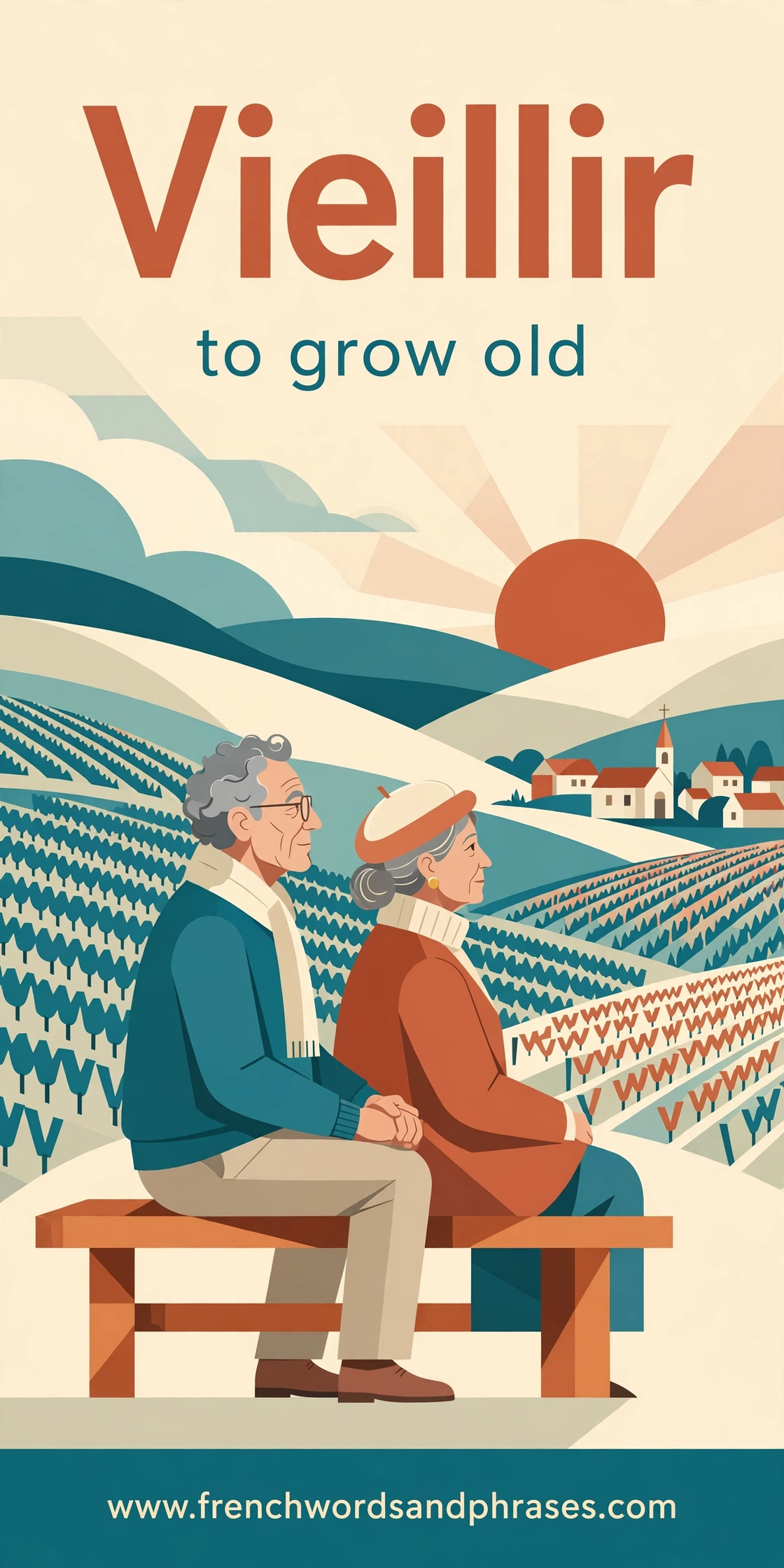
A French Word to Live By
How to Conjugate Vieillir in French
/vjɛ.jiʁ/
Vieillir means to grow old, to age.
Faces in old photographs, a house by the sea, a bottle of wine in a cellar — time changes them all. In French, that slow change is vieillir.
In this guide, you’ll learn how to conjugate vieillir in all the major French tenses and moods. Explore complete conjugation tables, French examples, English translations, and practice quizzes.
Understanding the French Verb Vieillir
Vieillir is a regular French verb belonging to the second group of verbs, those ending in -ir.
It means to grow old, to age. It is commonly used for people and things growing old — vieillir avec le temps — and, with a direct object, for ageing something on purpose: vieillir un vin (to age a wine).
Verb classification: Second group (-ir)
Auxiliary verb: Avoir or être, depending on the construction
Past participle: vieilli
Present participle: vieillissant
English equivalents: To grow old, to age, to grow older.
One important detail: vieillir follows the pattern of finir — the stem grows to vieilliss- in the plural of the present tense and in the imperfect: nous vieillissons, je vieillissais. It usually takes avoir — il a bien vieilli depuis un an (he has aged a lot in a year). In older and literary French, être marks the state that results — il est bien vieilli (he looks well aged). The tables on this page use avoir, the auxiliary of everyday French.
Experience the Word
Vieillir is the verb of slow time — the lines on a face, the grey in the hair, the wine growing deeper in the cellar.
Imagine returning to a village you left twenty years ago. The café is still there, the church is still there, but the baker is white-haired now, and the house where you grew up has new shutters and an old roof.
You have not just come back. You have seen time at work.
How to Conjugate Vieillir: Complete French Conjugation Guide
Let’s explore every major conjugation of vieillir, beginning with the indicative mood.
How to Conjugate Vieillir in the Indicative Mood
The indicative mood is used to express facts, observations, actions, and events.
How to Conjugate Vieillir in the Present Tense (Présent)
Used for actions happening now, habitual actions, and general truths.
| Subject | Conjugation |
|---|---|
| je | vieillis |
| tu | vieillis |
| il / elle | vieillit |
| nous | vieillissons |
| vous | vieillissez |
| ils / elles | vieillissent |
Example
Avec les années, le bâtiment vieillit doucement.
With the years, the building is slowly ageing.
Quick Quiz 1
Complete the sentence:
Avec les années, le bâtiment ______ doucement.
Reveal the answer
vieillit
Avec les années, le bâtiment vieillit doucement.
With the years, the building is slowly ageing.
How to Conjugate Vieillir in the Passé Composé
Used for completed actions in the past. Vieillir takes the auxiliary verb avoir or être, depending on the construction.
| Subject | Conjugation |
|---|---|
| j’ | ai vieilli |
| tu | as vieilli |
| il / elle | a vieilli |
| nous | avons vieilli |
| vous | avez vieilli |
| ils / elles | ont vieilli |
Example
Il a bien vieilli depuis son départ.
He has aged a lot since he left.
How to Conjugate Vieillir in the Imparfait (Imperfect Tense)
Used for habitual past actions, descriptions, and ongoing situations in the past.
| Subject | Conjugation |
|---|---|
| je | vieillissais |
| tu | vieillissais |
| il / elle | vieillissait |
| nous | vieillissions |
| vous | vieillissiez |
| ils / elles | vieillissaient |
Example
Quand je le voyais, il vieillissait à vue d’œil.
When I saw him, he was visibly ageing.
Quick Quiz 2
Choose the correct form:
This house has aged gracefully.
Cette maison ______ avec grâce. (a vieilli / est vieillie)
Reveal the answer
a vieilli
Cette maison a vieilli avec grâce.
Vieillir marks the process of ageing, so it takes avoir in everyday French.
How to Conjugate Vieillir in the Plus-que-parfait
Used to describe an action that had already been completed before another past event.
| Subject | Conjugation |
|---|---|
| j’ | avais vieilli |
| tu | avais vieilli |
| il / elle | avait vieilli |
| nous | avions vieilli |
| vous | aviez vieilli |
| ils / elles | avaient vieilli |
Example
Le vin avait vieilli dix ans en fût de chêne.
The wine had aged ten years in an oak barrel.
How to Conjugate Vieillir in the Passé Simple
Primarily used in formal writing, literature, and historical narratives. It is rarely used in everyday conversation.
| Subject | Conjugation |
|---|---|
| je | vieillis |
| tu | vieillis |
| il / elle | vieillit |
| nous | vieillîmes |
| vous | vieillîtes |
| ils / elles | vieillirent |
Example
Le vieux marin vieillit dans son village natal.
The old sailor grew old in his native village.
How to Conjugate Vieillir in the Passé Antérieur
A literary tense used to express an action completed immediately before another past action, generally in the passé simple.
| Subject | Conjugation |
|---|---|
| j’ | eus vieilli |
| tu | eus vieilli |
| il / elle | eut vieilli |
| nous | eûmes vieilli |
| vous | eûtes vieilli |
| ils / elles | eurent vieilli |
Example
Dès qu’il eut vieilli de dix ans, personne ne le reconnut.
As soon as he had aged ten years, nobody recognised him.
How to Conjugate Vieillir in the Future Tense (Futur Simple)
Used to describe actions that will take place in the future.
| Subject | Conjugation |
|---|---|
| je | vieillirai |
| tu | vieilliras |
| il / elle | vieillira |
| nous | vieillirons |
| vous | vieillirez |
| ils / elles | vieilliront |
Example
Avec le temps, le vin vieillira en cave.
With time, the wine will age in the cellar.
How to Conjugate Vieillir in the Futur Antérieur (Future Perfect)
Used for an action that will have been completed before a particular point in the future.
| Subject | Conjugation |
|---|---|
| j’ | aurai vieilli |
| tu | auras vieilli |
| il / elle | aura vieilli |
| nous | aurons vieilli |
| vous | aurez vieilli |
| ils / elles | auront vieilli |
Example
Dans dix ans, il aura vieilli de dix ans de plus.
In ten years, he will have aged another ten years.
How to Conjugate Vieillir in the Near Future (Futur Proche)
Used to describe something that is going to happen soon. Formed with aller + infinitive.
| Subject | Conjugation |
|---|---|
| je | vais vieillir |
| tu | vas vieillir |
| il / elle | va vieillir |
| nous | allons vieillir |
| vous | allez vieillir |
| ils / elles | vont vieillir |
Example
Ce fromage va vieillir encore quelques mois.
This cheese is going to age for a few more months.
How to Conjugate Vieillir in the Conditional Mood
The conditional mood expresses what would happen under certain circumstances. It is also frequently used to make polite requests or express wishes.
How to Conjugate Vieillir in the Present Conditional
| Subject | Conjugation |
|---|---|
| je | vieillirais |
| tu | vieillirais |
| il / elle | vieillirait |
| nous | vieillirions |
| vous | vieilliriez |
| ils / elles | vieilliraient |
Example
Je vieillirais volontiers dans ce village.
I would happily grow old in this village.
How to Conjugate Vieillir in the Past Conditional
| Subject | Conjugation |
|---|---|
| j’ | aurais vieilli |
| tu | aurais vieilli |
| il / elle | aurait vieilli |
| nous | aurions vieilli |
| vous | auriez vieilli |
| ils / elles | auraient vieilli |
Example
Il aurait vieilli plus vite sans sa vie calme.
He would have aged faster without his calm life.
Vieillir in the Literary Past Conditional Form
This less common literary form uses the imperfect subjunctive of avoir or être, depending on the construction.
| Subject | Conjugation |
|---|---|
| j’ | eusse vieilli |
| tu | eusses vieilli |
| il / elle | eût vieilli |
| nous | eussions vieilli |
| vous | eussiez vieilli |
| ils / elles | eussent vieilli |
Example
Le vin eût vieilli plus vite dans un fût neuf.
The wine would have aged faster in a new barrel.
How to Conjugate Vieillir in the Subjunctive Mood
The subjunctive is used to express wishes, emotions, doubts, necessity, and uncertainty. It frequently follows expressions such as il faut que (it is necessary that) or bien que (although).
How to Conjugate Vieillir in the Present Subjunctive
| Subject | Conjugation |
|---|---|
| que je | vieillisse |
| que tu | vieillisses |
| qu’il / qu’elle | vieillisse |
| que nous | vieillissions |
| que vous | vieillissiez |
| qu’ils / qu’elles | vieillissent |
Example
Il faut que ce vin vieillisse encore un an.
This wine needs to age for one more year.
Quick Quiz 3
Complete the sentence using the subjunctive:
Il faut que ce vin ______ encore un an.
Reveal the answer
vieillisse
Il faut que ce vin vieillisse encore un an.
This wine needs to age for one more year.
How to Conjugate Vieillir in the Imperfect Subjunctive
A literary tense, rarely encountered in modern spoken French.
| Subject | Conjugation |
|---|---|
| que je | vieillisse |
| que tu | vieillisses |
| qu’il / qu’elle | vieillît |
| que nous | vieillissions |
| que vous | vieillissiez |
| qu’ils / qu’elles | vieillissent |
Example
Il voulait que le fromage vieillît lentement.
He wanted the cheese to age slowly.
How to Conjugate Vieillir in the Pluperfect Subjunctive
A literary construction used to express an action completed before another past action.
| Subject | Conjugation |
|---|---|
| que j’ | eusse vieilli |
| que tu | eusses vieilli |
| qu’il / qu’elle | eût vieilli |
| que nous | eussions vieilli |
| que vous | eussiez vieilli |
| qu’ils / qu’elles | eussent vieilli |
Example
Il doutait que le vin eût vieilli assez vite.
He doubted the wine had aged fast enough.
How to Conjugate Vieillir in the Past Subjunctive
| Subject | Conjugation |
|---|---|
| que j’ | aie vieilli |
| que tu | aies vieilli |
| qu’il / qu’elle | ait vieilli |
| que nous | ayons vieilli |
| que vous | ayez vieilli |
| qu’ils / qu’elles | aient vieilli |
Example
Je suis content que tu aies bien vieilli.
I am glad you have aged well.
How to Conjugate Vieillir in the Imperative
The imperative is used to give commands, instructions, invitations, or suggestions. Subject pronouns are omitted.
How to Conjugate Vieillir in the Present Imperative
| Person | Conjugation |
|---|---|
| (tu) | vieillis |
| (nous) | vieillissons |
| (vous) | vieillissez |
Example
Vieillis en paix, mon ami !
Grow old in peace, my friend!
Quick Quiz 4
How would you say Grow old in peace, using the tu form?
Reveal the answer
Vieillis en paix !
French Participles of Vieillir
Participles are verb forms that can be used in compound tenses and other grammatical constructions.
Present Participle of Vieillir
vieillissant
En vieillissant, le vin gagne en profondeur.
As it ages, the wine gains depth.
Past Participle of Vieillir
vieilli
Après tant d’années de mer, le capitaine est bien vieilli.
After so many years at sea, the captain has aged a great deal.
Vieillir in Everyday French: Real-Life Examples
Now that you know the conjugations, let’s see how vieillir appears in everyday French.
Example 1 — Present
Le bois vieillit au soleil.
The wood ages in the sun.
Example 2 — Passé composé — avoir
Cette maison a vieilli avec grâce.
This house has aged gracefully.
Example 3 — Passé composé — être
Il est bien vieilli depuis son départ.
He has aged a great deal since he left.
Example 4 — Imparfait
Le village vieillissait paisiblement.
The village was ageing peacefully.
Example 5 — Future
Ce vin vieillira bien en cave.
This wine will age well in the cellar.
Example 6 — Conditional
Je vieillirais volontiers au bord de la mer.
I would happily grow old by the sea.
Beyond Translation: The Meaning of Vieillir
English says ‘grow old’ where French has one verb, vieillir, and the French verb works for people, houses, wine and cheese alike — anything that time changes.
And vieillir keeps the old action-state split.
With avoir you tell the process — il a bien vieilli depuis un an; with être you tell the state it left behind — il est bien vieilli. Modern French lives with avoir; the old form still lingers in books.
How to Remember the French Verb Vieillir
Remember it this way: Vieillir is about growing old — avoir for the process, être for the state in older French.
- You grow old, or something ages — il a vieilli: auxiliary avoir.
- The stem grows to vieilliss- in the plural and the imperfect — nous vieillissons, je vieillissais.
- In older French, the resulting state takes être — il est bien vieilli.
The key idea is growing old — avoir for the process, être for the state in older French.
Test Your Knowledge of Vieillir
Let’s see how much you’ve learned. Try answering these questions before revealing the answers.
Question 1
When does vieillir take être, and when does it take avoir?
Reveal the answer
Avoir for the process of growing old and for transitive uses — il a vieilli, le vigneron a vieilli son vin. Être in older and literary French for the state that results — il est bien vieilli.
Question 2
How do you say I would happily grow old by the sea in French?
Reveal the answer
Je vieillirais volontiers au bord de la mer.
Question 3
Translate: This house has aged gracefully.
Reveal the answer
Cette maison a vieilli avec grâce.
Question 4
What is the present participle of vieillir?
Reveal the answer
Vieillissant.
Question 5
Complete the sentence:
Il faut que ce vin ______ encore un an.
Reveal the answer
vieillisse
Il faut que ce vin vieillisse encore un an.
This wine needs to age for one more year.
Your Final Challenge
Can You Use It?
How would you say this in French?
With the years, the old house aged gracefully, and the garden kept its charm.
Reveal the answer
Avec les années, la vieille maison a vieilli avec grâce, et le jardin a gardé son charme.
With the years, the old house aged gracefully, and the garden kept its charm.
A little French. A little curiosity. A richer everyday life.
LEARN FRENCH ONE WORD AT A TIME




