A French Word to Live By
How to Conjugate Verser in French
/vɛʁ.se/
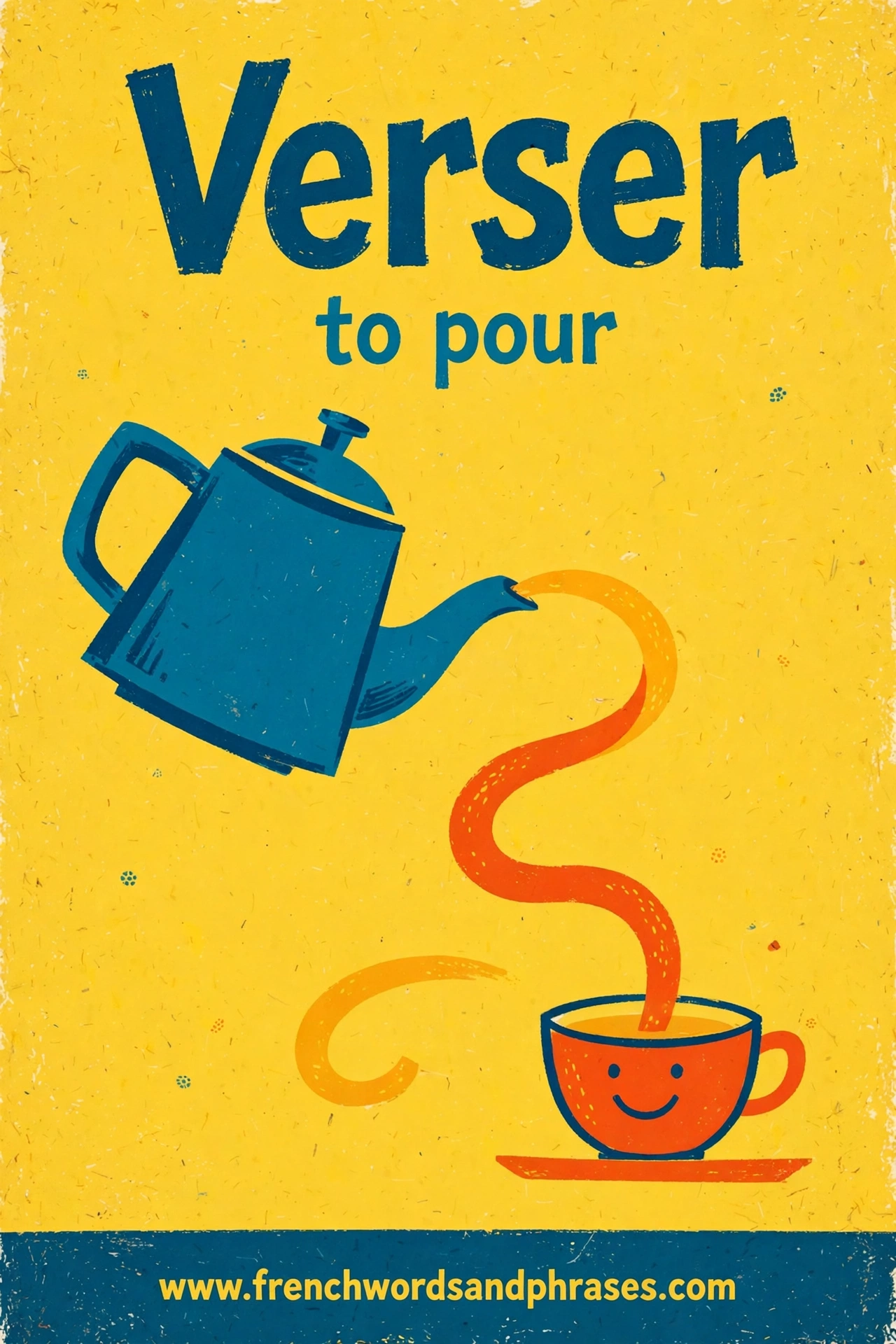
Verser means to pour.
Wine tipping into a glass, sauce flowing over pasta, milk streaming into a bowl of flour — verser is the verb of the graceful stream, the moment liquid leaves one vessel for another.
In this guide, you’ll learn how to conjugate verser in all the major French tenses and moods. Explore complete conjugation tables, French examples, English translations, and practice quizzes.
Understanding the French Verb Verser
Verser is a regular French verb belonging to the first group of verbs, those ending in -er.
It means to pour. It is commonly used for pouring wine, water, coffee and sauces, for adding liquid to a recipe little by little (verser en filet, to pour in a thin stream), for shedding tears, and in office French for paying money into an account — verser une somme, verser un salaire.
Verb classification: First group (-er)
Auxiliary verb: Avoir
Past participle: versé
Present participle: versant
English equivalents: To pour, to pour out; to shed (tears, blood); to pay in (money); to tip over (a vehicle).
One important detail: verser pours more than drinks. You versez des larmes — shed tears — a car that skids can verser, tip over into the ditch, and a salary is versé on your account, paid in. In the kitchen it keeps its simple, flowing sense: whatever streams out of a bottle, a jug or a ladle is versé.
Experience the Word
Verser is the verb of the controlled stream — too fast and it splashes, too slow and dinner waits; the good cook’s wrist knows the speed.
Imagine a sommelier in a Lyon bistro, bottle tilted at exactly the right angle, the red wine turning in the glass without a single drop on the white cloth. That small ceremony is verser at its most elegant.
Nothing has been spilled. It has been poured — smoothly, generously, on purpose.
How to Conjugate Verser: Complete French Conjugation Guide
Let’s explore every major conjugation of verser, beginning with the indicative mood.
How to Conjugate Verser in the Indicative Mood
The indicative mood is used to express facts, observations, actions, and events.
How to Conjugate Verser in the Present Tense (Présent)
Used for actions happening now, habitual actions, and general truths.
| Subject | Conjugation |
|---|---|
| je | verse |
| tu | verses |
| il / elle | verse |
| nous | versons |
| vous | versez |
| ils / elles | versent |
Example
Elle verse la sauce lentement sur les pâtes.
She pours the sauce slowly over the pasta.
Quick Quiz 1
Complete the sentence:
Nous ______ la soupe dans les bols.
Reveal the answer
versons
Nous versons la soupe dans les bols.
We pour the soup into the bowls.
How to Conjugate Verser in the Passé Composé
Used for completed actions in the past. Verser takes the auxiliary verb avoir.
| Subject | Conjugation |
|---|---|
| j’ | ai versé |
| tu | as versé |
| il / elle | a versé |
| nous | avons versé |
| vous | avez versé |
| ils / elles | ont versé |
Example
Il a versé un verre de vin rouge à son invité.
He poured a glass of red wine for his guest.
How to Conjugate Verser in the Imparfait (Imperfect Tense)
Used for habitual past actions, descriptions, and ongoing situations in the past.
| Subject | Conjugation |
|---|---|
| je | versais |
| tu | versais |
| il / elle | versait |
| nous | versions |
| vous | versiez |
| ils / elles | versaient |
Example
Grand-mère versait le lait dans la pâte à crêpes.
Grandmother used to pour the milk into the crêpe batter.
Quick Quiz 2
Choose the correct form:
He poured the wine.
Il ______ le vin. (a versé / est versé)
Reveal the answer
a versé
Il a versé le vin.
Verser takes avoir.
How to Conjugate Verser in the Plus-que-parfait
Used to describe an action that had already been completed before another past event.
| Subject | Conjugation |
|---|---|
| j’ | avais versé |
| tu | avais versé |
| il / elle | avait versé |
| nous | avions versé |
| vous | aviez versé |
| ils / elles | avaient versé |
Example
Nous avions versé la crème avant de servir la soupe.
We had poured the cream before serving the soup.
How to Conjugate Verser in the Passé Simple
Primarily used in formal writing, literature, and historical narratives. It is rarely used in everyday conversation.
| Subject | Conjugation |
|---|---|
| je | versai |
| tu | versas |
| il / elle | versa |
| nous | versâmes |
| vous | versâtes |
| ils / elles | versèrent |
Example
Le sommelier versa le vin avec un geste précis.
The sommelier poured the wine with a precise gesture.
How to Conjugate Verser in the Passé Antérieur
A literary tense used to express an action completed immediately before another past action, generally in the passé simple.
| Subject | Conjugation |
|---|---|
| j’ | eus versé |
| tu | eus versé |
| il / elle | eut versé |
| nous | eûmes versé |
| vous | eûtes versé |
| ils / elles | eurent versé |
Example
Quand elle eut versé l’eau chaude sur le thé, elle attendit cinq minutes.
When she had poured the hot water over the tea, she waited five minutes.
How to Conjugate Verser in the Future Tense (Futur Simple)
Used to describe actions that will take place in the future.
| Subject | Conjugation |
|---|---|
| je | verserai |
| tu | verseras |
| il / elle | versera |
| nous | verserons |
| vous | verserez |
| ils / elles | verseront |
Example
Tu verseras le sirop sur les crêpes chaudes.
You will pour the syrup over the hot crêpes.
How to Conjugate Verser in the Futur Antérieur (Future Perfect)
Used for an action that will have been completed before a particular point in the future.
| Subject | Conjugation |
|---|---|
| j’ | aurai versé |
| tu | auras versé |
| il / elle | aura versé |
| nous | aurons versé |
| vous | aurez versé |
| ils / elles | auront versé |
Example
À la fin du repas, il aura versé le café à tout le monde.
By the end of the meal, he will have poured coffee for everyone.
How to Conjugate Verser in the Near Future (Futur Proche)
Used to describe something that is going to happen soon. Formed with aller + infinitive.
| Subject | Conjugation |
|---|---|
| je | vais verser |
| tu | vas verser |
| il / elle | va verser |
| nous | allons verser |
| vous | allez verser |
| ils / elles | vont verser |
Example
Attention, tu vas verser trop de lait !
Careful, you are going to pour too much milk!
How to Conjugate Verser in the Conditional Mood
The conditional mood expresses what would happen under certain circumstances. It is also frequently used to make polite requests or express wishes.
How to Conjugate Verser in the Present Conditional
| Subject | Conjugation |
|---|---|
| je | verserais |
| tu | verserais |
| il / elle | verserait |
| nous | verserions |
| vous | verseriez |
| ils / elles | verseraient |
Example
Je verserais bien un deuxième verre, mais il se fait tard.
I would happily pour a second glass, but it is getting late.
How to Conjugate Verser in the Past Conditional
| Subject | Conjugation |
|---|---|
| j’ | aurais versé |
| tu | aurais versé |
| il / elle | aurait versé |
| nous | aurions versé |
| vous | auriez versé |
| ils / elles | auraient versé |
Example
Elle aurait versé plus de sauce si la saucière avait été pleine.
She would have poured more sauce if the sauce boat had been full.
Verser in the Literary Past Conditional Form
This less common literary form uses the imperfect subjunctive of avoir.
| Subject | Conjugation |
|---|---|
| j’ | eusse versé |
| tu | eusses versé |
| il / elle | eût versé |
| nous | eussions versé |
| vous | eussiez versé |
| ils / elles | eussent versé |
Example
Il eût versé le vin lui-même pour honorer ses invités.
He would have poured the wine himself to honour his guests.
How to Conjugate Verser in the Subjunctive Mood
The subjunctive is used to express wishes, emotions, doubts, necessity, and uncertainty. It frequently follows expressions such as il faut que (it is necessary that) or bien que (although).
How to Conjugate Verser in the Present Subjunctive
| Subject | Conjugation |
|---|---|
| que je | verse |
| que tu | verses |
| qu’il / qu’elle | verse |
| que nous | versions |
| que vous | versiez |
| qu’ils / qu’elles | versent |
Example
Il faut que tu verses l’huile doucement dans la mayonnaise.
You must pour the oil slowly into the mayonnaise.
Quick Quiz 3
Complete the sentence using the subjunctive:
Il faut que vous ______ le bouillon petit à petit.
Reveal the answer
versiez
Il faut que vous versiez le bouillon petit à petit.
You must pour the stock in little by little.
How to Conjugate Verser in the Imperfect Subjunctive
A literary tense, rarely encountered in modern spoken French.
| Subject | Conjugation |
|---|---|
| que je | versasse |
| que tu | versasses |
| qu’il / qu’elle | versât |
| que nous | versassions |
| que vous | versassiez |
| qu’ils / qu’elles | versassent |
Example
Elle attendait qu’il versât le champagne avant le toast.
She waited for him to pour the champagne before the toast.
How to Conjugate Verser in the Pluperfect Subjunctive
A literary construction used to express an action completed before another past action.
| Subject | Conjugation |
|---|---|
| que j’ | eusse versé |
| que tu | eusses versé |
| qu’il / qu’elle | eût versé |
| que nous | eussions versé |
| que vous | eussiez versé |
| qu’ils / qu’elles | eussent versé |
Example
Il regrettait que nous eussions versé toute la bouteille.
He regretted that we had poured the whole bottle.
How to Conjugate Verser in the Past Subjunctive
| Subject | Conjugation |
|---|---|
| que j’ | aie versé |
| que tu | aies versé |
| qu’il / qu’elle | ait versé |
| que nous | ayons versé |
| que vous | ayez versé |
| qu’ils / qu’elles | aient versé |
Example
Je suis content que tu aies versé l’eau à temps.
I am glad you poured the water in time.
How to Conjugate Verser in the Imperative
The imperative is used to give commands, instructions, invitations, or suggestions. Subject pronouns are omitted.
How to Conjugate Verser in the Present Imperative
| Person | Conjugation |
|---|---|
| (tu) | verse |
| (nous) | versons |
| (vous) | versez |
Example
Verse le lait dans le bol, doucement !
Pour the milk into the bowl, gently!
Quick Quiz 4
How would you say Pour the milk (tu form)?
Reveal the answer
Verse le lait !
French Participles of Verser
Participles are verb forms that can be used in compound tenses and other grammatical constructions.
Present Participle of Verser
versant
En versant la soupe, il a fait tomber quelques gouttes sur la nappe.
While pouring the soup, he dropped a few drops on the tablecloth.
Past Participle of Verser
versé
Versée dans une jolie carafe, l’eau semblait plus fraîche.
Poured into a pretty carafe, the water seemed fresher.
Verser in Everyday French: Real-Life Examples
Now that you know the conjugations, let’s see how verser appears in everyday French.
Example 1 — Present
Je verse un verre d’eau aux enfants.
I pour a glass of water for the children.
Example 2 — Passé composé
Elle a versé le thé dans les tasses.
She poured the tea into the cups.
Example 3 — Imparfait
Le serveur versait le vin sans faire de bruit.
The waiter used to pour the wine quietly.
Example 4 — Future
Nous verserons la soupe dans les assiettes creuses.
We will pour the soup into the soup plates.
Example 5 — Conditional
Tu verserais un peu plus de sauce, s’il te plaît ?
Would you pour a little more sauce, please?
Example 6 — Imperative
Versez le bouillon petit à petit !
Pour the stock in little by little!
Beyond Translation: The Meaning of Verser
English pour stays mostly in the kitchen and the rain; French verser travels — tears are shed with it, salaries are paid with it, and cars tip over with it.
Its family is all about tipping.
Renverser is to knock over or spill — the accident verser avoids — and déverser is to pour out in great quantities. Between the elegant stream and the flood, verser holds the middle: the human measure of liquid.
How to Remember the French Verb Verser
Remember it this way: Verser is about pouring — wine, sauces and tears.
- If it streams out of a bottle, a jug or a ladle, it is versé — verser le vin, verser la sauce.
- Verser des larmes — to shed tears: the same verb, a sadder liquid.
- Regular -er: je verse, nous versons, past participle versé.
The key idea is pouring — wine, sauces and tears.
Test Your Knowledge of Verser
Let’s see how much you’ve learned. Try answering these questions before revealing the answers.
Question 1
How do you say She pours the sauce over the pasta in French?
Reveal the answer
Elle verse la sauce sur les pâtes.
Question 2
What does verser des larmes mean?
Reveal the answer
To shed tears — verser pours tears just as it pours wine.
Question 3
Translate: He poured a glass of wine for his guest.
Reveal the answer
Il a versé un verre de vin à son invité.
Question 4
What is the past participle of verser?
Reveal the answer
Versé.
Question 5
Complete the sentence:
Il faut que tu ______ l’huile doucement.
Reveal the answer
verses
Il faut que tu verses l’huile doucement.
You must pour the oil slowly.
Your Final Challenge
Can You Use It?
How would you say this in French?
She pours the coffee, and the conversation begins.
Reveal the answer
Elle verse le café, et la conversation commence.
She pours the coffee, and the conversation begins.
A little French. A little curiosity. A richer everyday life.
LEARN FRENCH ONE WORD AT A TIME