A French Word to Live By
Translate Vendre la peau de l’ours avant de l’avoir tué to English
/vɑ̃dʁ la po də luʁs a.vɑ̃ də la.vwaʁ tɥe/
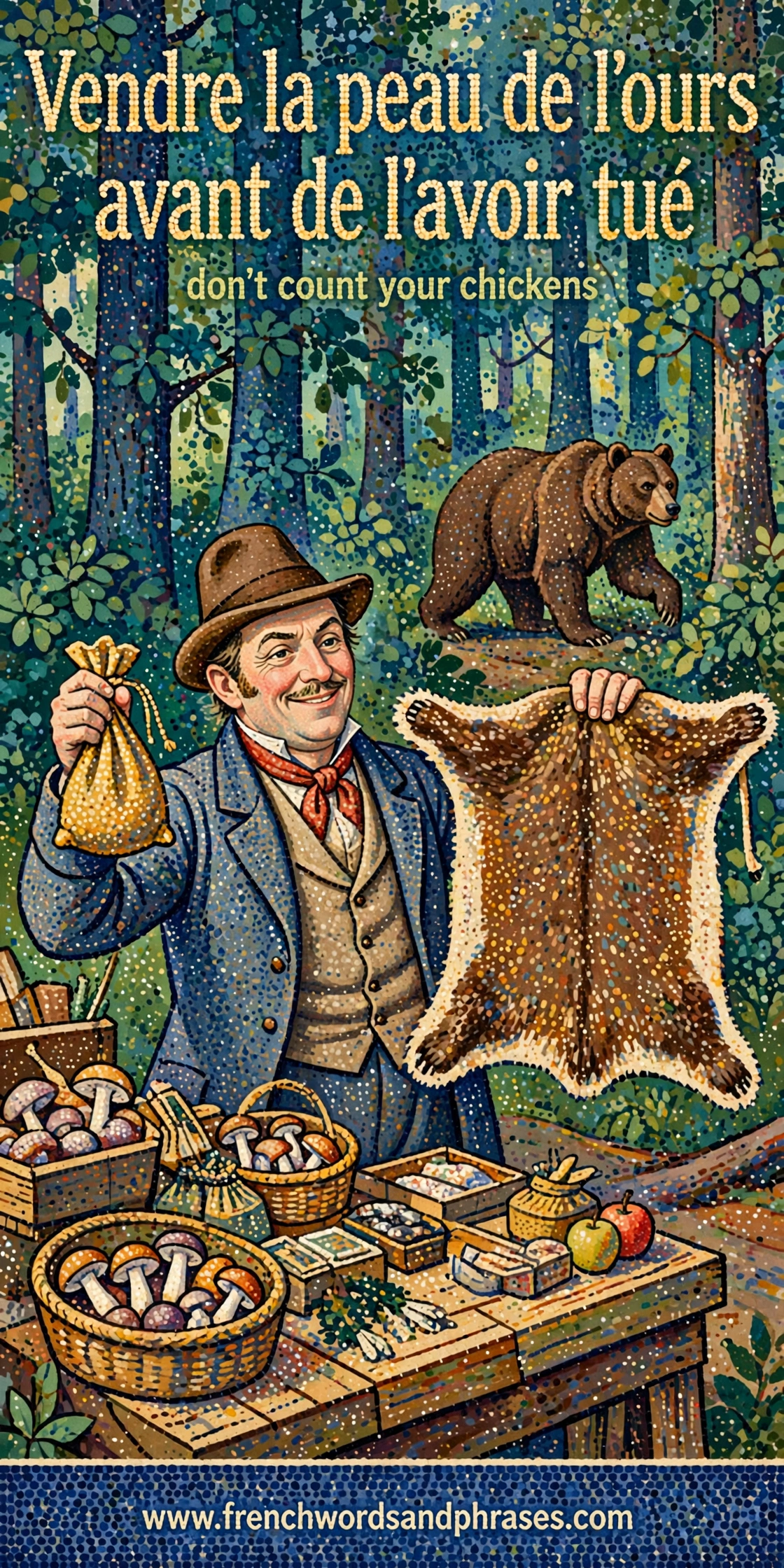
Vendre la peau de l’ours avant de l’avoir tué means don’t count your chickens — to count on a gain before it is actually yours.
The lottery numbers are not drawn until tonight, but your cousin has already chosen the colour of his new car and promised his sister a holiday. His grandmother shakes her head slowly and delivers the oldest warning in the French countryside: « Il ne faut pas vendre la peau de l’ours avant de l’avoir tué. »
Let’s explore how vendre la peau de l’ours avant de l’avoir tué works in French, beginning with the whole phrase on one card.
Understanding the French Phrase Vendre la peau de l’ours avant de l’avoir tué
Vendre la peau de l’ours avant de l’avoir tué is a French proverbial expression built from vendre (to sell), la peau (the skin), l’ours (the bear) and avant de l’avoir tué (before having killed it). It comes from La Fontaine’s fable of the two companions who sold a bear’s skin in advance — and then met the bear.
It means don’t count your chickens before they hatch — do not spend, promise or celebrate a gain before it is safely yours. The picture is exact: two hunters sell the bear’s skin to a merchant, drink the money in advance, and then the living bear walks into the story. The skin was never theirs to sell.
Type: Proverbial expression — caution (verb + noun phrase + avant de clause)
Answers the need: Warning someone not to count on an uncertain gain
Register: Neutral — a proverb, safe everywhere, often said by elders with a smile
Strength: Firm but kindly — a warning, not an insult
One important usage detail: the phrase most often appears as a warning with il ne faut pas — il ne faut pas vendre la peau de l’ours avant de l’avoir tué. In quick speech it is often shortened to vendre la peau de l’ours, or even ne vends pas la peau de l’ours, and everyone hears the missing half.
Experience the Word
Vendre la peau de l’ours avant de l’avoir tué is the countryside’s answer to every premature celebration — the bear is still out there, and it has not read your plans.
Imagine the fable itself: two friends, one merchant’s promise, a feast bought on credit against a skin still walking around the forest on its bear. Then the branches move. One hunter plays dead, the other climbs a tree, and the bear goes home with the moral in its teeth: never sell my skin before you have killed me.
Every generation rediscovers the bear. The phrase survives because hope keeps signing contracts that reality has not approved.
How to Use Vendre la peau de l’ours avant de l’avoir tué in French: Complete Guide
Let’s explore how vendre la peau de l’ours avant de l’avoir tué works in French, beginning with the whole phrase on one card.
Vendre la peau de l’ours avant de l’avoir tué at a Glance
The Whole Phrase on One Card
Real meaning, literal picture, English twin and register — vendre la peau de l’ours in five lines.
| Point | Vendre la peau de l’ours avant de l’avoir tué |
|---|---|
| What it really means | don’t count your chickens — never count on a gain before it is yours |
| Word for word | to sell the bear’s skin before having killed it |
| English equivalent | don’t count your chickens before they hatch |
| Register | neutral — a proverb, often a gentle warning from an elder |
| Use it for | premature spending, early celebrations, promised bonuses, unhatched plans |
Example
Il ne faut pas vendre la peau de l’ours avant de l’avoir tué.
You must not count your chickens before they hatch.
Word by Word: Building the Bear
Six small pieces — take them one by one and the bear walks out of the forest.
| Word | Literal meaning | Its job in the phrase |
|---|---|---|
| vendre | to sell | the premature bargain — money agreed before the goods exist |
| la peau | the skin | the prize being sold — what the bear is still wearing |
| de l’ours | of the bear | the owner of the skin — alive, large and unconsulted |
| avant de | before | the fatal timing — the order of events is the whole lesson |
| l’avoir tué | having killed it | the step that was skipped — tué is the past participle of tuer |
Example
Tu vends la peau de l’ours : l’examen n’est même pas corrigé.
You are counting your chickens: the exam has not even been marked.
Quick Quiz 1
Where does this expression come from?
Reveal the answer
La Fontaine’s fable — two companions sell a bear’s skin in advance, spend the money, and then meet the living bear.
L’ours de la fable a donné une leçon aux deux chasseurs.
The bear in the fable taught the two hunters a lesson.
When You Say It: The Premature Moments
Vendre la peau de l’ours fires at moments like these — wherever someone is spending a victory that has not arrived.
| Situation | Example |
|---|---|
| Before exam results | ne vends pas la peau de l’ours, les résultats ne sont pas là — don’t count your chickens, the results are not out |
| A promised bonus | il a déjà dépensé sa prime : la peau de l’ours ! — he has already spent his bonus: the bear’s skin! |
| An unhatched business deal | le contrat n’est pas signé, ne vendons pas la peau de l’ours — the contract is not signed, let’s not count our chickens |
| Sport, at half-time | à la mi-temps, rien n’est joué : pas de peau d’ours — at half-time nothing is decided: no bear’s skin |
| A lottery ticket | il choisit déjà sa voiture, peau d’ours classique — he is already choosing his car, a classic bear’s skin |
Example
Le contrat n’est pas signé, alors ne vendons pas la peau de l’ours.
The contract is not signed, so let’s not count our chickens.
Make It Yours: The Bear for Every Warning
The warning wears a few standard shapes — learn the full proverb first, then the shortenings everyone uses.
| Form | French | In English |
|---|---|---|
| The full warning | il ne faut pas vendre la peau de l’ours avant de l’avoir tué | you must not count your chickens before they hatch |
| To one person | ne vends pas la peau de l’ours | don’t count your chickens |
| Describing someone | il vend la peau de l’ours | he is counting his chickens |
| In the past | elle a vendu la peau de l’ours | she counted her chickens too soon |
| Short and sharp | la peau de l’ours ! | the bear’s skin! — said when the plan collapses |
| Question | tu ne vends pas la peau de l’ours, là ? | you’re not counting your chickens, are you? |
Example
Elle a vendu la peau de l’ours et le poste est allé à quelqu’un d’autre.
She counted her chickens, and the job went to someone else.
Quick Quiz 2
The phrase is often shortened. Which half survives — vendre la peau de l’ours or avant de l’avoir tué?
Reveal the answer
Vendre la peau de l’ours — the selling carries the whole story; everyone supplies the bear’s revenge themselves.
Doucement, tu vends la peau de l’ours.
Steady on, you are counting your chickens.
Everyday Expressions: Building on the Bear
Vendre la peau de l’ours slots into these everyday frames — each one ready to use as it stands.
| Frame | In English |
|---|---|
| il ne faut pas vendre la peau de l’ours avant de l’avoir tué | you must not count your chickens before they hatch |
| vendre la peau de l’ours | to count your chickens — the everyday shortening |
| ne pas vendre la peau de l’ours | not to count your chickens |
| c’est la peau de l’ours | that’s counting your chickens — said of a premature plan |
| vendre la peau de l’ours avant de l’avoir attrapé | a playful variant — before having caught it |
Example
C’est encore la peau de l’ours, cette histoire de promotion.
This promotion business is counting your chickens again.
Close Cousins: The Other Warnings Against Haste
French keeps a whole shelf of patience proverbs — the bear is the counting one; its cousins guard the other hasty sins.
| Expression | The difference |
|---|---|
| vendre la peau de l’ours avant de l’avoir tué | don’t count your chickens — celebrating a gain before it is secured |
| mettre la charrue avant les bœufs | to put the cart before the horse — doing things in the wrong order |
| aller plus vite que la musique | to jump the gun — starting before the signal, too eager |
| ne pas mettre tous ses œufs dans le même panier | don’t put all your eggs in one basket — a warning about risk, not timing |
| patience et longueur de temps | patience wins in the end — the slow, positive twin |
Example
Il va plus vite que la musique et vend la peau de l’ours à chaque projet.
He jumps the gun and counts his chickens on every project.
Quick Quiz 3
Your friend books the celebration dinner before the interview. Peau de l’ours or charrue avant les bœufs?
Reveal the answer
Peau de l’ours — she is counting on a gain she does not have yet. The charrue is about doing steps in the wrong order.
Elle vend la peau de l’ours avec ce dîner de fête.
She is counting her chickens with this celebration dinner.
Vendre la peau de l’ours and Its Neighbours
The fable shelf around the phrase — the bear, the skin and the hunt that must come first.
| French | In English |
|---|---|
| un ours | a bear |
| la peau | the skin |
| vendre | to sell |
| tuer | to kill |
| un chasseur | a hunter |
| une fable | a fable |
Example
Le chasseur de la fable n’avait ni peau ni ours à vendre.
The hunter in the fable had neither skin nor bear to sell.
Watch Out: The Traps Around Vendre la peau de l’ours
The traps: an order that cannot be swapped, a bear that is not a chicken, and a warning that is not a celebration.
| Trap | The truth |
|---|---|
| the order is the meaning | selling after the kill is honest trade — the whole sin is avant, before; swap the order and the proverb dies |
| do not mix the animals | English counts chickens, French sells a bear — say la peau de l’ours in French, never les poulets |
| tué agrees with l’ours | l’avoir tué — the participle tué stands for the masculine ours; for a feminine quarry it would change |
| it warns, it does not forbid hope | the phrase rebukes spending and promising, not hoping — dream freely, just do not sign anything |
Example
Espère tant que tu veux, mais ne vends pas la peau de l’ours.
Hope all you like, but do not count your chickens.
Quick Quiz 4
True or false: the phrase forbids hoping for a good result.
Reveal the answer
False — it forbids spending, promising and celebrating before the result is yours. Hope costs nothing; the feast on credit does.
Elle espère le poste, mais elle ne vend pas la peau de l’ours.
She hopes for the job, but she is not counting her chickens.
Vendre la peau de l’ours avant de l’avoir tué in Everyday French: Real-Life Examples
Now that you know the word, let’s see how vendre la peau de l’ours avant de l’avoir tué appears in everyday French.
Example 1 — Exam results
Ne vends pas la peau de l’ours, les résultats tombent vendredi.
Don’t count your chickens, the results come out on Friday.
Example 2 — The unsigned contract
Le contrat n’est pas signé : personne ne vend la peau de l’ours.
The contract is not signed: nobody counts their chickens.
Example 3 — The spent bonus
Il a déjà dépensé sa prime — la peau de l’ours, encore une fois.
He has already spent his bonus — counting his chickens, once again.
Example 4 — At half-time
Deux buts d’avance, mais ne vendons pas la peau de l’ours.
Two goals ahead, but let’s not count our chickens.
Example 5 — The lottery
Elle choisit déjà sa maison avec un billet de loto : la peau de l’ours !
She is already choosing her house with one lottery ticket: counting her chickens!
Example 6 — Grandmother’s warning
Ma grand-mère le répète : il ne faut pas vendre la peau de l’ours avant de l’avoir tué.
My grandmother keeps saying it: you must not count your chickens before they hatch.
Beyond Translation: The Meaning of Vendre la peau de l’ours avant de l’avoir tué
English counts chickens — small, countable, farmyard hopes, each egg a little promise. French sells a bearskin — one enormous, dangerous promise, made to a merchant, over drinks, with the owner of the skin still alive in the forest. The French picture is grander because the fall is grander: the chickens merely fail to hatch, but the bear arrives in person.
To vendre la peau de l’ours is to sign a contract with the future — and the future always sends its bear to check the signature.
La Fontaine gave the bear the last word centuries ago, and the bear has been collecting ever since.
How to Remember the French Phrase Vendre la peau de l’ours avant de l’avoir tué
Remember it this way: Vendre la peau de l’ours is the fable of the premature bargain — the skin is sold, the money spent, and the bear still alive.
- You picture the fable — two hunters, one merchant, a feast on credit, and a bear that walks in to cancel the deal.
- You guard the word avant — the whole sin is the timing: sell before the kill and the proverb wakes up.
- You keep the animals apart — chickens belong to English; in French, it is always the bear’s skin.
The key idea is vendre la peau de l’ours avant de l’avoir tué means don’t count your chickens — never sell a gain you do not yet hold.
Test Your Knowledge of Vendre la peau de l’ours avant de l’avoir tué
Let’s see how much you’ve learned. Try answering these questions before revealing the answers.
Question 1
What does vendre la peau de l’ours avant de l’avoir tué mean?
Reveal the answer
Don’t count your chickens before they hatch — do not count on a gain before it is safely yours.
Question 2
What is the literal, word-for-word meaning?
Reveal the answer
To sell the bear’s skin before having killed it — la peau is the skin, l’ours is the bear.
Question 3
Where does the expression come from?
Reveal the answer
From La Fontaine’s fable of the two companions who sold a bear’s skin in advance and then met the bear.
Question 4
How is the phrase usually shortened in everyday speech?
Reveal the answer
Vendre la peau de l’ours — or even ne vends pas la peau de l’ours; the ending is understood.
Question 5
Complete the sentence:
Il ne faut pas vendre la ______ de l’ours avant de l’avoir tué. (You must not count your chickens before they hatch.)
Reveal the answer
peau
Il ne faut pas vendre la peau de l’ours avant de l’avoir tué.
You must not count your chickens before they hatch.
Your Final Challenge
Can You Use It?
How would you say this in French?
“Don’t count your chickens.”
Reveal the answer
Il ne faut pas vendre la peau de l’ours avant de l’avoir tué.
Don’t count your chickens.
A little French. A little curiosity. A richer everyday life.
LEARN FRENCH ONE WORD AT A TIME