A French Word to Live By
Translate Vélo to English
/ve.lo/
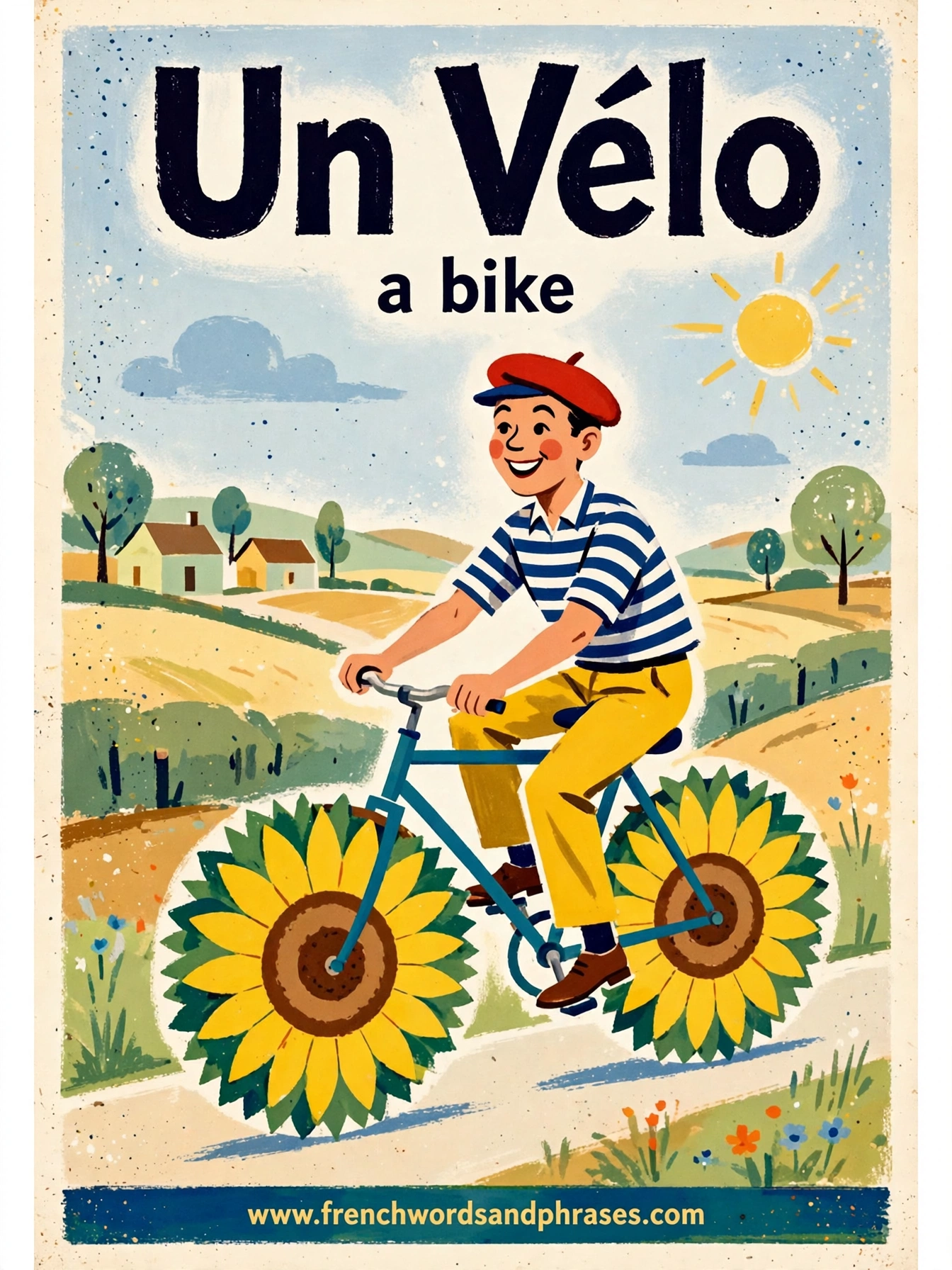
Le vélo means a bike, cycling.
Eight in the morning, the cycle path along the canal is already busy: a student with a baguette in the basket, an office worker in a suit, a grandmother on an electric model, overtaking everyone. In France, the day starts on le vélo.
In this guide, you’ll learn what vélo means in English, how to use it with its articles, how to form its plural, and how it appears in everyday French. Explore French examples, English translations, and practice quizzes.
Understanding the French Noun Vélo
Vélo is a masculine French noun. It is learned together with its article: le vélo, un vélo. It is the everyday short form of la bicyclette — the full, formal word you will meet in official documents, while the whole country simply says vélo.
It means a bike, a bicycle — and, with the verb faire, the activity of cycling itself: faire du vélo, to go cycling. The word covers the child’s first two-wheeler, the racer’s machine of the Tour de France, and the town bike with its basket and bell: un vélo de ville, un vélo de course, un vélo électrique. To ride one, French says faire du vélo or simply aller à vélo — to go by bike.
Gender: Masculine
Definite article: le — le vélo (the bike)
Indefinite article: un — un vélo (a bike)
Plural: les vélos
English equivalents: A bike, a bicycle; (with faire) cycling.
One important usage detail: the full word bicyclette is feminine — la bicyclette — but its short form vélo is masculine: le vélo. Same machine, two genders, depending on which word you choose. And for the activity, use the partitive: faire du vélo, to go cycling — never « faire le vélo ».
Experience the Word
Vélo is more than transport. It is France’s favourite machine — the vehicle of childhood freedom, of the Sunday club ride, and of the greatest cycle race on earth.
Imagine the country road at nine on a Sunday: a line of riders in club colours, the whirr of tyres, a wave from a farmer at his gate, and the café stop already being planned at kilometre forty.
You have not just travelled. You have joined the quiet procession of France on two wheels.
How to Use Vélo in French: Complete Guide
Let’s explore how vélo works in French, beginning with its articles.
Vélo with the Definite Article (Le, Les)
Used for the bike everyone knows — yours, the one by the door, the one with the red frame.
| Number | French |
|---|---|
| Singular | le vélo |
| Plural | les vélos |
Example
Le vélo est rangé dans le garage.
The bike is put away in the garage.
Vélo with the Indefinite Article (Un, Des)
Used for a bike in general — the one in the shop window, the one on your wish list.
| Number | French |
|---|---|
| Singular | un vélo |
| Plural | des vélos |
Example
Pour son anniversaire, il veut un vélo de course.
For his birthday, he wants a racing bike.
Vélo with the Partitive (Du): the Activity
For cycling itself — the activity, not the machine — French uses du with faire.
| French | In English |
|---|---|
| faire du vélo | to go cycling |
| faire un peu de vélo | to do a bit of cycling |
| je fais du vélo le dimanche | I go cycling on Sundays |
| aller à vélo | to go by bike |
Example
Nous faisons du vélo le long du canal.
We go cycling along the canal.
Quick Quiz 1
How do you say ‘to go cycling’?
Reveal the answer
Faire du vélo — the partitive du turns the machine into an activity.
Je fais du vélo tous les week-ends.
I go cycling every weekend.
The Plural of Vélo
Vélo adds an -s in the plural — les vélos, the bikes of the whole family.
| Number | French |
|---|---|
| Singular | le vélo |
| Plural | les vélos |
Example
Les vélos des enfants sont trop petits, il faut les changer.
The children’s bikes are too small; they need replacing.
Vélo with Possessive Adjectives (Mon, Ton, Son…)
Possessives agree with the noun, not with the owner — and vélo is masculine, so it takes mon, ton, son.
| Owner | French |
|---|---|
| my | mon vélo |
| your (tu) | ton vélo |
| his / her | son vélo |
| our | notre vélo |
| your (vous) | votre vélo |
| their | leur vélo |
Example
Mon vélo a un pneu crevé.
My bike has a puncture.
Quick Quiz 2
Complete the sentence:
______ vélo est électrique, le mien est classique. (Her)
Reveal the answer
Son
Son vélo est électrique, le mien est classique.
Her bike is electric; mine is a classic one.
Vélo with Demonstrative Adjectives (Ce, Ces)
Used to point: this bike here, those bikes there.
| Number | French |
|---|---|
| Singular | ce vélo |
| Plural | ces vélos |
Example
Ce vélo coûte moins cher que l’autre.
This bike costs less than the other one.
Vélo with Adjectives
Adjectives agree with vélo, masculine — électrique, léger, neuf.
| Adjective | With Vélo |
|---|---|
| électrique (electric) | un vélo électrique |
| léger (light) | un vélo léger |
| neuf (new) | un vélo neuf |
| rouge (red) | un vélo rouge |
| de course (racing) | un vélo de course |
Example
Un vélo électrique rend les côtes faciles.
An electric bike makes hills easy.
Quick Quiz 3
Le vélo is masculine — but what about its full name, bicyclette?
Reveal the answer
Bicyclette is feminine — la bicyclette, but le vélo. The short form changed gender.
Sa bicyclette est neuve, son vélo aussi.
Her bicycle is new, her bike too.
Everyday Expressions with Vélo
Repairs, rides and punctures — the vélo phrases of the week.
| Expression | In English |
|---|---|
| aller à vélo | to go by bike |
| faire du vélo | to go cycling |
| un vélo électrique | an electric bike |
| une piste cyclable | a cycle path |
| crever un pneu | to get a puncture |
| le Tour de France | the Tour de France (cycle race) |
Example
Elle va au travail à vélo, même en hiver.
She cycles to work, even in winter.
Words from the Same Family as Vélo
Wheels, pedals and riders — the words that travel with vélo.
| French | In English |
|---|---|
| la bicyclette | the bicycle (full word) |
| la roue | the wheel |
| la selle | the saddle |
| le guidon | the handlebars |
| pédaler | to pedal |
| un cycliste | a cyclist |
Example
Le cycliste pédale vite, les mains sur le guidon.
The cyclist pedals fast, hands on the handlebars.
Quick Quiz 4
Your friend says: « J’ai crevé ! » on a bike ride. What happened?
Reveal the answer
He has a puncture — crever un pneu, the cyclist’s classic disaster.
J’ai crevé à dix kilomètres de la maison.
I got a puncture ten kilometres from home.
Vélo in Everyday French: Real-Life Examples
Now that you know the word, let’s see how vélo appears in everyday French.
Example 1 — Commuting
Je vais au bureau à vélo quand il fait beau.
I cycle to the office when the weather is fine.
Example 2 — Sunday ride
Le dimanche, nous faisons du vélo en famille.
On Sundays, we go cycling as a family.
Example 3 — In the shop
Ce vélo électrique est parfait pour la ville.
This electric bike is perfect for town.
Example 4 — A puncture
Mon vélo a crevé sur le chemin du retour.
My bike got a puncture on the way back.
Example 5 — Children
Elle a appris à faire du vélo à quatre ans.
She learned to ride a bike at the age of four.
Example 6 — The Tour
En juillet, tout le village regarde passer le Tour de France.
In July, the whole village watches the Tour de France go by.
Beyond Translation: The Meaning of Vélo
No machine is more French than the vélo: it carried the postman and the schoolteacher for a century before it carried tourists, and every July the country stops to watch two hundred riders cross its mountains in the Tour de France. The word itself is a shortcut — vélo, clipped from the old vélocipède — as if French were in too much of a hurry to say the whole thing.
To say vélo is to feel the wind of the canal path.
It evokes the first wobbly ride without stabilisers, the baguette in the basket, the bell rung at a wandering dog — the machine of ordinary freedom.
How to Remember the French Noun Vélo
Remember it this way: Vélo is the bike — masculine, the short everyday word; its full name bicyclette is feminine, and the activity is faire du vélo.
- You ride — je vais au travail à vélo.
- You practise — nous faisons du vélo le dimanche.
- You dodge the trap — la bicyclette est féminine, mais le vélo est masculin.
The key idea is le vélo roule — la bicyclette is its formal sister.
Test Your Knowledge of Vélo
Let’s see how much you’ve learned. Try answering these questions before revealing the answers.
Question 1
Is vélo masculine or feminine?
Reveal the answer
Masculine — le vélo, un vélo.
Question 2
How do you say ‘to go cycling’?
Reveal the answer
Faire du vélo — with the partitive du.
Question 3
Translate: She goes to work by bike.
Reveal the answer
Elle va au travail à vélo.
Question 4
What is the full, formal word for vélo?
Reveal the answer
La bicyclette — feminine, where vélo is masculine.
Question 5
Complete the sentence:
Nous faisons ______ vélo le long de la rivière.
Reveal the answer
du
Nous faisons du vélo le long de la rivière.
We go cycling along the river.
Your Final Challenge
Can You Use It?
How would you say this in French?
“On Sundays, we go cycling along the canal.”
Reveal the answer
Le dimanche, nous faisons du vélo le long du canal.
On Sundays, we go cycling along the canal.
A little French. A little curiosity. A richer everyday life.
LEARN FRENCH ONE WORD AT A TIME