A French Word to Live By
How to Conjugate Valeter in French
/val.te/
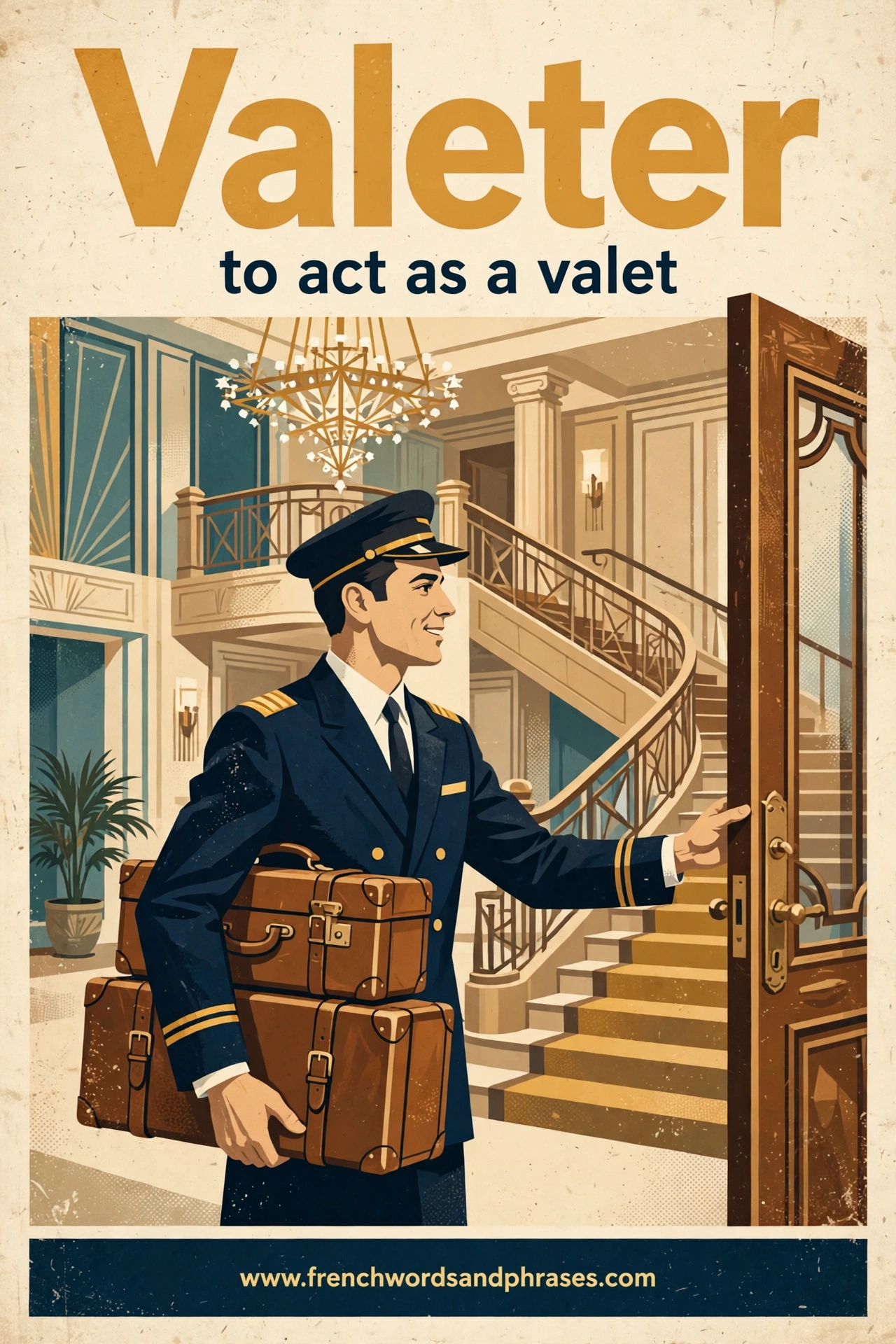
Valeter means to act as a valet — to serve someone personally, attending to their clothes, their rooms and their whims.
Laying out the evening clothes, brushing the coat, drawing the bath, standing silent at the door — valeter is the verb of the personal servant’s day: a whole life spent making someone else’s life run smoothly, in the age of great houses and greater egos.
In this guide, you’ll learn how to conjugate valeter in all the major French tenses and moods. Explore complete conjugation tables, French examples, English translations, and practice quizzes.
Understanding the French Verb Valeter
Valeter is a regular French verb belonging to the first group of verbs, those ending in -er.
It means to act as a valet. It is commonly used of the old world of domestic service — valets in great houses, at court, in hotels of another century — and figuratively, with a sting, of anyone who plays the lackey: valeter auprès des puissants, to dance attendance on the powerful.
Verb classification: First group (-er)
Auxiliary verb: Avoir
Past participle: valeté
Present participle: valetant
English equivalents: To act as a valet, to serve as a personal servant; un valet — a valet, a manservant; un valet de chambre — a gentleman’s personal servant; valeter auprès de quelqu’un — to dance attendance on someone.
One important detail: valeter doubles its t exactly like jeter. Where the next syllable is a mute e, the t doubles: je valette, tu valettes, il valette, ils valettent, and through the future and conditional — je valetterai, je valetterais — and in the subjunctive que je valette. But where the ending is heard, the t stays single: nous valetons, vous valetez, je valetais, past participle valeté. One valet, two spellings of his name’s verb — listen for the mute e and you will know which.
Experience the Word
Valeter is service as a craft — invisible when perfect, noticed only when it fails.
Imagine a Parisian hôtel particulier in 1890. Before his master wakes, the valet has already valeté through an hour of silent work: shoes polished, suit brushed, bath drawn, newspaper folded — and when the bell rings, he is simply there, as if comfort happened by itself.
A whole life in someone else’s shadow. He has served — il a valeté — and the house ran on his silence.
How to Conjugate Valeter: Complete French Conjugation Guide
Let’s explore every major conjugation of valeter, beginning with the indicative mood.
How to Conjugate Valeter in the Indicative Mood
The indicative mood is used to express facts, observations, actions, and events.
How to Conjugate Valeter in the Present Tense (Présent)
Used for actions happening now, habitual actions, and general truths.
| Subject | Conjugation |
|---|---|
| je | valette |
| tu | valettes |
| il / elle | valette |
| nous | valetons |
| vous | valetez |
| ils / elles | valettent |
Example
Le jeune homme valette auprès d’un vieux comte.
The young man acts as valet to an old count.
Quick Quiz 1
Complete the sentence:
Nous ______ chez le duc depuis un an. (nous form of valeter)
Reveal the answer
valetons
Nous valetons chez le duc depuis un an.
We have been serving as valets at the duke’s for a year.
How to Conjugate Valeter in the Passé Composé
Used for completed actions in the past. Valeter takes the auxiliary verb avoir.
| Subject | Conjugation |
|---|---|
| j’ | ai valeté |
| tu | as valeté |
| il / elle | a valeté |
| nous | avons valeté |
| vous | avez valeté |
| ils / elles | ont valeté |
Example
Il a valeté dix ans dans la même maison.
He served as a valet for ten years in the same house.
How to Conjugate Valeter in the Imparfait (Imperfect Tense)
Used for habitual past actions, descriptions, and ongoing situations in the past.
| Subject | Conjugation |
|---|---|
| je | valetais |
| tu | valetais |
| il / elle | valetait |
| nous | valetions |
| vous | valetiez |
| ils / elles | valetaient |
Example
Autrefois, les cadets de famille valetaient chez les grands seigneurs.
In the old days, younger sons used to serve as valets in great lords’ houses.
Quick Quiz 2
Choose the correct form:
He served as a valet for ten years.
Il ______ dix ans. (a valeté / est valeté)
Reveal the answer
a valeté
Il a valeté dix ans.
Valeter takes avoir.
How to Conjugate Valeter in the Plus-que-parfait
Used to describe an action that had already been completed before another past event.
| Subject | Conjugation |
|---|---|
| j’ | avais valeté |
| tu | avais valeté |
| il / elle | avait valeté |
| nous | avions valeté |
| vous | aviez valeté |
| ils / elles | avaient valeté |
Example
Elle avait valeté à la cour avant son mariage.
She had served as a lady’s maid at court before her marriage.
How to Conjugate Valeter in the Passé Simple
Primarily used in formal writing, literature, and historical narratives. It is rarely used in everyday conversation.
| Subject | Conjugation |
|---|---|
| je | valetai |
| tu | valetas |
| il / elle | valeta |
| nous | valetâmes |
| vous | valetâtes |
| ils / elles | valetèrent |
Example
Pendant trois ans, il valeta chez un ambassadeur.
For three years, he served as valet to an ambassador.
How to Conjugate Valeter in the Passé Antérieur
A literary tense used to express an action completed immediately before another past action, generally in the passé simple.
| Subject | Conjugation |
|---|---|
| j’ | eus valeté |
| tu | eus valeté |
| il / elle | eut valeté |
| nous | eûmes valeté |
| vous | eûtes valeté |
| ils / elles | eurent valeté |
Example
Quand il eut valeté assez longtemps, il ouvrit sa propre boutique.
When he had served as a valet long enough, he opened his own shop.
How to Conjugate Valeter in the Future Tense (Futur Simple)
Used to describe actions that will take place in the future.
| Subject | Conjugation |
|---|---|
| je | valetterai |
| tu | valetteras |
| il / elle | valettera |
| nous | valetterons |
| vous | valetterez |
| ils / elles | valetteront |
Example
Dès demain, tu valetteras auprès du marquis.
From tomorrow, you will act as valet to the marquis.
How to Conjugate Valeter in the Futur Antérieur (Future Perfect)
Used for an action that will have been completed before a particular point in the future.
| Subject | Conjugation |
|---|---|
| j’ | aurai valeté |
| tu | auras valeté |
| il / elle | aura valeté |
| nous | aurons valeté |
| vous | aurez valeté |
| ils / elles | auront valeté |
Example
À Noël, il aura valeté vingt ans dans cette famille.
By Christmas, he will have served as valet twenty years in this family.
How to Conjugate Valeter in the Near Future (Futur Proche)
Used to describe something that is going to happen soon. Formed with aller + infinitive.
| Subject | Conjugation |
|---|---|
| je | vais valeter |
| tu | vas valeter |
| il / elle | va valeter |
| nous | allons valeter |
| vous | allez valeter |
| ils / elles | vont valeter |
Example
Je vais valeter cet été dans un château de la Loire.
I am going to work as a valet this summer in a Loire château.
How to Conjugate Valeter in the Conditional Mood
The conditional mood expresses what would happen under certain circumstances. It is also frequently used to make polite requests or express wishes.
How to Conjugate Valeter in the Present Conditional
| Subject | Conjugation |
|---|---|
| je | valetterais |
| tu | valetterais |
| il / elle | valetterait |
| nous | valetterions |
| vous | valetteriez |
| ils / elles | valetteraient |
Example
Sans fierté mal placée, il valetterait volontiers chez le duc.
Without misplaced pride, he would gladly serve as valet to the duke.
How to Conjugate Valeter in the Past Conditional
| Subject | Conjugation |
|---|---|
| j’ | aurais valeté |
| tu | aurais valeté |
| il / elle | aurait valeté |
| nous | aurions valeté |
| vous | auriez valeté |
| ils / elles | auraient valeté |
Example
Elle aurait valeté à Versailles si le siècle l’avait permis.
She would have served at Versailles if the century had allowed it.
Valeter in the Literary Past Conditional Form
This less common literary form uses the imperfect subjunctive of avoir.
| Subject | Conjugation |
|---|---|
| j’ | eusse valeté |
| tu | eusses valeté |
| il / elle | eût valeté |
| nous | eussions valeté |
| vous | eussiez valeté |
| ils / elles | eussent valeté |
Example
Il eût valeté toute sa vie sans se plaindre.
He would have served as a valet all his life without complaining.
How to Conjugate Valeter in the Subjunctive Mood
The subjunctive is used to express wishes, emotions, doubts, necessity, and uncertainty. It frequently follows expressions such as il faut que (it is necessary that) or bien que (although).
How to Conjugate Valeter in the Present Subjunctive
| Subject | Conjugation |
|---|---|
| que je | valette |
| que tu | valettes |
| qu’il / qu’elle | valette |
| que nous | valetions |
| que vous | valetiez |
| qu’ils / qu’elles | valettent |
Example
Il faut qu’il valette avec discrétion et ponctualité.
He must serve as valet with discretion and punctuality.
Quick Quiz 3
Complete the sentence using the subjunctive:
Il faut qu’il ______ avec discrétion.
Reveal the answer
valette
Il faut qu’il valette avec discrétion.
He must serve with discretion — note the doubled t.
How to Conjugate Valeter in the Imperfect Subjunctive
A literary tense, rarely encountered in modern spoken French.
| Subject | Conjugation |
|---|---|
| que je | valetasse |
| que tu | valetasses |
| qu’il / qu’elle | valetât |
| que nous | valetassions |
| que vous | valetassiez |
| qu’ils / qu’elles | valetassent |
Example
Le duc exigeait que son valet valetât sans bruit.
The duke demanded that his valet serve noiselessly.
How to Conjugate Valeter in the Pluperfect Subjunctive
A literary construction used to express an action completed before another past action.
| Subject | Conjugation |
|---|---|
| que j’ | eusse valeté |
| que tu | eusses valeté |
| qu’il / qu’elle | eût valeté |
| que nous | eussions valeté |
| que vous | eussiez valeté |
| qu’ils / qu’elles | eussent valeté |
Example
On disait qu’il eût valeté chez trois rois.
People said he had served as valet to three kings.
How to Conjugate Valeter in the Past Subjunctive
| Subject | Conjugation |
|---|---|
| que j’ | aie valeté |
| que tu | aies valeté |
| qu’il / qu’elle | ait valeté |
| que nous | ayons valeté |
| que vous | ayez valeté |
| qu’ils / qu’elles | aient valeté |
Example
Je suis fier qu’il ait valeté honnêtement toute sa vie.
I am proud that he served honestly as a valet all his life.
How to Conjugate Valeter in the Imperative
The imperative is used to give commands, instructions, invitations, or suggestions. Subject pronouns are omitted.
How to Conjugate Valeter in the Present Imperative
| Person | Conjugation |
|---|---|
| (tu) | valette |
| (nous) | valetons |
| (vous) | valetez |
Example
Valette avec soin, le comte déteste attendre !
Serve carefully, the count hates waiting!
Quick Quiz 4
How would you say Serve carefully (tu form)?
Reveal the answer
Valette avec soin !
French Participles of Valeter
Participles are verb forms that can be used in compound tenses and other grammatical constructions.
Present Participle of Valeter
valetant
En valetant chez le ministre, il a tout entendu.
While serving as valet to the minister, he heard everything.
Past Participle of Valeter
valeté
Il a valeté partout, des cuisines aux salons.
He has served everywhere, from the kitchens to the drawing rooms.
Valeter in Everyday French: Real-Life Examples
Now that you know the conjugations, let’s see how valeter appears in everyday French.
Example 1 — Present
Il valette auprès d’un vieux comte.
He acts as valet to an old count.
Example 2 — Passé composé
Il a valeté dix ans dans la même maison.
He served as a valet for ten years in the same house.
Example 3 — Imparfait
Les cadets valetaient chez les grands seigneurs.
The younger sons used to serve as valets in great lords’ houses.
Example 4 — Future
Tu valetteras auprès du marquis dès demain.
You will act as valet to the marquis from tomorrow.
Example 5 — Conditional
Il valetterait volontiers chez le duc.
He would gladly serve as valet to the duke.
Example 6 — Imperative
Valetez en silence, le maître dort encore !
Serve in silence, the master is still asleep!
Beyond Translation: The Meaning of Valeter
English kept valet as a noun — and turned it into someone who parks your car; French valeter preserves the older, grander servant: the valet de chambre who dressed a lord, kept his secrets and outlived his fortunes.
Used figuratively, it bites.
Valeter auprès des puissants — to dance attendance on the powerful — accuses a person of playing the lackey. The verb carries the whole upstairs-downstairs world in four syllables, polish and resentment together.
How to Remember the French Verb Valeter
Remember it this way: Valeter is about the valet laying out the evening clothes in 1890 — and a t that doubles like jeter’s.
- Un valet serves one person personally; valeter is to do that job, clothes, bath and secrets included.
- The t doubles before a mute e, like jeter: je valette, je valetterai — but nous valetons, single t.
- Regular -er pattern with doubling: je valette, nous valetons, past participle valeté.
The key idea is the valet laying out the evening clothes in 1890 — and a t that doubles like jeter’s.
Test Your Knowledge of Valeter
Let’s see how much you’ve learned. Try answering these questions before revealing the answers.
Question 1
How do you say a valet, a manservant in French?
Reveal the answer
Un valet.
Question 2
How do you say He served as a valet for ten years in French?
Reveal the answer
Il a valeté dix ans.
Question 3
Translate: You will act as valet to the marquis from tomorrow.
Reveal the answer
Tu valetteras auprès du marquis dès demain.
Question 4
What is the past participle of valeter?
Reveal the answer
Valeté.
Question 5
Complete the sentence:
Il faut qu’il ______ avec discrétion.
Reveal the answer
valette
Il faut qu’il valette avec discrétion.
He must serve as valet with discretion.
Your Final Challenge
Can You Use It?
How would you say this in French?
He has acted as valet to the count for twenty years, and he knows his secrets better than anyone.
Reveal the answer
Il valette auprès du comte depuis vingt ans, et il connaît ses secrets mieux que personne.
He has acted as valet to the count for twenty years, and he knows his secrets better than anyone.
A little French. A little curiosity. A richer everyday life.
LEARN FRENCH ONE WORD AT A TIME