A French Word to Live By
Translate Vague to English
/vaɡ/
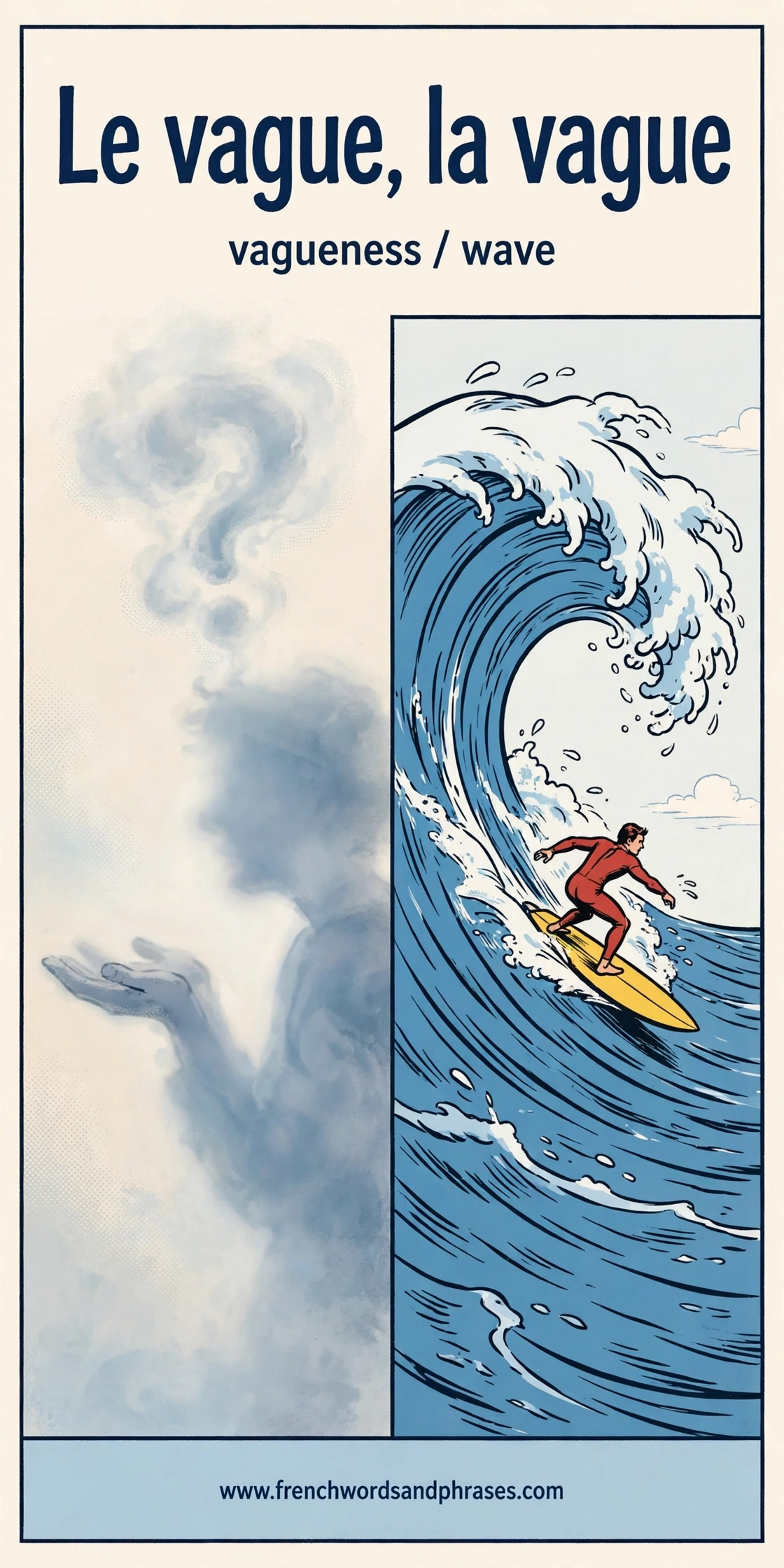
Le vague means vagueness — but la vague means wave.
A poet on the pier at Biarritz. Behind him the Atlantic rolls in, wave after wave — les vagues. In his notebook he is trying to name the sadness he cannot explain: le vague à l’âme, the vagueness in the soul. The sea’s word is feminine and loud; the feeling’s word is masculine and barely a whisper. Only the article tells them apart.
In this guide, you’ll learn what vague means in English, how to use it with its articles, how to form its plural, and how it appears in everyday French. Explore French examples, English translations, and practice quizzes.
Understanding the French Noun Vague
Vague is a two-gender noun: the article chooses the meaning. Feminine, la vague is a wave — of the sea, of heat, of people arriving. Masculine, le vague is vagueness — the state of being imprecise, undefined, hard to pin down, as in rester dans le vague, to stay vague. Do not confuse either with the adjective vague, which means vague, hazy, in both genders. Learn the article with the meaning, every time.
It means a wave when it is feminine: une vague énorme (an enormous wave), les vagues de l’océan (the ocean waves), and by extension une vague de chaleur (a heatwave), une vague de froid (a cold snap), une vague d’arrivées (a wave of arrivals). It means vagueness when it is masculine: le vague de sa réponse (the vagueness of his answer), rester dans le vague (to remain vague), and the poetic le vague à l’âme — a wistful, undefined melancholy.
Gender: Both — masculine and feminine, with different meanings
Definite article: le — le vague (vagueness); la — la vague (the wave)
Indefinite article: un — un vague (a vagueness, rare); une — une vague (a wave)
Plural: les vagues (the waves)
English equivalents: Masculine: vagueness. Feminine: the wave.
One important usage detail: the masculine lives in a handful of literary phrases — rester dans le vague, le vague à l’âme — and you will rarely need it at the market. The feminine, by contrast, is a working word of weather and news: heatwaves, cold waves, waves of tourists and waves of applause are all des vagues. When in doubt at the seaside, it is la vague.
Experience the Word
Vague is a word of water and of mist. The feminine you can surf, photograph and run from; the masculine you can only feel — the answer that says nothing, the sadness with no name.
Imagine the poet again at sunset: the last vague breaks white on the sand, the notebook closes on its unfinished line, and the two meanings walk home together — one soaked, one thoughtful.
You have not just learned a word. You have learned that French gives the sea a gender and vagueness another.
How to Use Vague in French: Complete Guide
Let’s explore how vague works in French — beginning with the article, because here the article is everything.
Vague with the Definite Article (Le, La, Les)
Le vague floats in an unfinished answer; la vague rolls in from the Atlantic.
| Gender | French |
|---|---|
| Masculine | le vague — vagueness |
| Feminine | la vague — the wave |
| Plural | les vagues — the waves |
Example
La vague a emporté son chapeau.
The wave carried off his hat.
Vague with the Indefinite Article (Un, Une, Des)
Une vague can knock you over; un vague can only leave you puzzled.
| Gender | French |
|---|---|
| Masculine | un vague — a vagueness (rare) |
| Feminine | une vague — a wave |
| Plural | des vagues — waves |
Example
Une vague de chaleur traverse le pays.
A heatwave is crossing the country.
Le Vague or La Vague? The Two Meanings Side by Side
Poetry on one side, weather on the other.
| French | In English |
|---|---|
| le vague à l’âme | a wistful melancholy |
| rester dans le vague | to stay vague |
| une vague énorme | an enormous wave |
| une vague de chaleur | a heatwave |
| les vagues de l’océan | the ocean waves |
| une vague d’applaudissements | a wave of applause |
Example
Il reste dans le vague quand on lui pose la question.
He stays vague when asked the question.
Quick Quiz 1
The weather forecast announces: « Une ______ de froid arrive demain. » Which gender is vague here?
Reveal the answer
Feminine — a wave of cold is une vague de froid, like every wave of weather.
Une vague de froid arrive demain.
A cold wave is arriving tomorrow.
The Plural of Vague
The plural belongs to the sea: les vagues break one after another on the shore.
| Number | French |
|---|---|
| Singular | le vague / la vague |
| Plural | les vagues |
Example
Les vagues sont fortes ce matin, attention en nageant.
The waves are strong this morning, be careful swimming.
Vague with Possessive Adjectives (Mon, Ma…)
Possessives follow the gender of the meaning: mon vague for the vagueness of a text, ma vague for the wave a surfer claims. Notre, votre and leur serve both senses.
| Owner | French |
|---|---|
| my | mon vague (vagueness) / ma vague (wave) |
| your (tu) | ton vague / ta vague |
| his / her | son vague / sa vague |
| our | notre vague (both senses) |
| your (vous) | votre vague (both senses) |
| their | leur vague (both senses) |
Example
Le surfeur attend sa vague, la plus grande.
The surfer waits for his wave, the biggest one.
Quick Quiz 2
Complete the sentence:
Sa réponse reste dans ______ vague, on ne comprend rien. (the)
Reveal the answer
le
Sa réponse reste dans le vague, on ne comprend rien.
His answer stays in vagueness, we understand nothing — vagueness is masculine.
Vague with Demonstrative Adjectives (Ce, Cette, Ces)
Ce vague points at the fog in an argument; cette vague points at the water coming at you.
| Gender | French |
|---|---|
| Masculine | ce vague — this vagueness |
| Feminine | cette vague — this wave |
| Plural | ces vagues — these waves |
Example
Cette vague est parfaite pour les surfeurs.
This wave is perfect for surfers.
Vague with Adjectives
Adjectives agree with the gender of the sense — grand for the rare masculine, grande for the wave.
| Adjective | Masculine sense | Feminine sense |
|---|---|---|
| grand / grande (big) | un grand vague (rare) | une grande vague |
| fort / forte (strong) | un vague fort (rare) | une vague forte |
| premier / première (first) | le premier vague (rare) | la première vague |
| nouveau / nouvelle (new) | un vague nouveau (rare) | une nouvelle vague |
Example
Une nouvelle vague de touristes arrive en août.
A new wave of tourists arrives in August.
Quick Quiz 3
Complete the sentence:
Une ______ vague a renversé le petit bateau. (enormous)
Reveal the answer
énorme
Une énorme vague a renversé le petit bateau.
An enormous wave overturned the little boat — the wave is feminine: une vague.
Everyday Expressions with Vague
Surf, weather and poetry — the vague phrases of daily life.
| Expression | In English |
|---|---|
| une vague de chaleur | a heatwave |
| une vague de froid | a cold wave, a cold snap |
| rester dans le vague | to stay vague |
| le vague à l’âme | a wistful melancholy |
| la nouvelle vague | the new wave (cinema, trends) |
| surfer sur la vague | to surf the wave |
Example
La nouvelle vague a changé le cinéma français.
The New Wave changed French cinema.
Words from the Same Family as Vague
Sea, mist and feelings — the words that travel with vague in both its lives.
| French | In English |
|---|---|
| la mer | the sea |
| l’écume | the foam |
| le flou | the blur, haziness |
| vaguement | vaguely |
| errer | to wander |
| la mélancolie | melancholy |
Example
L’écume blanche couvre les vagues près des rochers.
The white foam covers the waves near the rocks.
Quick Quiz 4
A poet writes: « Elle regarde le vague de la mer. » What has he mixed up?
Reveal the answer
The genders — the sea’s wave is la vague, feminine. Le vague is vagueness, which belongs to his soul, not to the ocean.
Elle regarde la vague de la mer.
She watches the wave of the sea.
Vague in Everyday French: Real-Life Examples
Now that you know the word, let’s see how vague appears in everyday French.
Example 1 — At the beach
Les vagues sont trop fortes pour les enfants.
The waves are too strong for the children.
Example 2 — Weather news
Une vague de chaleur arrive cette semaine.
A heatwave is arriving this week.
Example 3 — Surfing
Il surfe sur la plus grande vague.
He surfs on the biggest wave.
Example 4 — A vague answer
Le ministre reste dans le vague sur cette question.
The minister stays vague on this question.
Example 5 — Poetry
Elle a le vague à l’âme ce soir.
She feels a wistful melancholy this evening.
Example 6 — At the station
Une vague de voyageurs sort du train.
A wave of travellers pours out of the train.
Beyond Translation: The Meaning of Vague
The two vagues are strangers who met in French spelling. La vague came up from the sea — a Germanic word for moving water, cousin to the English wave and wake. Le vague wandered in from the Latin vagus — wandering, unsettled, the root of vagabond — and became the name of everything undefined. Poets fell in love with the coincidence: Baudelaire’s heirs wrote of le vague à l’âme while watching la vague, the soul’s mist and the sea’s water in a single breath.
To say vague is to choose between the mist in the mind and the water on the shore.
It evokes the surfer at dawn and the unanswered letter, the heatwave on the radio and the sadness nobody can name — France’s most poetic pair of genders.
How to Remember the French Noun Vague
Remember it this way: Vague is two words in one: le vague, the vagueness you feel — la vague, the wave you see.
- You surf — tu attends la vague, feminine, sur la plage.
- You wonder — tu restes dans le vague, masculine, sans réponse.
- You swelter — une vague de chaleur, feminine encore.
The key idea is le vague is felt — la vague is surfed.
Test Your Knowledge of Vague
Let’s see how much you’ve learned. Try answering these questions before revealing the answers.
Question 1
What does la vague mean?
Reveal the answer
A wave — feminine vague is the wave of the sea, and by extension a wave of heat, cold or people.
Question 2
How do you say to stay vague in French?
Reveal the answer
Rester dans le vague — with le, because vagueness is masculine.
Question 3
Translate: A big wave covers the beach.
Reveal the answer
Une grande vague couvre la plage.
Question 4
What is le vague à l’âme?
Reveal the answer
A wistful melancholy — an undefined sadness of the soul, the poets’ phrase.
Question 5
Complete the sentence:
Une ______ de chaleur traverse la France.
Reveal the answer
vague
Une vague de chaleur traverse la France.
A heatwave is crossing France.
Your Final Challenge
Can You Use It?
How would you say this in French?
“A big wave covers the beach.”
Reveal the answer
Une grande vague couvre la plage.
A big wave covers the beach.
A little French. A little curiosity. A richer everyday life.
LEARN FRENCH ONE WORD AT A TIME