A French Word to Live By
Translate Un éléphant dans un magasin de porcelaine to English
/œ̃ e.le.fɑ̃ dɑ̃.z‿œ̃ ma.ɡa.zɛ̃ də pɔʁ.sə.lɛn/
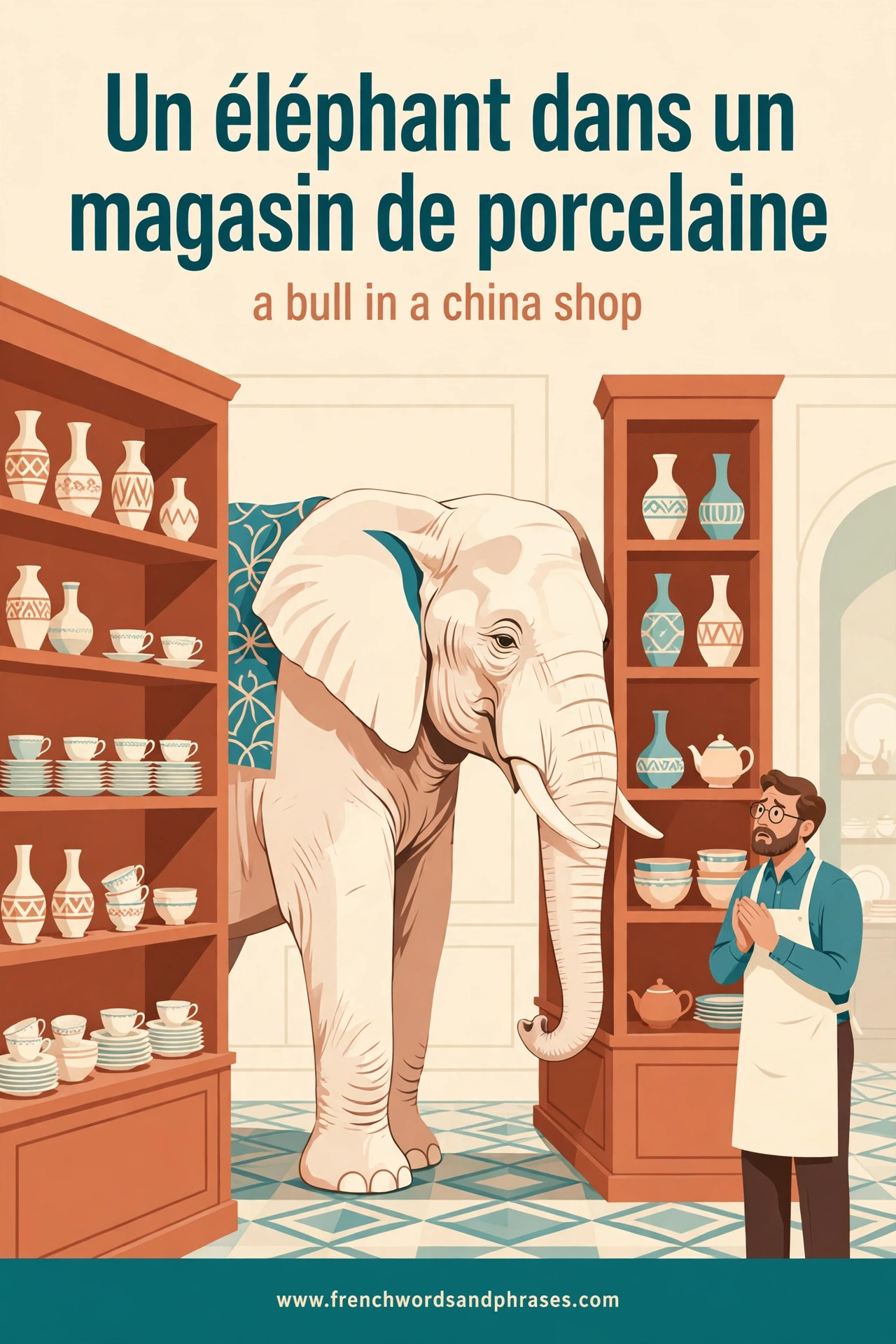
Un éléphant dans un magasin de porcelaine means a bull in a china shop — a clumsy, heavy-handed person in a delicate situation.
The antique shop is silent except for a ticking clock. Shelves of porcelain cups rise on every side — and in walks your brother-in-law, broad, cheerful, swinging his arms as he tells a story. The shopkeeper goes pale. In French, the whole room is thinking the same words: « Un éléphant dans un magasin de porcelaine. »
Let’s explore how un éléphant dans un magasin de porcelaine works in French, beginning with the whole phrase on one card.
Understanding the French Phrase Un éléphant dans un magasin de porcelaine
Un éléphant dans un magasin de porcelaine is a French idiomatic expression built from un éléphant (an elephant), un magasin (a shop) and la porcelaine (porcelain, fine china). It names a person hopelessly clumsy or tactless in a setting that calls for delicacy — the French twin of the English bull in a china shop.
It means a bull in a china shop — someone big, careless or blunt let loose among fragile things, delicate feelings or fine negotiations. France chose the elephant where England chose the bull, but the disaster is the same: every step risks a crash, and every word risks a crack. The phrase describes the person, or the effect they have, never the shop itself.
Type: Idiomatic expression — clumsiness (noun phrase, used like a portrait)
Answers the need: Calling someone dangerously clumsy or tactless in a delicate place
Register: Neutral to humorous — everyday speech and writing alike
Strength: Strong — total mismatch between the person and the setting
One important usage detail: the phrase usually arrives with être or comme — il est comme un éléphant dans un magasin de porcelaine, or the warning tu arrives comme un éléphant… It also works for tactless speech: a brutal remark in a sensitive meeting earns exactly the same comparison.
Experience the Word
Un éléphant dans un magasin de porcelaine is the fear of every host, curator and diplomat — size in the wrong room.
Imagine the family christening: a hundred-year-old service laid out by a proud grandmother, and one guest who gestures with his whole arm when he laughs. Everyone else breathes in smaller breaths. The phrase exists for the love in that room as much as for the clumsiness — it is a warning dressed as a joke.
French humour loves an animal in the wrong shop. The elephant is not wicked; he is simply built for another landscape.
How to Use Un éléphant dans un magasin de porcelaine in French: Complete Guide
Let’s explore how un éléphant dans un magasin de porcelaine works in French, beginning with the whole phrase on one card.
Un éléphant dans un magasin de porcelaine at a Glance
The Whole Phrase on One Card
Real meaning, literal picture, English twin and register — un éléphant dans un magasin de porcelaine in five lines.
| Point | Un éléphant dans un magasin de porcelaine |
|---|---|
| What it really means | a clumsy, tactless person in a delicate situation |
| Word for word | an elephant in a porcelain shop |
| English equivalent | a bull in a china shop |
| Register | neutral to humorous — a warning as much as a description |
| Use it for | clumsy guests, blunt speakers, heavy-handed negotiators |
Example
Avec ses gros souliers et ses grands gestes, c’est un éléphant dans un magasin de porcelaine.
With his big boots and sweeping gestures, he is a bull in a china shop.
Word by Word: Building the Elephant
Five small pieces — take them one by one and the shelves start to tremble.
| Word | Literal meaning | Its job in the phrase |
|---|---|---|
| un | a | one single animal is already too much for the room |
| éléphant | an elephant | the biggest land animal — size, weight and no brakes |
| dans | in | inside, where he should never be |
| magasin | a shop | the room full of breakable treasures |
| porcelaine | porcelain, fine china | the most fragile ware of all — one touch and it is gone |
Example
Un éléphant, un magasin, de la porcelaine : la catastrophe est annoncée.
An elephant, a shop, porcelain: disaster announced.
Quick Quiz 1
Which animal does English put in the china shop, where French puts an elephant?
Reveal the answer
A bull — the English twin is a bull in a china shop; the picture and the meaning are identical.
Les Anglais disent un taureau, les Français un éléphant.
The English say a bull, the French an elephant.
When You Say It: The Fragile Moments
Un éléphant dans un magasin de porcelaine fires at moments like these — someone too big, too loud or too blunt for a delicate room.
| Situation | Example |
|---|---|
| The clumsy guest | il entre comme un éléphant dans un magasin de porcelaine — he comes in like a bull in a china shop |
| The tactless remark | sa remarque a fait l’effet d’un éléphant dans un magasin de porcelaine — his remark landed like a bull in a china shop |
| Delicate talks | dans cette négociation, pas d’éléphant dans un magasin de porcelaine — in this negotiation, no bulls in china shops |
| Warning a friend | doucement, tu es un éléphant dans un magasin de porcelaine — gently, you are a bull in a china shop |
| About yourself | chez les antiquaires, je suis un éléphant dans un magasin de porcelaine — in antique shops, I am a bull in a china shop |
Example
Sa question sur le divorce, en plein repas de famille : un éléphant dans un magasin de porcelaine.
His question about the divorce, in the middle of the family dinner: a bull in a china shop.
Make It Yours: The Elephant for Every Setting
The phrase rides on être and comme — the elephant itself never changes shape.
| Form | French | In English |
|---|---|---|
| He is… | il est un éléphant dans un magasin de porcelaine | he is a bull in a china shop |
| Like… | comme un éléphant dans un magasin de porcelaine | like a bull in a china shop |
| Arriving like… | arriver comme un éléphant dans un magasin de porcelaine | to come barging in like a bull in a china shop |
| The effect of… | faire l’effet d’un éléphant dans un magasin de porcelaine | to land like a bull in a china shop |
| Not an elephant | ne sois pas un éléphant dans un magasin de porcelaine | don’t be a bull in a china shop |
| Question | tu veux jouer les éléphants dans un magasin de porcelaine ? | do you want to play the bull in the china shop? |
Example
Ne sois pas un éléphant dans un magasin de porcelaine avec ta belle-mère.
Don’t be a bull in a china shop with your mother-in-law.
Quick Quiz 2
Which little word usually carries the elephant into the sentence — comme or chez?
Reveal the answer
Comme — comme un éléphant dans un magasin de porcelaine, ‘like an elephant…’.
Il a traversé la galerie comme un éléphant dans un magasin de porcelaine.
He crossed the gallery like a bull in a china shop.
Everyday Expressions: Building on the Elephant
Un éléphant dans un magasin de porcelaine slots into these everyday frames — each one ready to use as it stands.
| Frame | In English |
|---|---|
| comme un éléphant dans un magasin de porcelaine | like a bull in a china shop |
| arriver comme un éléphant | to come barging in, all weight and no care |
| un éléphant dans un magasin de porcelaine | the person themselves — the walking disaster |
| faire des dégâts | to cause damage — what the elephant leaves behind |
| marcher sur des œufs | to walk on eggshells — the careful opposite |
Example
Après son passage, il n’y avait que des dégâts : un vrai éléphant dans un magasin de porcelaine.
After he passed through, there was nothing but damage: a real bull in a china shop.
Close Cousins: The Other Heavy Feet
French has a whole shelf of clumsiness phrases — the elephant is the heaviest; its cousins trip, drop and blunder in smaller ways.
| Expression | The difference |
|---|---|
| un éléphant dans un magasin de porcelaine | a bull in a china shop — the total mismatch of size and place |
| être maladroit | to be clumsy — the plain, everyday word, no animal needed |
| avoir deux mains gauches | to have two left hands — clumsy with your hands, dropping and fumbling |
| marcher sur des œufs | to walk on eggshells — the opposite pole: extreme, anxious care |
| mettre les pieds dans le plat | to put your foot in it — the tactless remark, said out loud |
Example
Maladroit des deux mains, il évite les magasins de porcelaine.
Clumsy with both hands, he avoids china shops.
Quick Quiz 3
A colleague keeps dropping tools and fumbling screws. Elephant, or deux mains gauches?
Reveal the answer
Deux mains gauches — two left hands is for manual clumsiness; the elephant is for the whole person in a delicate setting.
Avec ses deux mains gauches, il casse tout ce qu’il touche.
With his two left hands, he breaks everything he touches.
Un éléphant dans un magasin de porcelaine and Its Neighbours
The delicacy shelf around the phrase — the fragile goods, the careful walkers, and the damage.
| French | In English |
|---|---|
| la porcelaine | porcelain, fine china |
| fragile | fragile |
| un éléphant | an elephant |
| maladroit | clumsy |
| délicat | delicate |
| casser | to break |
Example
Tout est fragile ici : même l’éléphant avance délicatement.
Everything is fragile here: even the elephant walks delicately.
Watch Out: The Traps Around Un éléphant dans un magasin de porcelaine
The traps: a zoo visit that is not an idiom, the wrong animal in English, and size blamed where tact is the fault.
| Trap | The truth |
|---|---|
| the zoo trap | voir un éléphant au zoo is a day out; the magasin de porcelaine is what makes the idiom |
| the English animal | translating word for word gives ‘an elephant in a china shop’ — English says bull; use the French animal in French, the English one in English |
| not only about big people | a tiny, sharp-tongued guest can be the elephant — the phrase targets carelessness, not body size |
| porcelaine, not verre | the shop sells porcelaine, fine china — un magasin de verre would be a different, lesser disaster |
Example
Petite et mince, mais un éléphant dans un magasin de porcelaine dès qu’elle parle.
Small and slim, but a bull in a china shop the moment she speaks.
Quick Quiz 4
True or false: the phrase can describe a tactless speaker, not just a physically clumsy person.
Reveal the answer
True — blunt words in a delicate room break porcelain just as surely as elbows do.
Son discours a été un éléphant dans un magasin de porcelaine.
His speech was a bull in a china shop.
Un éléphant dans un magasin de porcelaine in Everyday French: Real-Life Examples
Now that you know the word, let’s see how un éléphant dans un magasin de porcelaine appears in everyday French.
Example 1 — At the antique shop
Il est entré chez l’antiquaire comme un éléphant dans un magasin de porcelaine.
He walked into the antique shop like a bull in a china shop.
Example 2 — The family dinner
Sa remarque sur l’héritage : un éléphant dans un magasin de porcelaine.
His remark about the inheritance: a bull in a china shop.
Example 3 — Warning a friend
Attention, ce soir tu es un éléphant dans un magasin de porcelaine.
Careful, tonight you are a bull in a china shop.
Example 4 — At the office
Le nouveau directeur arrive comme un éléphant dans un magasin de porcelaine.
The new manager comes barging in like a bull in a china shop.
Example 5 — About yourself
Chez ma belle-mère, je me sens un éléphant dans un magasin de porcelaine.
At my mother-in-law’s, I feel like a bull in a china shop.
Example 6 — The negotiation
Dans ce dossier délicat, il a joué l’éléphant dans un magasin de porcelaine.
In this delicate matter, he played the bull in the china shop.
Beyond Translation: The Meaning of Un éléphant dans un magasin de porcelaine
Two nations, one disaster, two animals. England picked the bull — farmyard temper, horns and temper. France picked the elephant — sheer tonnage, a creature so large that the room itself becomes the problem. The French choice is almost tender: the elephant cannot help his size.
To be un éléphant dans un magasin de porcelaine is to be built for the savanna and blamed for the shelves.
The phrase forgives even as it warns — which is why families use it about people they love.
How to Remember the French Phrase Un éléphant dans un magasin de porcelaine
Remember it this way: Un éléphant dans un magasin de porcelaine is size in the wrong room — the biggest animal among the most fragile goods.
- You picture the shelves — porcelaine is fine china, and every cup is listening.
- You swap the animal in English — French says éléphant, English says bull; the disaster is the same.
- You carry it in with comme — comme un éléphant dans un magasin de porcelaine.
The key idea is un éléphant dans un magasin de porcelaine means a bull in a china shop — too big and too blunt for a delicate place.
Test Your Knowledge of Un éléphant dans un magasin de porcelaine
Let’s see how much you’ve learned. Try answering these questions before revealing the answers.
Question 1
What does un éléphant dans un magasin de porcelaine mean?
Reveal the answer
A bull in a china shop — a clumsy or tactless person in a delicate situation.
Question 2
What is the literal, word-for-word meaning?
Reveal the answer
An elephant in a porcelain shop — the biggest animal among the most fragile goods.
Question 3
How do you say ‘he came in like a bull in a china shop’?
Reveal the answer
Il est entré comme un éléphant dans un magasin de porcelaine — comme carries the comparison.
Question 4
What is the difference between the elephant and avoir deux mains gauches?
Reveal the answer
Deux mains gauches is manual clumsiness — dropping and fumbling. The elephant is the whole person, size or speech, in a delicate setting.
Question 5
Complete the sentence:
Doucement ! Tu es un ______ dans un magasin de porcelaine. (Gently! You are a bull in a china shop.)
Reveal the answer
éléphant
Doucement ! Tu es un éléphant dans un magasin de porcelaine.
Gently! You are a bull in a china shop.
Your Final Challenge
Can You Use It?
How would you say this in French?
“He is a bull in a china shop.”
Reveal the answer
C’est un éléphant dans un magasin de porcelaine.
He is a bull in a china shop.
A little French. A little curiosity. A richer everyday life.
LEARN FRENCH ONE WORD AT A TIME