A French Word to Live By
Translate Tuer les mouches à quinze pas to English
/tɥe le muʃ a kɛ̃z pa/
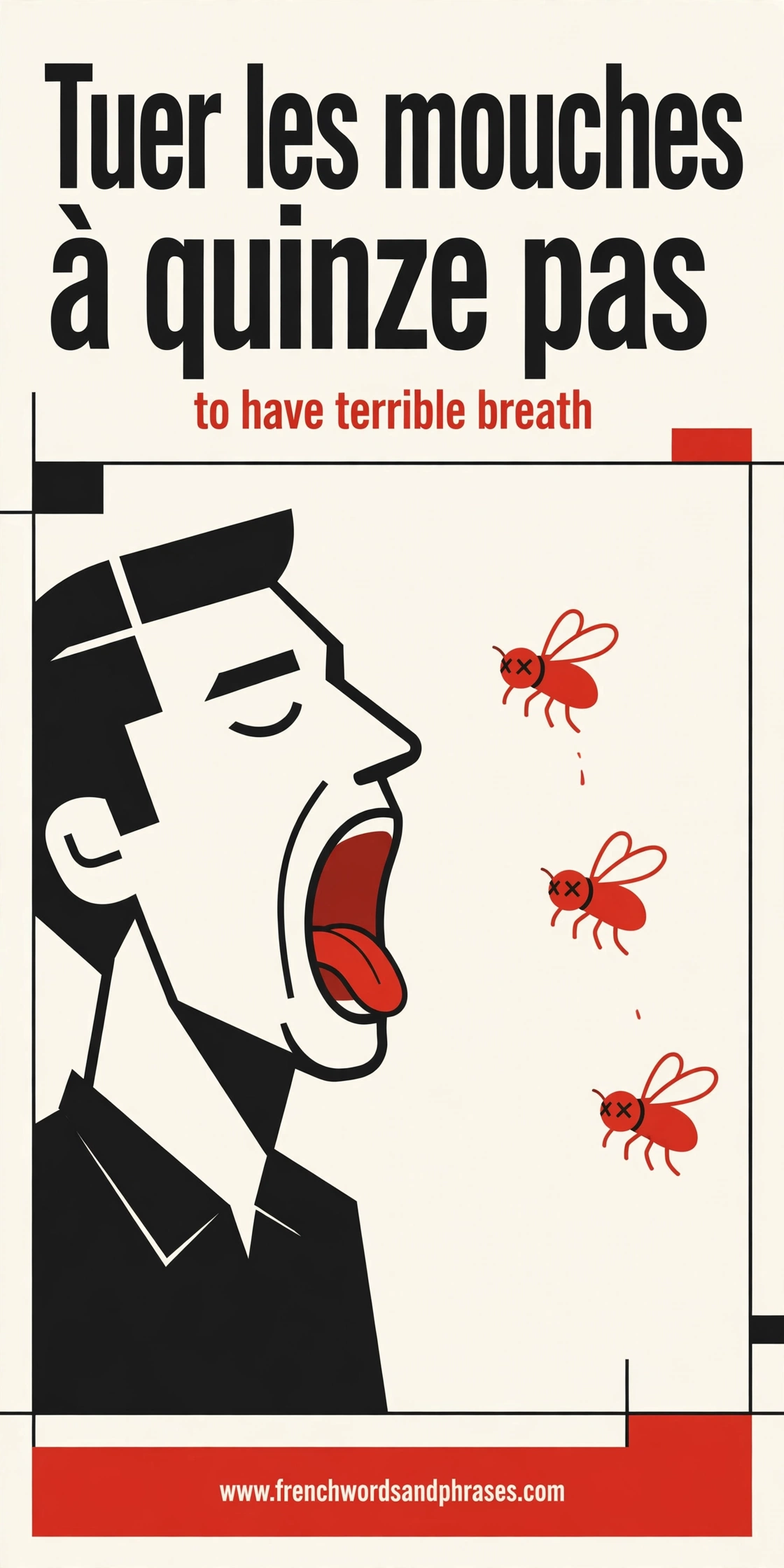
Tuer les mouches à quinze pas means to have breath so bad it could kill flies at fifteen paces — dreadful bad breath, said as a joke.
The office meeting is going well until Monsieur Fabre leans in to share a confidence about the quarterly figures — and three colleagues suddenly remember urgent business near the window. Nobody says a word, but the verdict travels the room in smiles: ce matin, il tue les mouches à quinze pas.
Let’s explore how tuer les mouches à quinze pas works in French, beginning with the whole phrase on one card.
Understanding the French Phrase Tuer les mouches à quinze pas
Tuer les mouches à quinze pas is a humorous French idiomatic expression built from tuer (to kill), les mouches (the flies) and quinze pas (fifteen paces). The picture is a duelling ground measured in paces — except the weapon is not a pistol. It is somebody’s breath, so dreadful that the flies drop out of the air fifteen paces away.
It means to have terrible bad breath — the kind that works at a distance. It is never a medical diagnosis and never said to the person’s face by anyone polite: it is a joke exchanged behind a hand, about garlic lunches, morning-after coffee breath and uncles who smoke. The exaggeration is the whole point — fifteen paces is roughly ten metres, and the flies are innocent bystanders.
Type: Idiomatic expression — humorous insult (hyperbole)
Answers the need: Joking that someone’s breath could strip paint at ten metres
Register: Familiar, teasing — said about someone, laughing, never in formal settings
The distance: Quinze pas — about fifteen paces, the duelling measure turned into a joke
One important usage detail: this is playground-and-family humour, aimed at people you know well — and usually said about them, not to them. The structure is avoir une haleine à tuer les mouches à quinze pas (to have breath fit to kill flies at fifteen paces) or the shorter verb form il tue les mouches à quinze pas. Keep it affectionate: the same joke about a stranger, or a boss, stops being charming very quickly.
Experience the Word
Tuer les mouches à quinze pas is the phrase of the morning after the garlic festival — the breath that arrives in the room a full second before its owner does.
Imagine a village wedding, years ago. The dancing is over, the accordion is asleep, and Uncle Robert — hero of the cheese course, the garlic snails and the local eau-de-vie — leans down to kiss the bride goodnight. The bride, the bouquet, and every fly within fifteen paces sway gently. The family has told the story for thirty years, and Uncle Robert tells it best.
That is the spirit of the expression: a tease so exaggerated it becomes a family medal — the flies are fictional, the affection is real.
How to Use Tuer les mouches à quinze pas in French: Complete Guide
Let’s explore how tuer les mouches à quinze pas works in French, beginning with the whole phrase on one card.
Tuer les mouches à quinze pas at a Glance
The Whole Phrase on One Card
Real meaning, literal picture, English twin and register — tuer les mouches à quinze pas in five lines.
| Point | Tuer les mouches à quinze pas |
|---|---|
| What it really means | to have appalling bad breath |
| Word for word | to kill the flies at fifteen paces |
| English equivalent | breath that could knock you out / dragon breath |
| Register | familiar, teasing, humorous — never formal |
| Use it for | garlic lunches, morning breath, the uncle after the cheese course |
Example
Après l’aïoli, il tuait les mouches à quinze pas.
After the garlic mayonnaise, his breath could have killed flies at fifteen paces.
Word by Word: Building the Weapon
A killer, some flies and a duelling distance — the three pieces of the joke.
| Word | Literal meaning | Its job in the phrase |
|---|---|---|
| tuer | to kill | the crime — committed without lifting a finger |
| les mouches | the flies | the victims — small, numerous and defenceless |
| à quinze pas | at fifteen paces | the range — the duelling measure that makes it absurd |
| une haleine | breath | the weapon itself, in the full form: une haleine à tuer les mouches |
Example
Une haleine à tuer les mouches à quinze pas : voilà son arme secrète.
Breath fit to kill flies at fifteen paces: that is his secret weapon.
Quick Quiz 1
What is actually being ‘killed’ in tuer les mouches à quinze pas?
Reveal the answer
Nothing, literally — the flies are comic victims. The phrase is hyperbole for terrible bad breath.
Après le café et la cigarette, il tuait les mouches à quinze pas.
After the coffee and the cigarette, his breath could kill flies at fifteen paces.
When You Say It: The Bad-Breath Moments
Garlic, mornings and cheese courses — the phrase’s natural hunting ground.
| Situation | Example |
|---|---|
| After garlic | Après la soupe à l’ail, on tuait toutes les mouches à quinze pas. |
| Morning breath | Au réveil, sans brossage, il tue les mouches à quinze pas. |
| The family uncle | Tonton, après le fromage, tu tues les mouches à quinze pas ! |
| As a warning | Brosse-toi les dents, sinon tu vas tuer les mouches à quinze pas. |
Example
Le matin de la fête, le chien lui-même a reculé : il tuait les mouches à quinze pas.
On the morning of the party, even the dog backed away: his breath could kill flies at fifteen paces.
Make It Yours: The Joke for Every Person
Tuer is a regular -er verb — aim the joke at every person, kindly.
| Form | French | In English |
|---|---|---|
| Present | tu tues les mouches à quinze pas | your breath could kill flies at fifteen paces |
| Past | il tuait les mouches à quinze pas | his breath could have killed flies at fifteen paces |
| Full form | avoir une haleine à tuer les mouches à quinze pas | to have breath fit to kill flies at fifteen paces |
| Gentle version | tu as une haleine de compétition | you have championship-level breath |
Example
Après les escargots à l’ail, nous tuions les mouches à quinze pas, tous ensemble.
After the garlic snails, our breath could have killed flies at fifteen paces, all of us together.
Quick Quiz 2
What is the full, noun-based form of the expression?
Reveal the answer
Avoir une haleine à tuer les mouches à quinze pas — to have breath fit to kill flies at fifteen paces.
Le matin, il a une haleine à tuer les mouches à quinze pas.
In the morning, he has breath fit to kill flies at fifteen paces.
Everyday Expressions: Building on the Flies
Frames from the same comic armoury — breath, smells and their victims.
| Frame | In English |
|---|---|
| tuer les mouches à quinze pas | to have breath that kills flies at fifteen paces |
| avoir une haleine de bouc | to have goat’s breath — another animal verdict on bad breath |
| puer de la bouche | to have a smelly mouth — the plain, unfunny version |
| un tue-mouches | a fly swatter — the honest tool for the honest job |
Example
Après le fromage de chèvre, il avait une haleine de bouc.
After the goat’s cheese, he had goat’s breath.
Close Cousins: The Other Comic Weapons
Neighbours built on the same exaggeration — effects measured at a distance.
| Expression | The difference |
|---|---|
| tuer les mouches à quinze pas | bad breath, measured in paces |
| avoir une haleine de bouc | bad breath again, judged by the goat standard |
| sentir à dix lieues | to smell from ten leagues away — the smell version, for cheeses and worse |
| réveiller un mort | to wake the dead — of noises, smells and coffees strong enough for anything |
Example
Ce fromage se sent à dix lieues — et il est délicieux.
That cheese can be smelled ten leagues away — and it is delicious.
Quick Quiz 3
Is tuer les mouches à quinze pas polite enough for the office?
Reveal the answer
Only as a joke among close colleagues — it is familiar teasing, said about someone with affection, never in a formal setting or to a stranger.
Entre amis, on rit ; devant le directeur, on offre un chewing-gum, en silence.
Among friends, you laugh; in front of the boss, you silently offer a chewing gum.
Tuer les mouches à quinze pas and Its Neighbours
The phrase in the wild, next to its exaggerated relations.
| French | In English |
|---|---|
| Il tue les mouches à quinze pas depuis le petit déjeuner. | His breath has been killing flies at fifteen paces since breakfast. |
| Une haleine de bouc après ce fromage, c’est normal. | Goat’s breath after that cheese is normal. |
| Ce café réveillerait un mort. | This coffee could wake the dead. |
| Offre-lui un bonbon à la menthe, par charité. | Offer him a mint, out of charity. |
Example
Le matin du départ, toute la famille tuait les mouches à quinze pas : merci, l’aïoli de la veille.
On the morning of departure, the whole family’s breath could kill flies at fifteen paces: thank you, yesterday’s garlic mayonnaise.
Watch Out: The Traps Around Tuer les mouches à quinze pas
A joke with rules — aim, distance and target all matter.
| Trap | The truth |
|---|---|
| Saying it to a stranger’s face | it is a tease for people you know and love — elsewhere it is simply rude |
| Dropping the distance | à quinze pas is the punchline; without the range, the joke loses its measure |
| Translating pas as ‘steps’ in a hurry | pas here is the pace, the duelling measure — not a dance step |
| Confusing tuer and tu es | tu tues (you kill) is the verb form; the phrase needs the verb tuer, conjugated |
Example
On le dit en riant, à un frère, jamais à un inconnu.
You say it laughing, to a brother, never to a stranger.
Quick Quiz 4
Complete the joke: « Après l’ail, il tue les ______ à ______ pas. »
Reveal the answer
Mouches, quinze — the flies, at fifteen paces.
Après l’ail, il tue les mouches à quinze pas.
After garlic, his breath kills flies at fifteen paces.
Tuer les mouches à quinze pas in Everyday French: Real-Life Examples
Now that you know the word, let’s see how tuer les mouches à quinze pas appears in everyday French.
Example 1 — In the family
Tonton Marcel, après les escargots, tu tues les mouches à quinze pas !
Uncle Marcel, after the snails, your breath could kill flies at fifteen paces!
Example 2 — In the morning
Avant le café et la brosse à dents, je tue les mouches à quinze pas, je l’avoue.
Before coffee and the toothbrush, my breath could kill flies at fifteen paces, I admit it.
Example 3 — Among friends
On a tous mangé l’aïoli ; dans la voiture, on tuait les mouches à quinze pas, collectivement.
We all ate the garlic mayonnaise; in the car, our combined breath could have killed flies at fifteen paces.
Example 4 — As advice
Prends un chewing-gum avant la réunion, sinon tu vas tuer les mouches à quinze pas.
Have a chewing gum before the meeting, or your breath will kill flies at fifteen paces.
Example 5 — About the dog
Même le chien, après son repas, tue les mouches à quinze pas — la famille entière recule.
Even the dog, after his meal, has breath that could kill flies at fifteen paces — the whole family steps back.
Example 6 — At the dentist
Le dentiste a vu arriver des haleines à tuer les mouches à quinze pas toute sa carrière.
The dentist has seen breath fit to kill flies at fifteen paces his whole career.
Beyond Translation: The Meaning of Tuer les mouches à quinze pas
English reaches for the dragon — dragon breath, morning breath, knock-out breath. French reaches for the duelling ground and an entomologist’s notebook: the damage is measured, precisely, in paces, and the victims are itemised as flies.
To tuer les mouches à quinze pas is to turn an embarrassment into a measurement — fifteen paces of comic range, with the flies as witnesses for the prosecution.
That is why families keep it for their own. The phrase is an insult engineered like a water pistol: unmistakable, soaking, and impossible to stay angry at.
How to Remember the French Phrase Tuer les mouches à quinze pas
Remember it this way: Tuer les mouches à quinze pas is a duel where nobody draws a pistol — the breath does all the work, and the flies fall at exactly fifteen paces.
- You picture the duelling ground — fifteen paces measured out, flies dropping mid-air.
- You keep the full form in reserve — une haleine à tuer les mouches à quinze pas, for the complete diagnosis.
- You aim with affection — family and close friends only; the joke is a medal, not a weapon.
The key idea is tuer les mouches à quinze pas means to have terrible breath — flies drop at fifteen paces.
Test Your Knowledge of Tuer les mouches à quinze pas
Let’s see how much you’ve learned. Try answering these questions before revealing the answers.
Question 1
What does tuer les mouches à quinze pas mean?
Reveal the answer
To have terrible bad breath — said as a joke, with the flies as comic victims.
Question 2
What is the full noun-based form of the expression?
Reveal the answer
Avoir une haleine à tuer les mouches à quinze pas — to have breath fit to kill flies at fifteen paces.
Question 3
Why fifteen paces?
Reveal the answer
It is the duelling measure — the joke borrows the range of a duel to measure the range of the breath.
Question 4
Who may you say it to?
Reveal the answer
Family and close friends, laughing — it is affectionate teasing, never a remark for strangers or formal settings.
Question 5
Which cousin expression judges breath by the goat standard?
Reveal the answer
Avoir une haleine de bouc — to have goat’s breath.
Your Final Challenge
Can You Use It?
How would you say this in French?
“After the garlic snails, Uncle Robert’s breath could kill flies at fifteen paces.”
Reveal the answer
Après les escargots à l’ail, l’haleine de tonton Robert tuait les mouches à quinze pas.
After the garlic snails, Uncle Robert’s breath could kill flies at fifteen paces.
A little French. A little curiosity. A richer everyday life.
LEARN FRENCH ONE WORD AT A TIME