A French Word to Live By
How to Conjugate Truffer in French
/tʁy.fe/
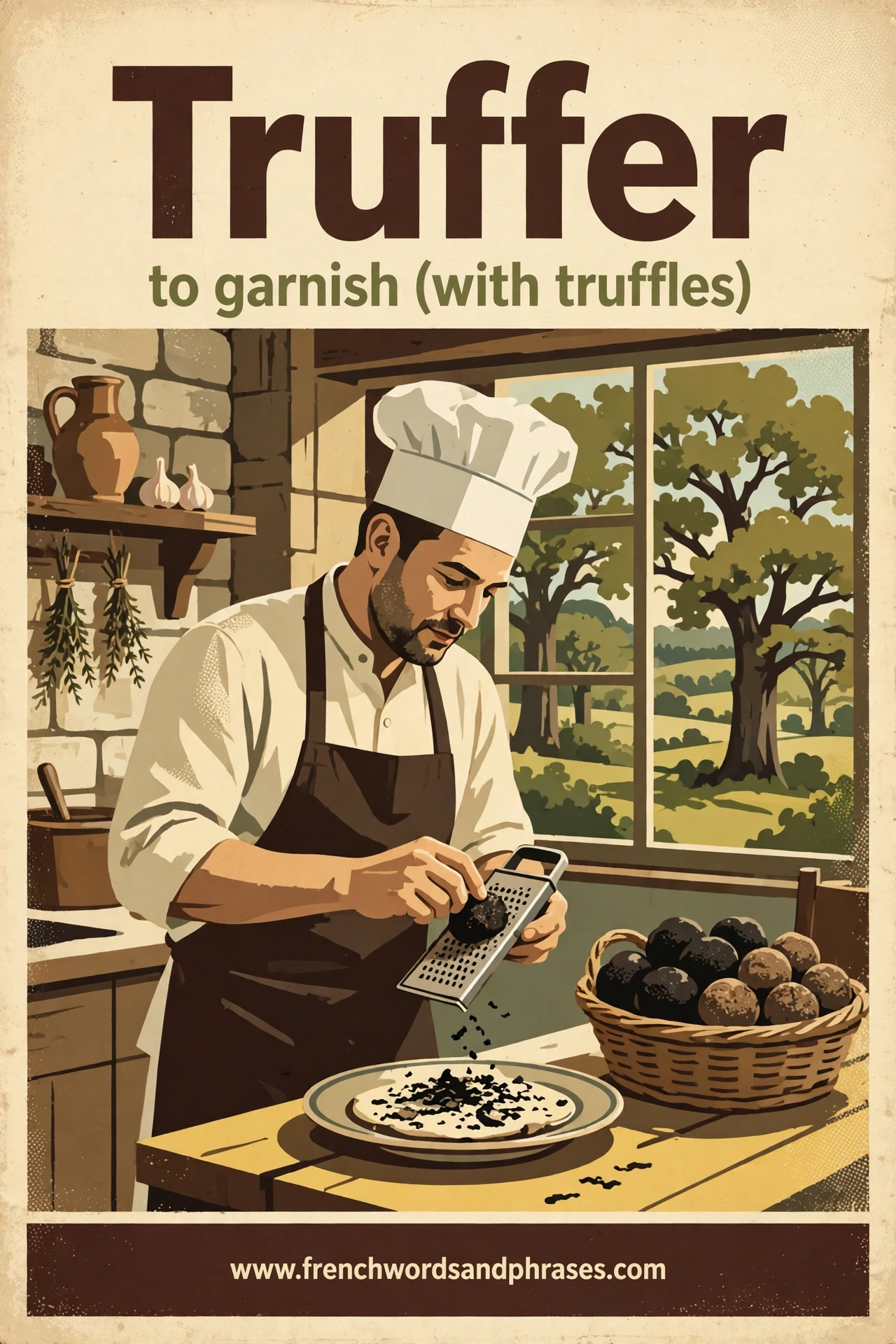
Truffer means to garnish with truffles — and, by extension, to stuff something full.
A black Périgord truffle shaved into dark ribbons over a Christmas capon, a manuscript so stuffed with mistakes that the editor despairs — truffer begins in the grand kitchen and ends anywhere something is packed full, for better or worse.
In this guide, you’ll learn how to conjugate truffer in all the major French tenses and moods. Explore complete conjugation tables, French examples, English translations, and practice quizzes.
Understanding the French Verb Truffer
Truffer is a regular French verb belonging to the first group of verbs, those ending in -er.
It means to garnish (with truffles). It is commonly used in classic French cooking for poultry, pâtés and roasts dressed with black truffle, and figuratively — far more often today — for texts, speeches and CVs packed full of errors, lies, jargon or details.
Verb classification: First group (-er)
Auxiliary verb: Avoir
Past participle: truffé
Present participle: truffant
English equivalents: To garnish with truffles, to stuff with; truffer une volaille — to stuff a bird with truffles; truffer de — to cram full of; un texte truffé de fautes — a text riddled with mistakes.
One important detail: truffer has two lives, and the bridge between them is the construction truffer de. In the kitchen, you truffez a bird or a pâté with truffle — slivers slipped under the skin or folded through the stuffing. Everywhere else, truffer de means to cram a thing full of something, usually unwelcome: un rapport truffé de chiffres, a report stuffed with figures; un discours truffé de mensonges, a speech riddled with lies. The participle truffé de is the form you will meet most.
Experience the Word
Truffer is the verb of generous stuffing — sometimes delicious, sometimes damning.
Imagine a Périgord kitchen at Christmas. Under the capon’s skin, the cook slides ribbon after ribbon of black truffle — truffant patiemment — until the bird is a parcel of perfume waiting for the oven.
Every slice will carry the truffle through it. The bird has been garnished — truffé — inside and out.
How to Conjugate Truffer: Complete French Conjugation Guide
Let’s explore every major conjugation of truffer, beginning with the indicative mood.
How to Conjugate Truffer in the Indicative Mood
The indicative mood is used to express facts, observations, actions, and events.
How to Conjugate Truffer in the Present Tense (Présent)
Used for actions happening now, habitual actions, and general truths.
| Subject | Conjugation |
|---|---|
| je | truffe |
| tu | truffes |
| il / elle | truffe |
| nous | truffons |
| vous | truffez |
| ils / elles | truffent |
Example
Le chef truffe la volaille de lamelles de truffe noire.
The chef garnishes the bird with slivers of black truffle.
Quick Quiz 1
Complete the sentence:
Le chef ______ la volaille de lamelles de truffe.
Reveal the answer
truffe
Le chef truffe la volaille de lamelles de truffe.
The chef garnishes the bird with slivers of truffle.
How to Conjugate Truffer in the Passé Composé
Used for completed actions in the past. Truffer takes the auxiliary verb avoir.
| Subject | Conjugation |
|---|---|
| j’ | ai truffé |
| tu | as truffé |
| il / elle | a truffé |
| nous | avons truffé |
| vous | avez truffé |
| ils / elles | ont truffé |
Example
Elle a truffé le pâté en croûte de morceaux de truffe.
She stuffed the pâté en croûte with pieces of truffle.
How to Conjugate Truffer in the Imparfait (Imperfect Tense)
Used for habitual past actions, descriptions, and ongoing situations in the past.
| Subject | Conjugation |
|---|---|
| je | truffais |
| tu | truffais |
| il / elle | truffait |
| nous | truffions |
| vous | truffiez |
| ils / elles | truffaient |
Example
Autrefois, on truffait les dindes de Noël au Périgord.
In the old days, Christmas turkeys were stuffed with truffles in the Périgord.
Quick Quiz 2
Choose the correct form:
She garnished the roast with truffles.
Elle ______ le rôti. (a truffé / est truffée)
Reveal the answer
a truffé
Elle a truffé le rôti.
Truffer takes avoir.
How to Conjugate Truffer in the Plus-que-parfait
Used to describe an action that had already been completed before another past event.
| Subject | Conjugation |
|---|---|
| j’ | avais truffé |
| tu | avais truffé |
| il / elle | avait truffé |
| nous | avions truffé |
| vous | aviez truffé |
| ils / elles | avaient truffé |
Example
Il avait truffé le rôti avant l’arrivée des invités.
He had garnished the roast with truffles before the guests arrived.
How to Conjugate Truffer in the Passé Simple
Primarily used in formal writing, literature, and historical narratives. It is rarely used in everyday conversation.
| Subject | Conjugation |
|---|---|
| je | truffai |
| tu | truffas |
| il / elle | truffa |
| nous | truffâmes |
| vous | truffâtes |
| ils / elles | truffèrent |
Example
Le cuisinier truffa la poularde avec soin.
The cook garnished the pullet with truffles, carefully.
How to Conjugate Truffer in the Passé Antérieur
A literary tense used to express an action completed immediately before another past action, generally in the passé simple.
| Subject | Conjugation |
|---|---|
| j’ | eus truffé |
| tu | eus truffé |
| il / elle | eut truffé |
| nous | eûmes truffé |
| vous | eûtes truffé |
| ils / elles | eurent truffé |
Example
Quand elle eut truffé la dinde, elle la mit au four.
When she had stuffed the turkey with truffles, she put it in the oven.
How to Conjugate Truffer in the Future Tense (Futur Simple)
Used to describe actions that will take place in the future.
| Subject | Conjugation |
|---|---|
| je | trufferai |
| tu | trufferas |
| il / elle | truffera |
| nous | trufferons |
| vous | trufferez |
| ils / elles | trufferont |
Example
Pour les fêtes, nous trufferons le chapon.
For the festive season, we will garnish the capon with truffles.
How to Conjugate Truffer in the Futur Antérieur (Future Perfect)
Used for an action that will have been completed before a particular point in the future.
| Subject | Conjugation |
|---|---|
| j’ | aurai truffé |
| tu | auras truffé |
| il / elle | aura truffé |
| nous | aurons truffé |
| vous | aurez truffé |
| ils / elles | auront truffé |
Example
À Noël, ils auront truffé toutes les volailles de la boutique.
By Christmas, they will have garnished all the shop’s poultry with truffles.
How to Conjugate Truffer in the Near Future (Futur Proche)
Used to describe something that is going to happen soon. Formed with aller + infinitive.
| Subject | Conjugation |
|---|---|
| je | vais truffer |
| tu | vas truffer |
| il / elle | va truffer |
| nous | allons truffer |
| vous | allez truffer |
| ils / elles | vont truffer |
Example
Je vais truffer ce pâté, regarde bien la technique.
I am going to stuff this pâté with truffles — watch the technique closely.
How to Conjugate Truffer in the Conditional Mood
The conditional mood expresses what would happen under certain circumstances. It is also frequently used to make polite requests or express wishes.
How to Conjugate Truffer in the Present Conditional
| Subject | Conjugation |
|---|---|
| je | trufferais |
| tu | trufferais |
| il / elle | trufferait |
| nous | trufferions |
| vous | trufferiez |
| ils / elles | trufferaient |
Example
Avec une belle truffe, tu trufferais ce rôti à merveille.
With a fine truffle, you would garnish this roast beautifully.
How to Conjugate Truffer in the Past Conditional
| Subject | Conjugation |
|---|---|
| j’ | aurais truffé |
| tu | aurais truffé |
| il / elle | aurait truffé |
| nous | aurions truffé |
| vous | auriez truffé |
| ils / elles | auraient truffé |
Example
Il aurait truffé la volaille si la truffe n’avait pas été si chère.
He would have garnished the bird if truffles had not been so expensive.
Truffer in the Literary Past Conditional Form
This less common literary form uses the imperfect subjunctive of avoir.
| Subject | Conjugation |
|---|---|
| j’ | eusse truffé |
| tu | eusses truffé |
| il / elle | eût truffé |
| nous | eussions truffé |
| vous | eussiez truffé |
| ils / elles | eussent truffé |
Example
Elle eût truffé la dinde avant le réveillon.
She would have garnished the turkey before Christmas Eve dinner.
How to Conjugate Truffer in the Subjunctive Mood
The subjunctive is used to express wishes, emotions, doubts, necessity, and uncertainty. It frequently follows expressions such as il faut que (it is necessary that) or bien que (although).
How to Conjugate Truffer in the Present Subjunctive
| Subject | Conjugation |
|---|---|
| que je | truffe |
| que tu | truffes |
| qu’il / qu’elle | truffe |
| que nous | truffions |
| que vous | truffiez |
| qu’ils / qu’elles | truffent |
Example
Il faut que vous truffiez le pâté généreusement.
You must garnish the pâté generously with truffles.
Quick Quiz 3
Complete the sentence using the subjunctive:
Il faut que vous ______ le pâté généreusement.
Reveal the answer
truffiez
Il faut que vous truffiez le pâté généreusement.
You must garnish the pâté generously with truffles.
How to Conjugate Truffer in the Imperfect Subjunctive
A literary tense, rarely encountered in modern spoken French.
| Subject | Conjugation |
|---|---|
| que je | truffasse |
| que tu | truffasses |
| qu’il / qu’elle | truffât |
| que nous | truffassions |
| que vous | truffassiez |
| qu’ils / qu’elles | truffassent |
Example
Le chef voulait qu’il truffât le chapon lui-même.
The chef wanted him to garnish the capon himself.
How to Conjugate Truffer in the Pluperfect Subjunctive
A literary construction used to express an action completed before another past action.
| Subject | Conjugation |
|---|---|
| que j’ | eusse truffé |
| que tu | eusses truffé |
| qu’il / qu’elle | eût truffé |
| que nous | eussions truffé |
| que vous | eussiez truffé |
| qu’ils / qu’elles | eussent truffé |
Example
On admirait qu’ils eussent truffé la poularde si finement.
People admired that they had garnished the pullet so finely.
How to Conjugate Truffer in the Past Subjunctive
| Subject | Conjugation |
|---|---|
| que j’ | aie truffé |
| que tu | aies truffé |
| qu’il / qu’elle | ait truffé |
| que nous | ayons truffé |
| que vous | ayez truffé |
| qu’ils / qu’elles | aient truffé |
Example
Je suis ravi que tu aies truffé le rôti pour les fêtes.
I am delighted you garnished the roast for the festive season.
How to Conjugate Truffer in the Imperative
The imperative is used to give commands, instructions, invitations, or suggestions. Subject pronouns are omitted.
How to Conjugate Truffer in the Present Imperative
| Person | Conjugation |
|---|---|
| (tu) | truffe |
| (nous) | truffons |
| (vous) | truffez |
Example
Truffe la volaille, mais n’exagère pas !
Garnish the bird with truffles, but do not overdo it!
Quick Quiz 4
How would you say Garnish the bird (tu form)?
Reveal the answer
Truffe la volaille !
French Participles of Truffer
Participles are verb forms that can be used in compound tenses and other grammatical constructions.
Present Participle of Truffer
truffant
En truffant la dinde, elle pensait déjà au réveillon.
As she garnished the turkey, she was already thinking of Christmas Eve dinner.
Past Participle of Truffer
truffé
Truffé de fautes, son texte a été refusé par l’éditeur.
Riddled with mistakes, his text was rejected by the publisher.
Truffer in Everyday French: Real-Life Examples
Now that you know the conjugations, let’s see how truffer appears in everyday French.
Example 1 — Present
Le chef truffe le chapon de lamelles de truffe.
The chef garnishes the capon with slivers of truffle.
Example 2 — Passé composé
Son discours était truffé de mensonges.
His speech was riddled with lies.
Example 3 — Imparfait
On truffait les dindes de Noël au Périgord.
Christmas turkeys were stuffed with truffles in the Périgord.
Example 4 — Future
Nous trufferons la volaille pour les fêtes.
We will garnish the bird with truffles for the festive season.
Example 5 — Conditional
Tu trufferais mieux ce pâté avec une truffe fraîche.
You would garnish this pâté better with a fresh truffle.
Example 6 — Imperative
Truffez le pâté généreusement !
Garnish the pâté generously with truffles!
Beyond Translation: The Meaning of Truffer
English riddled with is the everyday translation of truffer’s second life — and it keeps the kitchen hidden. French keeps the truffle in the picture.
To be truffé de fautes is to be stuffed like a Christmas bird — only the filling is errors.
It is one of French’s tastiest insults: the same verb that honours a capon in Périgord quietly ruins a manuscript in Paris.
How to Remember the French Verb Truffer
Remember it this way: Truffer is about a capon stuffed with truffle — and a text stuffed with errors.
- In the kitchen, truffer dresses a bird with black truffle.
- Truffé de — stuffed full of: un texte truffé de fautes, riddled with mistakes.
- Regular -er: je truffe, nous truffons, past participle truffé.
The key idea is a capon stuffed with truffle — and a text stuffed with errors.
Test Your Knowledge of Truffer
Let’s see how much you’ve learned. Try answering these questions before revealing the answers.
Question 1
What does un texte truffé de fautes mean?
Reveal the answer
A text riddled with mistakes — stuffed full of them, like a bird with truffles.
Question 2
How do you say She stuffed the pâté with pieces of truffle in French?
Reveal the answer
Elle a truffé le pâté de morceaux de truffe.
Question 3
Translate: His speech was riddled with lies.
Reveal the answer
Son discours était truffé de mensonges.
Question 4
What is the past participle of truffer?
Reveal the answer
Truffé.
Question 5
Complete the sentence:
Il faut que vous ______ le pâté généreusement.
Reveal the answer
truffiez
Il faut que vous truffiez le pâté généreusement.
You must garnish the pâté generously with truffles.
Your Final Challenge
Can You Use It?
How would you say this in French?
She garnishes the capon with black slivers of truffle, and the whole kitchen already smells of the feast.
Reveal the answer
Elle truffe le chapon de lamelles noires, et toute la cuisine embaume déjà la fête.
She garnishes the capon with black slivers of truffle, and the whole kitchen already smells of the feast.
A little French. A little curiosity. A richer everyday life.
LEARN FRENCH ONE WORD AT A TIME