A French Word to Live By
Translate Trop pour que to English
/tʁo puʁ kə/
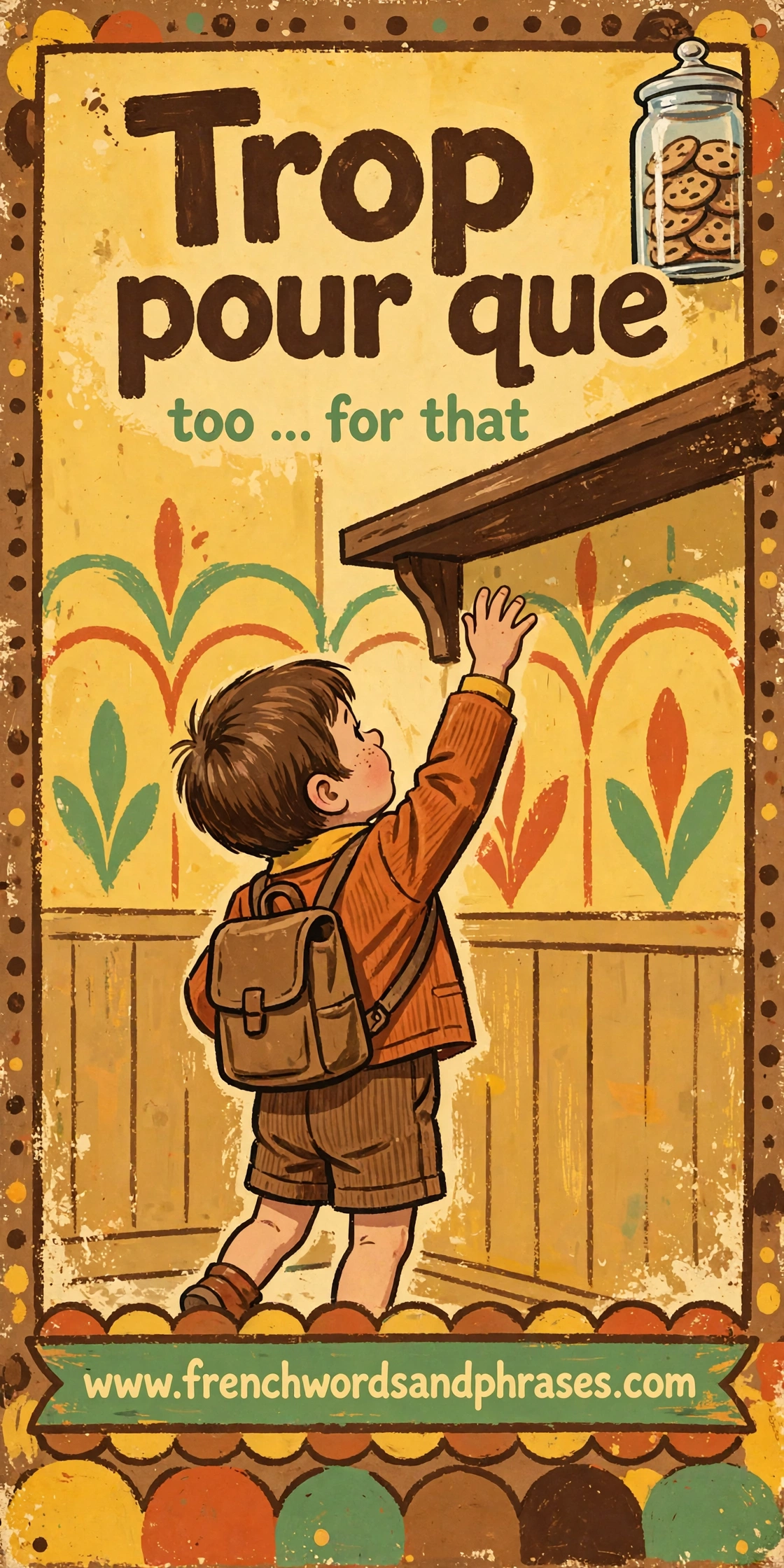
Trop pour que means too … for that.
A little boy drags a suitcase bigger than himself towards the stairs, determined, wobbling. His sister shakes her head: « Elle est trop lourde pour que tu la portes seul. » It is too heavy for you to carry alone. Trop pour que is the grammar of the exceeded limit — the point where ‘very’ tips over into ‘too much for this to happen’.
In this guide, you’ll learn what trop pour que means in English, how the pattern trop + adjective + pour que measures a quality past its limit, why the verb after pour que is always in the subjunctive, and when trop + pour + infinitive must be used instead. Explore French examples, English translations, and practice quizzes.
Understanding the French Conjunction Trop pour que
Trop pour que is a French degree construction joined to a conjunction — trop + an adjective or adverb + pour que. It means too … for (someone) to…, and it introduces the result that the excess makes impossible.
It means too … for that. The pattern needs three pieces: trop, a quality, and pour que + a clause with its own subject, always in the subjunctive: il fait trop froid pour que les enfants jouent dehors — it is too cold for the children to play outside. If the subject does not change, French uses trop + adjective + pour + infinitive instead.
Type: Degree construction + conjunction — result (blocked)
Answers the question: À quel point ? — To what extent? (Answer: past the limit)
What follows it: Pour que + a full clause with a DIFFERENT subject
Mood after it: Subjunctive — always
One important usage detail: trop pour que never travels alone — it needs its adjective or adverb in the middle (trop lourd pour que…, trop vite pour que…). And watch the subject: same subject → trop fatigué pour conduire (too tired to drive); new subject → trop fatigué pour que je lui demande de conduire.
Experience the Word
Trop pour que is the construction of the overflowing cup — the moment a quality stops being a description and becomes an obstacle.
Imagine a grandmother tasting the soup, spoon paused mid-air: « trop salée pour que les enfants en mangent » — too salty for the children to eat any. The salt has crossed a line, and grammar records the crossing.
You have not just said ‘very’. You have measured the exact point where possibility runs out.
How to Use Trop pour que in French: Complete Guide
Let’s explore how trop pour que works in French, beginning with the whole construction on one card.
Trop pour que at a Glance
Before the details, here is the whole construction on one card.
The Whole Construction on One Card
Meaning, job, pattern and mood — trop pour que in four lines.
| Point | Trop pour que |
|---|---|
| Meaning | too … for (someone) to… |
| Job | says a quality has passed the limit for a result |
| What follows | pour que + a full clause — with a DIFFERENT subject |
| Mood | subjunctive, always |
Example
Il fait trop froid pour que les enfants jouent dehors.
It’s too cold for the children to play outside.
How Trop pour que Links: The Excess First, the Blocked Result After
The main clause measures the excess — trop plus the adjective — and the pour que clause names the result that the excess rules out.
| Pattern | Example |
|---|---|
| trop + adjective + pour que + clause | la valise est trop lourde pour que je la porte seul — the suitcase is too heavy for me to carry alone |
| with a weather verb | il fait trop chaud pour que le chocolat reste dur — it’s too hot for the chocolate to stay hard |
| trop + adverb | elle parle trop vite pour que je comprenne — she speaks too fast for me to understand |
| a text and its readers | le texte est trop difficile pour que les élèves le lisent sans aide — the text is too hard for the pupils to read unaided |
Example
La musique est trop forte pour que le bébé dorme.
The music is too loud for the baby to sleep.
Quick Quiz 1
What three pieces does the pattern trop… pour que need?
Reveal the answer
trop + an adjective or adverb + pour que with a clause.
Trop lourde pour que je la porte.
Too heavy for me to carry.
The Mood Question: Always the Subjunctive
The result after pour que is blocked, unrealised — and unrealised results take the subjunctive. Some forms look identical to the indicative (jouent, lisent); the irregular ones (comprenne, puisse, soit) show the truth.
| Verb | Subjunctive forms after pour que |
|---|---|
| comprendre (to understand) | que je comprenne — trop vite pour que je comprenne |
| pouvoir (to be able) | qu’il puisse — trop jeune pour qu’il puisse entrer |
| être (to be) | que ce soit — trop tard pour que ce soit utile |
| jouer (to play) | que les enfants jouent — trop froid pour qu’ils jouent dehors |
Example
Le mur est trop haut pour que le chat saute par-dessus.
The wall is too high for the cat to jump over.
Where Trop pour que Goes: Glued Around Its Adjective — and the Infinitive Contrast
Trop and pour que wrap around the adjective like brackets and cannot be separated from it. The clause follows — unless the subject stays the same, in which case pour + infinitive takes over.
| Position / pattern | Example |
|---|---|
| trop + adjective + pour que | the three pieces stay in this order, always |
| Same subject → trop + adj + pour + infinitive | il est trop fatigué pour conduire — he is too tired to drive (he = he) |
| Different subject → trop + adj + pour que + subjunctive | il est trop fatigué pour que je lui demande de conduire — he is too tired for me to ask him to drive |
| No comma needed | the clause hangs directly on the adjective: trop loin pour qu’on y aille à pied |
Example
Elle est trop petite pour atteindre l’étagère, et trop fière pour qu’on l’aide.
She is too small to reach the shelf, and too proud for anyone to help her.
Quick Quiz 2
‘He is too tired to drive’ — pour que or pour + infinitive?
Reveal the answer
pour + infinitive — the subject does not change.
Il est trop fatigué pour conduire.
He is too tired to drive.
Everyday Expressions with Trop pour que
Trop pour que is what limits sound like in French — too early, too late, too far, too tired — each one closing a door with a reason attached.
| Expression | In English |
|---|---|
| trop tard pour que… | too late for… |
| trop loin pour qu’on y aille à pied | too far for us to walk there |
| trop tôt pour que le magasin soit ouvert | too early for the shop to be open |
| trop fatigué pour que je te demande un service | too tired for me to ask you a favour |
| trop petit pour que ça compte | too small for it to matter |
Example
Il est trop tôt pour que le soleil se lève, mais nous partons quand même.
It’s too early for the sun to be up, but we’re leaving anyway.
Close Cousins: Assez pour que, Si… que, Tellement… que
The degree family measures the same scale in both directions — assez reaches the threshold, trop overshoots it, and si… que reports a result that actually happened, in the indicative.
| Word | The difference |
|---|---|
| trop… pour que | ‘too … for…’ + subjunctive — the result is BLOCKED |
| assez… pour que | ‘… enough for…’ + subjunctive — the mirror image: the result is ENABLED: assez grand pour que tu voies |
| si… que | ‘so … that…’ + indicative — the result really happened: il était si fatigué qu’il s’est endormi |
| trop… pour + infinitive | same subject: trop fatigué pour conduire — no clause, no subjunctive |
Example
Il était si fatigué qu’il s’est endormi, trop fatigué pour que je le réveille.
He was so tired that he fell asleep, too tired for me to wake him.
Quick Quiz 3
Which cousin reports a result that really happened, with the indicative — trop… pour que or si… que?
Reveal the answer
si… que — its result is a fact, so the indicative is used.
Il était si content qu’il a chanté.
He was so happy that he sang.
Trop pour que and Its Neighbours
The whole measuring shelf: enough, too much, so much — and the phrases that say a limit has been reached in plain words.
| French | In English |
|---|---|
| assez… pour que | … enough for (the opposite direction) |
| si… que | so … that (real result) |
| à tel point que | to such a point that |
| au-delà de | beyond — past the limit, with a noun |
| dans la limite du possible | within the limits of the possible — the other side of trop |
Example
Le sac est assez léger pour que tu le portes, mais trop précieux pour qu’on le laisse tomber.
The bag is light enough for you to carry, but too precious for us to drop.
Watch Out: The Traps Around Trop pour que
The traps: a missing adjective, a same-subject clause, and an indicative where the blocked result demands the subjunctive.
| Trap | The truth |
|---|---|
| dropping the adjective | trop pour que alone is incomplete — the pattern needs its quality: trop lourd pour que, trop vite pour que |
| trop pour que with the same subject | prefer the infinitive: il est trop fatigué pour conduire, not pour qu’il conduise |
| indicative after pour que | the result is unrealised, so the subjunctive is compulsory: trop vite pour que je comprenne, not que je comprends |
| translating ‘too’ as très | très = very (no limit crossed); trop = too (limit crossed) — très froid is fine, trop froid blocks the picnic |
Example
La soupe est très chaude, même trop chaude pour que les enfants la mangent.
The soup is very hot, even too hot for the children to eat.
Quick Quiz 4
Complete: Elle parle trop vite pour que je ____ (comprendre).
Reveal the answer
comprenne — the subjunctive of comprendre.
Elle parle trop vite pour que je comprenne.
She speaks too fast for me to understand.
Trop pour que in Everyday French: Real-Life Examples
Now that you know the word, let’s see how trop pour que appears in everyday French.
Example 1 — Weather
Il fait trop froid pour que les enfants jouent dehors.
It’s too cold for the children to play outside.
Example 2 — Luggage
La valise est trop lourde pour que je la porte seul.
The suitcase is too heavy for me to carry on my own.
Example 3 — Speech
Il parle trop vite pour que les étudiants prennent des notes.
He speaks too fast for the students to take notes.
Example 4 — Distance
La mer est trop loin pour qu’on y aille à pied.
The sea is too far away for us to walk there.
Example 5 — Age
Elle est trop jeune pour que le film lui convienne.
She is too young for the film to be suitable for her.
Example 6 — Work
Le bruit est trop fort pour que je me concentre.
The noise is too loud for me to concentrate.
Beyond Translation: The Meaning of Trop pour que
English says too … for … to for the meaning of trop pour que — and hides the machinery inside an infinitive. French, when a new person enters the result, insists on a full clause and marks it with the subjunctive, the mood of things that will not happen.
To say trop pour que is to draw the line and name what lies beyond it in the same breath.
There is a whole ethics in the little construction: très admires, trop judges. The moment a quality becomes trop, the sentence stops describing the world and starts ruling on it.
How to Remember the French Conjunction Trop pour que
Remember it this way: Trop pour que is the overflowing-cup construction — a quality past its limit, a blocked result, and a new subject in the clause.
- You keep the three pieces together — trop + adjective + pour que, like brackets around the quality.
- You check the subject — same person? pour + infinitive. New person? pour que + subjunctive.
- You hear the judgement inside trop — not ‘very’, but ‘past the line’.
The key idea is trop + adjective + pour que means too … for, needs a different subject, and always takes the subjunctive.
Test Your Knowledge of Trop pour que
Let’s see how much you’ve learned. Try answering these questions before revealing the answers.
Question 1
What does trop pour que mean?
Reveal the answer
Too … for (someone) to… — a quality has passed the limit for a result to happen.
Question 2
Which mood follows pour que in this construction?
Reveal the answer
The subjunctive — always: trop froid pour que les enfants jouent dehors.
Question 3
Translate: It’s too cold for the children to play outside.
Reveal the answer
Il fait trop froid pour que les enfants jouent dehors.
Question 4
What is the difference between trop… pour and trop… pour que?
Reveal the answer
trop… pour + infinitive keeps the same subject (trop fatigué pour conduire); trop… pour que introduces a clause with a different subject, in the subjunctive.
Question 5
Complete the sentence:
La boîte est trop lourde pour que je la ______ (porter) seul.
Reveal the answer
porte
La boîte est trop lourde pour que je la porte seul.
The box is too heavy for me to carry on my own.
Your Final Challenge
Can You Use It?
How would you say this in French?
“It’s too cold for the children to play outside.”
Reveal the answer
Il fait trop froid pour que les enfants jouent dehors.
It’s too cold for the children to play outside.
A little French. A little curiosity. A richer everyday life.
LEARN FRENCH ONE WORD AT A TIME