
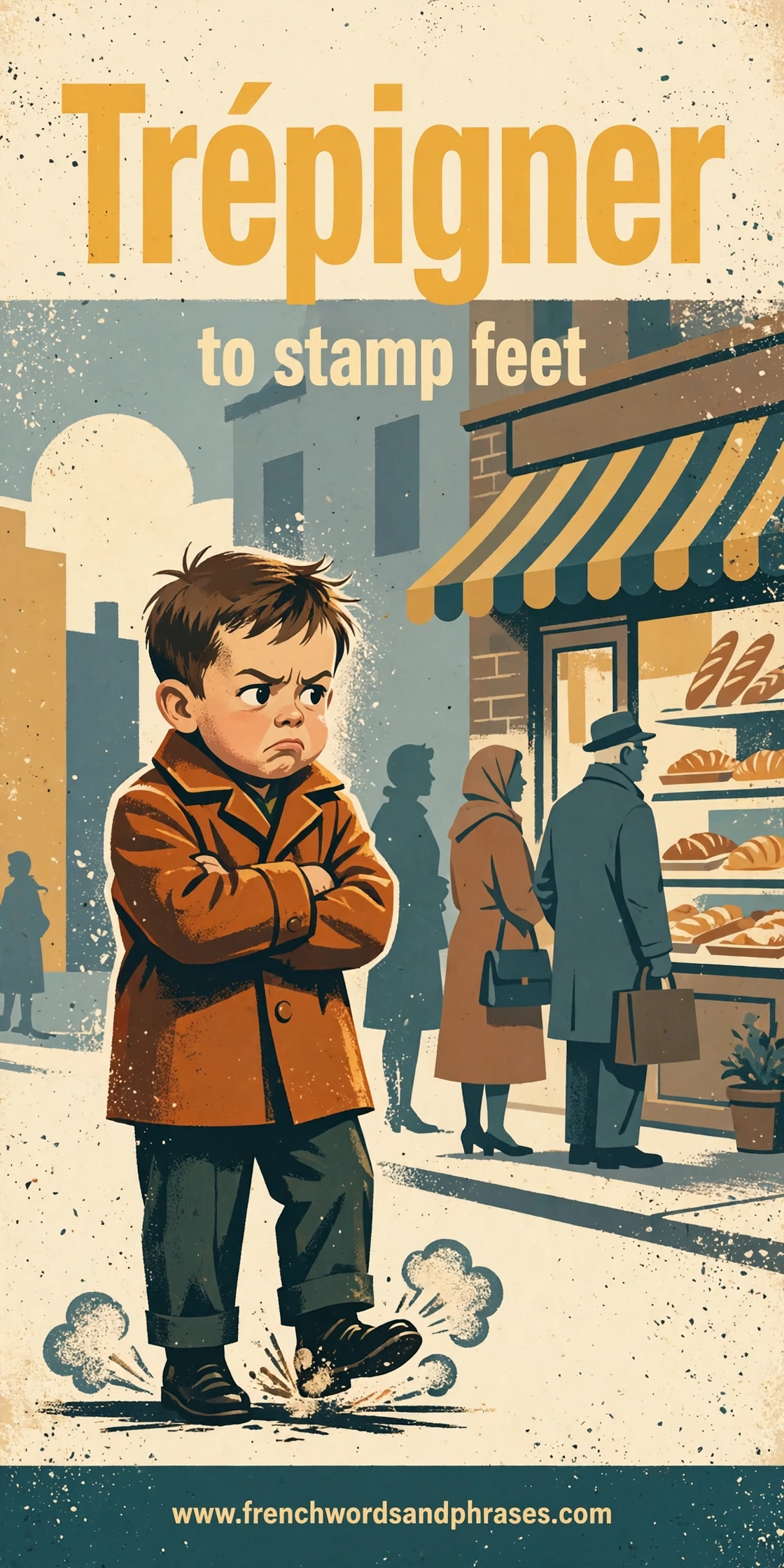
A French Word to Live By
How to Conjugate Trépigner in French
/tʁe.pi.ɲe/
Trépigner means to stamp one’s feet — the quick, repeated stamping of a child who cannot wait, or of someone bursting with impatience, anger or joy.
A little boy outside the sweetshop, hopping from one foot to the other; a queue that has not moved for an hour; a supporter who cannot sit still before the whistle — trépigner is the verb of feet that refuse to stay quiet when the heart is in a hurry.
In this guide, you’ll learn how to conjugate trépigner in all the major French tenses and moods. Explore complete conjugation tables, French examples, English translations, and practice quizzes.
Understanding the French Verb Trépigner
Trépigner is a regular French verb belonging to the first group of verbs, those ending in -er.
It means to stamp feet. It is commonly used for children stamping in temper or excitement, for crowds and queues fidgeting with impatience, for horses pawing and stamping in their stalls, and for anyone whose feet betray the emotion their face is trying to hide.
Verb classification: First group (-er)
Auxiliary verb: Avoir
Past participle: trépigné
Present participle: trépignant
English equivalents: To stamp one’s feet, to hop up and down; trépigner d’impatience — to stamp with impatience; trépigner de colère — to stamp with rage; trépigner de joie — to hop with joy.
One important detail: trépigner is a regular -er verb — je trépigne, nous trépignons, past participle trépigné — and it almost never travels alone: French pairs it with de plus the emotion that sets the feet going: trépigner d’impatience, de colère, d’envie, de joie. It is quicker and lighter than taper du pied, one stamp of protest; trépigner is a whole dance of small, rapid stamps.
Experience the Word
Trépigner is the verb of feelings that come out through the floor — when waiting becomes physically impossible.
Imagine Christmas Eve, 6 p.m., and a six-year-old who has been told the presents come after dinner. He does not complain; he simply trépigne in the doorway, up and down, up and down, as if his feet could hurry the clock along.
The clock does not move any faster. But he stamps — il trépigne — because standing still would be unbearable.
How to Conjugate Trépigner: Complete French Conjugation Guide
Let’s explore every major conjugation of trépigner, beginning with the indicative mood.
How to Conjugate Trépigner in the Indicative Mood
The indicative mood is used to express facts, observations, actions, and events.
How to Conjugate Trépigner in the Present Tense (Présent)
Used for actions happening now, habitual actions, and general truths.
| Subject | Conjugation |
|---|---|
| je | trépigne |
| tu | trépignes |
| il / elle | trépigne |
| nous | trépignons |
| vous | trépignez |
| ils / elles | trépignent |
Example
L’enfant trépigne d’impatience devant la vitrine.
The child stamps with impatience in front of the shop window.
Quick Quiz 1
Complete the sentence:
Nous ______ d’impatience dans la file d’attente.
Reveal the answer
trépignons
Nous trépignons d’impatience dans la file d’attente.
We stamp with impatience in the queue.
How to Conjugate Trépigner in the Passé Composé
Used for completed actions in the past. Trépigner takes the auxiliary verb avoir.
| Subject | Conjugation |
|---|---|
| j’ | ai trépigné |
| tu | as trépigné |
| il / elle | a trépigné |
| nous | avons trépigné |
| vous | avez trépigné |
| ils / elles | ont trépigné |
Example
Elle a trépigné de colère en apprenant la nouvelle.
She stamped with rage on hearing the news.
How to Conjugate Trépigner in the Imparfait (Imperfect Tense)
Used for habitual past actions, descriptions, and ongoing situations in the past.
| Subject | Conjugation |
|---|---|
| je | trépignais |
| tu | trépignais |
| il / elle | trépignait |
| nous | trépignions |
| vous | trépigniez |
| ils / elles | trépignaient |
Example
Les chevaux trépignaient dans leurs stalles avant la course.
The horses used to stamp in their stalls before the race.
Quick Quiz 2
Choose the correct form:
She stamped with rage.
Elle ______ de colère. (a trépigné / est trépignée)
Reveal the answer
a trépigné
Elle a trépigné de colère.
Trépigner takes avoir.
How to Conjugate Trépigner in the Plus-que-parfait
Used to describe an action that had already been completed before another past event.
| Subject | Conjugation |
|---|---|
| j’ | avais trépigné |
| tu | avais trépigné |
| il / elle | avait trépigné |
| nous | avions trépigné |
| vous | aviez trépigné |
| ils / elles | avaient trépigné |
Example
Il avait trépigné pendant une heure devant la porte fermée.
He had been stamping for an hour in front of the closed door.
How to Conjugate Trépigner in the Passé Simple
Primarily used in formal writing, literature, and historical narratives. It is rarely used in everyday conversation.
| Subject | Conjugation |
|---|---|
| je | trépignai |
| tu | trépignas |
| il / elle | trépigna |
| nous | trépignâmes |
| vous | trépignâtes |
| ils / elles | trépignèrent |
Example
De rage, elle trépigna sur le trottoir.
In a rage, she stamped on the pavement.
How to Conjugate Trépigner in the Passé Antérieur
A literary tense used to express an action completed immediately before another past action, generally in the passé simple.
| Subject | Conjugation |
|---|---|
| j’ | eus trépigné |
| tu | eus trépigné |
| il / elle | eut trépigné |
| nous | eûmes trépigné |
| vous | eûtes trépigné |
| ils / elles | eurent trépigné |
Example
Quand il eut trépigné assez longtemps, on finit par l’écouter.
When he had stamped long enough, people finally listened to him.
How to Conjugate Trépigner in the Future Tense (Futur Simple)
Used to describe actions that will take place in the future.
| Subject | Conjugation |
|---|---|
| je | trépignerai |
| tu | trépigneras |
| il / elle | trépignera |
| nous | trépignerons |
| vous | trépignerez |
| ils / elles | trépigneront |
Example
Demain, les enfants trépigneront devant le sapin.
Tomorrow, the children will hop up and down in front of the Christmas tree.
How to Conjugate Trépigner in the Futur Antérieur (Future Perfect)
Used for an action that will have been completed before a particular point in the future.
| Subject | Conjugation |
|---|---|
| j’ | aurai trépigné |
| tu | auras trépigné |
| il / elle | aura trépigné |
| nous | aurons trépigné |
| vous | aurez trépigné |
| ils / elles | auront trépigné |
Example
À midi, il aura trépigné toute la matinée dans la file.
By noon, he will have been stamping all morning in the queue.
How to Conjugate Trépigner in the Near Future (Futur Proche)
Used to describe something that is going to happen soon. Formed with aller + infinitive.
| Subject | Conjugation |
|---|---|
| je | vais trépigner |
| tu | vas trépigner |
| il / elle | va trépigner |
| nous | allons trépigner |
| vous | allez trépigner |
| ils / elles | vont trépigner |
Example
Regarde-le : il va trépigner si on ne l’appelle pas.
Look at him: he is going to stamp if they do not call him.
How to Conjugate Trépigner in the Conditional Mood
The conditional mood expresses what would happen under certain circumstances. It is also frequently used to make polite requests or express wishes.
How to Conjugate Trépigner in the Present Conditional
| Subject | Conjugation |
|---|---|
| je | trépignerais |
| tu | trépignerais |
| il / elle | trépignerait |
| nous | trépignerions |
| vous | trépigneriez |
| ils / elles | trépigneraient |
Example
Sans cette attente, tu ne trépignerais pas ainsi.
Without this wait, you would not be stamping like that.
How to Conjugate Trépigner in the Past Conditional
| Subject | Conjugation |
|---|---|
| j’ | aurais trépigné |
| tu | aurais trépigné |
| il / elle | aurait trépigné |
| nous | aurions trépigné |
| vous | auriez trépigné |
| ils / elles | auraient trépigné |
Example
Elle aurait trépigné de joie si elle avait gagné.
She would have hopped with joy if she had won.
Trépigner in the Literary Past Conditional Form
This less common literary form uses the imperfect subjunctive of avoir.
| Subject | Conjugation |
|---|---|
| j’ | eusse trépigné |
| tu | eusses trépigné |
| il / elle | eût trépigné |
| nous | eussions trépigné |
| vous | eussiez trépigné |
| ils / elles | eussent trépigné |
Example
L’enfant eût trépigné jusqu’à l’ouverture des portes.
The child would have stamped until the doors opened.
How to Conjugate Trépigner in the Subjunctive Mood
The subjunctive is used to express wishes, emotions, doubts, necessity, and uncertainty. It frequently follows expressions such as il faut que (it is necessary that) or bien que (although).
How to Conjugate Trépigner in the Present Subjunctive
| Subject | Conjugation |
|---|---|
| que je | trépigne |
| que tu | trépignes |
| qu’il / qu’elle | trépigne |
| que nous | trépignions |
| que vous | trépigniez |
| qu’ils / qu’elles | trépignent |
Example
Je ne veux pas que tu trépignes comme un enfant gâté.
I do not want you stamping like a spoiled child.
Quick Quiz 3
Complete the sentence using the subjunctive:
Je ne veux pas que vous ______ ainsi.
Reveal the answer
trépigniez
Je ne veux pas que vous trépigniez ainsi.
I do not want you stamping like that.
How to Conjugate Trépigner in the Imperfect Subjunctive
A literary tense, rarely encountered in modern spoken French.
| Subject | Conjugation |
|---|---|
| que je | trépignasse |
| que tu | trépignasses |
| qu’il / qu’elle | trépignât |
| que nous | trépignassions |
| que vous | trépignassiez |
| qu’ils / qu’elles | trépignassent |
Example
Il souriait pendant que le petit trépignât de plus belle.
He smiled while the little boy stamped away harder than ever.
How to Conjugate Trépigner in the Pluperfect Subjunctive
A literary construction used to express an action completed before another past action.
| Subject | Conjugation |
|---|---|
| que j’ | eusse trépigné |
| que tu | eusses trépigné |
| qu’il / qu’elle | eût trépigné |
| que nous | eussions trépigné |
| que vous | eussiez trépigné |
| qu’ils / qu’elles | eussent trépigné |
Example
On disait que les chevaux eussent trépigné toute la nuit.
People said the horses had stamped all night.
How to Conjugate Trépigner in the Past Subjunctive
| Subject | Conjugation |
|---|---|
| que j’ | aie trépigné |
| que tu | aies trépigné |
| qu’il / qu’elle | ait trépigné |
| que nous | ayons trépigné |
| que vous | ayez trépigné |
| qu’ils / qu’elles | aient trépigné |
Example
Je suis amusé qu’elle ait trépigné de joie à l’annonce.
I am amused that she hopped with joy at the announcement.
How to Conjugate Trépigner in the Imperative
The imperative is used to give commands, instructions, invitations, or suggestions. Subject pronouns are omitted.
How to Conjugate Trépigner in the Present Imperative
| Person | Conjugation |
|---|---|
| (tu) | trépigne |
| (nous) | trépignons |
| (vous) | trépignez |
Example
Trépigne si tu veux, cela ne fera pas avancer la file !
Stamp all you like, it will not make the queue move!
Quick Quiz 4
How would you say Stamp all you like (tu form)?
Reveal the answer
Trépigne si tu veux !
French Participles of Trépigner
Participles are verb forms that can be used in compound tenses and other grammatical constructions.
Present Participle of Trépigner
trépignant
Trépignant d’impatience, la foule attendait l’ouverture.
Stamping with impatience, the crowd waited for the opening.
Past Participle of Trépigner
trépigné
Trépigné de colère pendant dix minutes, il finit par se calmer.
Having stamped with rage for ten minutes, he finally calmed down.
Trépigner in Everyday French: Real-Life Examples
Now that you know the conjugations, let’s see how trépigner appears in everyday French.
Example 1 — Present
L’enfant trépigne d’impatience.
The child stamps with impatience.
Example 2 — Passé composé
Elle a trépigné de colère.
She stamped with rage.
Example 3 — Imparfait
Les chevaux trépignaient avant la course.
The horses used to stamp before the race.
Example 4 — Future
Les enfants trépigneront devant le sapin.
The children will hop in front of the tree.
Example 5 — Conditional
Tu trépignerais de joie à sa place.
You would hop with joy in her place.
Example 6 — Imperative
Trépignez si vous voulez, la file n’avance pas !
Stamp if you like, the queue is not moving!
Beyond Translation: The Meaning of Trépigner
English stamp your feet sounds mostly angry; French trépigner covers the whole keyboard of impatience — rage, yes, but also envy, eagerness and pure joy.
The emotion after de does the steering.
Trépigner de joie at good news and trépigner de colère at bad news are the same feet doing the same dance; only the heart’s tempo changes.
How to Remember the French Verb Trépigner
Remember it this way: Trépigner is about feet that cannot wait — stamping with impatience, rage or joy.
- Trépigner + de + emotion: d’impatience, de colère, de joie.
- Quicker and lighter than taper du pied — a dance of small, rapid stamps.
- Regular -er: je trépigne, nous trépignons, past participle trépigné.
The key idea is feet that cannot wait — stamping with impatience, rage or joy.
Test Your Knowledge of Trépigner
Let’s see how much you’ve learned. Try answering these questions before revealing the answers.
Question 1
How do you say to stamp with impatience in French?
Reveal the answer
Trépigner d’impatience.
Question 2
How do you say The child stamps in front of the window in French?
Reveal the answer
L’enfant trépigne devant la vitrine.
Question 3
Translate: She stamped with rage on hearing the news.
Reveal the answer
Elle a trépigné de colère en apprenant la nouvelle.
Question 4
What is the past participle of trépigner?
Reveal the answer
Trépigné.
Question 5
Complete the sentence:
Je ne veux pas que tu ______ comme un enfant gâté.
Reveal the answer
trépignes
Je ne veux pas que tu trépignes comme un enfant gâté.
I do not want you stamping like a spoiled child.
Your Final Challenge
Can You Use It?
How would you say this in French?
In front of the bakery, the little boy stamps with impatience, and the door finally opens on the smell of warm bread.
Reveal the answer
Devant la boulangerie, le petit garçon trépigne d’impatience, et la porte s’ouvre enfin sur l’odeur du pain chaud.
In front of the bakery, the little boy stamps with impatience, and the door finally opens on the smell of warm bread.
A little French. A little curiosity. A richer everyday life.
LEARN FRENCH ONE WORD AT A TIME




