
A French Word to Live By
How to Conjugate Trépaner in French
/tʁe.pa.ne/
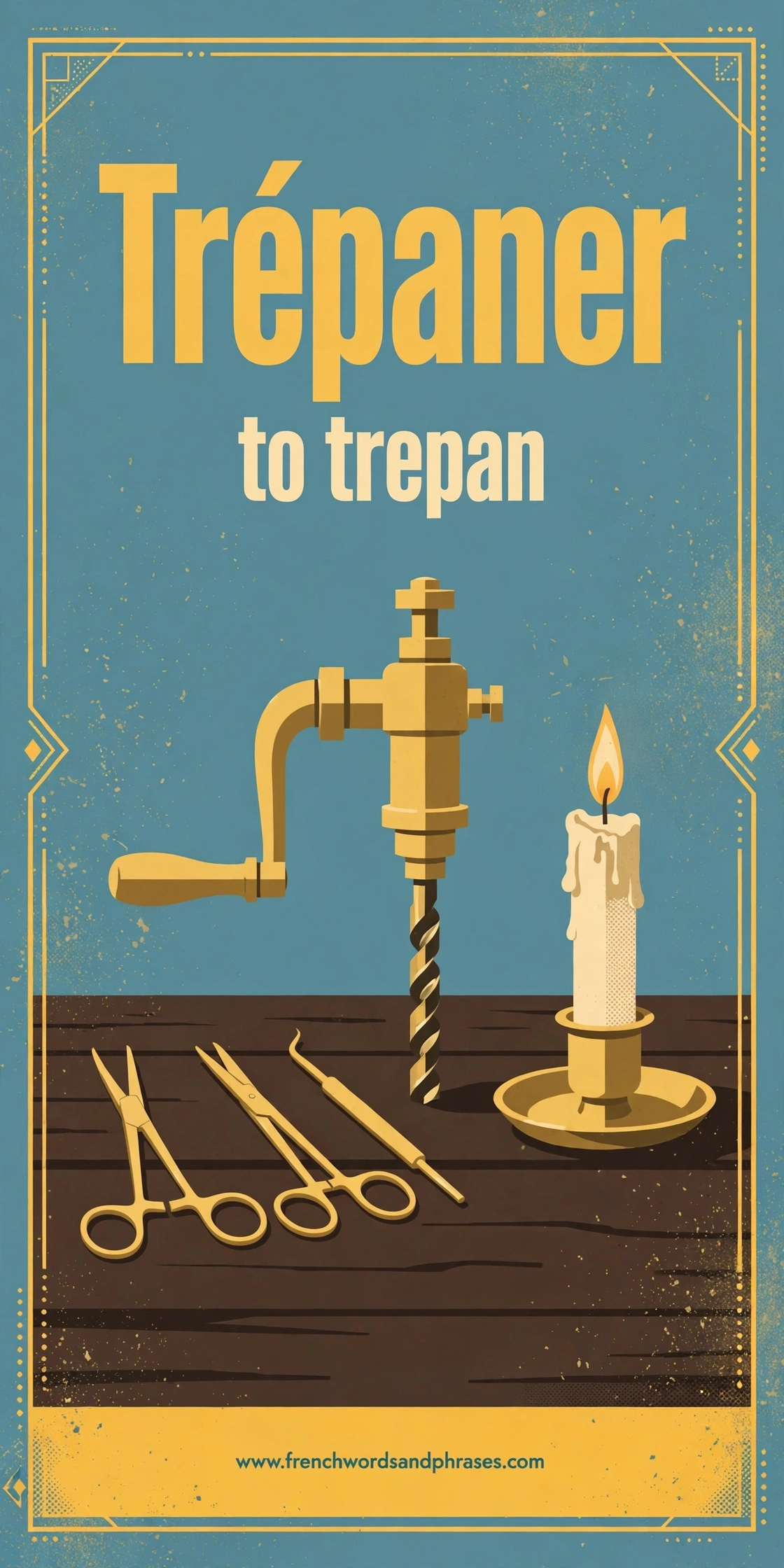
Trépaner means to trepan — to bore a hole in the skull, one of the oldest surgical operations in the world.
A stone-age patient, a flint tool, and a surgeon drilling a neat round hole in a living skull — trépaner is the verb of trepanation, the astonishing operation humans have performed, and survived, for thousands of years.
In this guide, you’ll learn how to conjugate trépaner in all the major French tenses and moods. Explore complete conjugation tables, French examples, English translations, and practice quizzes.
Understanding the French Verb Trépaner
Trépaner is a regular French verb belonging to the first group of verbs, those ending in -er.
It means to trepan. It is commonly used in medicine and medical history for opening the skull to relieve pressure, treat head wounds or remove fragments, and in archaeology for the prehistoric operation whose healed skulls prove that patients often survived it.
Verb classification: First group (-er)
Auxiliary verb: Avoir
Past participle: trépané
Present participle: trépanant
English equivalents: To trepan, to trephine; un trépan — a trepan (the surgeon’s drill); la trépanation — trepanation; trépaner un malade — to trepan a patient.
One important detail: trépaner is a regular -er verb — je trépane, nous trépanons, past participle trépané. The instrument gives the verb its name: un trépan is the cylindrical saw or drill, from the Greek trypanon, a borer. The noun la trépanation names the operation itself, and archaeologists find trépanés skulls — with bone that clearly grew back — on every continent.
Experience the Word
Trépaner is the verb of humanity’s oldest surgery — a hole in the head, made on purpose, to heal.
Imagine a Neolithic village. A hunter has fallen and lies senseless, his head swelling. The healer heats his flint, opens the scalp, and slowly, carefully, trépane — cutting a disc of bone free while the family holds the patient still. Days later, against all odds, the hunter wakes up.
It sounds like madness, and it worked. He was trepanned — trépané — and he lived.
How to Conjugate Trépaner: Complete French Conjugation Guide
Let’s explore every major conjugation of trépaner, beginning with the indicative mood.
How to Conjugate Trépaner in the Indicative Mood
The indicative mood is used to express facts, observations, actions, and events.
How to Conjugate Trépaner in the Present Tense (Présent)
Used for actions happening now, habitual actions, and general truths.
| Subject | Conjugation |
|---|---|
| je | trépane |
| tu | trépanes |
| il / elle | trépane |
| nous | trépanons |
| vous | trépanez |
| ils / elles | trépanent |
Example
Le chirurgien trépane le crâne pour soulager la pression.
The surgeon trepans the skull to relieve the pressure.
Quick Quiz 1
Complete the sentence:
Nous ______ seulement en cas d’urgence.
Reveal the answer
trépanons
Nous trépanons seulement en cas d’urgence.
We trepan only in an emergency.
How to Conjugate Trépaner in the Passé Composé
Used for completed actions in the past. Trépaner takes the auxiliary verb avoir.
| Subject | Conjugation |
|---|---|
| j’ | ai trépané |
| tu | as trépané |
| il / elle | a trépané |
| nous | avons trépané |
| vous | avez trépané |
| ils / elles | ont trépané |
Example
Les médecins ont trépané le patient après son accident.
The doctors trepanned the patient after his accident.
How to Conjugate Trépaner in the Imparfait (Imperfect Tense)
Used for habitual past actions, descriptions, and ongoing situations in the past.
| Subject | Conjugation |
|---|---|
| je | trépanais |
| tu | trépanais |
| il / elle | trépanait |
| nous | trépanions |
| vous | trépaniez |
| ils / elles | trépanaient |
Example
Dans l’Antiquité, on trépanait avec des outils de silex.
In ancient times, people used to trepan with flint tools.
Quick Quiz 2
Choose the correct form:
The doctors trepanned the patient.
Les médecins ______ le patient. (ont trépané / sont trépanés)
Reveal the answer
ont trépané
Les médecins ont trépané le patient.
Trépaner takes avoir.
How to Conjugate Trépaner in the Plus-que-parfait
Used to describe an action that had already been completed before another past event.
| Subject | Conjugation |
|---|---|
| j’ | avais trépané |
| tu | avais trépané |
| il / elle | avait trépané |
| nous | avions trépané |
| vous | aviez trépané |
| ils / elles | avaient trépané |
Example
Le chirurgien avait trépané deux blessés avant l’aube.
The surgeon had trepanned two wounded men before dawn.
How to Conjugate Trépaner in the Passé Simple
Primarily used in formal writing, literature, and historical narratives. It is rarely used in everyday conversation.
| Subject | Conjugation |
|---|---|
| je | trépanai |
| tu | trépanas |
| il / elle | trépana |
| nous | trépanâmes |
| vous | trépanâtes |
| ils / elles | trépanèrent |
Example
Le médecin trépana le crâne du roi blessé.
The physician trepanned the wounded king’s skull.
How to Conjugate Trépaner in the Passé Antérieur
A literary tense used to express an action completed immediately before another past action, generally in the passé simple.
| Subject | Conjugation |
|---|---|
| j’ | eus trépané |
| tu | eus trépané |
| il / elle | eut trépané |
| nous | eûmes trépané |
| vous | eûtes trépané |
| ils / elles | eurent trépané |
Example
Quand il eut trépané le malade, il referma la plaie.
When he had trepanned the patient, he closed the wound.
How to Conjugate Trépaner in the Future Tense (Futur Simple)
Used to describe actions that will take place in the future.
| Subject | Conjugation |
|---|---|
| je | trépanerai |
| tu | trépaneras |
| il / elle | trépanera |
| nous | trépanerons |
| vous | trépanerez |
| ils / elles | trépaneront |
Example
Demain, l’équipe trépanera pour atteindre l’hématome.
Tomorrow, the team will trepan to reach the haematoma.
How to Conjugate Trépaner in the Futur Antérieur (Future Perfect)
Used for an action that will have been completed before a particular point in the future.
| Subject | Conjugation |
|---|---|
| j’ | aurai trépané |
| tu | auras trépané |
| il / elle | aura trépané |
| nous | aurons trépané |
| vous | aurez trépané |
| ils / elles | auront trépané |
Example
À midi, ils auront trépané et refermé l’incision.
By noon, they will have trepanned and closed the incision.
How to Conjugate Trépaner in the Near Future (Futur Proche)
Used to describe something that is going to happen soon. Formed with aller + infinitive.
| Subject | Conjugation |
|---|---|
| je | vais trépaner |
| tu | vas trépaner |
| il / elle | va trépaner |
| nous | allons trépaner |
| vous | allez trépaner |
| ils / elles | vont trépaner |
Example
Le neurochirurgien va trépaner, préparez le bloc.
The neurosurgeon is going to trepan, prepare the theatre.
How to Conjugate Trépaner in the Conditional Mood
The conditional mood expresses what would happen under certain circumstances. It is also frequently used to make polite requests or express wishes.
How to Conjugate Trépaner in the Present Conditional
| Subject | Conjugation |
|---|---|
| je | trépanerais |
| tu | trépanerais |
| il / elle | trépanerait |
| nous | trépanerions |
| vous | trépaneriez |
| ils / elles | trépaneraient |
Example
Dans ce cas précis, vous trépaneriez du côté gauche.
In this particular case, you would trepan on the left side.
How to Conjugate Trépaner in the Past Conditional
| Subject | Conjugation |
|---|---|
| j’ | aurais trépané |
| tu | aurais trépané |
| il / elle | aurait trépané |
| nous | aurions trépané |
| vous | auriez trépané |
| ils / elles | auraient trépané |
Example
Il aurait trépané plus tôt si le scanner avait été prêt.
He would have trepanned sooner if the scanner had been ready.
Trépaner in the Literary Past Conditional Form
This less common literary form uses the imperfect subjunctive of avoir.
| Subject | Conjugation |
|---|---|
| j’ | eusse trépané |
| tu | eusses trépané |
| il / elle | eût trépané |
| nous | eussions trépané |
| vous | eussiez trépané |
| ils / elles | eussent trépané |
Example
Le barbier eût trépané le soldat sur le champ de bataille.
The barber-surgeon would have trepanned the soldier on the battlefield.
How to Conjugate Trépaner in the Subjunctive Mood
The subjunctive is used to express wishes, emotions, doubts, necessity, and uncertainty. It frequently follows expressions such as il faut que (it is necessary that) or bien que (although).
How to Conjugate Trépaner in the Present Subjunctive
| Subject | Conjugation |
|---|---|
| que je | trépane |
| que tu | trépanes |
| qu’il / qu’elle | trépane |
| que nous | trépanions |
| que vous | trépaniez |
| qu’ils / qu’elles | trépanent |
Example
Il faut que vous trépaniez avec une extrême précision.
You must trepan with extreme precision.
Quick Quiz 3
Complete the sentence using the subjunctive:
Il faut que vous ______ avec précision.
Reveal the answer
trépaniez
Il faut que vous trépaniez avec précision.
You must trepan with precision.
How to Conjugate Trépaner in the Imperfect Subjunctive
A literary tense, rarely encountered in modern spoken French.
| Subject | Conjugation |
|---|---|
| que je | trépanasse |
| que tu | trépanasses |
| qu’il / qu’elle | trépanât |
| que nous | trépanassions |
| que vous | trépanassiez |
| qu’ils / qu’elles | trépanassent |
Example
Le professeur expliquait comment on trépanât autrefois.
The professor explained how people used to trepan in the old days.
How to Conjugate Trépaner in the Pluperfect Subjunctive
A literary construction used to express an action completed before another past action.
| Subject | Conjugation |
|---|---|
| que j’ | eusse trépané |
| que tu | eusses trépané |
| qu’il / qu’elle | eût trépané |
| que nous | eussions trépané |
| que vous | eussiez trépané |
| qu’ils / qu’elles | eussent trépané |
Example
Les archéologues pensent qu’on eût trépané ce guerrier deux fois.
Archaeologists think this warrior had been trepanned twice.
How to Conjugate Trépaner in the Past Subjunctive
| Subject | Conjugation |
|---|---|
| que j’ | aie trépané |
| que tu | aies trépané |
| qu’il / qu’elle | ait trépané |
| que nous | ayons trépané |
| que vous | ayez trépané |
| qu’ils / qu’elles | aient trépané |
Example
Je suis soulagé que le chirurgien ait trépané à temps.
I am relieved that the surgeon trepanned in time.
How to Conjugate Trépaner in the Imperative
The imperative is used to give commands, instructions, invitations, or suggestions. Subject pronouns are omitted.
How to Conjugate Trépaner in the Present Imperative
| Person | Conjugation |
|---|---|
| (tu) | trépane |
| (nous) | trépanons |
| (vous) | trépanez |
Example
Trépanez doucement, le patient est fragile !
Trepan gently, the patient is fragile!
Quick Quiz 4
How would you say Trepan gently (vous form)?
Reveal the answer
Trépanez doucement !
French Participles of Trépaner
Participles are verb forms that can be used in compound tenses and other grammatical constructions.
Present Participle of Trépaner
trépanant
En trépanant ce crâne préhistorique, on risque de l’abîmer : prudence.
Trephining this prehistoric skull risks damaging it: care needed.
Past Participle of Trépaner
trépané
Trépané avec succès, le patient s’est réveillé le lendemain.
Successfully trepanned, the patient woke up the next day.
Trépaner in Everyday French: Real-Life Examples
Now that you know the conjugations, let’s see how trépaner appears in everyday French.
Example 1 — Present
Le chirurgien trépane le crâne du patient.
The surgeon trepans the patient’s skull.
Example 2 — Passé composé
Les médecins ont trépané le blessé cette nuit.
The doctors trepanned the wounded man tonight.
Example 3 — Imparfait
Autrefois, on trépanait avec du silex.
In the old days, people used to trepan with flint.
Example 4 — Future
L’équipe trépanera demain matin.
The team will trepan tomorrow morning.
Example 5 — Conditional
Vous trépaneriez du côté gauche.
You would trepan on the left side.
Example 6 — Imperative
Trépanez avec une extrême précision !
Trepan with extreme precision!
Beyond Translation: The Meaning of Trépaner
English trepan survives mainly in medical history books; French trépaner does the same work, and both hide a small joke: in old slang, a trépan could also be a trap or snare.
The healed skulls are the real marvel.
Museum shelves hold skulls with smooth, regrown bone around the hole — proof that the patient lived for years after someone trépana. The oldest surgery in the world was also, often, a successful one.
How to Remember the French Verb Trépaner
Remember it this way: Trépaner is about the oldest surgery in the world — a careful hole in the skull.
- Un trépan is the drill; trépaner is to drill the skull with it.
- La trépanation — the operation, practised since the Stone Age.
- Regular -er: je trépane, nous trépanons, past participle trépané.
The key idea is the oldest surgery in the world — a careful hole in the skull.
Test Your Knowledge of Trépaner
Let’s see how much you’ve learned. Try answering these questions before revealing the answers.
Question 1
What is un trépan?
Reveal the answer
A trepan — the cylindrical surgical drill used to open the skull.
Question 2
How do you say The surgeon trepans the skull in French?
Reveal the answer
Le chirurgien trépane le crâne.
Question 3
Translate: The doctors trepanned the patient after his accident.
Reveal the answer
Les médecins ont trépané le patient après son accident.
Question 4
What is the past participle of trépaner?
Reveal the answer
Trépané.
Question 5
Complete the sentence:
Il faut que vous ______ avec une extrême précision.
Reveal the answer
trépaniez
Il faut que vous trépaniez avec une extrême précision.
You must trepan with extreme precision.
Your Final Challenge
Can You Use It?
How would you say this in French?
The surgeon trepans with steady hands, and the patient opens his eyes again the next day.
Reveal the answer
Le chirurgien trépane avec des gestes sûrs, et le patient rouvre les yeux le lendemain.
The surgeon trepans with steady hands, and the patient opens his eyes again the next day.
A little French. A little curiosity. A richer everyday life.
LEARN FRENCH ONE WORD AT A TIME




