
A French Word to Live By
How to Conjugate Traverser in French
/tʁa.vɛʁ.se/
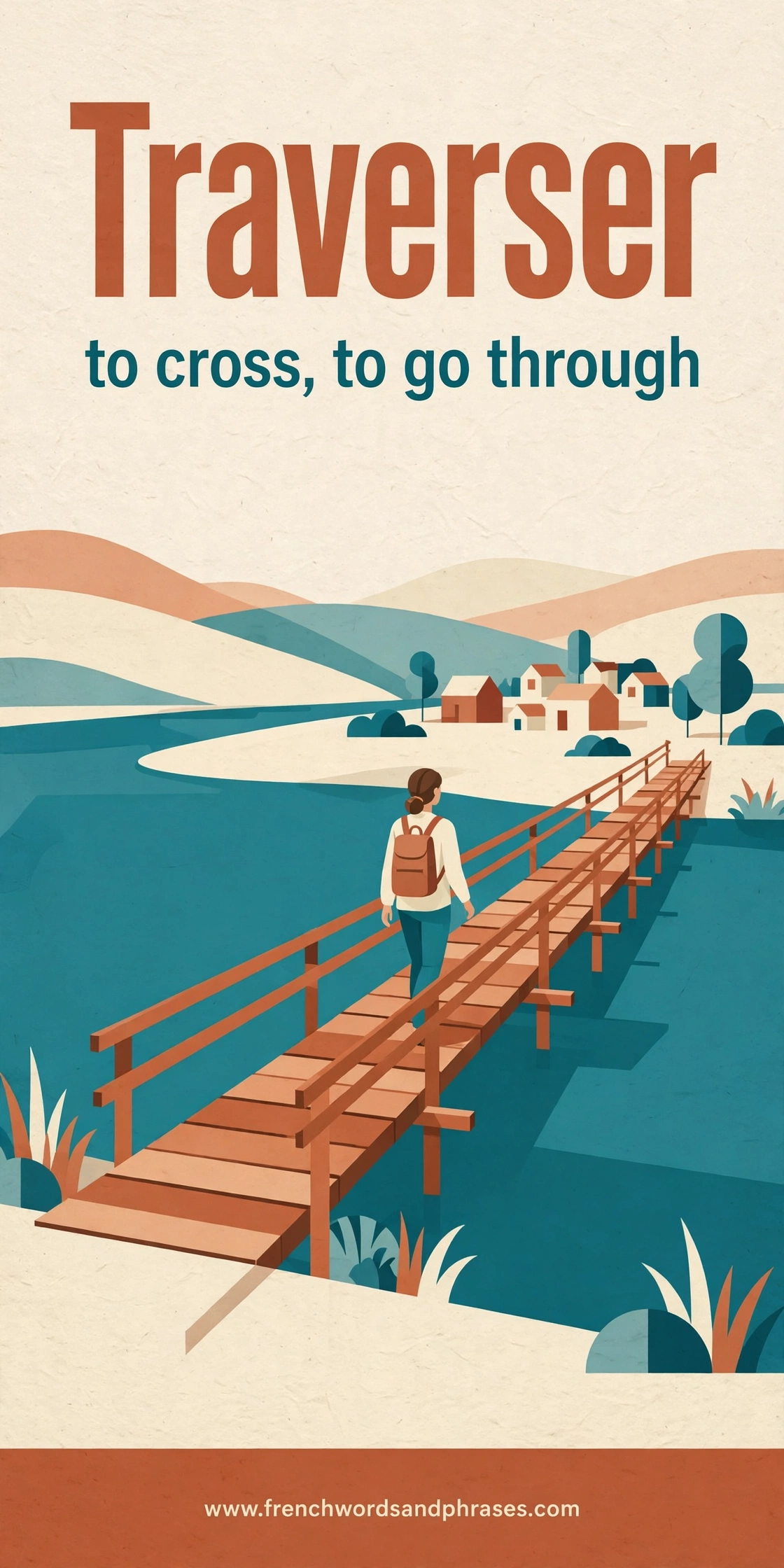
Traverser means to cross, to go through — to pass from one side of something to the other.
A child at the kerb, looking left, then right, then left again, before stepping into the road — traverser is the everyday verb of crossing: streets and oceans, deserts and crises, everything that lies between here and the other side.
In this guide, you’ll learn how to conjugate traverser in all the major French tenses and moods. Explore complete conjugation tables, French examples, English translations, and practice quizzes.
Understanding the French Verb Traverser
Traverser is a regular French verb belonging to the first group of verbs, those ending in -er.
It means to cross, to go through. It is commonly used for crossing streets, bridges, rivers and oceans, for passing through towns, tunnels and difficult periods of life, and figuratively for thoughts crossing the mind — one of the most useful verbs in daily French.
Verb classification: First group (-er)
Auxiliary verb: Avoir
Past participle: traversé
Present participle: traversant
English equivalents: To cross, to go through, to pass through; traverser la rue — to cross the street; traverser une crise — to go through a crisis; une idée m’a traversé l’esprit — a thought crossed my mind; traverser la Manche — to cross the Channel.
One important detail: traverser always takes avoir in compound tenses — j’ai traversé la rue, never with être. Learners expect a movement verb to behave like partir or arriver, but traverser names the crossing of a space, not a departure or an arrival, so French gives it avoir every time. Note also the jewel of its figurative uses: une idée m’a traversé l’esprit — a thought crossed my mind, the mind itself become a road to cross.
Experience the Word
Traverser is the verb of the in-between — every crossing it names has a far side waiting.
Imagine the first ferry of the morning leaving Calais. On deck, a lorry driver who has traversé la Manche a thousand times watches the white cliffs grow out of the mist. Half an hour of grey water, and the whole geography of his life changes sides.
The water is behind him now. He has crossed — il a traversé — and the other side has become here.
How to Conjugate Traverser: Complete French Conjugation Guide
Let’s explore every major conjugation of traverser, beginning with the indicative mood.
How to Conjugate Traverser in the Indicative Mood
The indicative mood is used to express facts, observations, actions, and events.
How to Conjugate Traverser in the Present Tense (Présent)
Used for actions happening now, habitual actions, and general truths.
| Subject | Conjugation |
|---|---|
| je | traverse |
| tu | traverses |
| il / elle | traverse |
| nous | traversons |
| vous | traversez |
| ils / elles | traversent |
Example
Les enfants traversent la rue au passage piéton.
The children cross the street at the pedestrian crossing.
Quick Quiz 1
Complete the sentence:
Nous ______ la rue au passage piéton.
Reveal the answer
traversons
Nous traversons la rue au passage piéton.
We cross the street at the pedestrian crossing.
How to Conjugate Traverser in the Passé Composé
Used for completed actions in the past. Traverser takes the auxiliary verb avoir.
| Subject | Conjugation |
|---|---|
| j’ | ai traversé |
| tu | as traversé |
| il / elle | a traversé |
| nous | avons traversé |
| vous | avez traversé |
| ils / elles | ont traversé |
Example
Nous avons traversé le pont à pied ce matin.
We crossed the bridge on foot this morning.
How to Conjugate Traverser in the Imparfait (Imperfect Tense)
Used for habitual past actions, descriptions, and ongoing situations in the past.
| Subject | Conjugation |
|---|---|
| je | traversais |
| tu | traversais |
| il / elle | traversait |
| nous | traversions |
| vous | traversiez |
| ils / elles | traversaient |
Example
Autrefois, on traversait l’océan en paquebot.
In the old days, people used to cross the ocean by liner.
Quick Quiz 2
Choose the correct form:
We crossed the bridge on foot.
Nous ______ le pont à pied. (avons traversé / sommes traversés)
Reveal the answer
avons traversé
Nous avons traversé le pont à pied.
Traverser always takes avoir, even for crossing on foot.
How to Conjugate Traverser in the Plus-que-parfait
Used to describe an action that had already been completed before another past event.
| Subject | Conjugation |
|---|---|
| j’ | avais traversé |
| tu | avais traversé |
| il / elle | avait traversé |
| nous | avions traversé |
| vous | aviez traversé |
| ils / elles | avaient traversé |
Example
Elle avait traversé tout le désert avant la saison des pluies.
She had crossed the whole desert before the rainy season.
How to Conjugate Traverser in the Passé Simple
Primarily used in formal writing, literature, and historical narratives. It is rarely used in everyday conversation.
| Subject | Conjugation |
|---|---|
| je | traversai |
| tu | traversas |
| il / elle | traversa |
| nous | traversâmes |
| vous | traversâtes |
| ils / elles | traversèrent |
Example
Il traversa la place d’un pas décidé.
He crossed the square with a determined stride.
How to Conjugate Traverser in the Passé Antérieur
A literary tense used to express an action completed immediately before another past action, generally in the passé simple.
| Subject | Conjugation |
|---|---|
| j’ | eus traversé |
| tu | eus traversé |
| il / elle | eut traversé |
| nous | eûmes traversé |
| vous | eûtes traversé |
| ils / elles | eurent traversé |
Example
Quand ils eurent traversé la rivière, ils firent une pause.
When they had crossed the river, they took a break.
How to Conjugate Traverser in the Future Tense (Futur Simple)
Used to describe actions that will take place in the future.
| Subject | Conjugation |
|---|---|
| je | traverserai |
| tu | traverseras |
| il / elle | traversera |
| nous | traverserons |
| vous | traverserez |
| ils / elles | traverseront |
Example
Demain, nous traverserons la Manche en ferry.
Tomorrow, we will cross the Channel by ferry.
How to Conjugate Traverser in the Futur Antérieur (Future Perfect)
Used for an action that will have been completed before a particular point in the future.
| Subject | Conjugation |
|---|---|
| j’ | aurai traversé |
| tu | auras traversé |
| il / elle | aura traversé |
| nous | aurons traversé |
| vous | aurez traversé |
| ils / elles | auront traversé |
Example
À minuit, le train aura traversé trois pays.
By midnight, the train will have crossed three countries.
How to Conjugate Traverser in the Near Future (Futur Proche)
Used to describe something that is going to happen soon. Formed with aller + infinitive.
| Subject | Conjugation |
|---|---|
| je | vais traverser |
| tu | vas traverser |
| il / elle | va traverser |
| nous | allons traverser |
| vous | allez traverser |
| ils / elles | vont traverser |
Example
Attends, je vais traverser, le feu est rouge pour les voitures.
Wait, I am going to cross, the light is red for the cars.
How to Conjugate Traverser in the Conditional Mood
The conditional mood expresses what would happen under certain circumstances. It is also frequently used to make polite requests or express wishes.
How to Conjugate Traverser in the Present Conditional
| Subject | Conjugation |
|---|---|
| je | traverserais |
| tu | traverserais |
| il / elle | traverserait |
| nous | traverserions |
| vous | traverseriez |
| ils / elles | traverseraient |
Example
Avec un guide, tu traverserais la forêt sans danger.
With a guide, you would cross the forest safely.
How to Conjugate Traverser in the Past Conditional
| Subject | Conjugation |
|---|---|
| j’ | aurais traversé |
| tu | aurais traversé |
| il / elle | aurait traversé |
| nous | aurions traversé |
| vous | auriez traversé |
| ils / elles | auraient traversé |
Example
Elle aurait traversé le fleuve si le courant avait été moins fort.
She would have crossed the river if the current had been weaker.
Traverser in the Literary Past Conditional Form
This less common literary form uses the imperfect subjunctive of avoir.
| Subject | Conjugation |
|---|---|
| j’ | eusse traversé |
| tu | eusses traversé |
| il / elle | eût traversé |
| nous | eussions traversé |
| vous | eussiez traversé |
| ils / elles | eussent traversé |
Example
Il eût traversé les mers pour la retrouver.
He would have crossed the seas to find her again.
How to Conjugate Traverser in the Subjunctive Mood
The subjunctive is used to express wishes, emotions, doubts, necessity, and uncertainty. It frequently follows expressions such as il faut que (it is necessary that) or bien que (although).
How to Conjugate Traverser in the Present Subjunctive
| Subject | Conjugation |
|---|---|
| que je | traverse |
| que tu | traverses |
| qu’il / qu’elle | traverse |
| que nous | traversions |
| que vous | traversiez |
| qu’ils / qu’elles | traversent |
Example
Il faut que vous traversiez au passage piéton.
You must cross at the pedestrian crossing.
Quick Quiz 3
Complete the sentence using the subjunctive:
Il faut que vous ______ prudemment.
Reveal the answer
traversiez
Il faut que vous traversiez prudemment.
You must cross carefully.
How to Conjugate Traverser in the Imperfect Subjunctive
A literary tense, rarely encountered in modern spoken French.
| Subject | Conjugation |
|---|---|
| que je | traversasse |
| que tu | traversasses |
| qu’il / qu’elle | traversât |
| que nous | traversassions |
| que vous | traversassiez |
| qu’ils / qu’elles | traversassent |
Example
Je voulais qu’il traversât la rue en tenant ma main.
I wanted him to cross the street holding my hand.
How to Conjugate Traverser in the Pluperfect Subjunctive
A literary construction used to express an action completed before another past action.
| Subject | Conjugation |
|---|---|
| que j’ | eusse traversé |
| que tu | eusses traversé |
| qu’il / qu’elle | eût traversé |
| que nous | eussions traversé |
| que vous | eussiez traversé |
| qu’ils / qu’elles | eussent traversé |
Example
On racontait qu’elle eût traversé l’Atlantique à la voile.
People told how she had crossed the Atlantic under sail.
How to Conjugate Traverser in the Past Subjunctive
| Subject | Conjugation |
|---|---|
| que j’ | aie traversé |
| que tu | aies traversé |
| qu’il / qu’elle | ait traversé |
| que nous | ayons traversé |
| que vous | ayez traversé |
| qu’ils / qu’elles | aient traversé |
Example
Je suis content que tu aies traversé la crise avec courage.
I am glad you went through the crisis with courage.
How to Conjugate Traverser in the Imperative
The imperative is used to give commands, instructions, invitations, or suggestions. Subject pronouns are omitted.
How to Conjugate Traverser in the Present Imperative
| Person | Conjugation |
|---|---|
| (tu) | traverse |
| (nous) | traversons |
| (vous) | traversez |
Example
Traverse prudemment et regarde des deux côtés !
Cross carefully and look both ways!
Quick Quiz 4
How would you say Cross carefully (tu form)?
Reveal the answer
Traverse prudemment !
French Participles of Traverser
Participles are verb forms that can be used in compound tenses and other grammatical constructions.
Present Participle of Traverser
traversant
En traversant le village, nous avons vu la vieille église.
While passing through the village, we saw the old church.
Past Participle of Traverser
traversé
Traversée en une nuit, la Manche semblait minuscule au matin.
Crossed in one night, the Channel seemed tiny in the morning.
Traverser in Everyday French: Real-Life Examples
Now that you know the conjugations, let’s see how traverser appears in everyday French.
Example 1 — Present
Les enfants traversent la rue au passage piéton.
The children cross the street at the pedestrian crossing.
Example 2 — Passé composé
Nous avons traversé le pont à pied.
We crossed the bridge on foot.
Example 3 — Imparfait
On traversait l’océan en paquebot.
People used to cross the ocean by liner.
Example 4 — Future
Demain, nous traverserons la Manche en ferry.
Tomorrow, we will cross the Channel by ferry.
Example 5 — Conditional
Tu traverserais la forêt sans danger avec un guide.
You would cross the forest safely with a guide.
Example 6 — Imperative
Traversez au passage piéton !
Cross at the pedestrian crossing!
Beyond Translation: The Meaning of Traverser
English splits the work between cross and go through; French traverser covers both, and then keeps walking into the figurative.
A crisis, a desert, a thought — all can be crossed.
Traverser une crise is to go through a crisis and out the other side; traverser une mauvaise passe, a rough patch. And when une idée vous traverse l’esprit, the thought itself does the crossing, and you are the road.
How to Remember the French Verb Traverser
Remember it this way: Traverser is about crossing the street — and a thought crossing your mind.
- Traverser always takes avoir: j’ai traversé la rue — never être.
- Traverser la rue, la Manche, une crise — streets, seas and hard times are all crossed.
- Regular -er: je traverse, nous traversons, past participle traversé.
The key idea is crossing the street — and a thought crossing your mind.
Test Your Knowledge of Traverser
Let’s see how much you’ve learned. Try answering these questions before revealing the answers.
Question 1
How do you say A thought crossed my mind in French?
Reveal the answer
Une idée m’a traversé l’esprit.
Question 2
How do you say The children cross the street in French?
Reveal the answer
Les enfants traversent la rue.
Question 3
Translate: We crossed the bridge on foot.
Reveal the answer
Nous avons traversé le pont à pied.
Question 4
What is the past participle of traverser?
Reveal the answer
Traversé.
Question 5
Complete the sentence:
Il faut que vous ______ au passage piéton.
Reveal the answer
traversiez
Il faut que vous traversiez au passage piéton.
You must cross at the pedestrian crossing.
Your Final Challenge
Can You Use It?
How would you say this in French?
She crosses the sunny square, a new idea crosses her mind, and her day changes course.
Reveal the answer
Elle traverse la place ensoleillée, une idée nouvelle lui traverse l’esprit, et sa journée change de cap.
She crosses the sunny square, a new idea crosses her mind, and her day changes course.
A little French. A little curiosity. A richer everyday life.
LEARN FRENCH ONE WORD AT A TIME




