A French Word to Live By
How to Conjugate Transvider in French
/tʁɑ̃s.vi.de/
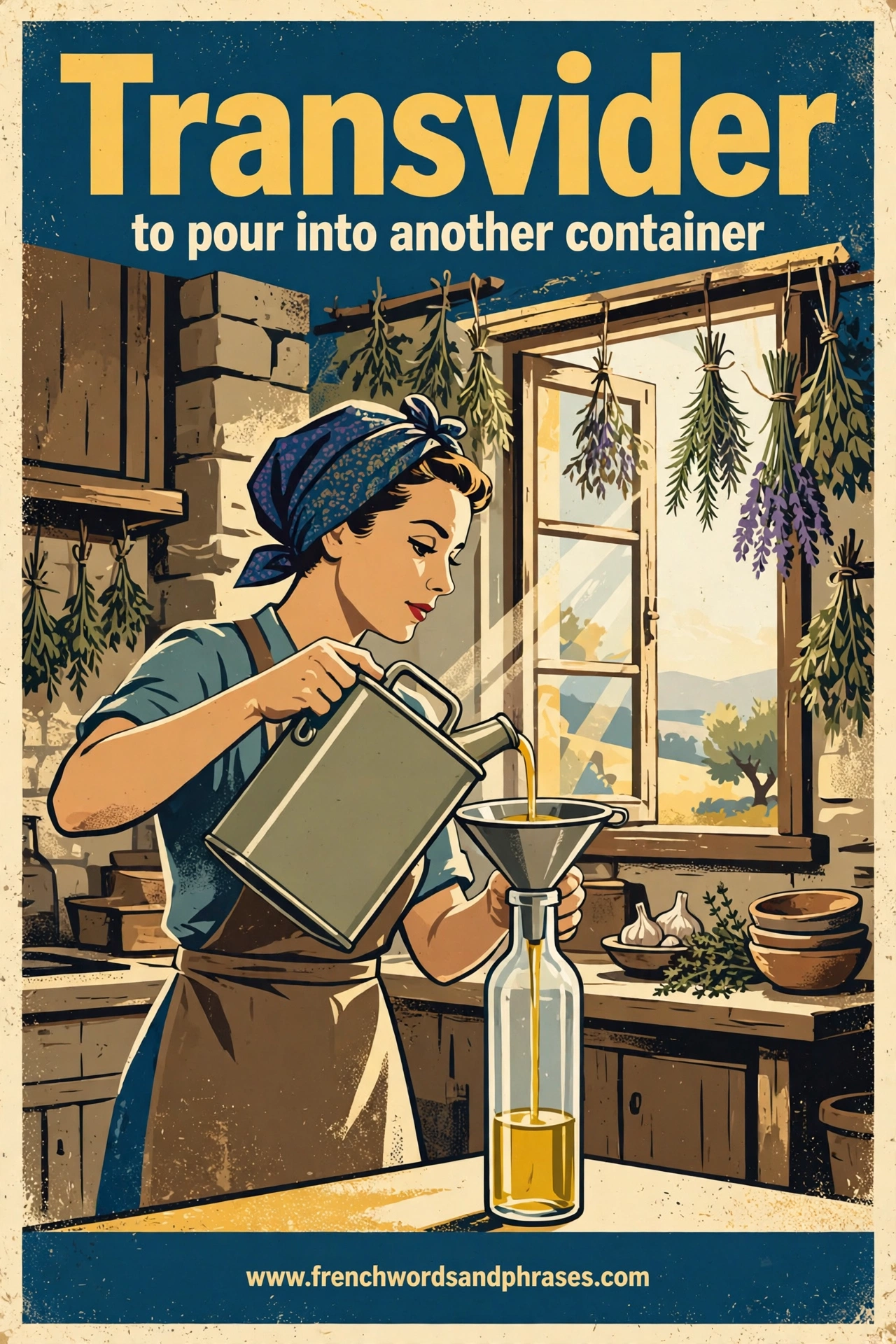
Transvider means to pour into another container — to empty the contents of one vessel out into a different one.
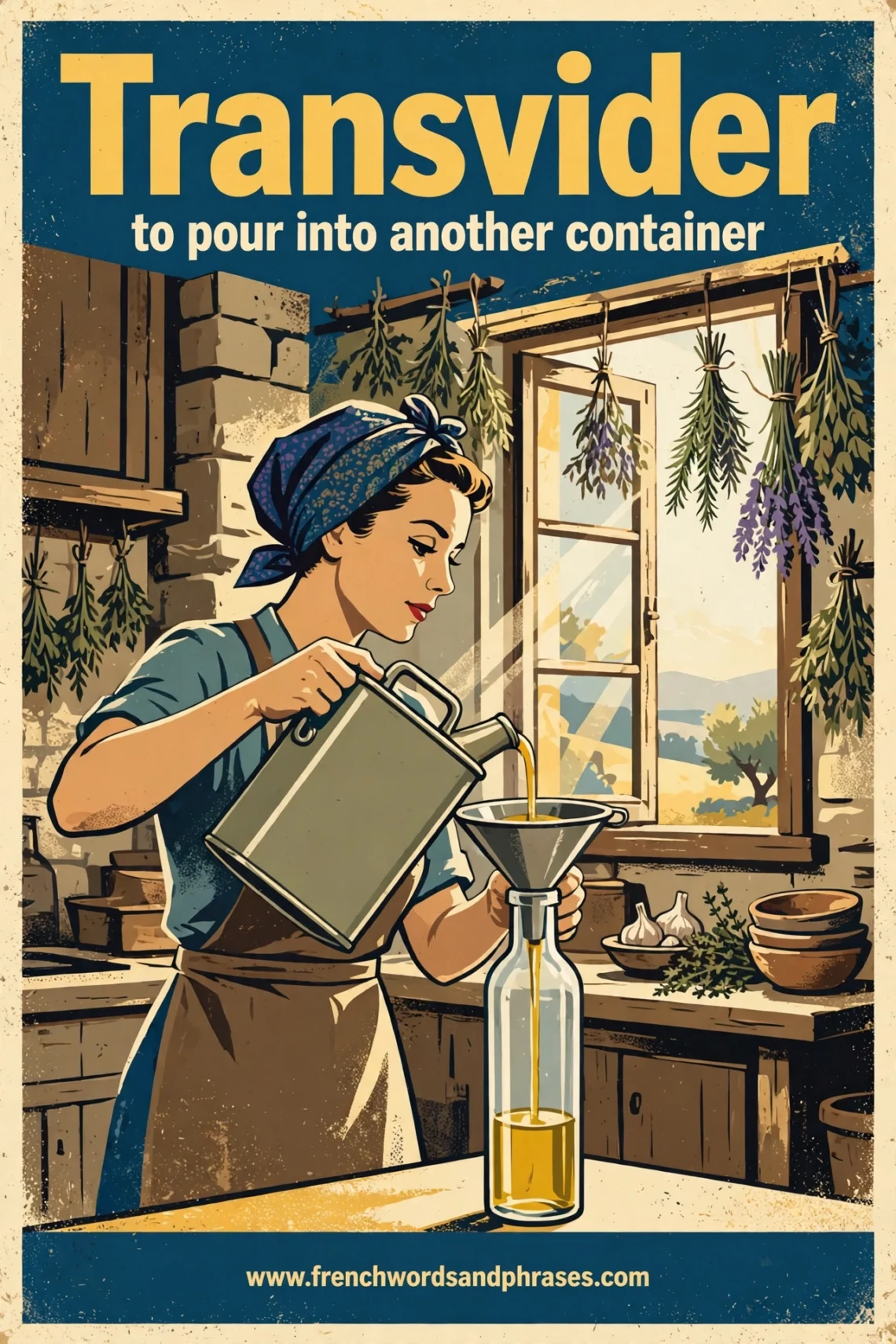
In a farmhouse kitchen in Provence, the big tin of olive oil is too heavy to lift every day, so grandmother transvide — she pours the golden oil from the great tin into the small bottle that lives by the stove, until the tin runs light and empty.
In this guide, you’ll learn how to conjugate transvider in all the major French tenses and moods. Explore complete conjugation tables, French examples, English translations, and practice quizzes.
Understanding the French Verb Transvider
Transvider is a regular French verb belonging to the first group of verbs, those ending in -er.
It means to pour into another container. It is commonly used in kitchens and farms for pouring oil, wine, milk or grain from a large container into a smaller one, in workshops for emptying buckets and drums into other vessels, and anywhere the contents change container and the original is left empty.
Verb classification: First group (-er)
Auxiliary verb: Avoir
Past participle: transvidé
Present participle: transvidant
English equivalents: To pour into another container, to empty into another vessel; transvider l’huile — to pour the oil into a smaller bottle; transvider un seau — to empty a bucket into another; transvider les grains — to transfer the grain.
One important detail: transvider is built on vider, to empty — the point of the verb is that the first container ends up vide, empty. That is what separates it from its cellar twin transvaser: transvaser pours a liquid across with care, watching the sediment; transvider empties one container out into another, whether it holds oil, grain, sand or water, and the job is done when the first vessel is empty.
Experience the Word
Transvider is the verb of the emptying pour — everything crosses over, nothing stays behind.
Imagine the harvest kitchen at the end of summer. The great jar of preserved cherries is too heavy for the shelf, so the jars are filled one by one: she transvide, wipes the rim, seals the lid, and the big jar grows lighter until it stands empty on the table.
Every drop has changed home. It has been poured across — transvidé — and the old vessel is empty.
How to Conjugate Transvider: Complete French Conjugation Guide
Let’s explore every major conjugation of transvider, beginning with the indicative mood.
How to Conjugate Transvider in the Indicative Mood
The indicative mood is used to express facts, observations, actions, and events.
How to Conjugate Transvider in the Present Tense (Présent)
Used for actions happening now, habitual actions, and general truths.
| Subject | Conjugation |
|---|---|
| je | transvide |
| tu | transvides |
| il / elle | transvide |
| nous | transvidons |
| vous | transvidez |
| ils / elles | transvident |
Example
Elle transvide l’huile d’olive dans une petite bouteille.
She pours the olive oil into a small bottle.
Quick Quiz 1
Complete the sentence:
Nous ______ l’huile dans des bouteilles propres.
Reveal the answer
transvidons
Nous transvidons l’huile dans des bouteilles propres.
We pour the oil into clean bottles.
How to Conjugate Transvider in the Passé Composé
Used for completed actions in the past. Transvider takes the auxiliary verb avoir.
| Subject | Conjugation |
|---|---|
| j’ | ai transvidé |
| tu | as transvidé |
| il / elle | a transvidé |
| nous | avons transvidé |
| vous | avez transvidé |
| ils / elles | ont transvidé |
Example
Nous avons transvidé le grain dans des sacs propres.
We poured the grain into clean sacks.
How to Conjugate Transvider in the Imparfait (Imperfect Tense)
Used for habitual past actions, descriptions, and ongoing situations in the past.
| Subject | Conjugation |
|---|---|
| je | transvidais |
| tu | transvidais |
| il / elle | transvidait |
| nous | transvidions |
| vous | transvidiez |
| ils / elles | transvidaient |
Example
Autrefois, on transvidait le lait dans des bidons en fer.
In the old days, people used to pour the milk into iron churns.
Quick Quiz 2
Choose the correct form:
She poured the honey into glass jars.
Elle ______ le miel dans des pots de verre. (a transvidé / est transvidée)
Reveal the answer
a transvidé
Elle a transvidé le miel dans des pots de verre.
Transvider takes avoir.
How to Conjugate Transvider in the Plus-que-parfait
Used to describe an action that had already been completed before another past event.
| Subject | Conjugation |
|---|---|
| j’ | avais transvidé |
| tu | avais transvidé |
| il / elle | avait transvidé |
| nous | avions transvidé |
| vous | aviez transvidé |
| ils / elles | avaient transvidé |
Example
Il avait transvidé le seau avant de le laver.
He had emptied the bucket into another before washing it.
How to Conjugate Transvider in the Passé Simple
Primarily used in formal writing, literature, and historical narratives. It is rarely used in everyday conversation.
| Subject | Conjugation |
|---|---|
| je | transvidai |
| tu | transvidas |
| il / elle | transvida |
| nous | transvidâmes |
| vous | transvidâtes |
| ils / elles | transvidèrent |
Example
Elle transvida le miel dans des pots de verre.
She poured the honey into glass jars.
How to Conjugate Transvider in the Passé Antérieur
A literary tense used to express an action completed immediately before another past action, generally in the passé simple.
| Subject | Conjugation |
|---|---|
| j’ | eus transvidé |
| tu | eus transvidé |
| il / elle | eut transvidé |
| nous | eûmes transvidé |
| vous | eûtes transvidé |
| ils / elles | eurent transvidé |
Example
Quand il eut transvidé la cuve, il la rinça à grande eau.
When he had emptied the vat into the other, he rinsed it with plenty of water.
How to Conjugate Transvider in the Future Tense (Futur Simple)
Used to describe actions that will take place in the future.
| Subject | Conjugation |
|---|---|
| je | transviderai |
| tu | transvideras |
| il / elle | transvidera |
| nous | transviderons |
| vous | transviderez |
| ils / elles | transvideront |
Example
Demain, je transviderai le sable dans la brouette.
Tomorrow, I will pour the sand into the wheelbarrow.
How to Conjugate Transvider in the Futur Antérieur (Future Perfect)
Used for an action that will have been completed before a particular point in the future.
| Subject | Conjugation |
|---|---|
| j’ | aurai transvidé |
| tu | auras transvidé |
| il / elle | aura transvidé |
| nous | aurons transvidé |
| vous | aurez transvidé |
| ils / elles | auront transvidé |
Example
À midi, ils auront transvidé tous les bidons.
By noon, they will have emptied all the cans into the tank.
How to Conjugate Transvider in the Near Future (Futur Proche)
Used to describe something that is going to happen soon. Formed with aller + infinitive.
| Subject | Conjugation |
|---|---|
| je | vais transvider |
| tu | vas transvider |
| il / elle | va transvider |
| nous | allons transvider |
| vous | allez transvider |
| ils / elles | vont transvider |
Example
Je vais transvider ce pot de confiture, il est trop plein.
I am going to pour this jar of jam into another, it is too full.
How to Conjugate Transvider in the Conditional Mood
The conditional mood expresses what would happen under certain circumstances. It is also frequently used to make polite requests or express wishes.
How to Conjugate Transvider in the Present Conditional
| Subject | Conjugation |
|---|---|
| je | transviderais |
| tu | transviderais |
| il / elle | transviderait |
| nous | transviderions |
| vous | transvideriez |
| ils / elles | transvideraient |
Example
Avec un entonnoir, tu transviderais sans en perdre une goutte.
With a funnel, you would pour it across without losing a drop.
How to Conjugate Transvider in the Past Conditional
| Subject | Conjugation |
|---|---|
| j’ | aurais transvidé |
| tu | aurais transvidé |
| il / elle | aurait transvidé |
| nous | aurions transvidé |
| vous | auriez transvidé |
| ils / elles | auraient transvidé |
Example
Elle aurait transvidé l’huile si la bouteille avait été propre.
She would have poured the oil across if the bottle had been clean.
Transvider in the Literary Past Conditional Form
This less common literary form uses the imperfect subjunctive of avoir.
| Subject | Conjugation |
|---|---|
| j’ | eusse transvidé |
| tu | eusses transvidé |
| il / elle | eût transvidé |
| nous | eussions transvidé |
| vous | eussiez transvidé |
| ils / elles | eussent transvidé |
Example
Il eût transvidé la jarre avant la tombée de la nuit.
He would have emptied the jar into another before nightfall.
How to Conjugate Transvider in the Subjunctive Mood
The subjunctive is used to express wishes, emotions, doubts, necessity, and uncertainty. It frequently follows expressions such as il faut que (it is necessary that) or bien que (although).
How to Conjugate Transvider in the Present Subjunctive
| Subject | Conjugation |
|---|---|
| que je | transvide |
| que tu | transvides |
| qu’il / qu’elle | transvide |
| que nous | transvidions |
| que vous | transvidiez |
| qu’ils / qu’elles | transvident |
Example
Il faut que vous transvidiez le lait avant midi.
You must pour the milk into the churns before noon.
Quick Quiz 3
Complete the sentence using the subjunctive:
Il faut que vous ______ le grain sans le renverser.
Reveal the answer
transvidiez
Il faut que vous transvidiez le grain sans le renverser.
You must pour the grain across without spilling it.
How to Conjugate Transvider in the Imperfect Subjunctive
A literary tense, rarely encountered in modern spoken French.
| Subject | Conjugation |
|---|---|
| que je | transvidasse |
| que tu | transvidasses |
| qu’il / qu’elle | transvidât |
| que nous | transvidassions |
| que vous | transvidassiez |
| qu’ils / qu’elles | transvidassent |
Example
Je voulais qu’il transvidât les grains sans les renverser.
I wanted him to pour the grain across without spilling it.
How to Conjugate Transvider in the Pluperfect Subjunctive
A literary construction used to express an action completed before another past action.
| Subject | Conjugation |
|---|---|
| que j’ | eusse transvidé |
| que tu | eusses transvidé |
| qu’il / qu’elle | eût transvidé |
| que nous | eussions transvidé |
| que vous | eussiez transvidé |
| qu’ils / qu’elles | eussent transvidé |
Example
On racontait qu’ils eussent transvidé tout le vin de la cave en une nuit.
People told how they had emptied all the cellar’s wine into other vessels in one night.
How to Conjugate Transvider in the Past Subjunctive
| Subject | Conjugation |
|---|---|
| que j’ | aie transvidé |
| que tu | aies transvidé |
| qu’il / qu’elle | ait transvidé |
| que nous | ayons transvidé |
| que vous | ayez transvidé |
| qu’ils / qu’elles | aient transvidé |
Example
Je suis content que tu aies transvidé l’huile sans en renverser.
I am glad you poured the oil across without spilling any.
How to Conjugate Transvider in the Imperative
The imperative is used to give commands, instructions, invitations, or suggestions. Subject pronouns are omitted.
How to Conjugate Transvider in the Present Imperative
| Person | Conjugation |
|---|---|
| (tu) | transvide |
| (nous) | transvidons |
| (vous) | transvidez |
Example
Transvide ce seau dans l’autre, puis rince-le !
Pour this bucket into the other one, then rinse it!
Quick Quiz 4
How would you say Pour this bucket into the other one (tu form)?
Reveal the answer
Transvide ce seau dans l’autre !
French Participles of Transvider
Participles are verb forms that can be used in compound tenses and other grammatical constructions.
Present Participle of Transvider
transvidant
En transvidant la cuve, il a renversé un peu de vin.
While emptying the vat into the other, he spilled a little wine.
Past Participle of Transvider
transvidé
Transvidée dans des pots propres, la confiture se gardera tout l’hiver.
Poured into clean jars, the jam will keep all winter.
Transvider in Everyday French: Real-Life Examples
Now that you know the conjugations, let’s see how transvider appears in everyday French.
Example 1 — Present
Elle transvide l’huile dans une petite bouteille.
She pours the oil into a small bottle.
Example 2 — Passé composé
Nous avons transvidé le grain dans des sacs.
We poured the grain into sacks.
Example 3 — Imparfait
On transvidait le lait dans des bidons en fer.
People used to pour the milk into iron churns.
Example 4 — Future
Je transviderai le sable dans la brouette.
I will pour the sand into the wheelbarrow.
Example 5 — Conditional
Tu transviderais mieux avec un entonnoir.
You would pour it across better with a funnel.
Example 6 — Imperative
Transvidez le lait avant midi !
Pour the milk into the churns before noon!
Beyond Translation: The Meaning of Transvider
English makes do with pour into another container — five words where French spends one: transvider.
Its twin transvaser pours; transvider empties.
Transvaser un vin is the sommelier’s careful decanting, eyes on the sediment. Transvider is the farmhouse gesture: the big tin, the small bottle, and the job finished when the first vessel stands empty — vide, as the verb itself tells you.
How to Remember the French Verb Transvider
Remember it this way: Transvider is about pouring the olive oil from the big tin into the little bottle.
- Vider is to empty: transvider empties one container into another.
- Transvider l’huile, le lait, le grain — everyday farmhouse and kitchen work.
- Regular -er: je transvide, nous transvidons, past participle transvidé.
The key idea is pouring the olive oil from the big tin into the little bottle.
Test Your Knowledge of Transvider
Let’s see how much you’ve learned. Try answering these questions before revealing the answers.
Question 1
How do you say to pour the oil into a small bottle in French?
Reveal the answer
Transvider l’huile dans une petite bouteille.
Question 2
What part of transvider tells you the first container ends up empty?
Reveal the answer
Vider — to empty. The source vessel finishes vide, empty.
Question 3
Translate: We poured the grain into clean sacks.
Reveal the answer
Nous avons transvidé le grain dans des sacs propres.
Question 4
What is the past participle of transvider?
Reveal the answer
Transvidé.
Question 5
Complete the sentence:
Il faut que vous ______ le lait avant midi.
Reveal the answer
transvidiez
Il faut que vous transvidiez le lait avant midi.
You must pour the milk into the churns before noon.
Your Final Challenge
Can You Use It?
How would you say this in French?
She pours the great jar into clean pots, and the kitchen smells of cherries and summer.
Reveal the answer
Elle transvide la grande jarre dans des pots propres, et la cuisine sent bon la cerise et l’été.
She pours the great jar into clean pots, and the kitchen smells of cherries and summer.
A little French. A little curiosity. A richer everyday life.
LEARN FRENCH ONE WORD AT A TIME