A French Word to Live By
How to Conjugate Transiter in French
/tʁɑ̃.zi.te/
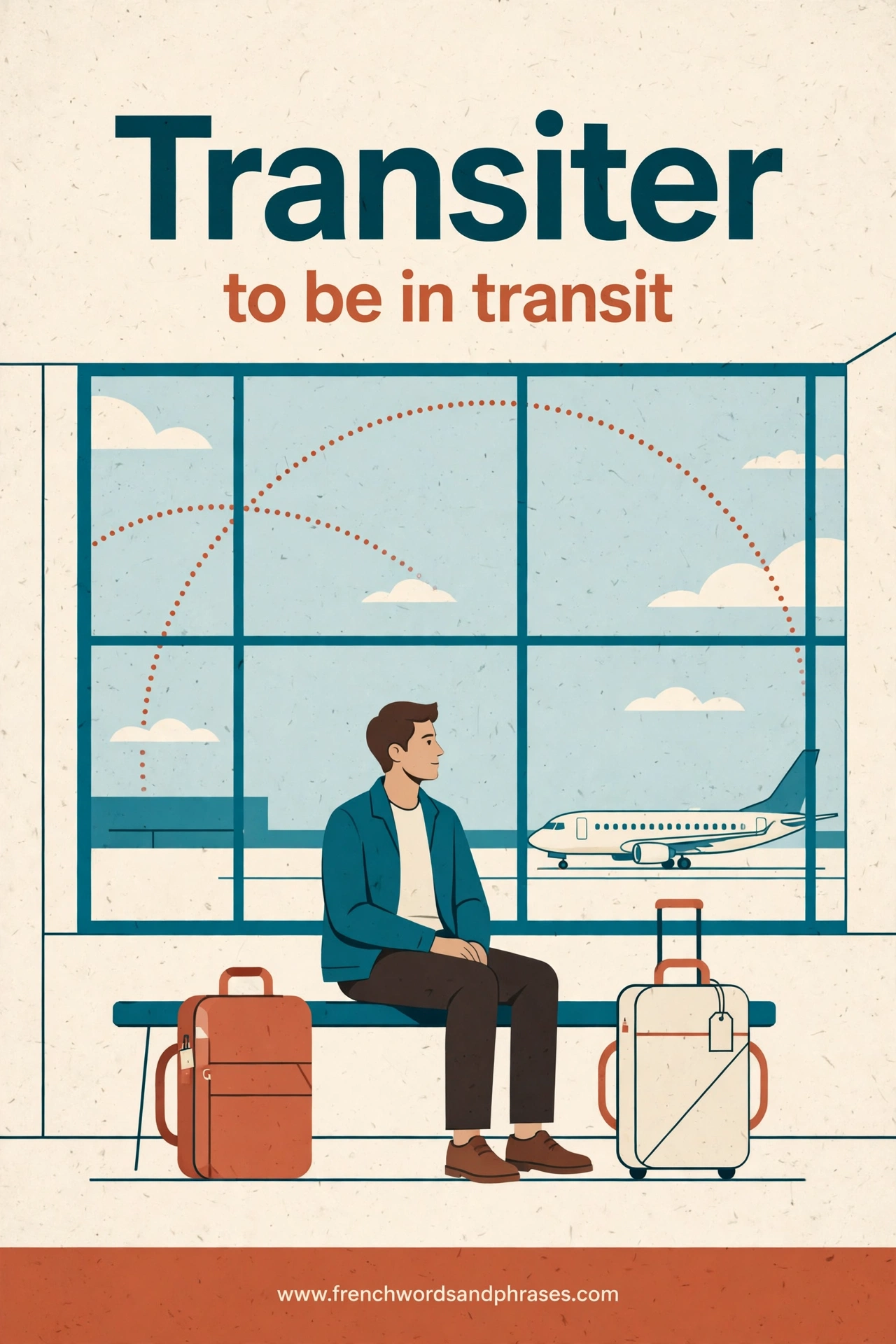
Transiter means to be in transit — to pass through a country, a port or an airport on the way somewhere else.
Crates sleeping one night in a bonded warehouse, a suitcase circling a foreign carousel, passengers dozing in a transit lounge at 3 a.m. — transiter is the verb of everything that passes through a place without belonging to it.
In this guide, you’ll learn how to conjugate transiter in all the major French tenses and moods. Explore complete conjugation tables, French examples, English translations, and practice quizzes.
Understanding the French Verb Transiter
Transiter is a regular French verb belonging to the first group of verbs, those ending in -er.
It means to be in transit. It is commonly used in shipping, customs and aviation for freight and luggage passing through intermediate ports and airports, and for travellers with a connection who never leave the transit zone.
Verb classification: First group (-er)
Auxiliary verb: Avoir
Past participle: transité
Present participle: transitant
English equivalents: To be in transit, to pass through; faire transiter des marchandises — to route goods through a place; un passager en transit — a transit passenger; un pays de transit — a transit country.
One important detail: transiter is a regular -er verb, and it works for goods and for people alike: les marchandises transitent par Rotterdam, the goods pass through Rotterdam; les voyageurs transitent par Munich. With faire it becomes a causative: faire transiter un colis par Lyon, to route a parcel through Lyon. Do not confuse the travel sense with the everyday joke le transit intestinal — digestion — which French speakers find endlessly funny.
Experience the Word
Transiter is the verb of the in-between — a place is crossed, slept in, stamped, but never truly visited.
Imagine a crate of Bordeaux wine on its way to Quebec. It is loaded at dawn, sleeps in a warehouse at Le Havre, crosses the Atlantic in the dark hold, and is unloaded in a country it will never see — it has simply transité, and the paperwork proves it.
The crate was never French-exited or Canadian-arrived for long. It has transité — passed through, on its way to somewhere else.
How to Conjugate Transiter: Complete French Conjugation Guide
Let’s explore every major conjugation of transiter, beginning with the indicative mood.
How to Conjugate Transiter in the Indicative Mood
The indicative mood is used to express facts, observations, actions, and events.
How to Conjugate Transiter in the Present Tense (Présent)
Used for actions happening now, habitual actions, and general truths.
| Subject | Conjugation |
|---|---|
| je | transite |
| tu | transites |
| il / elle | transite |
| nous | transitons |
| vous | transitez |
| ils / elles | transitent |
Example
Les marchandises transitent par le port de Rotterdam.
The goods pass in transit through the port of Rotterdam.
Quick Quiz 1
Complete the sentence:
Les colis ______ par ce dépôt.
Reveal the answer
transitent
Les colis transitent par ce dépôt.
The parcels pass through this depot.
How to Conjugate Transiter in the Passé Composé
Used for completed actions in the past. Transiter takes the auxiliary verb avoir.
| Subject | Conjugation |
|---|---|
| j’ | ai transité |
| tu | as transité |
| il / elle | a transité |
| nous | avons transité |
| vous | avez transité |
| ils / elles | ont transité |
Example
Notre valise a transité par Francfort avant d’arriver.
Our suitcase went through Frankfurt before arriving.
How to Conjugate Transiter in the Imparfait (Imperfect Tense)
Used for habitual past actions, descriptions, and ongoing situations in the past.
| Subject | Conjugation |
|---|---|
| je | transitais |
| tu | transitais |
| il / elle | transitait |
| nous | transitions |
| vous | transitiez |
| ils / elles | transitaient |
Example
Autrefois, les épices transitaient par Venise.
In the old days, spices used to pass through Venice.
Quick Quiz 2
Choose the correct form:
My bag went through Vienna.
Mon sac ______ par Vienne. (a transité / est transité)
Reveal the answer
a transité
Mon sac a transité par Vienne.
Transiter takes avoir.
How to Conjugate Transiter in the Plus-que-parfait
Used to describe an action that had already been completed before another past event.
| Subject | Conjugation |
|---|---|
| j’ | avais transité |
| tu | avais transité |
| il / elle | avait transité |
| nous | avions transité |
| vous | aviez transité |
| ils / elles | avaient transité |
Example
Le conteneur avait transité par trois ports avant Dakar.
The container had passed through three ports before Dakar.
How to Conjugate Transiter in the Passé Simple
Primarily used in formal writing, literature, and historical narratives. It is rarely used in everyday conversation.
| Subject | Conjugation |
|---|---|
| je | transitai |
| tu | transitas |
| il / elle | transita |
| nous | transitâmes |
| vous | transitâtes |
| ils / elles | transitèrent |
Example
La caravane transita par le col sans s’arrêter.
The caravan passed through the pass without stopping.
How to Conjugate Transiter in the Passé Antérieur
A literary tense used to express an action completed immediately before another past action, generally in the passé simple.
| Subject | Conjugation |
|---|---|
| j’ | eus transité |
| tu | eus transité |
| il / elle | eut transité |
| nous | eûmes transité |
| vous | eûtes transité |
| ils / elles | eurent transité |
Example
Quand les caisses eurent transité par le Havre, elles partirent pour Québec.
When the crates had passed through Le Havre, they left for Quebec City.
How to Conjugate Transiter in the Future Tense (Futur Simple)
Used to describe actions that will take place in the future.
| Subject | Conjugation |
|---|---|
| je | transiterai |
| tu | transiteras |
| il / elle | transitera |
| nous | transiterons |
| vous | transiterez |
| ils / elles | transiteront |
Example
Vos bagages transiteront par Munich.
Your luggage will go through Munich.
How to Conjugate Transiter in the Futur Antérieur (Future Perfect)
Used for an action that will have been completed before a particular point in the future.
| Subject | Conjugation |
|---|---|
| j’ | aurai transité |
| tu | auras transité |
| il / elle | aura transité |
| nous | aurons transité |
| vous | aurez transité |
| ils / elles | auront transité |
Example
À minuit, le fret aura transité par deux aéroports.
By midnight, the freight will have passed through two airports.
How to Conjugate Transiter in the Near Future (Futur Proche)
Used to describe something that is going to happen soon. Formed with aller + infinitive.
| Subject | Conjugation |
|---|---|
| je | vais transiter |
| tu | vas transiter |
| il / elle | va transiter |
| nous | allons transiter |
| vous | allez transiter |
| ils / elles | vont transiter |
Example
Ce colis va transiter par Lyon avant la livraison.
This parcel is going to pass through Lyon before delivery.
How to Conjugate Transiter in the Conditional Mood
The conditional mood expresses what would happen under certain circumstances. It is also frequently used to make polite requests or express wishes.
How to Conjugate Transiter in the Present Conditional
| Subject | Conjugation |
|---|---|
| je | transiterais |
| tu | transiterais |
| il / elle | transiterait |
| nous | transiterions |
| vous | transiteriez |
| ils / elles | transiteraient |
Example
Sans la grève, les marchandises transiteraient plus vite.
Without the strike, the goods would move through faster.
How to Conjugate Transiter in the Past Conditional
| Subject | Conjugation |
|---|---|
| j’ | aurais transité |
| tu | aurais transité |
| il / elle | aurait transité |
| nous | aurions transité |
| vous | auriez transité |
| ils / elles | auraient transité |
Example
Le vin aurait transité par Bordeaux si la route avait été ouverte.
The wine would have gone through Bordeaux if the road had been open.
Transiter in the Literary Past Conditional Form
This less common literary form uses the imperfect subjunctive of avoir.
| Subject | Conjugation |
|---|---|
| j’ | eusse transité |
| tu | eusses transité |
| il / elle | eût transité |
| nous | eussions transité |
| vous | eussiez transité |
| ils / elles | eussent transité |
Example
Les épices eussent transité par Gênes autrefois.
The spices would have passed through Genoa in the old days.
How to Conjugate Transiter in the Subjunctive Mood
The subjunctive is used to express wishes, emotions, doubts, necessity, and uncertainty. It frequently follows expressions such as il faut que (it is necessary that) or bien que (although).
How to Conjugate Transiter in the Present Subjunctive
| Subject | Conjugation |
|---|---|
| que je | transite |
| que tu | transites |
| qu’il / qu’elle | transite |
| que nous | transitions |
| que vous | transitiez |
| qu’ils / qu’elles | transitent |
Example
Il se peut que les colis transitent par un autre dépôt.
The parcels may pass through another depot.
Quick Quiz 3
Complete the sentence using the subjunctive:
Il se peut que les colis ______ par un autre dépôt.
Reveal the answer
transitent
Il se peut que les colis transitent par un autre dépôt.
The parcels may pass through another depot.
How to Conjugate Transiter in the Imperfect Subjunctive
A literary tense, rarely encountered in modern spoken French.
| Subject | Conjugation |
|---|---|
| que je | transitasse |
| que tu | transitasses |
| qu’il / qu’elle | transitât |
| que nous | transitassions |
| que vous | transitassiez |
| qu’ils / qu’elles | transitassent |
Example
Le douanier exigeait que tout transitât par son bureau.
The customs officer demanded that everything pass through his office.
How to Conjugate Transiter in the Pluperfect Subjunctive
A literary construction used to express an action completed before another past action.
| Subject | Conjugation |
|---|---|
| que j’ | eusse transité |
| que tu | eusses transité |
| qu’il / qu’elle | eût transité |
| que nous | eussions transité |
| que vous | eussiez transité |
| qu’ils / qu’elles | eussent transité |
Example
On doutait que les caisses eussent transité légalement.
People doubted that the crates had passed through legally.
How to Conjugate Transiter in the Past Subjunctive
| Subject | Conjugation |
|---|---|
| que j’ | aie transité |
| que tu | aies transité |
| qu’il / qu’elle | ait transité |
| que nous | ayons transité |
| que vous | ayez transité |
| qu’ils / qu’elles | aient transité |
Example
Je suis surpris que ta lettre ait transité par trois pays.
I am surprised your letter passed through three countries.
How to Conjugate Transiter in the Imperative
The imperative is used to give commands, instructions, invitations, or suggestions. Subject pronouns are omitted.
How to Conjugate Transiter in the Present Imperative
| Person | Conjugation |
|---|---|
| (tu) | transite |
| (nous) | transitons |
| (vous) | transitez |
Example
Transite par le couloir de gauche pour ta correspondance !
Go through the left corridor for your connection!
Quick Quiz 4
How would you say Go through gate C for your connection (vous form)?
Reveal the answer
Transitez par la porte C pour votre correspondance !
French Participles of Transiter
Participles are verb forms that can be used in compound tenses and other grammatical constructions.
Present Participle of Transiter
transitant
En transitant par Singapour, le navire a fait escale une nuit.
Passing through Singapore, the ship stopped over for one night.
Past Participle of Transiter
transité
Transitées par Venise, ces épices valaient de l’or.
Having passed through Venice, these spices were worth gold.
Transiter in Everyday French: Real-Life Examples
Now that you know the conjugations, let’s see how transiter appears in everyday French.
Example 1 — Present
Les colis transitent par ce dépôt.
The parcels pass through this depot.
Example 2 — Passé composé
Mon sac a transité par Vienne.
My bag went through Vienna.
Example 3 — Imparfait
Les épices transitaient par Venise.
Spices used to pass through Venice.
Example 4 — Future
Le fret transitera par Anvers.
The freight will go through Antwerp.
Example 5 — Conditional
Sans grève, tout transiterait plus vite.
Without the strike, everything would move through faster.
Example 6 — Imperative
Transitez par la porte C pour votre correspondance !
Go through gate C for your connection!
Beyond Translation: The Meaning of Transiter
English transit is mostly a noun on a timetable; French transiter is a working verb of ports, customs sheds and airport corridors.
It describes a whole modern condition.
Goods, luggage and people transiter through places they will never visit — a night in a warehouse, an hour in a lounge — and French gives that passing-through its own verb, stamps and all.
How to Remember the French Verb Transiter
Remember it this way: Transiter is about passing through a place that is not the destination.
- Transiter par — to pass through a place on the way somewhere else.
- Faire transiter — to route something through; un passager en transit — a transit passenger.
- Regular -er: je transite, nous transitons, past participle transité.
The key idea is passing through a place that is not the destination.
Test Your Knowledge of Transiter
Let’s see how much you’ve learned. Try answering these questions before revealing the answers.
Question 1
How do you say The goods pass through Rotterdam in French?
Reveal the answer
Les marchandises transitent par Rotterdam.
Question 2
How do you say Our suitcase went through Frankfurt in French?
Reveal the answer
Notre valise a transité par Francfort.
Question 3
Translate: In the old days, spices used to pass through Venice.
Reveal the answer
Autrefois, les épices transitaient par Venise.
Question 4
What is the past participle of transiter?
Reveal the answer
Transité.
Question 5
Complete the sentence:
Vos bagages ______ par Munich.
Reveal the answer
transiteront
Vos bagages transiteront par Munich.
Your luggage will go through Munich.
Your Final Challenge
Can You Use It?
How would you say this in French?
The parcel passes through three countries, sleeps in two warehouses, and finally arrives at the right door.
Reveal the answer
Le colis transite par trois pays, dort dans deux entrepôts, et arrive enfin à la bonne porte.
The parcel passes through three countries, sleeps in two warehouses, and finally arrives at the right door.
A little French. A little curiosity. A richer everyday life.
LEARN FRENCH ONE WORD AT A TIME