
A French Word to Live By
How to Conjugate Transfiler in French
/tʁɑ̃s.fi.le/
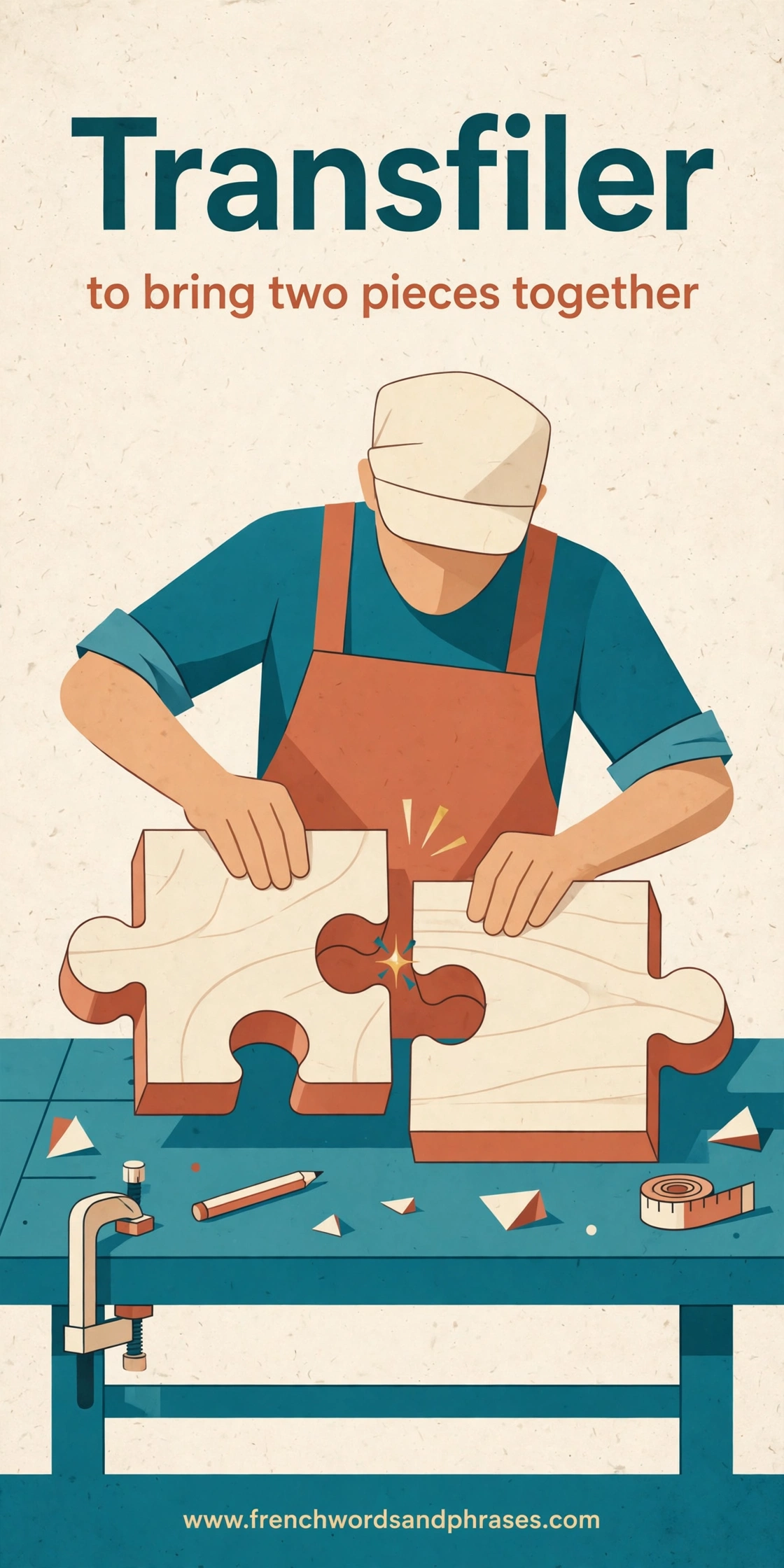
Transfiler means to bring two pieces together — to join two pieces end to end, edge to edge, so that they form a single whole.
In a quiet workshop, a cabinetmaker holds two pieces of oak up to the light, turns one a fraction, and brings them together until the joint all but disappears — transfiler is the craftsman’s verb for that moment when two pieces stop being two and start being one.
In this guide, you’ll learn how to conjugate transfiler in all the major French tenses and moods. Explore complete conjugation tables, French examples, English translations, and practice quizzes.
Understanding the French Verb Transfiler
Transfiler is a regular French verb belonging to the first group of verbs, those ending in -er.
It means to bring two pieces together. It is commonly used by cabinetmakers, joiners and restorers for joining two pieces of wood end to end or edge to edge, and more generally in craft and technical contexts wherever two separate pieces must be brought together into one.
Verb classification: First group (-er)
Auxiliary verb: Avoir
Past participle: transfilé
Present participle: transfilant
English equivalents: To bring two pieces together, to join end to end; transfiler deux pièces de bois — to join two pieces of wood; un assemblage — a joint, an assembly.
One important detail: transfiler is a technical verb of the workshop, built on trans- (across) — the two pieces are brought across the gap between them until they meet. It is a regular -er verb: je transfile, nous transfilons, past participle transfilé. You will not hear it in a café; it lives in joinery, restoration and craft workshops, where joining two pieces so the seam vanishes is the whole art.
Experience the Word
Transfiler is the verb of the invisible seam — two pieces, one gesture, and the join disappears.
Imagine a restorer saving an old table. One board is too short, cracked at the end. He cuts a matching piece of old oak, planes the edges, and slowly, carefully, il transfile les deux pièces — until even his own fingers can barely find the join.
The table is whole again. Its pieces have been brought together — transfilées — and the break is only a memory.
How to Conjugate Transfiler: Complete French Conjugation Guide
Let’s explore every major conjugation of transfiler, beginning with the indicative mood.
How to Conjugate Transfiler in the Indicative Mood
The indicative mood is used to express facts, observations, actions, and events.
How to Conjugate Transfiler in the Present Tense (Présent)
Used for actions happening now, habitual actions, and general truths.
| Subject | Conjugation |
|---|---|
| je | transfile |
| tu | transfiles |
| il / elle | transfile |
| nous | transfilons |
| vous | transfilez |
| ils / elles | transfilent |
Example
L’ébéniste transfile les deux pièces de chêne avec soin.
The cabinetmaker brings the two pieces of oak together with care.
Quick Quiz 1
Complete the sentence:
Nous ______ les pièces du cadre.
Reveal the answer
transfilons
Nous transfilons les pièces du cadre.
We bring the pieces of the frame together.
How to Conjugate Transfiler in the Passé Composé
Used for completed actions in the past. Transfiler takes the auxiliary verb avoir.
| Subject | Conjugation |
|---|---|
| j’ | ai transfilé |
| tu | as transfilé |
| il / elle | a transfilé |
| nous | avons transfilé |
| vous | avez transfilé |
| ils / elles | ont transfilé |
Example
Il a transfilé les deux morceaux pour former une seule planche.
He brought the two pieces together to form a single board.
How to Conjugate Transfiler in the Imparfait (Imperfect Tense)
Used for habitual past actions, descriptions, and ongoing situations in the past.
| Subject | Conjugation |
|---|---|
| je | transfilais |
| tu | transfilais |
| il / elle | transfilait |
| nous | transfilions |
| vous | transfiliez |
| ils / elles | transfilaient |
Example
Autrefois, les artisans transfilaient les pièces entièrement à la main.
In the old days, craftsmen used to join the pieces entirely by hand.
Quick Quiz 2
Choose the correct form:
He brought the two pieces together.
Il ______ les deux pièces. (a transfilé / est transfilé)
Reveal the answer
a transfilé
Il a transfilé les deux pièces.
Transfiler takes avoir.
How to Conjugate Transfiler in the Plus-que-parfait
Used to describe an action that had already been completed before another past event.
| Subject | Conjugation |
|---|---|
| j’ | avais transfilé |
| tu | avais transfilé |
| il / elle | avait transfilé |
| nous | avions transfilé |
| vous | aviez transfilé |
| ils / elles | avaient transfilé |
Example
Elle avait transfilé les deux pièces avant de les coller.
She had brought the two pieces together before gluing them.
How to Conjugate Transfiler in the Passé Simple
Primarily used in formal writing, literature, and historical narratives. It is rarely used in everyday conversation.
| Subject | Conjugation |
|---|---|
| je | transfilai |
| tu | transfilas |
| il / elle | transfila |
| nous | transfilâmes |
| vous | transfilâtes |
| ils / elles | transfilèrent |
Example
Le menuisier transfila les pièces et les serra dans l’étau.
The joiner brought the pieces together and clamped them in the vice.
How to Conjugate Transfiler in the Passé Antérieur
A literary tense used to express an action completed immediately before another past action, generally in the passé simple.
| Subject | Conjugation |
|---|---|
| j’ | eus transfilé |
| tu | eus transfilé |
| il / elle | eut transfilé |
| nous | eûmes transfilé |
| vous | eûtes transfilé |
| ils / elles | eurent transfilé |
Example
Quand il eut transfilé les deux pièces, il les laissa sécher.
When he had brought the two pieces together, he left them to dry.
How to Conjugate Transfiler in the Future Tense (Futur Simple)
Used to describe actions that will take place in the future.
| Subject | Conjugation |
|---|---|
| je | transfilerai |
| tu | transfileras |
| il / elle | transfilera |
| nous | transfilerons |
| vous | transfilerez |
| ils / elles | transfileront |
Example
Demain, nous transfilerons les pièces du cadre.
Tomorrow, we will bring the pieces of the frame together.
How to Conjugate Transfiler in the Futur Antérieur (Future Perfect)
Used for an action that will have been completed before a particular point in the future.
| Subject | Conjugation |
|---|---|
| j’ | aurai transfilé |
| tu | auras transfilé |
| il / elle | aura transfilé |
| nous | aurons transfilé |
| vous | aurez transfilé |
| ils / elles | auront transfilé |
Example
À midi, ils auront transfilé toutes les pièces de la porte.
By noon, they will have brought all the pieces of the door together.
How to Conjugate Transfiler in the Near Future (Futur Proche)
Used to describe something that is going to happen soon. Formed with aller + infinitive.
| Subject | Conjugation |
|---|---|
| je | vais transfiler |
| tu | vas transfiler |
| il / elle | va transfiler |
| nous | allons transfiler |
| vous | allez transfiler |
| ils / elles | vont transfiler |
Example
Je vais transfiler ces deux pièces, passe-moi la colle.
I am going to bring these two pieces together, hand me the glue.
How to Conjugate Transfiler in the Conditional Mood
The conditional mood expresses what would happen under certain circumstances. It is also frequently used to make polite requests or express wishes.
How to Conjugate Transfiler in the Present Conditional
| Subject | Conjugation |
|---|---|
| je | transfilerais |
| tu | transfilerais |
| il / elle | transfilerait |
| nous | transfilerions |
| vous | transfileriez |
| ils / elles | transfileraient |
Example
Avec une presse, tu transfilerais ces pièces en cinq minutes.
With a press, you would join these pieces in five minutes.
How to Conjugate Transfiler in the Past Conditional
| Subject | Conjugation |
|---|---|
| j’ | aurais transfilé |
| tu | aurais transfilé |
| il / elle | aurait transfilé |
| nous | aurions transfilé |
| vous | auriez transfilé |
| ils / elles | auraient transfilé |
Example
Il aurait transfilé les pièces si le bois n’avait pas été tordu.
He would have brought the pieces together if the wood had not been warped.
Transfiler in the Literary Past Conditional Form
This less common literary form uses the imperfect subjunctive of avoir.
| Subject | Conjugation |
|---|---|
| j’ | eusse transfilé |
| tu | eusses transfilé |
| il / elle | eût transfilé |
| nous | eussions transfilé |
| vous | eussiez transfilé |
| ils / elles | eussent transfilé |
Example
Il eût transfilé les pièces avant la nuit.
He would have brought the pieces together before nightfall.
How to Conjugate Transfiler in the Subjunctive Mood
The subjunctive is used to express wishes, emotions, doubts, necessity, and uncertainty. It frequently follows expressions such as il faut que (it is necessary that) or bien que (although).
How to Conjugate Transfiler in the Present Subjunctive
| Subject | Conjugation |
|---|---|
| que je | transfile |
| que tu | transfiles |
| qu’il / qu’elle | transfile |
| que nous | transfilions |
| que vous | transfiliez |
| qu’ils / qu’elles | transfilent |
Example
Il faut que vous transfiliez les pièces sans forcer.
You must bring the pieces together without forcing them.
Quick Quiz 3
Complete the sentence using the subjunctive:
Il faut que vous ______ les pièces sans forcer.
Reveal the answer
transfiliez
Il faut que vous transfiliez les pièces sans forcer.
You must bring the pieces together without forcing them.
How to Conjugate Transfiler in the Imperfect Subjunctive
A literary tense, rarely encountered in modern spoken French.
| Subject | Conjugation |
|---|---|
| que je | transfilasse |
| que tu | transfilasses |
| qu’il / qu’elle | transfilât |
| que nous | transfilassions |
| que vous | transfilassiez |
| qu’ils / qu’elles | transfilassent |
Example
L’atelier voulait qu’il transfilât les deux pièces lui-même.
The workshop wanted him to join the two pieces himself.
How to Conjugate Transfiler in the Pluperfect Subjunctive
A literary construction used to express an action completed before another past action.
| Subject | Conjugation |
|---|---|
| que j’ | eusse transfilé |
| que tu | eusses transfilé |
| qu’il / qu’elle | eût transfilé |
| que nous | eussions transfilé |
| que vous | eussiez transfilé |
| qu’ils / qu’elles | eussent transfilé |
Example
On regrettait qu’ils eussent transfilé des bois différents.
People regretted that they had joined different woods together.
How to Conjugate Transfiler in the Past Subjunctive
| Subject | Conjugation |
|---|---|
| que j’ | aie transfilé |
| que tu | aies transfilé |
| qu’il / qu’elle | ait transfilé |
| que nous | ayons transfilé |
| que vous | ayez transfilé |
| qu’ils / qu’elles | aient transfilé |
Example
Je suis content que tu aies transfilé les pièces proprement.
I am glad you brought the pieces together neatly.
How to Conjugate Transfiler in the Imperative
The imperative is used to give commands, instructions, invitations, or suggestions. Subject pronouns are omitted.
How to Conjugate Transfiler in the Present Imperative
| Person | Conjugation |
|---|---|
| (tu) | transfile |
| (nous) | transfilons |
| (vous) | transfilez |
Example
Transfile ces deux pièces bien droites !
Bring these two pieces together nice and straight!
Quick Quiz 4
How would you say Bring these two pieces together (tu form)?
Reveal the answer
Transfile ces deux pièces !
French Participles of Transfiler
Participles are verb forms that can be used in compound tenses and other grammatical constructions.
Present Participle of Transfiler
transfilant
En transfilant les pièces, il vérifie l’alignement.
While bringing the pieces together, he checks the alignment.
Past Participle of Transfiler
transfilé
Transfilées avec soin, les deux pièces n’en font plus qu’une.
Brought together with care, the two pieces are now only one.
Transfiler in Everyday French: Real-Life Examples
Now that you know the conjugations, let’s see how transfiler appears in everyday French.
Example 1 — Present
L’ébéniste transfile les deux pièces de chêne.
The cabinetmaker brings the two pieces of oak together.
Example 2 — Passé composé
Il a transfilé les deux morceaux ce matin.
He brought the two pieces together this morning.
Example 3 — Imparfait
Les artisans transfilaient les pièces à la main.
The craftsmen used to join the pieces by hand.
Example 4 — Future
Nous transfilerons les pièces du cadre demain.
We will bring the pieces of the frame together tomorrow.
Example 5 — Conditional
Tu transfilerais plus vite avec une presse.
You would join them faster with a press.
Example 6 — Imperative
Transfilez les pièces sans forcer !
Bring the pieces together without forcing them!
Beyond Translation: The Meaning of Transfiler
English has no single everyday verb for this — you join, butt or splice two pieces, or you reach for a phrase. French transfiler is a specialist’s word, and that is its charm.
Workshop French is full of such precision.
Where English makes do with join for everything, the French atelier distinguishes joining end to end, edge to edge, with glue, with tenons — a whole vocabulary of how two pieces become one.
How to Remember the French Verb Transfiler
Remember it this way: Transfiler is about two pieces of wood meeting in the workshop until the seam disappears.
- Transfiler is a workshop verb: to join two pieces end to end so they form one whole.
- Trans- means across — the pieces are brought across the gap between them.
- Regular -er: je transfile, nous transfilons, past participle transfilé.
The key idea is two pieces of wood meeting in the workshop until the seam disappears.
Test Your Knowledge of Transfiler
Let’s see how much you’ve learned. Try answering these questions before revealing the answers.
Question 1
How do you say to bring two pieces together in French?
Reveal the answer
Transfiler deux pièces.
Question 2
How do you say The cabinetmaker brings the two pieces together in French?
Reveal the answer
L’ébéniste transfile les deux pièces.
Question 3
Translate: He brought the two pieces together to form a single board.
Reveal the answer
Il a transfilé les deux morceaux pour former une seule planche.
Question 4
What is the past participle of transfiler?
Reveal the answer
Transfilé.
Question 5
Complete the sentence:
Il faut que vous ______ les pièces sans forcer.
Reveal the answer
transfiliez
Il faut que vous transfiliez les pièces sans forcer.
You must bring the pieces together without forcing them.
Your Final Challenge
Can You Use It?
How would you say this in French?
The cabinetmaker brings the two pieces of oak together, and the joint disappears as if by magic.
Reveal the answer
L’ébéniste transfile les deux pièces de chêne, et le joint disparaît comme par magie.
The cabinetmaker brings the two pieces of oak together, and the joint disappears as if by magic.
A little French. A little curiosity. A richer everyday life.
LEARN FRENCH ONE WORD AT A TIME




