A French Word to Live By
How to Conjugate Transborder in French
/tʁɑ̃s.bɔʁ.de/
Transborder means to transfer — to move goods or passengers from one ship, train or vehicle to another.
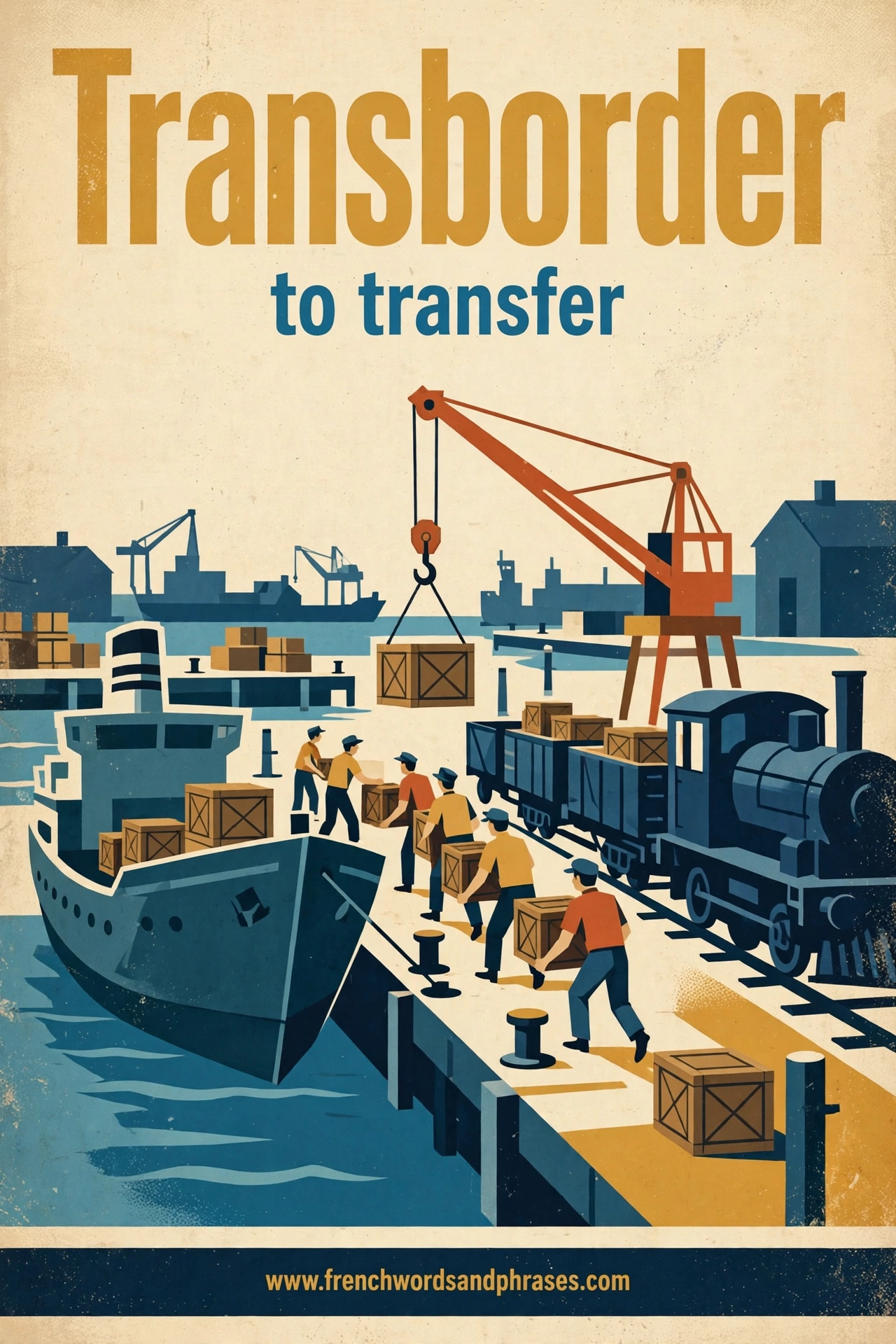
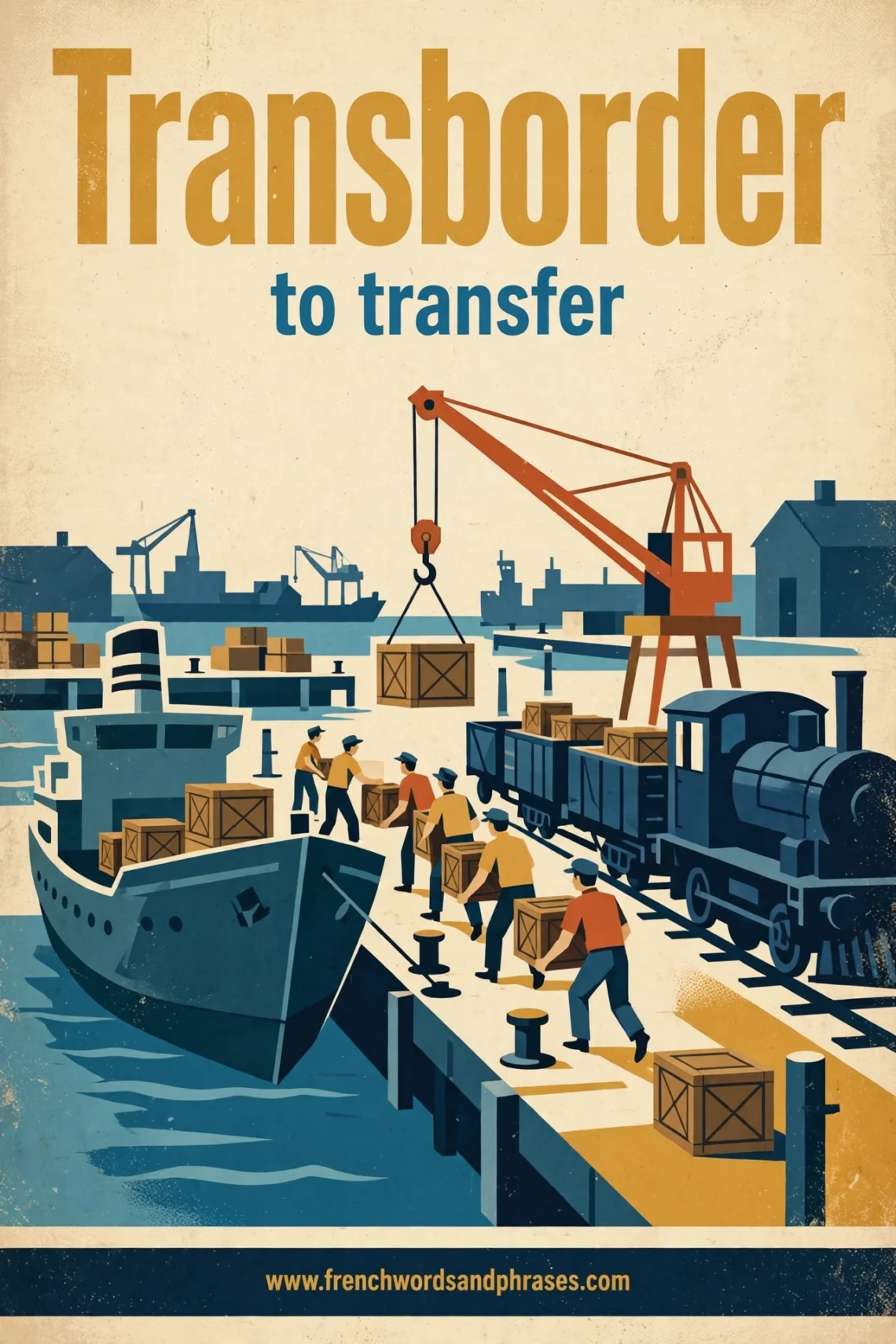
A harbour crane swinging a container from ship to lorry, passengers hurrying across a platform to a waiting train — transborder is the verb of the transfer: everything changes vehicle, and the journey continues.
In this guide, you’ll learn how to conjugate transborder in all the major French tenses and moods. Explore complete conjugation tables, French examples, English translations, and practice quizzes.
Understanding the French Verb Transborder
Transborder is a regular French verb belonging to the first group of verbs, those ending in -er.
It means to transfer. It is commonly used in ports and freight for containers and cargo changing ships or lorries, on railways for passengers transferred to another train or a coach, and for anything moved across from one vehicle, vessel or container to another.
Verb classification: First group (-er)
Auxiliary verb: Avoir
Past participle: transbordé
Present participle: transbordant
English equivalents: To transfer, to transship; transborder des marchandises — to transfer goods; le transbordement — the transfer, the transshipment; transborder les passagers — to transfer the passengers.
One important detail: transborder joins trans-, across, to bord, the side of a ship: the cargo quite literally crosses from one ship’s side to another’s. The noun le transbordement names the whole operation, and travellers meet the verb on station platforms whenever a train fails and everyone must change: les voyageurs seront transbordés dans un car.
Experience the Word
Transborder is the verb of the in-between — the crane’s swing, the platform dash, the journey paused and resumed.
Imagine a night train stopped in a small station, its engine dead. In the rain, porters transbordent the luggage while the passengers, half asleep, cross the platform to a waiting coach — the journey changes its skin and goes on.
Nothing has reached its destination yet. Everything has been transferred — transbordé — and the journey continues.
How to Conjugate Transborder: Complete French Conjugation Guide
Let’s explore every major conjugation of transborder, beginning with the indicative mood.
How to Conjugate Transborder in the Indicative Mood
The indicative mood is used to express facts, observations, actions, and events.
How to Conjugate Transborder in the Present Tense (Présent)
Used for actions happening now, habitual actions, and general truths.
| Subject | Conjugation |
|---|---|
| je | transborde |
| tu | transbordes |
| il / elle | transborde |
| nous | transbordons |
| vous | transbordez |
| ils / elles | transbordent |
Example
Au port, les dockers transbordent les conteneurs sur les camions.
At the port, the dockers transfer the containers onto the lorries.
Quick Quiz 1
Complete the sentence:
Nous ______ les conteneurs demain matin.
Reveal the answer
transbordons
Nous transbordons les conteneurs demain matin.
We transfer the containers tomorrow morning.
How to Conjugate Transborder in the Passé Composé
Used for completed actions in the past. Transborder takes the auxiliary verb avoir.
| Subject | Conjugation |
|---|---|
| j’ | ai transbordé |
| tu | as transbordé |
| il / elle | a transbordé |
| nous | avons transbordé |
| vous | avez transbordé |
| ils / elles | ont transbordé |
Example
On a transbordé les voyageurs dans un car.
They transferred the passengers onto a coach.
How to Conjugate Transborder in the Imparfait (Imperfect Tense)
Used for habitual past actions, descriptions, and ongoing situations in the past.
| Subject | Conjugation |
|---|---|
| je | transbordais |
| tu | transbordais |
| il / elle | transbordait |
| nous | transbordions |
| vous | transbordiez |
| ils / elles | transbordaient |
Example
Autrefois, on transbordait les marchandises à dos d’homme.
In the old days, goods were transferred on men’s backs.
Quick Quiz 2
Choose the correct form:
They transferred the cargo.
Ils ______ la cargaison. (ont transbordé / sont transbordés)
Reveal the answer
ont transbordé
Ils ont transbordé la cargaison.
Transborder takes avoir.
How to Conjugate Transborder in the Plus-que-parfait
Used to describe an action that had already been completed before another past event.
| Subject | Conjugation |
|---|---|
| j’ | avais transbordé |
| tu | avais transbordé |
| il / elle | avait transbordé |
| nous | avions transbordé |
| vous | aviez transbordé |
| ils / elles | avaient transbordé |
Example
Ils avaient transbordé tout le fret avant la tempête.
They had transferred all the freight before the storm.
How to Conjugate Transborder in the Passé Simple
Primarily used in formal writing, literature, and historical narratives. It is rarely used in everyday conversation.
| Subject | Conjugation |
|---|---|
| je | transbordai |
| tu | transbordas |
| il / elle | transborda |
| nous | transbordâmes |
| vous | transbordâtes |
| ils / elles | transbordèrent |
Example
L’équipage transborda les passagers sur le navire de secours.
The crew transferred the passengers onto the rescue ship.
How to Conjugate Transborder in the Passé Antérieur
A literary tense used to express an action completed immediately before another past action, generally in the passé simple.
| Subject | Conjugation |
|---|---|
| j’ | eus transbordé |
| tu | eus transbordé |
| il / elle | eut transbordé |
| nous | eûmes transbordé |
| vous | eûtes transbordé |
| ils / elles | eurent transbordé |
Example
Quand ils eurent transbordé le dernier sac, le bateau leva l’ancre.
When they had transferred the last sack, the boat weighed anchor.
How to Conjugate Transborder in the Future Tense (Futur Simple)
Used to describe actions that will take place in the future.
| Subject | Conjugation |
|---|---|
| je | transborderai |
| tu | transborderas |
| il / elle | transbordera |
| nous | transborderons |
| vous | transborderez |
| ils / elles | transborderont |
Example
À la prochaine gare, on transbordera les voyageurs.
At the next station, the passengers will be transferred.
How to Conjugate Transborder in the Futur Antérieur (Future Perfect)
Used for an action that will have been completed before a particular point in the future.
| Subject | Conjugation |
|---|---|
| j’ | aurai transbordé |
| tu | auras transbordé |
| il / elle | aura transbordé |
| nous | aurons transbordé |
| vous | aurez transbordé |
| ils / elles | auront transbordé |
Example
À minuit, ils auront transbordé toute la cargaison.
By midnight, they will have transferred the whole cargo.
How to Conjugate Transborder in the Near Future (Futur Proche)
Used to describe something that is going to happen soon. Formed with aller + infinitive.
| Subject | Conjugation |
|---|---|
| je | vais transborder |
| tu | vas transborder |
| il / elle | va transborder |
| nous | allons transborder |
| vous | allez transborder |
| ils / elles | vont transborder |
Example
Je vais transborder ces caisses sur l’autre péniche.
I am going to transfer these crates onto the other barge.
How to Conjugate Transborder in the Conditional Mood
The conditional mood expresses what would happen under certain circumstances. It is also frequently used to make polite requests or express wishes.
How to Conjugate Transborder in the Present Conditional
| Subject | Conjugation |
|---|---|
| je | transborderais |
| tu | transborderais |
| il / elle | transborderait |
| nous | transborderions |
| vous | transborderiez |
| ils / elles | transborderaient |
Example
Avec une grue, on transborderait le conteneur en cinq minutes.
With a crane, we could transfer the container in five minutes.
How to Conjugate Transborder in the Past Conditional
| Subject | Conjugation |
|---|---|
| j’ | aurais transbordé |
| tu | aurais transbordé |
| il / elle | aurait transbordé |
| nous | aurions transbordé |
| vous | auriez transbordé |
| ils / elles | auraient transbordé |
Example
Ils auraient transbordé le fret plus tôt sans la grève.
They would have transferred the freight earlier without the strike.
Transborder in the Literary Past Conditional Form
This less common literary form uses the imperfect subjunctive of avoir.
| Subject | Conjugation |
|---|---|
| j’ | eusse transbordé |
| tu | eusses transbordé |
| il / elle | eût transbordé |
| nous | eussions transbordé |
| vous | eussiez transbordé |
| ils / elles | eussent transbordé |
Example
L’équipage eût transbordé les vivres avant la nuit.
The crew would have transferred the provisions before nightfall.
How to Conjugate Transborder in the Subjunctive Mood
The subjunctive is used to express wishes, emotions, doubts, necessity, and uncertainty. It frequently follows expressions such as il faut que (it is necessary that) or bien que (although).
How to Conjugate Transborder in the Present Subjunctive
| Subject | Conjugation |
|---|---|
| que je | transborde |
| que tu | transbordes |
| qu’il / qu’elle | transborde |
| que nous | transbordions |
| que vous | transbordiez |
| qu’ils / qu’elles | transbordent |
Example
Il faut que vous transbordiez les passagers rapidement.
You must transfer the passengers quickly.
Quick Quiz 3
Complete the sentence using the subjunctive:
Il faut que vous ______ le fret avant midi.
Reveal the answer
transbordiez
Il faut que vous transbordiez le fret avant midi.
You must transfer the freight before noon.
How to Conjugate Transborder in the Imperfect Subjunctive
A literary tense, rarely encountered in modern spoken French.
| Subject | Conjugation |
|---|---|
| que je | transbordasse |
| que tu | transbordasses |
| qu’il / qu’elle | transbordât |
| que nous | transbordassions |
| que vous | transbordassiez |
| qu’ils / qu’elles | transbordassent |
Example
Le capitaine voulait que l’équipage transbordât les vivres d’abord.
The captain wanted the crew to transfer the provisions first.
How to Conjugate Transborder in the Pluperfect Subjunctive
A literary construction used to express an action completed before another past action.
| Subject | Conjugation |
|---|---|
| que j’ | eusse transbordé |
| que tu | eusses transbordé |
| qu’il / qu’elle | eût transbordé |
| que nous | eussions transbordé |
| que vous | eussiez transbordé |
| qu’ils / qu’elles | eussent transbordé |
Example
On craignait qu’ils n’eussent pas transbordé tout le fret.
People feared they had not transferred all the freight.
How to Conjugate Transborder in the Past Subjunctive
| Subject | Conjugation |
|---|---|
| que j’ | aie transbordé |
| que tu | aies transbordé |
| qu’il / qu’elle | ait transbordé |
| que nous | ayons transbordé |
| que vous | ayez transbordé |
| qu’ils / qu’elles | aient transbordé |
Example
Je suis content que vous ayez transbordé les voyageurs à temps.
I am glad you transferred the passengers in time.
How to Conjugate Transborder in the Imperative
The imperative is used to give commands, instructions, invitations, or suggestions. Subject pronouns are omitted.
How to Conjugate Transborder in the Present Imperative
| Person | Conjugation |
|---|---|
| (tu) | transborde |
| (nous) | transbordons |
| (vous) | transbordez |
Example
Transbordez les caisses sur le camion, vite !
Transfer the crates onto the lorry, quickly!
Quick Quiz 4
How would you say Transfer the crates onto the lorry (tu form)?
Reveal the answer
Transborde les caisses sur le camion !
French Participles of Transborder
Participles are verb forms that can be used in compound tenses and other grammatical constructions.
Present Participle of Transborder
transbordant
En transbordant les conteneurs, ils suivent un plan précis.
When transferring the containers, they follow a precise plan.
Past Participle of Transborder
transbordé
Transbordée trois fois, la cargaison est arrivée intacte.
Transferred three times, the cargo arrived intact.
Transborder in Everyday French: Real-Life Examples
Now that you know the conjugations, let’s see how transborder appears in everyday French.
Example 1 — Present
On transborde les voyageurs dans un autre train.
They transfer the passengers onto another train.
Example 2 — Passé composé
Ils ont transbordé tout le fret ce matin.
They transferred all the freight this morning.
Example 3 — Imparfait
On transbordait les sacs à la main.
They used to transfer the sacks by hand.
Example 4 — Future
Nous transborderons les conteneurs demain.
We will transfer the containers tomorrow.
Example 5 — Conditional
On transborderait plus vite avec deux grues.
We could transfer faster with two cranes.
Example 6 — Imperative
Transbordez les passagers par la porte avant !
Transfer the passengers through the front door!
Beyond Translation: The Meaning of Transborder
English borrows the idea in pieces — transfer, transship, change trains; French transborder keeps the harbour inside it.
Every transbordement is a small adventure.
Cargo, passengers and luggage all leave one vessel’s side for another’s — the verb remembers when every transfer meant ropes, planks and men carrying sacks on their backs.
How to Remember the French Verb Transborder
Remember it this way: Transborder is about the crane’s swing — everything changes vehicle mid-journey.
- Trans- (across) + bord (a ship’s side): the cargo crosses from ship to ship.
- Le transbordement — the transfer itself, at ports and stations.
- Regular -er: je transborde, nous transbordons, past participle transbordé.
The key idea is the crane’s swing — everything changes vehicle mid-journey.
Test Your Knowledge of Transborder
Let’s see how much you’ve learned. Try answering these questions before revealing the answers.
Question 1
How do you say to transfer the passengers in French?
Reveal the answer
Transborder les passagers.
Question 2
How do you say They transferred all the freight this morning in French?
Reveal the answer
Ils ont transbordé tout le fret ce matin.
Question 3
Translate: The dockers transfer the containers onto the lorries.
Reveal the answer
Les dockers transbordent les conteneurs sur les camions.
Question 4
What is the past participle of transborder?
Reveal the answer
Transbordé.
Question 5
Complete the sentence:
Il faut que vous ______ les passagers rapidement.
Reveal the answer
transbordiez
Il faut que vous transbordiez les passagers rapidement.
You must transfer the passengers quickly.
Your Final Challenge
Can You Use It?
How would you say this in French?
The dockers transfer the last container, and the cargo ship heads back out to the open sea.
Reveal the answer
Les dockers transbordent le dernier conteneur, et le cargo repart vers la haute mer.
The dockers transfer the last container, and the cargo ship heads back out to the open sea.
A little French. A little curiosity. A richer everyday life.
LEARN FRENCH ONE WORD AT A TIME