A French Word to Live By
Translate Tout le monde to English
/tu lə mɔ̃d/
Tout le monde means everyone — everybody, all the people together.
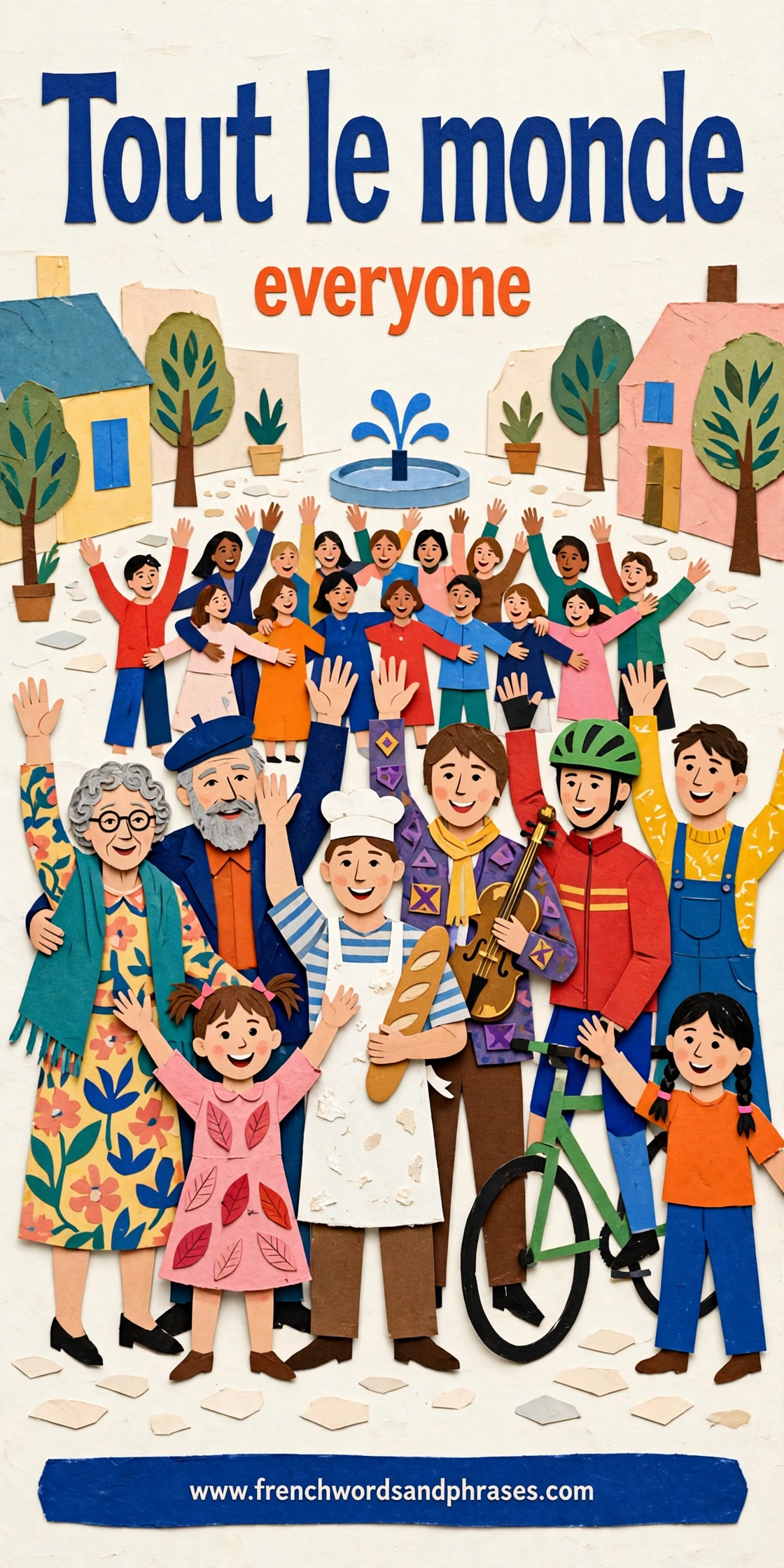
The village square on market morning, stalls open, baskets filling, the café terrace already loud. The mayor climbs the town hall steps, raises both hands and greets the whole crowd in two words: « Bonjour, tout le monde ! »
Let’s explore how tout le monde works in French, beginning with the whole phrase on one card.
Understanding the French Phrase Tout le monde
Tout le monde is a French expression built from tout (all, every), le (the) and monde (the world, people — a masculine noun that has its own page on this site). Word for word it is “all the world” — and that is exactly how French uses it: not humanity in the abstract, but every person in the room, the square, the story.
It means everyone, everybody. Tout le monde est là — everyone is here. Tout le monde sait — everyone knows. Nobody is being counted one by one: French gathers the whole crowd into a single group, treats it as one body, and — this is the famous trap — gives it a singular verb.
Type: Everyday expression — people (tout + le + monde)
Answers the need: Talking about every person in a group, without exception
Register: Neutral — everywhere, from the classroom to the family table
Strength: Total — it leaves nobody out, and French insists on it with a singular verb
One important usage detail, the trap that catches every learner: tout le monde takes a SINGULAR verb, always. Tout le monde est content, tout le monde a compris, tout le monde veut — never « tout le monde sont », never « ils » agreement inside the same clause. English everyone works the same way (everyone is), and French is just as firm: the crowd is one body, and the verb stays singular.
Experience the Word
Tout le monde is the phrase of assemblies, classrooms and family announcements — the two words that turn a crowd into an audience.
Imagine the schoolteacher at the door on the first morning of term, thirty faces turned up at her. She does not name them one by one; she takes them all in a single sweep: « Bonjour, tout le monde, asseyez-vous. »
French could have counted heads. Instead it opens its arms — tout le monde — and takes the whole world of the room at once.
How to Use Tout le monde in French: Complete Guide
Let’s explore how tout le monde works in French, beginning with the whole phrase on one card.
Tout le monde at a Glance
The Whole Phrase on One Card
Real meaning, literal picture, English twin and register — tout le monde in five lines.
| Point | Tout le monde |
|---|---|
| What it really means | everyone, everybody — every person in the group |
| Word for word | all the world — tout (all) + le monde (the world, the people) |
| English equivalent | everyone / everybody |
| Register | neutral — safe everywhere |
| Use it for | greetings, announcements, general truths about people |
Example
Tout le monde est arrivé à l’heure.
Everyone arrived on time.
Word by Word: Building the Crowd
Three small pieces — take them one by one and the whole crowd assembles.
| Word | Literal meaning | Its job in the phrase |
|---|---|---|
| tout | all, every | the totaliser: it leaves nobody out |
| le | the | the definite article — the crowd is one known body |
| monde | the world, people | a masculine noun: le monde means both the planet and the people in it |
Example
Tout le monde connaît ce village.
Everyone knows this village.
Quick Quiz 1
Say it right: tout le monde est là or tout le monde sont là?
Reveal the answer
Tout le monde est là — the verb is singular, always. The crowd counts as one body in French grammar.
Tout le monde est là, on peut commencer.
Everyone is here, we can begin.
When You Say It: The Crowd Moments
Tout le monde fires at moments like these — wherever a whole group is greeted, gathered or described at once.
| Situation | Example |
|---|---|
| A greeting | bonjour, tout le monde ! — hello, everyone! |
| An announcement | tout le monde écoute, s’il vous plaît — everyone listen, please |
| A general truth | tout le monde sait que… — everyone knows that… |
| A full house | tout le monde est venu — everyone came |
| An invitation | tout le monde est invité — everyone is invited |
Example
Tout le monde est invité à la fête du village.
Everyone is invited to the village fête.
Make It Yours: The Singular Verb, Every Time
The phrase never changes — only the singular verb moves with the tense.
| Form | French | In English |
|---|---|---|
| Everyone is… | tout le monde est… | everyone is… |
| Everyone has… | tout le monde a… | everyone has… |
| Everyone wants… | tout le monde veut… | everyone wants… |
| Everyone was… | tout le monde était… | everyone was… |
| Everyone will be… | tout le monde sera… | everyone will be… |
| Everyone loves… | tout le monde adore… | everyone loves… |
Example
Tout le monde veut un morceau de gâteau.
Everyone wants a piece of cake.
Quick Quiz 2
Complete it: Tout le monde ______ compris. (has understood)
Reveal the answer
a — tout le monde a compris. Singular auxiliary, because tout le monde is grammatically one.
Tout le monde a compris la règle.
Everyone has understood the rule.
Everyday Expressions: Building on the Crowd
Tout le monde slots into these everyday frames — each one ready to use as it stands.
| Frame | In English |
|---|---|
| tout le monde sait que… | everyone knows that… |
| comme tout le monde | like everyone else, like everybody |
| tout le monde dehors ! | everybody out! — the evacuation order |
| tout le monde à table ! | everyone to the table! — dinner is ready |
| tout le monde descend | everybody off — the bus driver’s call at the terminus |
Example
Tout le monde à table, le dîner est prêt !
Everyone to the table, dinner is ready!
Close Cousins: The Other Ways to Mean Everyone
French has a whole shelf of crowd words — tout le monde is the warm everyday one; its cousins count, distribute or negate.
| Expression | The difference |
|---|---|
| tout le monde | everyone — the whole group as one body, singular verb |
| tous / toutes | all of them — plural, and it names a known group: ils sont tous venus |
| chacun | each one — the group taken one by one: chacun son tour |
| personne | nobody — the negative opposite: personne n’est venu |
| n’importe qui | anyone at all — no matter who |
Example
Chacun a apporté un plat, et tout le monde a bien mangé.
Each person brought a dish, and everyone ate well.
Quick Quiz 3
Which cousin means each one, one by one — tout le monde or chacun?
Reveal the answer
Chacun — tout le monde takes the group as a single body; chacun walks through it one person at a time.
Chacun son tour, tout le monde passera.
Each in turn, everyone will get through.
Tout le monde and Its Neighbours
The crowd shelf around the phrase — the people, the group and the gathering.
| French | In English |
|---|---|
| les gens | the people (a crowd in general) |
| le public | the audience, the public |
| la foule | the crowd (a dense mass of people) |
| chacun | each one |
| ensemble | together |
Example
La foule attendait, et tout le monde regardait la scène.
The crowd was waiting, and everyone was watching the stage.
Watch Out: The Traps Around Tout le monde
The traps: the plural verb, the English pronoun swap, and a tout that changes its spelling elsewhere.
| Trap | The truth |
|---|---|
| the plural verb | never « tout le monde sont » — est, a, veut, était: singular, always |
| reprising with ils in the same breath | inside the clause, tout le monde stays one: tout le monde est prêt, pas « ils sont prêts » bolted onto it |
| tout le monde vs tous les mondes | tous les mondes would be all the worlds — the phrase for everyone is fixed: tout le monde |
| tout seul | tout le monde does not shrink to « tout monde » — the le is part of the furniture |
Example
Tout le monde est prêt, et tout le monde attend le signal.
Everyone is ready, and everyone is waiting for the signal.
Quick Quiz 4
True or false: tout le monde veulent partir is correct, because everyone means many people.
Reveal the answer
False — tout le monde veut partir. Many people, one grammatical body, singular verb.
Tout le monde veut partir tôt ce soir.
Everyone wants to leave early this evening.
Tout le monde in Everyday French: Real-Life Examples
Now that you know the word, let’s see how tout le monde appears in everyday French.
Example 1 — A greeting
Bonjour, tout le monde ! Asseyez-vous.
Hello, everyone! Sit down.
Example 2 — At the office
Tout le monde a reçu le message ?
Has everyone received the message?
Example 3 — A family dinner
Tout le monde à table, ça va refroidir !
Everyone to the table, it will get cold!
Example 4 — A general truth
Tout le monde sait que Paris est la capitale.
Everyone knows that Paris is the capital.
Example 5 — A full train
Tout le monde descend à la prochaine station.
Everyone gets off at the next station.
Example 6 — A celebration
Tout le monde lève son verre pour les mariés.
Everyone raises their glass to the newlyweds.
Beyond Translation: The Meaning of Tout le monde
English everyone is a tidy compound, one word doing quiet work. French says it with a small act of poetry: tout le monde, all the world — as if the people in front of you, in this room, on this square, were for this moment the entire world that matters.
To say tout le monde is to make your room into the world, and everyone in it into everybody.
And the singular verb is the grammar of belonging: the crowd is not a sum of strangers, it is one body — est, a, veut — a single heartbeat in the sentence.
How to Remember the French Phrase Tout le monde
Remember it this way: Tout le monde means everyone — all the world in one body, and the verb beside it is always singular.
- You keep the verb singular — tout le monde est, a, veut, never sont.
- You greet with it — bonjour, tout le monde !, the warmest way to open a room.
- You hear the poetry — tout le monde is literally all the world, gathered in one phrase.
The key idea is tout le monde means everyone — singular verb always: tout le monde est, never sont.
Test Your Knowledge of Tout le monde
Let’s see how much you’ve learned. Try answering these questions before revealing the answers.
Question 1
What does tout le monde mean?
Reveal the answer
Everyone, everybody — literally, all the world.
Question 2
Singular or plural: tout le monde ______ là. (is)
Reveal the answer
est — tout le monde est là. The verb is always singular.
Question 3
Translate: Everyone knows that.
Reveal the answer
Tout le monde sait ça.
Question 4
What is the difference between tout le monde and chacun?
Reveal the answer
Tout le monde takes the group as one body; chacun takes it one person at a time — chacun son tour, each in turn.
Question 5
Complete the sentence:
Tout le monde ______ content de la nouvelle. (is)
Reveal the answer
est
Tout le monde est content de la nouvelle.
Everyone is happy with the news.
Your Final Challenge
Can You Use It?
How would you say this in French?
“Everyone is here, we can begin.”
Reveal the answer
Tout le monde est là, on peut commencer.
Everyone is here, we can begin.
A little French. A little curiosity. A richer everyday life.
LEARN FRENCH ONE WORD AT A TIME