A French Word to Live By
How to Conjugate Tordre in French
/tɔʁdʁ/
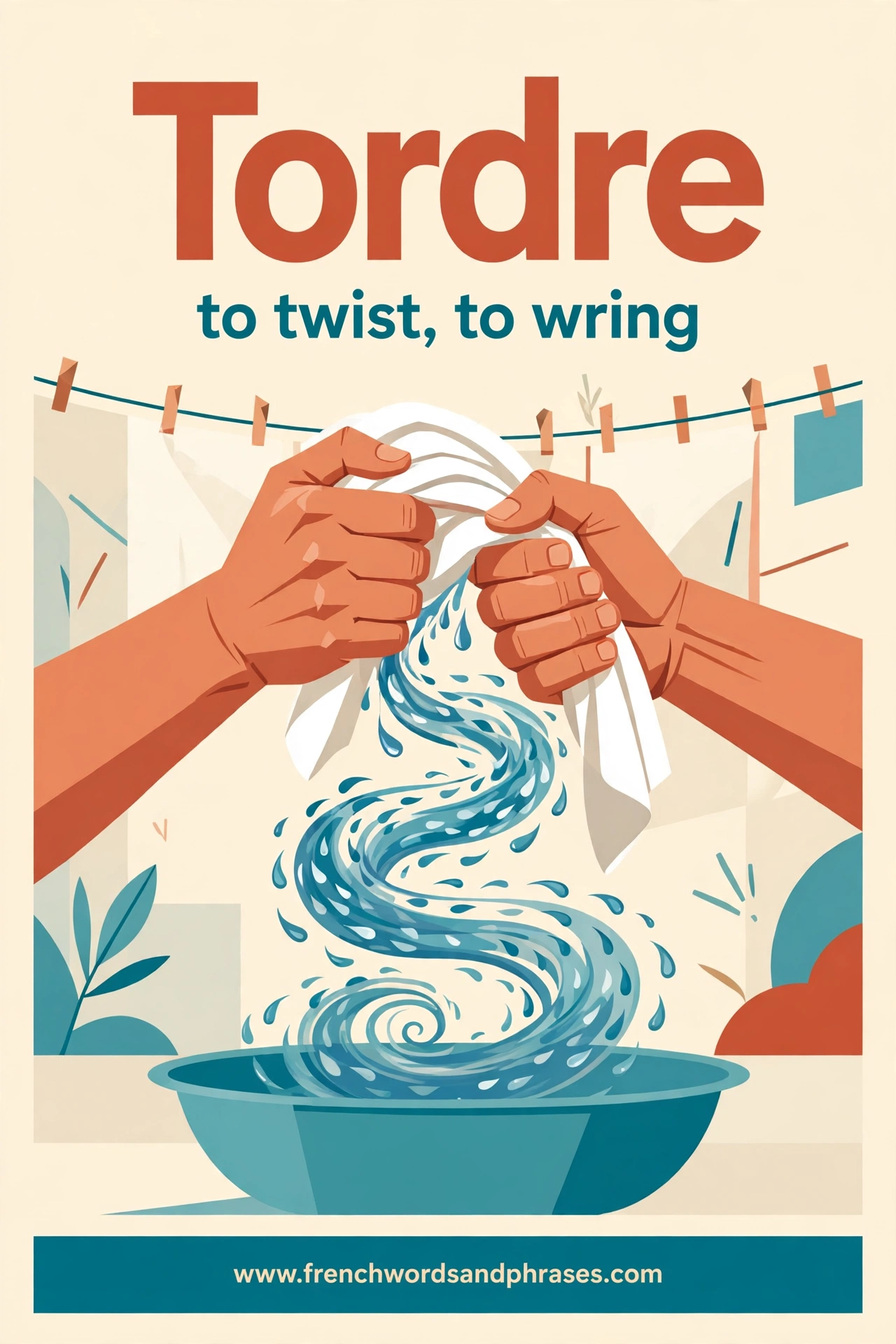
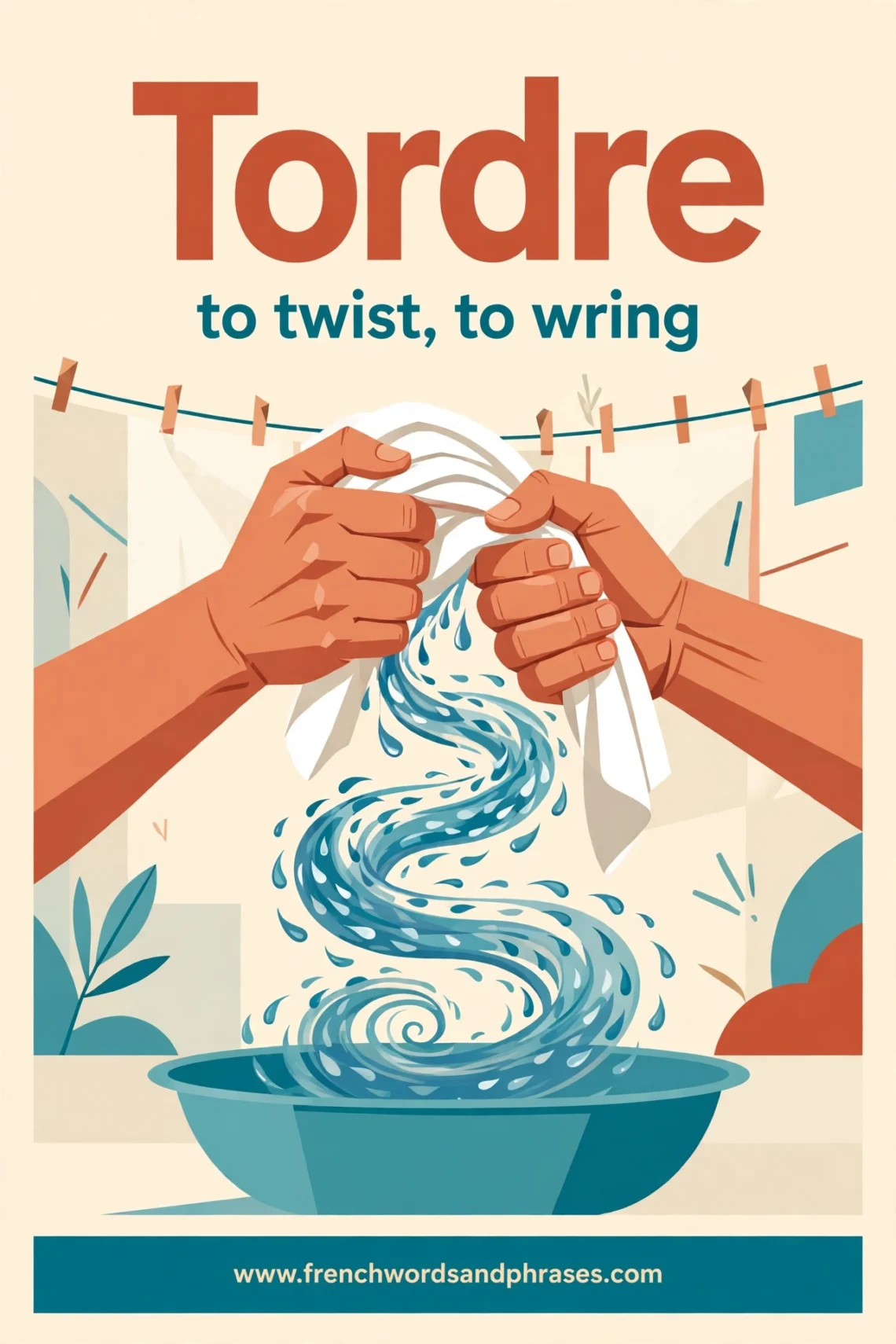
Tordre means to twist or to wring.
Wet washing wrung out by hand, a path twisting through the hills, a face twisted with laughter — tordre is the verb of everything that turns on itself.
In this guide, you’ll learn how to conjugate tordre in all the major French tenses and moods. Explore complete conjugation tables, French examples, English translations, and practice quizzes.
Understanding the French Verb Tordre
Tordre is a regular French verb belonging to the third group of verbs, those ending in -re.
It means to twist, to wring. It is commonly used for wringing clothes, twisting wires and branches, spraining ankles (se tordre la cheville), and grimacing — tordre la bouche — or doubling up with laughter.
Verb classification: Third group (-re)
Auxiliary verb: Avoir
Past participle: tordu
Present participle: tordant
English equivalents: To twist, to wring, to wrench; (se) to twist (an ankle), to double up (laughing).
One important detail: tordre wrings washing — tordre le linge — and twists ankles in its reflexive form: se tordre la cheville. Its happiest use is se tordre de rire, to double up with laughter; and something hilarious is tordant — literally, twisting.
Experience the Word
Tordre is the verb of the spiral — hands wringing, roads winding, bodies bending double.
Imagine washday before machines, at a stone lavoir in a village square. The women twist each sheet with strong hands until the water runs out in ropes. Tordre was strength, twice a week.
The cloth gives up its water. A twist is small — and it changes everything.
How to Conjugate Tordre: Complete French Conjugation Guide
Let’s explore every major conjugation of tordre, beginning with the indicative mood.
How to Conjugate Tordre in the Indicative Mood
The indicative mood is used to express facts, observations, actions, and events.
How to Conjugate Tordre in the Present Tense (Présent)
Used for actions happening now, habitual actions, and general truths.
| Subject | Conjugation |
|---|---|
| je | tords |
| tu | tords |
| il / elle | tord |
| nous | tordons |
| vous | tordez |
| ils / elles | tordent |
Example
Elle tord le linge au-dessus de l’évier.
She is wringing the washing over the sink.
Quick Quiz 1
Complete the sentence:
Nous ______ le linge à la main.
Reveal the answer
tordons
Nous tordons le linge à la main.
We wring the washing by hand.
How to Conjugate Tordre in the Passé Composé
Used for completed actions in the past. Tordre takes the auxiliary verb avoir.
| Subject | Conjugation |
|---|---|
| j’ | ai tordu |
| tu | as tordu |
| il / elle | a tordu |
| nous | avons tordu |
| vous | avez tordu |
| ils / elles | ont tordu |
Example
Il s’est tordu la cheville en courant.
He twisted his ankle while running.
How to Conjugate Tordre in the Imparfait (Imperfect Tense)
Used for habitual past actions, descriptions, and ongoing situations in the past.
| Subject | Conjugation |
|---|---|
| je | tordais |
| tu | tordais |
| il / elle | tordait |
| nous | tordions |
| vous | tordiez |
| ils / elles | tordaient |
Example
Le chemin tordait à travers les collines.
The path used to twist through the hills.
Quick Quiz 2
Choose the correct form:
He twisted his ankle.
Il ______ la cheville. (s’est tordu / a tordu soi)
Reveal the answer
s’est tordu
Il s’est tordu la cheville.
Your own ankle takes the reflexive se tordre, with être.
How to Conjugate Tordre in the Plus-que-parfait
Used to describe an action that had already been completed before another past event.
| Subject | Conjugation |
|---|---|
| j’ | avais tordu |
| tu | avais tordu |
| il / elle | avait tordu |
| nous | avions tordu |
| vous | aviez tordu |
| ils / elles | avaient tordu |
Example
Nous avions tordu le fil de fer autour du poteau.
We had twisted the wire around the post.
How to Conjugate Tordre in the Passé Simple
Primarily used in formal writing, literature, and historical narratives. It is rarely used in everyday conversation.
| Subject | Conjugation |
|---|---|
| je | tordis |
| tu | tordis |
| il / elle | tordit |
| nous | tordîmes |
| vous | tordîtes |
| ils / elles | tordirent |
Example
Elle tordit la serviette et la pendit.
She wrung the towel and hung it up.
How to Conjugate Tordre in the Passé Antérieur
A literary tense used to express an action completed immediately before another past action, generally in the passé simple.
| Subject | Conjugation |
|---|---|
| j’ | eus tordu |
| tu | eus tordu |
| il / elle | eut tordu |
| nous | eûmes tordu |
| vous | eûtes tordu |
| ils / elles | eurent tordu |
Example
Quand il eut tordu le linge, il l’étendit.
When he had wrung the washing, he hung it out.
How to Conjugate Tordre in the Future Tense (Futur Simple)
Used to describe actions that will take place in the future.
| Subject | Conjugation |
|---|---|
| je | tordrai |
| tu | tordras |
| il / elle | tordra |
| nous | tordrons |
| vous | tordrez |
| ils / elles | tordront |
Example
Tu te tordras de rire devant ce film.
You will double up laughing at this film.
How to Conjugate Tordre in the Futur Antérieur (Future Perfect)
Used for an action that will have been completed before a particular point in the future.
| Subject | Conjugation |
|---|---|
| j’ | aurai tordu |
| tu | auras tordu |
| il / elle | aura tordu |
| nous | aurons tordu |
| vous | aurez tordu |
| ils / elles | auront tordu |
Example
À la fin, elle aura tordu toutes les serviettes.
By the end, she will have wrung all the towels.
How to Conjugate Tordre in the Near Future (Futur Proche)
Used to describe something that is going to happen soon. Formed with aller + infinitive.
| Subject | Conjugation |
|---|---|
| je | vais tordre |
| tu | vas tordre |
| il / elle | va tordre |
| nous | allons tordre |
| vous | allez tordre |
| ils / elles | vont tordre |
Example
Attention, tu vas te tordre la cheville !
Careful, you are going to twist your ankle!
How to Conjugate Tordre in the Conditional Mood
The conditional mood expresses what would happen under certain circumstances. It is also frequently used to make polite requests or express wishes.
How to Conjugate Tordre in the Present Conditional
| Subject | Conjugation |
|---|---|
| je | tordrais |
| tu | tordrais |
| il / elle | tordrait |
| nous | tordrions |
| vous | tordriez |
| ils / elles | tordraient |
Example
Sans essoreuse, je tordrais le linge à la main.
Without a spin dryer, I would wring the washing by hand.
How to Conjugate Tordre in the Past Conditional
| Subject | Conjugation |
|---|---|
| j’ | aurais tordu |
| tu | aurais tordu |
| il / elle | aurait tordu |
| nous | aurions tordu |
| vous | auriez tordu |
| ils / elles | auraient tordu |
Example
Il se serait tordu la cheville sur ce chemin.
He would have twisted his ankle on that path.
Tordre in the Literary Past Conditional Form
This less common literary form uses the imperfect subjunctive of avoir.
| Subject | Conjugation |
|---|---|
| j’ | eusse tordu |
| tu | eusses tordu |
| il / elle | eût tordu |
| nous | eussions tordu |
| vous | eussiez tordu |
| ils / elles | eussent tordu |
Example
Elle eût tordu le cou aux rumeurs.
She would have wrung the rumours’ neck — put an end to them.
How to Conjugate Tordre in the Subjunctive Mood
The subjunctive is used to express wishes, emotions, doubts, necessity, and uncertainty. It frequently follows expressions such as il faut que (it is necessary that) or bien que (although).
How to Conjugate Tordre in the Present Subjunctive
| Subject | Conjugation |
|---|---|
| que je | torde |
| que tu | tordes |
| qu’il / qu’elle | torde |
| que nous | tordions |
| que vous | tordiez |
| qu’ils / qu’elles | tordent |
Example
Il faut que tu tordes bien le linge.
You must wring the washing well.
Quick Quiz 3
Complete the sentence using the subjunctive:
Je crains qu’elle ______ la cheville.
Reveal the answer
se torde
Je crains qu’elle se torde la cheville.
I fear she may twist her ankle.
How to Conjugate Tordre in the Imperfect Subjunctive
A literary tense, rarely encountered in modern spoken French.
| Subject | Conjugation |
|---|---|
| que je | tordisse |
| que tu | tordisses |
| qu’il / qu’elle | tordît |
| que nous | tordissions |
| que vous | tordissiez |
| qu’ils / qu’elles | tordissent |
Example
Je craignais qu’il se tordît la cheville.
I feared he might twist his ankle.
How to Conjugate Tordre in the Pluperfect Subjunctive
A literary construction used to express an action completed before another past action.
| Subject | Conjugation |
|---|---|
| que j’ | eusse tordu |
| que tu | eusses tordu |
| qu’il / qu’elle | eût tordu |
| que nous | eussions tordu |
| que vous | eussiez tordu |
| qu’ils / qu’elles | eussent tordu |
Example
Il regrettait qu’elle se fût tordu le poignet.
He regretted that she had twisted her wrist.
How to Conjugate Tordre in the Past Subjunctive
| Subject | Conjugation |
|---|---|
| que j’ | aie tordu |
| que tu | aies tordu |
| qu’il / qu’elle | ait tordu |
| que nous | ayons tordu |
| que vous | ayez tordu |
| qu’ils / qu’elles | aient tordu |
Example
Je suis désolé que tu te sois tordu la cheville.
I am sorry you twisted your ankle.
How to Conjugate Tordre in the Imperative
The imperative is used to give commands, instructions, invitations, or suggestions. Subject pronouns are omitted.
How to Conjugate Tordre in the Present Imperative
| Person | Conjugation |
|---|---|
| (tu) | tords |
| (nous) | tordons |
| (vous) | tordez |
Example
Tords le linge encore une fois !
Wring the washing once more!
Quick Quiz 4
How would you say Wring it well (tu form)?
Reveal the answer
Tords-le bien !
French Participles of Tordre
Participles are verb forms that can be used in compound tenses and other grammatical constructions.
Present Participle of Tordre
tordant
En tordant le fil, il a fait un nœud solide.
By twisting the wire, he made a solid knot.
Past Participle of Tordre
tordu
Tordu par le vent, le vieil arbre penchait.
Twisted by the wind, the old tree leaned.
Tordre in Everyday French: Real-Life Examples
Now that you know the conjugations, let’s see how tordre appears in everyday French.
Example 1 — Present
Je tords le linge avant de l’étendre.
I wring the washing before hanging it out.
Example 2 — Passé composé
Il s’est tordu la cheville au football.
He twisted his ankle at football.
Example 3 — Imparfait
La route tordait dans la montagne.
The road used to twist through the mountains.
Example 4 — Laughter
Nous nous sommes tordus de rire.
We doubled up with laughter.
Example 5 — Future
Ce comédien vous tordra de rire.
This comedian will have you in stitches.
Example 6 — Imperative
Tords bien la serviette !
Wring the towel well!
Beyond Translation: The Meaning of Tordre
English twist covers most of it, but tordre owns the laundry and the laughter: no other French verb wrings a sheet and doubles up a room of people.
Its present participle is a review.
Call a film tordant and every French speaker knows: it twists you — with laughter. Five stars, in one word.
How to Remember the French Verb Tordre
Remember it this way: Tordre is about the twist — washing, ankles and laughter.
- Tordre le linge — to wring the washing: the verb’s home territory.
- Se tordre la cheville — to twist your ankle; se tordre de rire — to double up laughing.
- Regular -re: je tords, il tord, past participle tordu.
The key idea is the twist — washing, ankles and laughter.
Test Your Knowledge of Tordre
Let’s see how much you’ve learned. Try answering these questions before revealing the answers.
Question 1
What does se tordre de rire mean?
Reveal the answer
To double up with laughter — to twist yourself laughing.
Question 2
How do you say He twisted his ankle in French?
Reveal the answer
Il s’est tordu la cheville.
Question 3
Translate: She is wringing the washing.
Reveal the answer
Elle tord le linge.
Question 4
What is the past participle of tordre?
Reveal the answer
Tordu.
Question 5
Complete the sentence:
Il faut que tu ______ bien la serviette.
Reveal the answer
tordes
Il faut que tu tordes bien la serviette.
You must wring the towel well.
Your Final Challenge
Can You Use It?
How would you say this in French?
This film is hilarious: we doubled up with laughter.
Reveal the answer
Ce film est tordant : nous nous sommes tordus de rire.
This film is hilarious: we doubled up with laughter.
A little French. A little curiosity. A richer everyday life.
LEARN FRENCH ONE WORD AT A TIME