A French Word to Live By
Translate T’es mimi to English
/tɛ mi.mi/
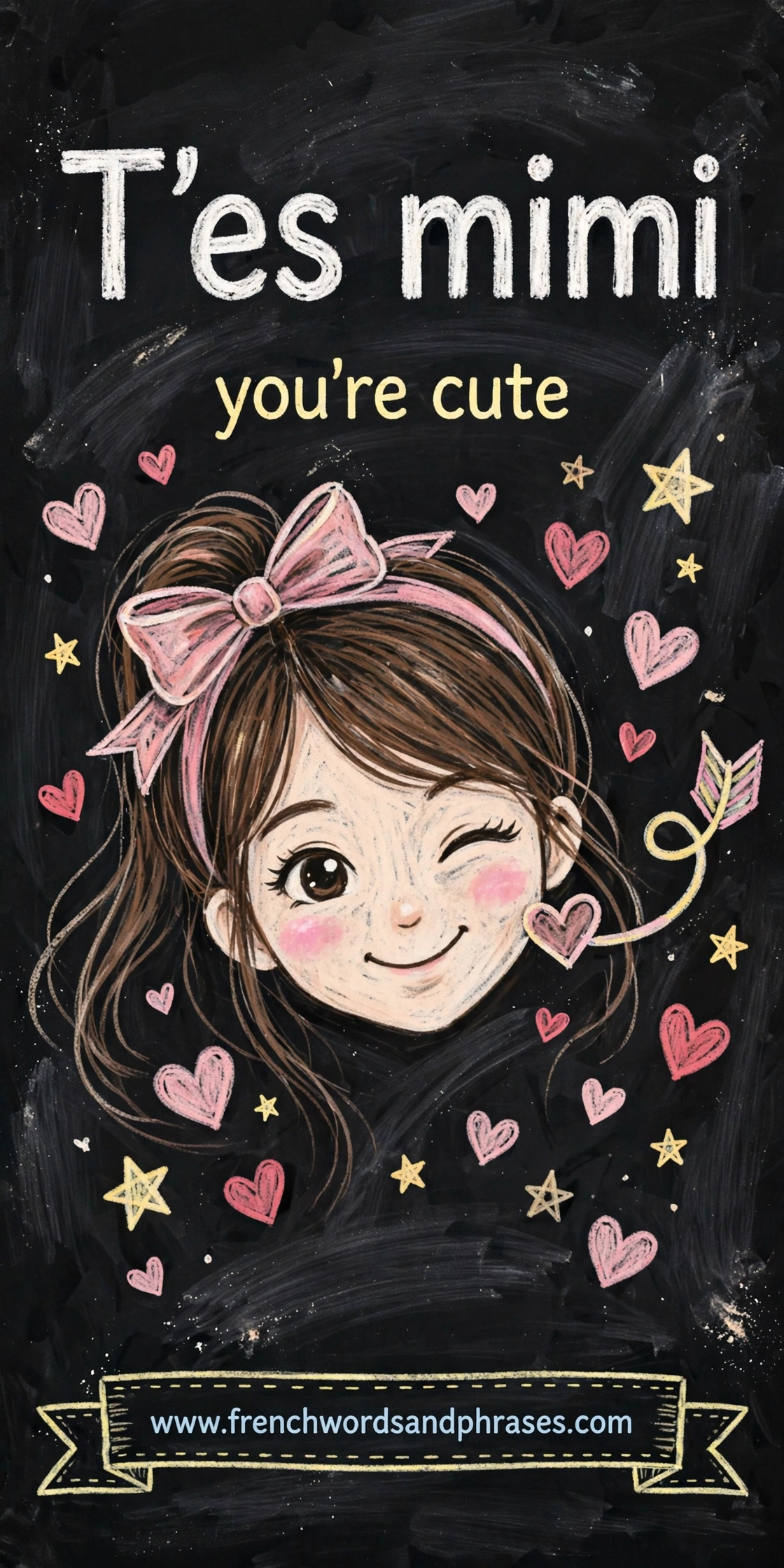
T’es mimi means you’re cute — a sweet little compliment, halfway between tender and teasing.
Sunday morning, and the kitchen door opens very slowly. Your little cousin appears in her mother’s shoes and a hat down to her eyebrows, walking with enormous care, holding the door frame like a model on a catwalk. The whole table says it at once, in one soft word, before anyone has even decided to speak: « T’es mimi, toi ! »
Let’s explore how t’es mimi works in French, beginning with the whole phrase on one card.
Understanding the French Phrase T’es mimi
T’es mimi is a French idiomatic expression built from t’es — the spoken form of tu es, you are — and mimi, a soft little word for cute that French keeps for children, kittens and people it is fond of. The whole phrase is a compliment in miniature: two syllables of affection, delivered at close range.
It means you’re cute — said to a child in a new dress, a partner pulling a face, a friend blushing at exactly the right moment. Mimi is not grand beauty; it is charm at close range, the cuteness that makes people smile rather than stare. And the t’es keeps the phrase in the spoken world: it lives in kitchens, playgrounds and messages, not in essays.
Type: Idiomatic compliment — spoken phrase (t’es + adjective)
Answers the need: Calling someone cute, sweetly, in everyday speech
Register: Informal and affectionate — family, children, partners, close friends
Strength: Small and warm — a fond smile of a compliment, not a grand declaration
One important usage detail: t’es is the contraction of tu es that French mouths make automatically; in careful writing it unfolds back into tu es mimi. Mimi itself never changes — il est mimi, elle est mimi, ils sont mimi. Said to an adult it is teasing and tender; said of a baby or a kitten, it is simply the truth.
Experience the Word
T’es mimi is affection before it learns manners — the compliment in its pyjamas.
Imagine the kitchen on a Sunday morning: a small girl in her mother’s shoes and a hat down to her eyebrows, walking with enormous care. The whole table says the word at once — mimi. Nobody says belle. Belle is for statues and film stars; mimi is for people you want to pick up and hug.
The word survives into adult love because grown-ups need it too. T’es mimi is what tenderness says when it is too happy for grammar.
How to Use T’es mimi in French: Complete Guide
Let’s explore how t’es mimi works in French, beginning with the whole phrase on one card.
T’es mimi at a Glance
The Whole Phrase on One Card
Real meaning, literal picture, English twin and register — t’es mimi in five lines.
| Point | T’es mimi |
|---|---|
| What it really means | you’re cute — sweet, charming, smile-making |
| Word for word | you are cute — mimi is the soft, child-word for cute |
| English equivalent | you’re cute / aren’t you cute |
| Register | informal and affectionate — spoken French and messages |
| Use it for | children showing off, partners pulling faces, friends at their most charming |
Example
Avec ta nouvelle coupe, t’es mimi !
With your new haircut, you’re cute!
Word by Word: Building the Little Compliment
Two small pieces — take them one by one and the smile is already there.
| Word | Literal meaning | Its job in the phrase |
|---|---|---|
| t’es | you are (spoken) | tu es with its vowel swallowed — the sound of real conversation |
| mimi | cute | a soft, round little word, made for children, kittens and favourite people |
Example
Elle est mimi quand elle rit comme ça.
She’s cute when she laughs like that.
Quick Quiz 1
What is t’es the spoken form of?
Reveal the answer
Tu es — French mouths swallow the u in speech; careful writing unfolds it again.
T’es mimi, dit la grand-mère à sa petite-fille.
‘You’re cute,’ says the grandmother to her granddaughter.
When You Say It: The Close-Range Charm Moments
T’es mimi fires at moments like these — someone is being adorable, and the word arrives before you can stop it.
| Situation | Example |
|---|---|
| The new haircut | t’es mimi avec cette coupe — you’re cute with that haircut |
| The child showing off | t’es mimi dans ta robe rouge — you’re cute in your red dress |
| The partner’s sulk | arrête de bouder, t’es mimi quand tu boudes — stop sulking, you’re cute when you sulk |
| The blushing friend | tu rougis ? t’es mimi — you’re blushing? you’re cute |
| About the kitten | il est mimi, ce chaton — that kitten is cute |
Example
T’es mimi quand tu te concentres comme ça.
You’re cute when you concentrate like that.
Make It Yours: The Cute for Every Person
Mimi never changes — only the person in front of it does.
| Form | French | In English |
|---|---|---|
| You are cute | t’es mimi | you’re cute |
| He is cute | il est mimi | he’s cute |
| She is cute | elle est mimi | she’s cute |
| So cute | t’es trop mimi | you’re so cute |
| Written carefully | tu es mimi | you are cute (the full form) |
| The exclamation | trop mimi ! | so cute! |
Example
T’es trop mimi avec tes couettes.
You’re so cute with your bunches.
Quick Quiz 2
Does mimi change for a girl — elle est mimie?
Reveal the answer
No — mimi is invariable: elle est mimi, ils sont mimi, and that is the end of it.
Les jumelles sont mimi dans leurs robes assorties.
The twins are cute in their matching dresses.
Everyday Expressions: Building on the Cute
T’es mimi slots into these everyday frames — each one ready to use as it stands.
| Frame | In English |
|---|---|
| t’es mimi | you’re cute |
| t’es trop mimi | you’re so cute |
| il / elle est mimi | he / she is cute |
| mimi comme tout | cute as anything |
| un air mimi | a cute look about someone |
Example
Elle a un air mimi avec son chapeau trop grand.
She looks cute with her too-big hat.
Close Cousins: The Other Compliments
French has a whole shelf of compliments — mimi is the soft, small one; its cousins warm up, stand up straighter, or go grand.
| Expression | The difference |
|---|---|
| t’es mimi | you’re cute — soft, childlike, affectionate |
| tu es adorable | you’re adorable — a degree warmer, works for adults everywhere |
| tu es charmante | you’re charming — elegant, for a woman, a compliment with posture |
| tu es beau / belle | you’re handsome / beautiful — the grand compliment, appearance first |
| quel chou ! | what a cutie — the exclamation version, often for babies |
Example
Adorable au bureau, mimi à la maison : le registre change, le sourire reste.
Adorable at the office, mimi at home: the register changes, the smile stays.
Quick Quiz 3
Which cousin is the grand, elegant compliment — mimi or charmante?
Reveal the answer
Charmante — elegance and posture; mimi is the kitchen-table version, soft and small.
Charmante en soirée, mimi au petit-déjeuner.
Charming at the party, cute at breakfast.
T’es mimi and Its Neighbours
The small-charm shelf around the phrase — the children, the kittens, and the blushes.
| French | In English |
|---|---|
| un enfant | a child |
| un chaton | a kitten |
| sourire | to smile |
| rougir | to blush |
| une fossette | a dimple |
| gentil | kind, sweet |
Example
Le chaton fait rougir l’enfant, qui sourit : deux mimis en une phrase.
The kitten makes the child blush and smile: two cuties in one sentence.
Watch Out: The Traps Around T’es mimi
The traps: a compliment too soft for the office, an agreement that never happens, and a statue it cannot describe.
| Trap | The truth |
|---|---|
| not for formal life | mimi is baby-soft — to a colleague or a stranger it can sound patronising; keep it for people who love you |
| invariable | no mimie, no mimis in the adjective — elle est mimi, full stop |
| t’es is speech | in a formal letter, write tu es — or better, vous êtes; t’es belongs to the spoken world |
| cute, not grand beauty | mimi is charm at close range — for grand beauty French says beau or belle; mimi is the smile, not the statue |
Example
À la directrice, on ne dit pas « t’es mimi » ; on dit « vous êtes charmante ».
To the headmistress you don’t say ‘t’es mimi’; you say ‘you’re charming.’
Quick Quiz 4
True or false: t’es mimi is a good compliment for your new boss.
Reveal the answer
False — too familiar and baby-soft; keep it for family, children and partners.
T’es mimi, c’est pour la maison, pas pour le bureau.
‘T’es mimi’ is for home, not for the office.
T’es mimi in Everyday French: Real-Life Examples
Now that you know the word, let’s see how t’es mimi appears in everyday French.
Example 1 — The haircut
T’es mimi avec ta nouvelle coupe !
You’re cute with your new haircut!
Example 2 — The dress
Elle est mimi dans sa robe à fleurs.
She’s cute in her flowery dress.
Example 3 — The sulk
T’es mimi quand tu boudes, tu sais.
You’re cute when you sulk, you know.
Example 4 — The kitten
Il est mimi, ce petit chaton roux.
That little ginger kitten is cute.
Example 5 — The blush
Tu rougis — t’es trop mimi.
You’re blushing — you’re so cute.
Example 6 — The photo
Sur cette photo, vous êtes mimi tous les deux.
In this photo, you’re both cute.
Beyond Translation: The Meaning of T’es mimi
English cute is small and quick — a word for buttons and puppies, gone in a breath. French mimi is a word shaped like the thing it names: two soft syllables, round and warm, a smile you can actually hear. It does not describe beauty; it describes the effect on the person looking.
T’es mimi is affection at whisper size — the compliment you give with a grin, not a speech.
That is why it crosses from nurseries into love letters without changing a letter: the people we love most are the ones we find cute at close range.
How to Remember the French Phrase T’es mimi
Remember it this way: T’es mimi is the smallest compliment in French — two syllables of softness, aimed at the people and creatures you love most.
- You hear the shape — mi-mi, two round little sounds, as soft as the thing it describes.
- You never change it — il est mimi, elle est mimi, ils sont mimi: invariable.
- You keep it at home — mimi is for family, children and partners; the office gets adorable or charmant.
The key idea is t’es mimi means you’re cute — the soft, spoken, affectionate compliment.
Test Your Knowledge of T’es mimi
Let’s see how much you’ve learned. Try answering these questions before revealing the answers.
Question 1
What does t’es mimi mean?
Reveal the answer
You’re cute — a soft, affectionate compliment for close range.
Question 2
What is t’es short for?
Reveal the answer
Tu es — the spoken contraction French mouths make automatically.
Question 3
Does mimi agree with a feminine subject?
Reveal the answer
No — elle est mimi; the word is invariable.
Question 4
When should you avoid it?
Reveal the answer
With strangers, colleagues and bosses — it is familiar and baby-soft; use adorable or charmant instead.
Question 5
Complete the sentence:
Avec tes couettes, t’es trop ______ ! (With your bunches, you’re so cute!)
Reveal the answer
mimi
Avec tes couettes, t’es trop mimi !
With your bunches, you’re so cute!
Your Final Challenge
Can You Use It?
How would you say this in French?
“With that new haircut, you’re cute!”
Reveal the answer
Avec cette nouvelle coupe, t’es mimi !
With that new haircut, you’re cute!
A little French. A little curiosity. A richer everyday life.
LEARN FRENCH ONE WORD AT A TIME