A French Word to Live By
Translate Terrasse to English
/te.ʁas/
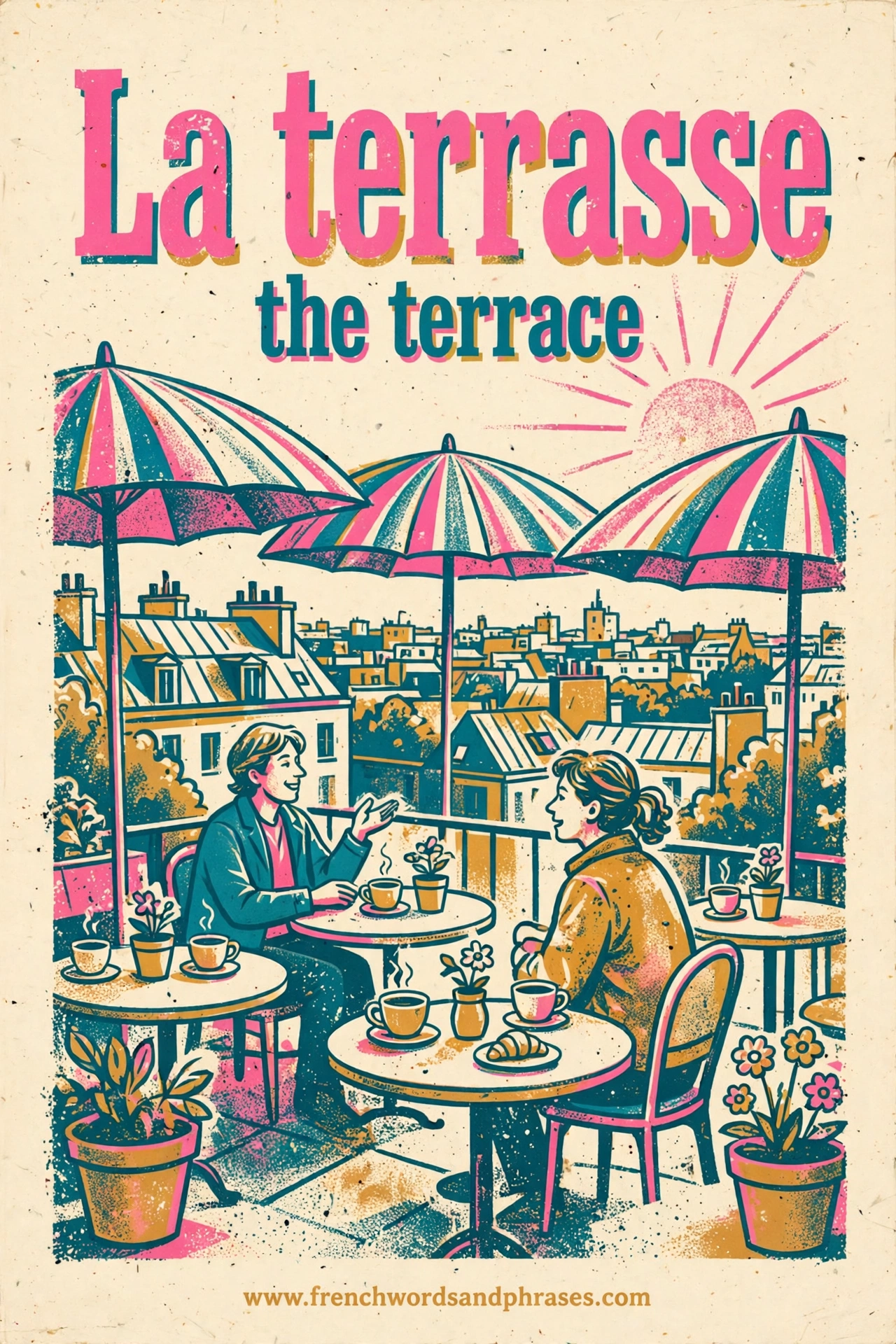
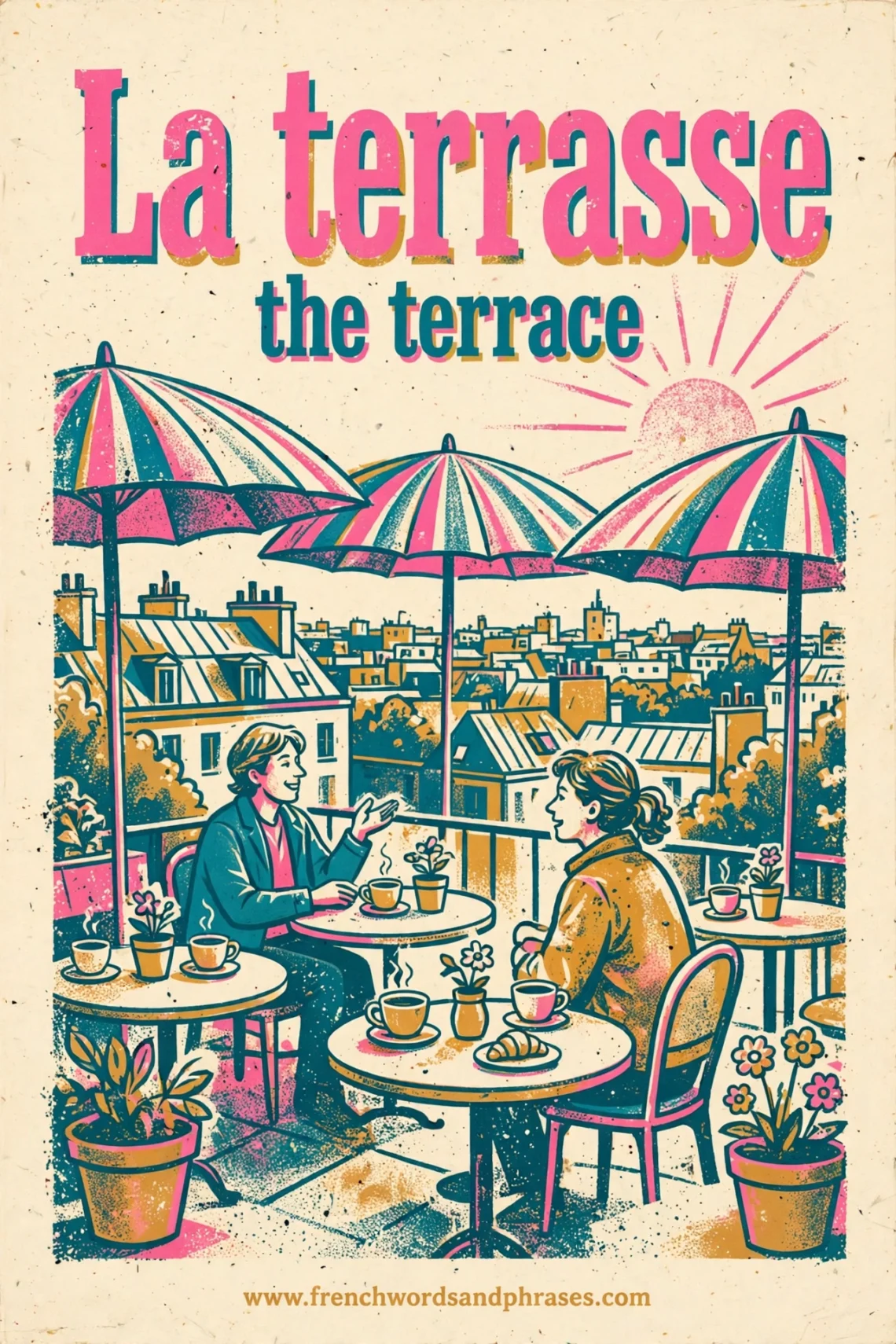
La terrasse means the terrace.
First warm evening of May: the café folds back its glass wall, the chairs spill onto the pavement, and the whole street seems to exhale. « On s’assoit en terrasse ? » The terrasse is France’s outdoor living room — the café terrace, the house terrace, anywhere a table can stand under the sky.
In this guide, you’ll learn what terrasse means in English, how to use it with its articles, how to form its plural, and how it appears in everyday French. Explore French examples, English translations, and practice quizzes.
Understanding the French Noun Terrasse
Terrasse is a feminine French noun: la terrasse, une terrasse. It comes from terre, earth — a terrasse was first a flat platform of earth, then any flat outdoor platform: the terrace of a house, the terrace of a café on the pavement, a roof terrace, even the terraced steps of a stadium or a hillside.
It means the terrace: la terrasse d’un café, a café terrace; une maison avec terrasse, a house with a terrace; déjeuner en terrasse, to have lunch on the terrace. In French café life the word is a choice you make at the door: en salle ou en terrasse ? — inside, or on the terrace? In the garden it is the paved or decked platform where summer is lived.
Gender: Feminine — la terrasse
Definite article: la — la terrasse (the terrace)
Indefinite article: une — une terrasse (a terrace)
Plural: les terrasses — regular, with a simple -s
Spelling note: double r, double s: terrasse — from terre, earth
Close neighbour: un balcon — a balcony; smaller, upstairs, railed
English equivalents: The terrace; (café) the pavement seating.
The preposition matters: you sit en terrasse at a café — the set phrase for eating and drinking outside: on déjeune en terrasse. At home it is sur la terrasse, on the terrace: les enfants jouent sur la terrasse. And a house advert counts it as a room of its own: terrasse exposée au sud, a south-facing terrace — three words that raise the price.
Experience the Word
Terrasse is the room France adds to every building when the sun comes out — no walls, no roof, all welcome.
Imagine the little house in Provence in July: lunch begins on la terrasse at noon under the vine, siesta follows in its shade, and dinner returns there at nine, with the swallows and the first stars. La terrasse n’est pas un luxe, c’est la pièce principale de l’été — the terrace is not a luxury, it is summer’s main room.
You have not just named a platform. You have named the outdoor heart of French life — la terrasse, the terrace.
How to Use Terrasse in French: Complete Guide
Let’s explore how terrasse works in French, beginning with its articles — la terrasse, une terrasse, déjeuner en terrasse.
Terrasse with the Definite Article (La, Les)
Used for a specific terrace — the one facing south, the one above the street.
| Form | French |
|---|---|
| Feminine singular | la terrasse |
| Plural | les terrasses |
Example
La terrasse du café est pleine dès midi.
The café terrace is full from noon onwards.
Terrasse with the Indefinite Article (Une, Des)
Used for a terrace in general — any platform under the sky.
| Form | French |
|---|---|
| Feminine singular | une terrasse |
| Plural | des terrasses |
Example
Ils rêvent d’une maison avec une grande terrasse.
They dream of a house with a big terrace.
Terrasse with Quantities (Une, Deux, Assez de…)
Terraces are counted in vineyards and stadiums as well as cafés.
| Quantity | French |
|---|---|
| one terrace | une terrasse |
| two terraces | deux terrasses |
| enough terraces | assez de terrasses |
| too many terraces | trop de terrasses |
| a hillside of terraces | un coteau de terrasses |
Example
Le coteau est couvert de terrasses plantées de vignes.
The hillside is covered with terraces planted with vines.
Quick Quiz 1
Complete the sentence:
______ terrasse du café est pleine dès midi. (the)
Reveal the answer
La
La terrasse du café est pleine dès midi.
The café terrace is full from noon onwards — terrasse is feminine, so la.
The Plural of Terrasse
Terrasse takes a regular plural in -s — whole hillsides of them.
| Number | French |
|---|---|
| Singular | la terrasse |
| Plural | les terrasses |
Example
Les terrasses des cafés se remplissent au printemps.
The café terraces fill up in spring.
Terrasse with Possessive Adjectives (Ma, Ta, Sa…)
Possessives agree with the noun: terrasse is feminine, so ma, ta, sa in the singular.
| Owner | French |
|---|---|
| my | ma terrasse |
| your (tu) | ta terrasse |
| his / her | sa terrasse |
| our | notre terrasse |
| your (vous) | votre terrasse |
| their | leur terrasse |
Example
Ma terrasse donne sur la place du village.
My terrace overlooks the village square.
Quick Quiz 2
Complete the sentence:
______ terrasse donne sur la place du village. (my)
Reveal the answer
Ma
Ma terrasse donne sur la place du village.
My terrace overlooks the village square — ma, because terrasse is feminine.
Terrasse with Demonstrative Adjectives (Cette, Ces)
Used to point: cette terrasse, this terrace — usually the sunny one everyone wants.
| Form | French |
|---|---|
| Feminine singular | cette terrasse |
| Plural | ces terrasses |
Example
Cette terrasse est ensoleillée toute la journée.
This terrace is sunny all day long.
Terrasse with Adjectives
Adjectives agree with terrasse — feminine singular: une terrasse ensoleillée, une grande terrasse.
| Adjective | With Terrasse |
|---|---|
| ensoleillée (sunny) | une terrasse ensoleillée |
| grande (big) | une grande terrasse |
| couverte (covered) | une terrasse couverte |
| en bois (wooden) | une terrasse en bois |
| exposée au sud (south-facing) | une terrasse exposée au sud |
Example
Ils ont construit une terrasse en bois derrière la maison.
They built a wooden terrace behind the house.
Quick Quiz 3
What does en terrasse mean at a café?
Reveal the answer
On the terrace — the set phrase for sitting outside: on s’assoit en terrasse.
Nous déjeunons en terrasse aujourd’hui.
We’re having lunch on the terrace today.
Everyday Expressions with Terrasse
Cafés, gardens and summer evenings — the terrasse phrases of daily life.
| Expression | In English |
|---|---|
| en terrasse | on the terrace (at a café) |
| déjeuner en terrasse | to have lunch on the terrace |
| la terrasse d’un café | a café terrace |
| une terrasse exposée au sud | a south-facing terrace |
| faire terrasse | to sit out at a café (slangy, joyful) |
Example
Au premier soleil, tout le monde déjeune en terrasse.
At the first sun, everyone has lunch on the terrace.
Words from the Same Family as Terrasse
Outside living — the words that travel with terrasse.
| French | In English |
|---|---|
| un balcon | a balcony |
| un jardin | a garden |
| la terre | earth, land — the word terrasse comes from |
| un toit-terrasse | a roof terrace |
| une véranda | a veranda, a conservatory |
Example
Du balcon de l’hôtel, on voit la terrasse du restaurant.
From the hotel balcony, you can see the restaurant terrace.
Quick Quiz 4
What is une terrasse exposée au sud?
Reveal the answer
A south-facing terrace — the advert’s promise of sun all day.
La terrasse exposée au sud est parfaite pour le petit déjeuner.
The south-facing terrace is perfect for breakfast.
Terrasse in Everyday French: Real-Life Examples
Now that you know the word, let’s see how terrasse appears in everyday French.
Example 1 — At the café
On s’assoit en terrasse ou en salle ?
Shall we sit on the terrace or inside?
Example 2 — Lunch
Nous déjeunons en terrasse aujourd’hui.
We’re having lunch on the terrace today.
Example 3 — The house
Ils rêvent d’une maison avec une grande terrasse.
They dream of a house with a big terrace.
Example 4 — Morning
Ma terrasse donne sur la place du village.
My terrace overlooks the village square.
Example 5 — Building
Ils ont construit une terrasse en bois derrière la maison.
They built a wooden terrace behind the house.
Example 6 — Spring
Les terrasses des cafés se remplissent au printemps.
The café terraces fill up in spring.
Beyond Translation: The Meaning of Terrasse
Terrasse is terre, earth, raised into a platform: farmers cut terrasses into hillsides to hold the soil and the vines, and the word climbed from the vineyard to the café — any flat place, open to the sky, where life can be set out on a table. In France the café terrasse became an institution, a front-row seat on the street’s theatre, defended in every season.
To say terrasse is to claim a piece of the outdoors for living in.
It evokes the first May evening, the clink of glasses and the long light — everywhere French summer actually happens.
How to Remember the French Noun Terrasse
Remember it this way: Terrasse is the terrace — feminine, from terre, and taken en terrasse at every café in France.
- Always feminine — la terrasse, une terrasse, ma terrasse.
- The café phrase — en terrasse : on déjeune en terrasse, on s’assoit en terrasse.
- The earth in the word — terrasse vient de terre, la plateforme de terre devenue pièce d’été.
The key idea is la terrasse — the terrace, feminine; en terrasse = on the terrace at a café.
Test Your Knowledge of Terrasse
Let’s see how much you’ve learned. Try answering these questions before revealing the answers.
Question 1
Is terrasse masculine or feminine?
Reveal the answer
Feminine — la terrasse, une terrasse.
Question 2
How do you say to have lunch on the terrace?
Reveal the answer
Déjeuner en terrasse.
Question 3
Translate: The café terraces fill up in spring.
Reveal the answer
Les terrasses des cafés se remplissent au printemps.
Question 4
What is the difference between en terrasse and sur la terrasse?
Reveal the answer
En terrasse is the café phrase (sitting outside); sur la terrasse is at home, on the physical terrace.
Question 5
Complete the sentence:
______ terrasse donne sur la place du village. (my)
Reveal the answer
Ma
Ma terrasse donne sur la place du village.
My terrace overlooks the village square.
Your Final Challenge
Can You Use It?
How would you say this in French?
“We’re having lunch on the terrace today.”
Reveal the answer
Nous déjeunons en terrasse aujourd’hui.
We’re having lunch on the terrace today.
A little French. A little curiosity. A richer everyday life.
LEARN FRENCH ONE WORD AT A TIME