A French Word to Live By
Translate Tendance to English
/tɑ̃.dɑ̃s/
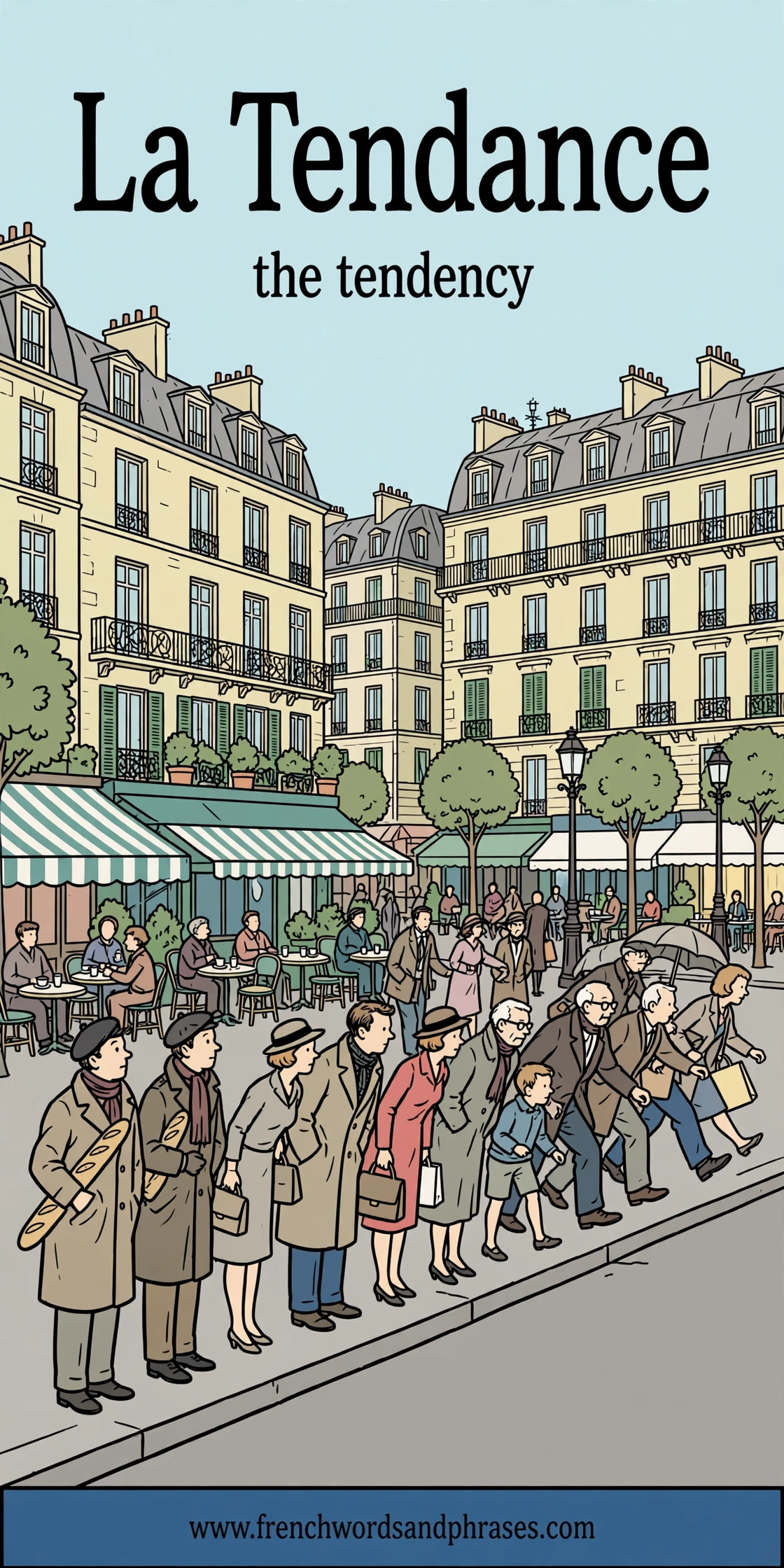
La tendance means the tendency.
A weather map on the evening news, arrows sweeping across the country, and the presenter concluding: « La tendance se confirme. » From markets to hemlines, French loves to name the direction things lean — la tendance.
In this guide, you’ll learn what tendance means in English, how to use it with its articles, how to form its plural, and how it appears in everyday French. Explore French examples, English translations, and practice quizzes.
Understanding the French Noun Tendance
Tendance is a feminine French noun, learned with its article: la tendance, une tendance. It comes from the verb tendre (to stretch, to lean towards). Its plural adds a simple -s: les tendances. Both syllables carry the nasal sound « an ».
It means the tendency — a leaning, a drift, a direction things take. It works for people: avoir tendance à oublier (to have a tendency to forget); for numbers: une tendance à la hausse (an upward trend); and for fashion, where la tendance is simply the trend of the season.
Gender: Feminine
Definite article: la — la tendance (the tendency, the trend)
Indefinite article: une — une tendance (a tendency)
Plural: les tendances
Typical partner: avoir tendance à + infinitive — to tend to do something
English equivalents: The tendency; the trend, the drift, the fashion.
One important usage detail: in fashion and café French, tendance also works as an invariable adjective meaning trendy: « un bar très tendance » — a very trendy bar. It never changes form there: no -s, no feminine -e, however many bars you praise. As a noun, though, it stays a well-behaved feminine: la tendance, les tendances.
Experience the Word
Tendance is the word of forecasters and grandmothers alike — one reads it in stock charts, the other in a grandson’s habits: « Tu as tendance à exagérer. » Both are watching which way something leans.
Imagine a small fashion boutique in Lyon in September: new colours in the window, a queue at the till, and the owner smiling — she guessed la tendance of the season before Paris announced it.
You have not just spotted a fashion. You have read a direction — deviné, sensed where things lean.
How to Use Tendance in French: Complete Guide
Let’s explore how tendance works in French, beginning with its articles — la, une, les, for leanings of every size.
Tendance with the Definite Article (La, Les)
La tendance for the trend of the moment; les tendances for the whole landscape of them.
| Form | French |
|---|---|
| Singular | la tendance |
| Plural | les tendances |
Example
La tendance de cet automne est aux couleurs chaudes.
This autumn’s trend is for warm colours.
Tendance with the Indefinite Article (Une, Des)
Une tendance — one leaning, one drift among others.
| Form | French |
|---|---|
| Singular | une tendance |
| Plural | des tendances |
Example
On observe une tendance nouvelle dans les villages.
A new trend can be seen in the villages.
Tendance with Quantities (Beaucoup de tendances, Une forte tendance…)
Tendencies are weighed by strength: strong, clear, slight — French grades them like a slope.
| Quantity | French |
|---|---|
| a strong tendency | une forte tendance |
| a clear tendency | une tendance nette |
| a slight tendency | une légère tendance |
| many tendencies | beaucoup de tendances |
| the same tendency | la même tendance |
Example
Il y a une forte tendance à télétravailler.
There is a strong tendency to work from home.
Quick Quiz 1
Complete the sentence:
Tu as ______ à parler trop vite. (tendency)
Reveal the answer
tendance
Tu as tendance à parler trop vite.
You have a tendency to speak too fast — the set pattern is avoir tendance à plus the infinitive.
The Plural of Tendance
Tendance adds an -s in the plural — les tendances, of fashion, of markets, of the times.
| Number | French |
|---|---|
| Singular | la tendance |
| Plural | les tendances |
Example
Les tendances changent plus vite que les saisons.
Trends change faster than the seasons.
Tendance with Possessive Adjectives (Ma, Ta, Sa…)
Possessives agree with the noun: tendance is feminine, so it takes ma, ta, sa in the singular.
| Owner | French |
|---|---|
| my | ma tendance |
| your (tu) | ta tendance |
| his / her | sa tendance |
| our | notre tendance |
| your (vous) | votre tendance |
| their | leur tendance |
Example
Ma tendance à rêver me suit depuis l’enfance.
My tendency to daydream has followed me since childhood.
Quick Quiz 2
Complete the sentence:
______ tendance à tout remettre au lendemain nous épuise. (His)
Reveal the answer
Sa
Sa tendance à tout remettre au lendemain nous épuise.
His tendency to put everything off until tomorrow exhausts us — tendance is feminine, so sa, whoever the owner is.
Tendance with Demonstrative Adjectives (Cette, Ces)
Used to point: cette tendance, this trend under discussion.
| Form | French |
|---|---|
| Singular | cette tendance |
| Plural | ces tendances |
Example
Cette tendance inquiète les petits commerces.
This trend worries small shops.
Tendance with Adjectives
Adjectives agree with tendance, feminine: une tendance croissante, une tendance lourde.
| Adjective | With Tendance |
|---|---|
| croissante (growing) | une tendance croissante |
| lourde (heavy, marked) | une tendance lourde |
| nouvelle (new) | une nouvelle tendance |
| générale (general) | la tendance générale |
| inquiétante (worrying) | une tendance inquiétante |
Example
Une tendance lourde se dessine dans les sondages.
A marked trend is emerging in the polls.
Quick Quiz 3
What does « une tendance à la baisse » describe?
Reveal the answer
A downward trend — prices, temperatures or figures falling.
La tendance est à la baisse pour les loyers.
Rents are on a downward trend.
Everyday Expressions with Tendance
Polls, prices and personalities — the tendance phrases of daily life.
| Expression | In English |
|---|---|
| avoir tendance à | to have a tendency to, to tend to |
| une tendance à la hausse | an upward trend |
| une tendance à la baisse | a downward trend |
| suivre la tendance | to follow the trend |
| la tendance actuelle | the current trend |
| très tendance | very trendy (invariable adjective) |
Example
Les jeunes suivent la tendance sans toujours la comprendre.
Young people follow the trend without always understanding it.
Words from the Same Family as Tendance
Leaning and stretching — the words that travel with tendance.
| French | In English |
|---|---|
| tendre | to stretch out; to tend, to lean towards |
| tendre vers | to tend towards, to approach |
| tendancieux | biased, tendentious |
| la mode | fashion |
| un sondage | an opinion poll |
| une courbe | a curve, a graph line |
Example
Les prix tendent à se stabiliser enfin.
Prices are finally tending to stabilise.
Quick Quiz 4
Translate: This café is very trendy.
Reveal the answer
Ce café est très tendance.
Used as an adjective, tendance never changes — très tendance, for one café or for twenty.
Tendance in Everyday French: Real-Life Examples
Now that you know the word, let’s see how tendance appears in everyday French.
Example 1 — A personal habit
J’ai tendance à oublier les prénoms.
I have a tendency to forget first names.
Example 2 — Reading the news
La tendance des prix est à la baisse ce mois-ci.
The price trend is downward this month.
Example 3 — In a boutique
Les clientes suivent la tendance de très près.
The customers follow the trend very closely.
Example 4 — Weather watching
La tendance pour le week-end est au soleil.
The trend for the weekend is towards sunshine.
Example 5 — A warning
Sa tendance à exagérer agace ses collègues.
His tendency to exaggerate annoys his colleagues.
Example 6 — Café talk
Ce quartier devient très tendance.
This neighbourhood is becoming very trendy.
Beyond Translation: The Meaning of Tendance
Tendance was born in the language of scholastic philosophy — the leaning of a thing towards its end — before escaping into weather reports, stock tickers and fashion weeks. Few French words commute so easily between the laboratory and the boutique: the same la tendance describes a fever chart, a rent curve and the colour of next spring’s coats.
To say tendance is to catch the world mid-lean.
It evokes the pollster’s graph, the grandmother’s raised eyebrow, the boutique window in September — every French attempt to say not where things are, but where they are going.
How to Remember the French Noun Tendance
Remember it this way: Tendance is the tendency — feminine, born from tendre, to lean; and it doubles as the fashion word for trendy.
- You lean with it — avoir tendance à oublier, to tend to forget.
- You read it — une tendance à la hausse, à la baisse, up or down on the graph.
- You wear it — très tendance, trendy, and the word never changes its clothes.
The key idea is la tendance à — a leaning always leans towards something.
Test Your Knowledge of Tendance
Let’s see how much you’ve learned. Try answering these questions before revealing the answers.
Question 1
Is tendance masculine or feminine?
Reveal the answer
Feminine — la tendance, une tendance, ma tendance.
Question 2
How do you say « to have a tendency to forget »?
Reveal the answer
Avoir tendance à oublier — tendance is followed by à plus the infinitive.
Question 3
Translate: Prices are on an upward trend.
Reveal the answer
Les prix sont en tendance à la hausse. (also: La tendance des prix est à la hausse.)
Question 4
What does « très tendance » mean?
Reveal the answer
Very trendy — tendance used as an invariable adjective, common in fashion and café talk.
Question 5
Complete the sentence:
______ tendance se confirme dans tout le pays. (This)
Reveal the answer
Cette
Cette tendance se confirme dans tout le pays.
This trend is confirmed across the whole country.
Your Final Challenge
Can You Use It?
How would you say this in French?
“I have a tendency to forget first names.”
Reveal the answer
J’ai tendance à oublier les prénoms.
I have a tendency to forget first names.
A little French. A little curiosity. A richer everyday life.
LEARN FRENCH ONE WORD AT A TIME