A French Word to Live By
How to Conjugate Tapoter in French
/ta.pɔ.te/
Tapoter means to tap lightly and repeatedly — fingertips drumming on a table, a foot tapping under a desk, small knuckles knock-knocking at a door. It is tapping with the volume turned down.
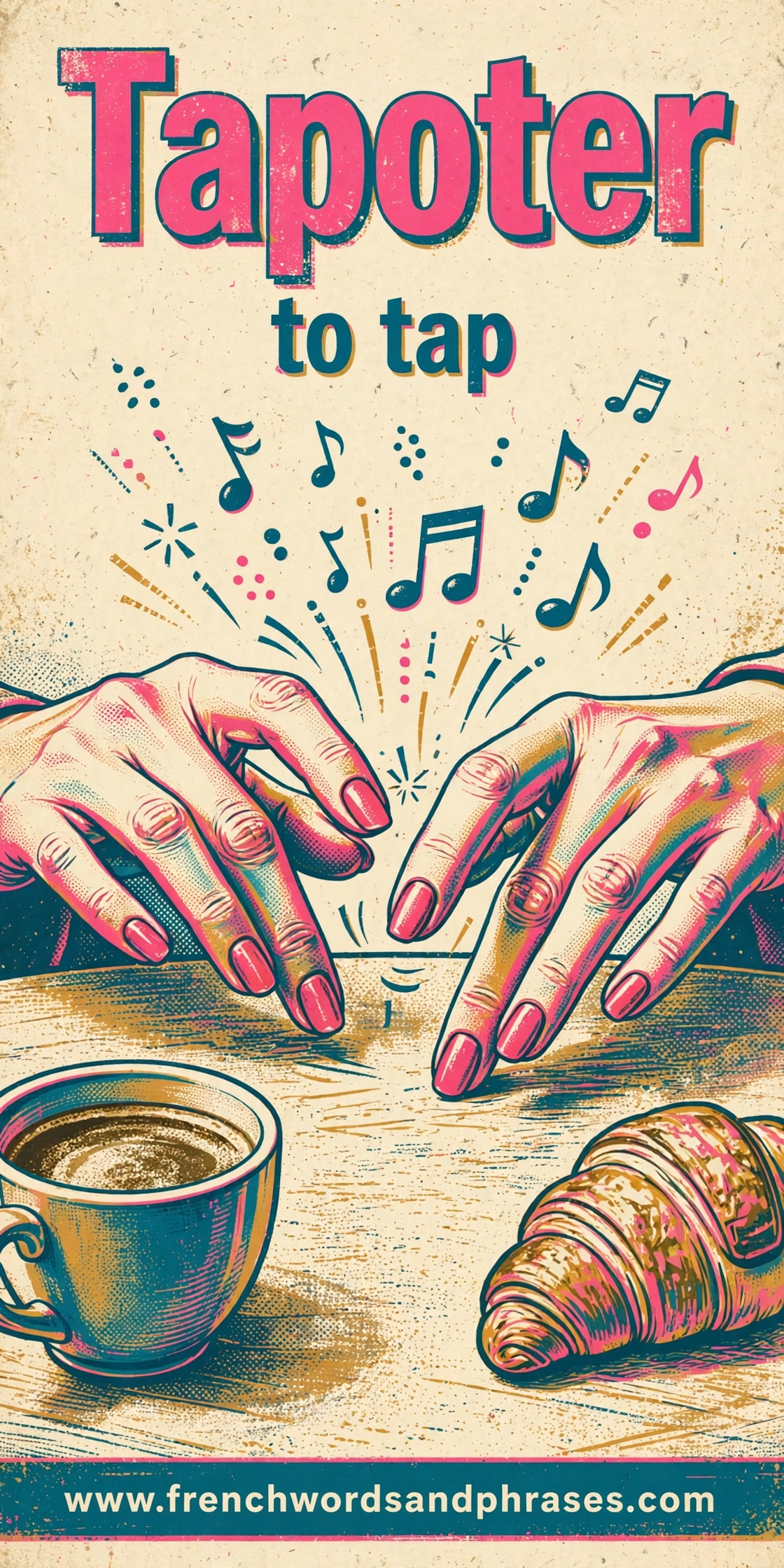
Impatience has a sound, and it is tapoter: fingers drumming on a café table while the waiter takes his time, a pencil tapping through a long phone call. Tapoter is the gentle, repeated tap — too light to be a knock, too regular to ignore.
In this guide, you’ll learn how to conjugate tapoter in all the major French tenses and moods. Explore complete conjugation tables, French examples, English translations, and practice quizzes.
Understanding the French Verb Tapoter
Tapoter is a regular French verb belonging to the first group of verbs, those ending in-er.
It means to tap. Tapoter sits between taper (to hit, to tap once or firmly) and tambouriner (to drum noisily). You tapotez sur la table with your fingers, sur une épaule to attract someone’s attention, or à une porte when the bell is broken. The gesture is always small and repeated — a single tap would just be toucher or taper doucement.
Verb classification: First group (-er)
Auxiliary verb: Avoir
Past participle: tapoté
Present participle: tapotant
English equivalents: To tap lightly, to drum (one’s fingers); tapoter sur la table — to drum on the table; tapoter du doigt — to tap with one’s finger; tapoter sur l’épaule de quelqu’un — to tap someone on the shoulder; tapoter un rythme — to tap out a rhythm; un tapotement — a light tapping.
One important detail: tapoter has a single t in every form: je tapote, nous tapotons, je tapotais, tapoté — never *je tapotte. The ending -oter is a frequentative ending: it builds ‘doing it in little repeats’ into the verb itself, so tapoter is taper shrunk down and set on repeat.
Experience the Word
Tapoter is the verb of waiting made audible — fingers keeping time while the mind is somewhere else.
Imagine a café terrace at noon. The coffee was ordered twenty minutes ago; the waiter is deep in conversation at the bar. At table four, a woman watches the street and, without noticing, tapote la table du bout des doigts — tip, tip, tip — and the whole terrace hears her patience running out.
Small sound, clear message. She is tapping — elle tapote — and the waiter finally looks up.
How to Conjugate Tapoter: Complete French Conjugation Guide
Let’s explore every major conjugation of tapoter, beginning with the indicative mood.
How to Conjugate Tapoter in the Indicative Mood
The indicative mood is used to express facts, observations, actions, and events.
How to Conjugate Tapoter in the Present Tense (Présent)
Used for actions happening now, habitual actions, and general truths.
| Subject | Conjugation |
|---|---|
| je | tapote |
| tu | tapotes |
| il / elle | tapote |
| nous | tapotons |
| vous | tapotez |
| ils / elles | tapotent |
Example
Elle tapote la table avec ses doigts en attendant.
She taps the table with her fingers while she waits.
Quick Quiz 1
Complete the sentence:
Nous ______ du pied sous la table.
Reveal the answer
tapotons
Nous tapotons du pied sous la table.
We tap our feet under the table.
How to Conjugate Tapoter in the Passé Composé
Used for completed actions in the past. Tapoter takes the auxiliary verb avoir.
| Subject | Conjugation |
|---|---|
| j’ | ai tapoté |
| tu | as tapoté |
| il / elle | a tapoté |
| nous | avons tapoté |
| vous | avez tapoté |
| ils / elles | ont tapoté |
Example
Il a tapoté sur l’épaule de son voisin pour le prévenir.
He tapped his neighbour on the shoulder to warn him.
How to Conjugate Tapoter in the Imparfait (Imperfect Tense)
Used for habitual past actions, descriptions, and ongoing situations in the past.
| Subject | Conjugation |
|---|---|
| je | tapotais |
| tu | tapotais |
| il / elle | tapotait |
| nous | tapotions |
| vous | tapotiez |
| ils / elles | tapotaient |
Example
Le pianiste tapotait le rythme sur son genou.
The pianist used to tap the rhythm on his knee.
Quick Quiz 2
Choose the correct form:
He tapped his neighbour on the shoulder.
Il ______ sur l’épaule de son voisin. (a tapoté / est tapoté)
Reveal the answer
a tapoté
Il a tapoté sur l’épaule de son voisin.
Tapoter takes avoir.
How to Conjugate Tapoter in the Plus-que-parfait
Used to describe an action that had already been completed before another past event.
| Subject | Conjugation |
|---|---|
| j’ | avais tapoté |
| tu | avais tapoté |
| il / elle | avait tapoté |
| nous | avions tapoté |
| vous | aviez tapoté |
| ils / elles | avaient tapoté |
Example
Elle avait tapoté doucement à la porte avant d’entrer.
She had tapped gently at the door before coming in.
How to Conjugate Tapoter in the Passé Simple
Primarily used in formal writing, literature, and historical narratives. It is rarely used in everyday conversation.
| Subject | Conjugation |
|---|---|
| je | tapotai |
| tu | tapotas |
| il / elle | tapota |
| nous | tapotâmes |
| vous | tapotâtes |
| ils / elles | tapotèrent |
Example
Il tapota du doigt le bord de son verre.
He tapped the rim of his glass with his finger.
How to Conjugate Tapoter in the Passé Antérieur
A literary tense used to express an action completed immediately before another past action, generally in the passé simple.
| Subject | Conjugation |
|---|---|
| j’ | eus tapoté |
| tu | eus tapoté |
| il / elle | eut tapoté |
| nous | eûmes tapoté |
| vous | eûtes tapoté |
| ils / elles | eurent tapoté |
Example
Quand elle eut tapoté trois fois, la porte s’ouvrit.
When she had tapped three times, the door opened.
How to Conjugate Tapoter in the Future Tense (Futur Simple)
Used to describe actions that will take place in the future.
| Subject | Conjugation |
|---|---|
| je | tapoterai |
| tu | tapoteras |
| il / elle | tapotera |
| nous | tapoterons |
| vous | tapoterez |
| ils / elles | tapoteront |
Example
Tu tapoteras encore sur la table si le train tarde.
You will tap on the table again if the train is late.
How to Conjugate Tapoter in the Futur Antérieur (Future Perfect)
Used for an action that will have been completed before a particular point in the future.
| Subject | Conjugation |
|---|---|
| j’ | aurai tapoté |
| tu | auras tapoté |
| il / elle | aura tapoté |
| nous | aurons tapoté |
| vous | aurez tapoté |
| ils / elles | auront tapoté |
Example
À la fin du cours, il aura tapoté cent fois sur son cahier.
By the end of the lesson, he will have tapped his notebook a hundred times.
How to Conjugate Tapoter in the Near Future (Futur Proche)
Used to describe something that is going to happen soon. Formed with aller + infinitive.
| Subject | Conjugation |
|---|---|
| je | vais tapoter |
| tu | vas tapoter |
| il / elle | va tapoter |
| nous | allons tapoter |
| vous | allez tapoter |
| ils / elles | vont tapoter |
Example
Elle va tapoter à la fenêtre pour attirer le chat.
She is going to tap on the window to attract the cat.
How to Conjugate Tapoter in the Conditional Mood
The conditional mood expresses what would happen under certain circumstances. It is also frequently used to make polite requests or express wishes.
How to Conjugate Tapoter in the Present Conditional
| Subject | Conjugation |
|---|---|
| je | tapoterais |
| tu | tapoterais |
| il / elle | tapoterait |
| nous | tapoterions |
| vous | tapoteriez |
| ils / elles | tapoteraient |
Example
Elle tapoterait sur la table si l’attente durait.
She would tap on the table if the wait went on.
How to Conjugate Tapoter in the Past Conditional
| Subject | Conjugation |
|---|---|
| j’ | aurais tapoté |
| tu | aurais tapoté |
| il / elle | aurait tapoté |
| nous | aurions tapoté |
| vous | auriez tapoté |
| ils / elles | auraient tapoté |
Example
Sans la sonnette en panne, il n’aurait pas tapoté à la porte.
Without the broken doorbell, he would not have tapped at the door.
Tapoter in the Literary Past Conditional Form
This less common literary form uses the imperfect subjunctive of avoir.
| Subject | Conjugation |
|---|---|
| j’ | eusse tapoté |
| tu | eusses tapoté |
| il / elle | eût tapoté |
| nous | eussions tapoté |
| vous | eussiez tapoté |
| ils / elles | eussent tapoté |
Example
Elle eût tapoté plus doucement sans l’impatience du moment.
She would have tapped more gently, if not for the impatience of the moment.
How to Conjugate Tapoter in the Subjunctive Mood
The subjunctive is used to express wishes, emotions, doubts, necessity, and uncertainty. It frequently follows expressions such as il faut que (it is necessary that) or bien que (although).
How to Conjugate Tapoter in the Present Subjunctive
| Subject | Conjugation |
|---|---|
| que je | tapote |
| que tu | tapotes |
| qu’il / qu’elle | tapote |
| que nous | tapotions |
| que vous | tapotiez |
| qu’ils / qu’elles | tapotent |
Example
Il faut que tu tapotes doucement pour ne pas réveiller le bébé.
You must tap gently so as not to wake the baby.
Quick Quiz 3
Complete the sentence using the subjunctive:
Il faut que tu ______ doucement, le bébé dort.
Reveal the answer
tapotes
Il faut que tu tapotes doucement, le bébé dort.
You must tap gently, the baby is asleep.
How to Conjugate Tapoter in the Imperfect Subjunctive
A literary tense, rarely encountered in modern spoken French.
| Subject | Conjugation |
|---|---|
| que je | tapotasse |
| que tu | tapotasses |
| qu’il / qu’elle | tapotât |
| que nous | tapotassions |
| que vous | tapotassiez |
| qu’ils / qu’elles | tapotassent |
Example
Le chef d’orchestre détestait que le public tapotât pendant le silence.
The conductor hated the audience tapping during the silence.
How to Conjugate Tapoter in the Pluperfect Subjunctive
A literary construction used to express an action completed before another past action.
| Subject | Conjugation |
|---|---|
| que j’ | eusse tapoté |
| que tu | eusses tapoté |
| qu’il / qu’elle | eût tapoté |
| que nous | eussions tapoté |
| que vous | eussiez tapoté |
| qu’ils / qu’elles | eussent tapoté |
Example
On a souri à l’idée qu’elle eût tapoté si longtemps sans s’en rendre compte.
People smiled at the thought that she had tapped for so long without realising it.
How to Conjugate Tapoter in the Past Subjunctive
| Subject | Conjugation |
|---|---|
| que j’ | aie tapoté |
| que tu | aies tapoté |
| qu’il / qu’elle | ait tapoté |
| que nous | ayons tapoté |
| que vous | ayez tapoté |
| qu’ils / qu’elles | aient tapoté |
Example
Je suis content qu’il ait tapoté avant d’entrer.
I am glad he tapped before coming in.
How to Conjugate Tapoter in the Imperative
The imperative is used to give commands, instructions, invitations, or suggestions. Subject pronouns are omitted.
How to Conjugate Tapoter in the Present Imperative
| Person | Conjugation |
|---|---|
| (tu) | tapote |
| (nous) | tapotons |
| (vous) | tapotez |
Example
Tapote doucement à la porte, le bébé dort !
Tap gently at the door, the baby is asleep!
Quick Quiz 4
How would you say Tap three times (tu form)?
Reveal the answer
Tapote trois fois !
French Participles of Tapoter
Participles are verb forms that can be used in compound tenses and other grammatical constructions.
Present Participle of Tapoter
tapotant
En tapotant un rythme, elle apprend la chanson.
By tapping out a rhythm, she is learning the song.
Past Participle of Tapoter
tapoté
Tapotée du bout des doigts, la table résonne doucement.
Tapped by fingertips, the table echoes softly.
Tapoter in Everyday French: Real-Life Examples
Now that you know the conjugations, let’s see how tapoter appears in everyday French.
Example 1 — Present
Il tapote sur la table en réfléchissant.
He taps on the table while thinking.
Example 2 — Passé composé
Elle a tapoté à la porte avant d’entrer.
She tapped at the door before coming in.
Example 3 — Imparfait
Nous tapotions du pied sous la table.
We used to tap our feet under the table.
Example 4 — Future
Tu me tapoteras sur l’épaule si tu as besoin de moi.
You will tap me on the shoulder if you need me.
Example 5 — Conditional
Elle tapoterait moins sans cette attente.
She would tap less without this wait.
Example 6 — Imperative
Tapote trois fois, c’est notre signal !
Tap three times, that’s our signal!
Beyond Translation: The Meaning of Tapoter
Tapoter belongs to a happy French family built on the little syllable tap-: taper is to hit or tap, une tape is a pat, and the ending -oter shrinks the action into small repeats, the way -iller does in sautiller, to hop about.
The ending does the drumming.
Where taper strikes once, tapoter keeps going — tip, tip, tip. It is the same trick as English patter and tap-tap: the language makes the sound small, then makes it again.
How to Remember the French Verb Tapoter
Remember it this way: Tapoter is about fingertips drumming tip-tip-tip on a café table while the coffee takes its time.
- One t only, everywhere: je tapote, nous tapotons, tapoté — the doubling never happens.
- The -oter ending means ‘in little repeats’: tapoter is taper made small and regular.
- Regular -er endings throughout: je tapote, nous tapotons, past participle tapoté.
The key idea is fingertips drumming tip-tip-tip on a café table while the coffee takes its time.
Test Your Knowledge of Tapoter
Let’s see how much you’ve learned. Try answering these questions before revealing the answers.
Question 1
What is the difference between taper and tapoter?
Reveal the answer
Tapoter is the small, repeated version — taper strikes or taps firmly; tapoter taps lightly over and over, like fingers on a table.
Question 2
How do you say She taps the table with her fingers in French?
Reveal the answer
Elle tapote la table avec ses doigts.
Question 3
Translate: Tap gently at the door, the baby is asleep!
Reveal the answer
Tapote doucement à la porte, le bébé dort !
Question 4
What is the past participle of tapoter?
Reveal the answer
Tapoté.
Question 5
Complete the sentence:
Le pianiste ______ le rythme sur son genou.
Reveal the answer
tapote
Le pianiste tapote le rythme sur son genou.
The pianist taps the rhythm on his knee.
Your Final Challenge
Can You Use It?
How would you say this in French?
She taps the table with her fingertips, and the whole café understands she is waiting.
Reveal the answer
Elle tapote la table du bout des doigts, et tout le café comprend qu’elle attend.
She taps the table with her fingertips, and the whole café understands she is waiting.
A little French. A little curiosity. A richer everyday life.
LEARN FRENCH ONE WORD AT A TIME