A French Word to Live By
Translate Sur to English
/syʁ/
Sur means on / on top of.
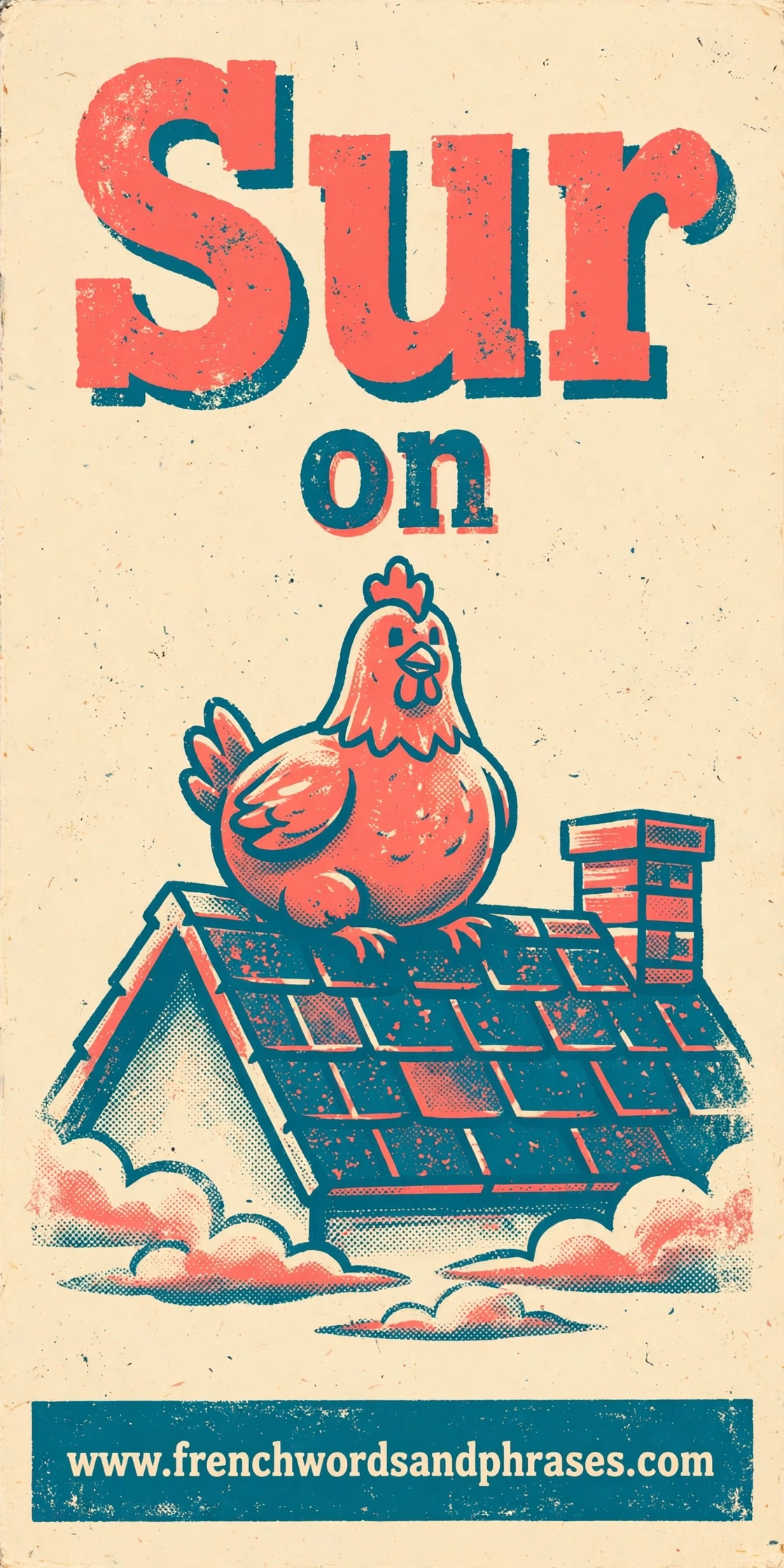
A cat pads across a sunny rooftop, settles on the warm tiles, and closes its eyes. « Le chat dort sur le toit » — the cat sleeps on the roof. Sur is the French word for on: contact, weight, a surface doing its job underneath. It is one of the shortest French words and one of the hardest working — it also talks about topics, ratios and screens.
Let’s explore how sur works in French, beginning with the whole word on one card.
Understanding the French Preposition Sur
Sur is a true French preposition — one of the core place prepositions. Its home territory is contact with a surface (on, on top of), and from there it spreads to topics (a book on history), proportions (nine out of ten) and media (on TV, on the internet).
It means on or on top of. The picture is physical: something resting on a surface and touching it — a book on the table, snow on the roof, a hat on a head. That touching is the whole point: if there is a gap of air, French switches to au-dessus de (above).
Type: Preposition — place (contact with a surface), plus topic and ratio uses
Answers the question: Où ? — Where? (Answer: on it, touching it)
What follows it: A noun or pronoun: sur la table, sur moi; also screens and topics
Watch the pair: sur (on, touching) vs au-dessus de (above, with a gap)
One important usage detail: sur also means “about” for topics — un livre sur la Révolution is a book ON (about) the Revolution, and it handles scores and ratios too: neuf sur dix, nine out of ten. English learners often reach for “à propos de” where a French speaker simply says sur.
Experience the Word
Sur is the preposition of contact — the book and the table, the foot and the floor, the snow and the roof.
Imagine a market stall in Provence: melons sur la table, baskets sur le sol, a striped awning sur la tête des clients — everything stacked, resting, touching.
You have not just placed something in the air. You have set it down, and let the surface take its weight.
How to Use Sur in French: Complete Guide
Let’s explore how sur works in French, beginning with the whole word on one card.
Sur at a Glance
The Whole Word on One Card
Meaning, job, pattern and pair — sur in four lines.
| Point | Sur |
|---|---|
| Meaning | on / on top of (touching); also about, out of |
| Job | sets one thing down on a surface — or on a topic |
| What follows | a noun or pronoun — la table, le toit, moi |
| Its gap cousin | au-dessus de — above, hovering, no contact |
Example
Le livre est sur la table.
The book is on the table.
The Pattern in Action: Weight on a Surface
Sur connects a thing to the surface carrying it — the two always touch.
| Pattern | Example |
|---|---|
| an object on furniture | les clés sont sur la table — the keys are on the table |
| a person on a vehicle | il est sur son vélo — he is on his bike |
| weather on a roof | la neige est sur le toit — the snow is on the roof |
| a picture on a wall | le tableau est sur le mur — the picture is on the wall |
Example
Elle a posé le vase sur la cheminée.
She put the vase on the mantelpiece.
Quick Quiz 1
What must be true between the two things when you use sur?
Reveal the answer
They must touch — sur is contact. A gap of air means au-dessus de.
La lampe est au-dessus de la table.
The lamp is above the table.
The Tricky Bit: Sur vs Au-dessus de — and Sur for Topics
Two signatures in one word: the contact test against au-dessus de, and the topic use that surprises English speakers.
| Word | The difference |
|---|---|
| sur | ON, touching: le chat est sur le toit — the cat is on the roof |
| au-dessus de | ABOVE, with air between: l’avion est au-dessus du toit — the plane is above the roof |
| sur = about | un film sur la guerre — a film about the war; une question sur le texte |
| sur = out of | ratios and scores: huit sur dix — eight out of ten |
Example
Neuf élèves sur dix ont réussi l’examen sur la Révolution.
Nine pupils out of ten passed the exam on the Revolution.
Where It Goes: Straight After the Verb, Before the Surface
Sur slots between the thing and its surface, and it also anchors a crowd of fixed phrases.
| Position / pattern | Example |
|---|---|
| thing + sur + surface | le verre est sur la nappe — the glass is on the tablecloth |
| with pronouns | ne compte pas sur moi — don’t count on me |
| screens and media | sur internet, sur la photo, à la télé mais sur l’écran — on the internet, in the photo, on TV but on the screen |
| direction onto | il monte sur la chaise — he climbs onto the chair |
Example
Je l’ai vu sur la photo.
I saw it in the photo.
Quick Quiz 2
“A book ABOUT Napoleon” — which word does French use: sur or au-dessus de?
Reveal the answer
sur — for topics, sur means about.
Un livre sur Napoléon.
A book about Napoleon.
Everyday Expressions with Sur
Sur is everywhere in daily French — at the table, at work, and in arguments.
| Expression | In English |
|---|---|
| sur la table | on the table — also: cards on the table, honestly |
| compter sur quelqu’un | to count on someone |
| sur le point de | about to / on the point of |
| neuf sur dix | nine out of ten |
| sur place | on site / on the spot (eat in: sur place ou à emporter) |
Example
Tu peux compter sur moi.
You can count on me.
Close Cousins: The Surface Family
Four ways to relate to a surface — contact, hovering, underneath, and leaning.
| Word | The difference |
|---|---|
| sur | on, touching the top surface |
| au-dessus de | above the surface, with a gap |
| sous | under the surface — the exact opposite: le chat est sous la table |
| contre | against a vertical surface, leaning: l’échelle est contre le mur |
Example
Le livre est sur la table et le chat est sous la table.
The book is on the table and the cat is under the table.
Quick Quiz 3
Which cousin means “under” — sur or sous?
Reveal the answer
sous — the exact opposite of sur.
Les chaussures sont sous le lit.
The shoes are under the bed.
Sur and Its Neighbours
The vertical shelf around sur, from hovering high to hiding low.
| French | In English |
|---|---|
| au-dessus de | above (gap) |
| sur | on (contact) |
| sous | under |
| au-dessous de | below (gap) |
| dans | in / inside |
Example
La lampe est au-dessus de la table, le livre est sur la table, et le chat est sous la table.
The lamp is above the table, the book is on the table, and the cat is under the table.
Watch Out: The Traps Around Sur
The traps: using it where English ‘on’ goes but French doesn’t, and missing its topic meaning.
| Trap | The truth |
|---|---|
| ‘on Monday’ with sur | days take no preposition: lundi, je pars — never sur lundi |
| ‘on the bus’ with sur | transport usually takes en or à: en bus, à vélo — sur is for surfaces you stand or sit on |
| forgetting the topic use | a book ‘on’ history is un livre sur l’histoire — sur, not a long phrase |
| confusing sur and sûr | sur = on; sûr = sure/safe — the accent changes the word entirely |
Example
Il lit un livre sur l’histoire dans le train.
He is reading a book about history on the train.
Quick Quiz 4
Complete: Huit élèves ______ dix ont réussi. (Eight pupils out of ten passed.)
Reveal the answer
sur — sur builds ratios: eight out of ten.
Huit élèves sur dix ont réussi.
Eight pupils out of ten passed.
Sur in Everyday French: Real-Life Examples
Now that you know the word, let’s see how sur appears in everyday French.
Example Example 1 — Home
Les clés sont sur la table.
The keys are on the table.
Example Example 2 — Animals
Le chat dort sur le toit.
The cat sleeps on the roof.
Example Example 3 — Topics
C’est un film sur la mer.
It’s a film about the sea.
Example Example 4 — Trust
Tu peux compter sur moi.
You can count on me.
Example Example 5 — Scores
Elle a eu dix-huit sur vingt.
She got eighteen out of twenty.
Example Example 6 — Eating out
Sur place ou à emporter ?
Eat in or takeaway?
Beyond Translation: The Meaning of Sur
English “on” is a workhorse, and French sur matches it job for job — then adds a few of its own. A surface, a topic, a score out of twenty, a face on a screen: sur carries them all, because in the French imagination they are all things resting on something.
To say sur is to set something down and let it be supported.
That is why compter sur quelqu’un — to count on someone — is so warm in French: the person is the surface, and your weight is safe on them.
How to Remember the French Preposition Sur
Remember it this way: Remember it this way: Sur is the cat on the roof — full contact, no air. If it hovers, it is au-dessus de.
- You run the touch test — touching is sur, hovering is au-dessus de.
- You collect the bonus jobs — topics (un livre sur…) and ratios (neuf sur dix).
- You mind the accent — sur (on) is not sûr (sure).
The key idea is sur means on with contact, au-dessus de means above with a gap, and sur also means about and out of.
Test Your Knowledge of Sur
Let’s see how much you’ve learned. Try answering these questions before revealing the answers.
Question 1
What does sur mean?
Reveal the answer
On / on top of — resting on a surface and touching it; also about, and out of in ratios.
Question 2
What is the difference between sur and au-dessus de?
Reveal the answer
Sur touches the surface (the cat on the roof); au-dessus de hovers above it with a gap (the plane above the roof).
Question 3
Translate: The keys are on the table.
Reveal the answer
Les clés sont sur la table.
Question 4
How do you say “nine out of ten” in French?
Reveal the answer
Neuf sur dix.
Question 5
Complete the sentence:
Le chat dort ______ le toit. (The cat sleeps on the roof.)
Reveal the answer
sur
Le chat dort sur le toit.
The cat sleeps on the roof.
Your Final Challenge
Can You Use It?
How would you say this in French?
“How would you say this in French?”
Reveal the answer
Les clés sont sur la table.
The keys are on the table.
A little French. A little curiosity. A richer everyday life.
LEARN FRENCH ONE WORD AT A TIME