A French Word to Live By
Translate S’occuper de ses oignons to English
/sɔ.ky.pe də se.z‿ɔ.ɲɔ̃/
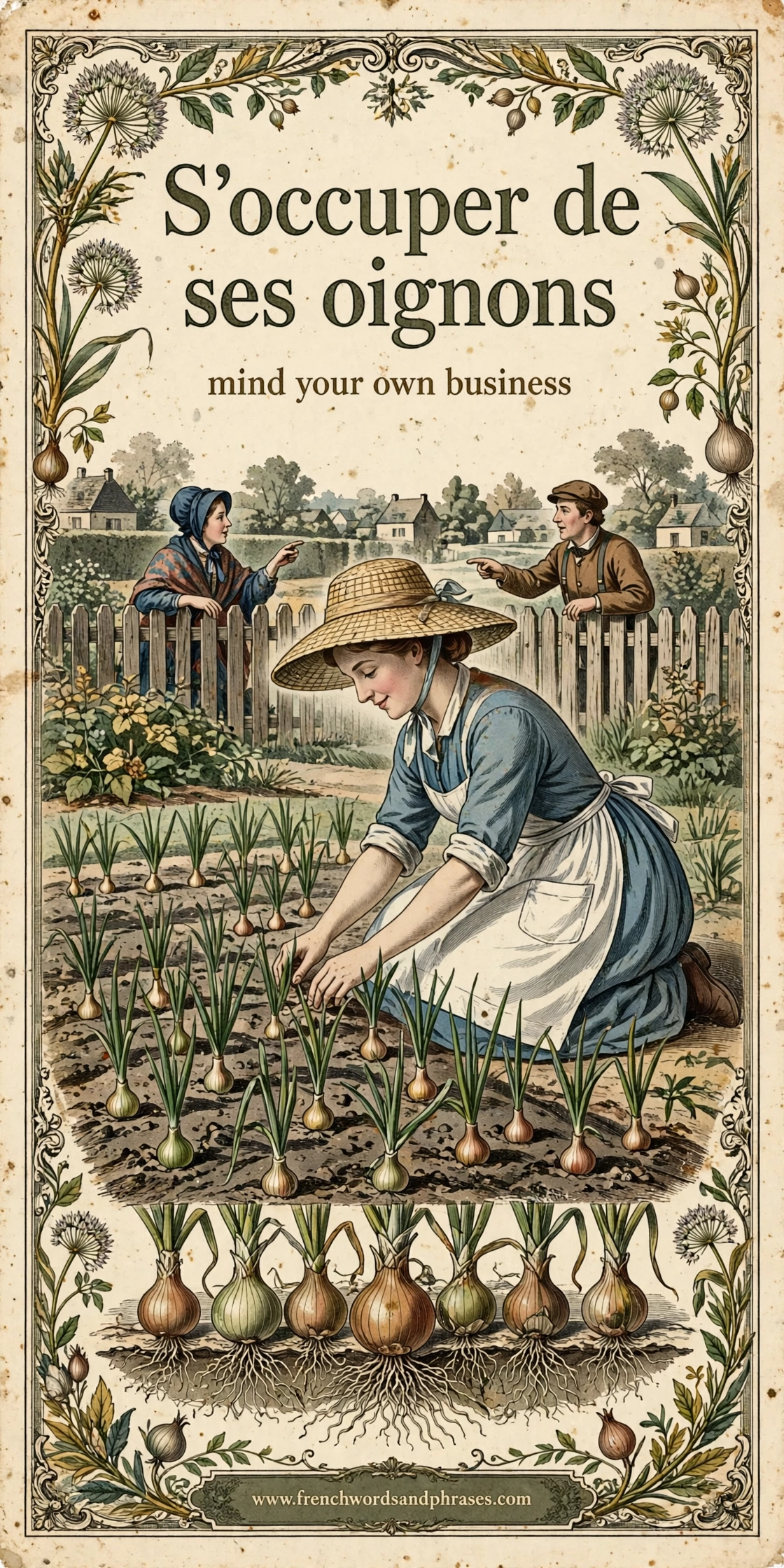
S’occuper de ses oignons means to mind one’s own business.
At the market in Dijon, the onion seller is deep in conversation about the mayor, the neighbours and somebody’s cousin’s divorce. The woman at the next stall leans over her crates and delivers the classic verdict, half laughing, half serious: « Occupe-toi de tes oignons ! » Mind your own business — literally, look after your own onions.
Let’s explore how s’occuper de ses oignons works in French, beginning with the whole phrase on one card.
Understanding the French Phrase S’occuper de ses oignons
S’occuper de ses oignons is an informal French idiom built from the reflexive verb s’occuper de (to busy yourself with, to take care of) and ses oignons (one’s onions). Your onions are your own affairs: to look after them, and only them, is to mind your own business.
It means to mind one’s own business. English tells the curious to keep their nose out; French sends them back to their vegetable patch. The idiom is most famous as a command — occupe-toi de tes oignons ! — cheerful between friends, sharp when the nosiness has gone too far.
Type: Idiom — reflexive verb phrase built on a market-garden picture
Answers the need: Telling someone to mind their own business — or doing so yourself
Register: Informal — the tone, from teasing to sharp, is set by the voice
Strength: Direct — a real boundary, softened only by the comedy of the onions
One important usage detail: the possessive follows the person — mes oignons for me, tes oignons for you, ses oignons for him or her, nos oignons and leurs oignons for groups. The famous form is the tu command: occupe-toi de tes oignons !
Experience the Word
S’occuper de ses oignons is the border fence of French private life — a sentence that draws a line around your affairs and hands the other person back to theirs.
Imagine the village where everyone knows everyone’s harvest, debts and romances. The onions are the perfect symbol: humble, personal, and nobody else’s to count. Tend your own row, says the idiom, and let your neighbour tend his.
French defends privacy with vegetables rather than walls. The command is firm, but it arrives wearing a smile — it is very hard to stay offended at an onion.
How to Use S’occuper de ses oignons in French: Complete Guide
Let’s explore how s’occuper de ses oignons works in French, beginning with the whole phrase on one card.
S’occuper de ses oignons at a Glance
The Whole Phrase on One Card
Real meaning, literal building blocks, English twin and register — the idiom in five lines.
| Point | S’occuper de ses oignons |
|---|---|
| What it really means | to mind one’s own business |
| Word for word | to take care of one’s onions |
| English equivalent | mind your own business! / to keep your nose out of it |
| Register | informal — teasing between friends, sharp when patience ends |
| Use it for | nosy questions, unwanted advice, and gossip that has gone too far |
Example
Occupe-toi de tes oignons, ce n’est pas ton affaire.
Mind your own business, it’s not your concern.
Word by Word: Tending Your Own Row
Two pieces — the busy reflexive verb and the onions that stand for your affairs.
| Word | Literal meaning | Its job in the phrase |
|---|---|---|
| s’occuper de | to busy yourself with, to take care of | the reflexive verb — the same verb as s’occuper des enfants, to look after the children |
| ses | one’s own (his, her, their) | the possessive that changes with the person: mes, tes, ses, nos, vos, leurs oignons |
| oignons | onions | your affairs pictured as your vegetable row — yours to tend, nobody else’s to count |
Example
Elle s’occupe de ses oignons et ne dit rien.
She minds her own business and says nothing.
Quick Quiz 1
How do you say ‘mind your own business’ to a friend, with this idiom?
Reveal the answer
Occupe-toi de tes oignons ! — the tu command, with tes for ‘your’.
Occupe-toi de tes oignons, s’il te plaît.
Mind your own business, please.
When You Say It: The Nosiness Moments
The idiom appears wherever curiosity crosses the fence — questions too personal, advice nobody requested.
| Situation | Example |
|---|---|
| The personal question | occupe-toi de tes oignons, c’est ma vie privée — mind your own business, it’s my private life |
| The unwanted advice | je ne t’ai rien demandé, occupe-toi de tes oignons — I didn’t ask you anything, mind your own business |
| Describing a discreet person | elle s’occupe de ses oignons, elle ne parle jamais des autres — she minds her own business, she never talks about others |
| About a gossip | il ne s’occupe jamais de ses oignons — he never minds his own business |
| Between old friends, laughing | allez, occupe-toi de tes oignons, curieux ! — go on, mind your own business, nosy! |
Example
Depuis quand tu t’occupes de mes oignons ?
Since when is my business any of your concern?
Make It Yours: Every Person’s Onions
The reflexive verb and the possessive both follow the person — learn the whole row of onion-owners.
| Form | French | In English |
|---|---|---|
| I mind mine | je m’occupe de mes oignons | I mind my own business |
| You mind yours (tu) | tu t’occupes de tes oignons | you mind your own business |
| The tu command | occupe-toi de tes oignons ! | mind your own business! |
| The vous command | occupez-vous de vos oignons ! | mind your own business! — to a group or formally |
| They mind theirs | ils s’occupent de leurs oignons | they mind their own business |
| In the negative | elle ne s’occupe pas de ses oignons | she doesn’t mind her own business |
Example
Nous nous occupons de nos oignons, merci.
We mind our own business, thank you.
Quick Quiz 2
Which possessive goes with nous in this idiom?
Reveal the answer
Nos — nous nous occupons de nos oignons. The onions always belong to the subject.
Occupons-nous de nos oignons.
Let’s mind our own business.
Everyday Expressions: Frames Around the Onions
The idiom slots into these everyday frames — each one ready to use as it stands.
| Frame | In English |
|---|---|
| occupe-toi de tes oignons ! | mind your own business! — the signature command |
| ce ne sont pas tes oignons | that’s none of your business — the verdict form |
| chacun ses oignons | each to his own affairs — everyone mind their own row |
| s’occuper de ses propres oignons | to mind one’s own business — with propres for extra emphasis |
| mêle-toi de tes oignons | keep to your own onions — a variant built on se mêler de |
Example
Ce ne sont pas tes oignons, laisse-les tranquilles.
That’s none of your business, leave them alone.
Close Cousins: The Other Boundaries
French draws the privacy line in several registers — the onions are the comic one; its cousins are drier or sharper.
| Expression | The difference |
|---|---|
| s’occuper de ses oignons | the standard idiom — comic picture, tone set by the voice |
| mêle-toi de tes affaires | mind your own affairs — the plain version, no vegetables, a little drier |
| ça ne te regarde pas | that’s none of your business — literally, that doesn’t look at you; sharp and direct |
| s’occuper de ses affaires | to mind one’s own affairs — the idiom with the onions removed |
| regarder ailleurs | to look the other way — the polite behaviour the idiom demands |
Example
Ça ne te regarde pas, mêle-toi de tes affaires.
That’s none of your business, mind your own affairs.
Quick Quiz 3
Which cousin is the sharpest way to say ‘none of your business’?
Reveal the answer
Ça ne te regarde pas — flat and direct. The onions keep a smile in reserve; this one doesn’t.
Ça ne te regarde pas, point.
That’s none of your business, full stop.
S’occuper de ses oignons and Its Neighbours
The privacy shelf around the idiom — curiosity, discretion and gossip.
| French | In English |
|---|---|
| un curieux | a nosy person — the one the idiom is aimed at |
| la vie privée | private life — what the onions are protecting |
| être discret | to be discreet — minding your onions as a character trait |
| les commérages | gossip — what happens when nobody minds their onions |
| mettre son nez partout | to stick your nose everywhere — the opposite habit |
Example
Il met son nez partout, ce n’est pas un homme discret.
He sticks his nose into everything, he’s not a discreet man.
Watch Out: The Traps Around S’occuper de ses oignons
The traps: the verb’s other honest job, the changing possessive, and the real onions at the market.
| Trap | The truth |
|---|---|
| forgetting the verb’s day job | s’occuper de also honestly means to take care of — s’occuper des enfants is childcare, not nosiness; the onions make the idiom |
| freezing the possessive on ses | ses belongs to il/elle — your onions are tes oignons, mine are mes oignons; match the owner |
| the market reading | at a stall, des oignons are real onions — the idiom needs s’occuper de and a nosy human in sight |
| using it with your boss | the idiom is informal and can bite — to a superior, silence or je préfère ne pas en parler is safer |
Example
Elle s’occupe des enfants le matin et de ses oignons le reste du temps.
She looks after the children in the morning and minds her own business the rest of the time.
Quick Quiz 4
True or false: in this idiom, the possessive is always ses.
Reveal the answer
False — the onions belong to the subject: mes oignons, tes oignons, ses oignons, nos oignons, leurs oignons.
Occupez-vous de vos oignons, messieurs.
Mind your own business, gentlemen.
S’occuper de ses oignons in Everyday French: Real-Life Examples
Now that you know the word, let’s see how s’occuper de ses oignons appears in everyday French.
Example 1 — The salary question
Combien je gagne ? Occupe-toi de tes oignons !
How much do I earn? Mind your own business!
Example 2 — The discreet neighbour
Notre voisine s’occupe de ses oignons, on l’apprécie pour ça.
Our neighbour minds her own business, we like her for it.
Example 3 — The family dinner
À table, mon oncle a dit à ma tante de s’occuper de ses oignons.
At the table, my uncle told my aunt to mind her own business.
Example 4 — The office gossip
Il ne s’occupe jamais de ses oignons, il sait tout sur tout le monde.
He never minds his own business, he knows everything about everyone.
Example 5 — The group command
Occupez-vous de vos oignons, les enfants, et finissez vos devoirs.
Mind your own business, children, and finish your homework.
Example 6 — The quiet reply
Je m’occupe de mes oignons, moi, je ne demande rien.
I mind my own business, me, I don’t ask anything.
Beyond Translation: The Meaning of S’occuper de ses oignons
Every culture grows a garden for this sentence. English guards the nose — keep it out, don’t be nosy — while French guards the vegetable patch, and the difference is a whole philosophy: your affairs are not a body part to be poked in, but a crop to be tended.
S’occuper de ses oignons turns privacy into gardening advice: your row is over there, and it needs you.
That is why the command, even at its sharpest, keeps a rustic humour. It does not accuse the nosy person of wickedness — it simply hands them back their own onions, which have been waiting, neglected, all this time.
How to Remember the French Phrase S’occuper de ses oignons
Remember it this way: picture your private life as a row of onions in your own garden — the idiom sends everyone else back to tend theirs.
- You hear oignons and think affairs — your onions are your business, nobody else’s crop.
- You match the owner — mes, tes, ses, nos, vos, leurs oignons follow the person.
- You keep the famous command ready — occupe-toi de tes oignons ! is the idiom’s home.
The key idea is s’occuper de ses oignons means to mind one’s own business — your onions are your own affairs.
Test Your Knowledge of S’occuper de ses oignons
Let’s see how much you’ve learned. Try answering these questions before revealing the answers.
Question 1
What does s’occuper de ses oignons mean?
Reveal the answer
To mind one’s own business — to tend your own affairs and leave other people’s alone.
Question 2
What is the famous command form, to a friend?
Reveal the answer
Occupe-toi de tes oignons ! — mind your own business!
Question 3
How does the possessive change for ‘we mind our own business’?
Reveal the answer
It becomes nos — nous nous occupons de nos oignons. The onions always belong to the subject.
Question 4
Translate: That’s none of your business.
Reveal the answer
Ce ne sont pas tes oignons.
Question 5
Complete the sentence:
Elle s’occupe de ______ oignons. (She minds her own business.)
Reveal the answer
ses
Elle s’occupe de ses oignons.
She minds her own business.
Your Final Challenge
Can You Use It?
How would you say this in French?
“Mind your own business — it’s my private life!”
Reveal the answer
Occupe-toi de tes oignons — c’est ma vie privée !
Mind your own business — it’s my private life!
A little French. A little curiosity. A richer everyday life.
LEARN FRENCH ONE WORD AT A TIME