A French Word to Live By
Translate Si to English
/si/
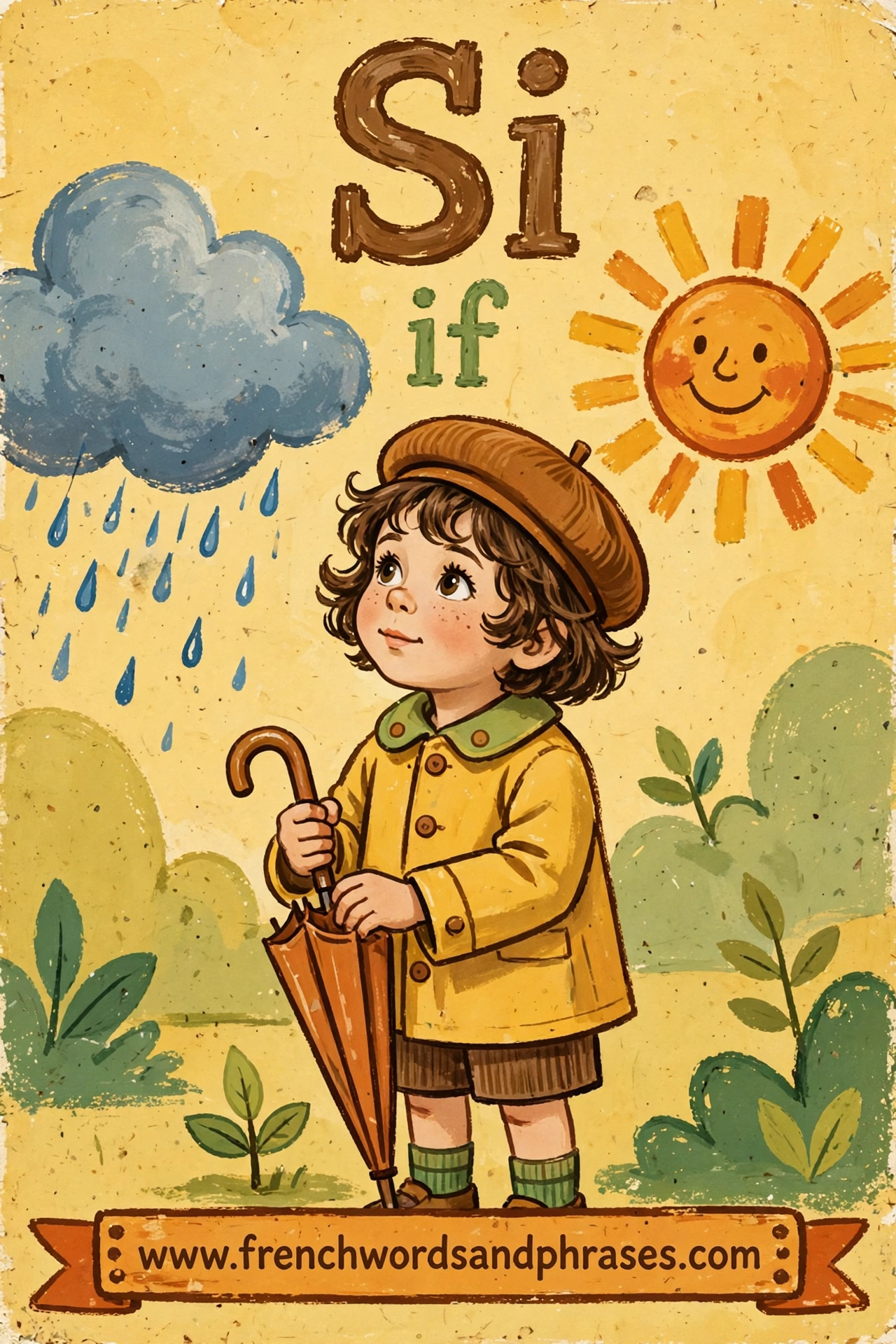
Si means if.
« Et si on allait à la mer ? » — what if we went to the seaside? Every plan, every dream and every warning in French begins in the same place: inside a small si, where nothing is real yet and everything is possible.
In this guide, you’ll learn what si means in English, the famous tense ladder that follows it, why the future tense is banned right after si, and how si also means ‘whether’, ‘so’ and even ‘yes’. Explore French examples, English translations, and practice quizzes.
Understanding the French Conjunction Si
Si is a French subordinating conjunction of condition. It opens a hypothesis — an if-clause — and the rest of the sentence tells you what follows if the hypothesis comes true.
It means if. After si comes a clause in the present or the imperfect, never the future: si tu viens, je serai content — if you come, I’ll be happy. Si also means whether in indirect questions: je me demande si elle viendra — I wonder whether she’ll come.
Type: Subordinating conjunction — condition
What follows it: A clause in the present, imperfect or pluperfect — never the future
Mood after it: Indicative only (present, imperfect, pluperfect)
The partner clause: Future with si + present; conditional with si + imperfect
One famous exception to learn by heart: in indirect questions si means ‘whether’ and the future IS allowed — je me demande si elle viendra, I wonder whether she’ll come. The ban on the future applies only to real if-clauses.
Experience the Word
Si is the conjunction of the possible — it builds a small room next to reality and invites you to step inside.
Imagine two friends over a map on a café table: « si on prend le train de huit heures… si on dort chez Paul… » — the whole holiday exists first as si-clauses, fragile and shining, before a single ticket is bought.
You have not just stated a condition. You have opened a door that reality has not yet walked through.
How to Use Si in French: Complete Guide
Let’s explore how si works in French, beginning with the whole word on one card.
Si at a Glance
Before the details, here is the whole word on one card.
The Whole Word on One Card
Meaning, job, pattern and mood — si in four lines.
| Point | Si |
|---|---|
| Meaning | if (also: whether, so) |
| Job | opens a hypothesis |
| What follows | a clause in the present or imperfect — never the future |
| Mood | indicative only |
Example
Si tu as faim, mange quelque chose.
If you’re hungry, eat something.
How Si Links: The Famous Ladder
Si-clauses climb a ladder of three rungs. The tense after si fixes the tense of the result — learn the ladder once and every French condition falls into place.
| Pattern | Example |
|---|---|
| si + present → future result | si tu étudies, tu réussiras — if you study, you will pass |
| si + imperfect → conditional result | si tu étudiais, tu réussirais — if you studied, you would pass |
| si + pluperfect → past conditional result | si tu avais étudié, tu aurais réussi — if you had studied, you would have passed |
| si + present → order or fact | si tu es prêt, on y va — if you’re ready, let’s go |
Example
Si j’ai le temps, je t’aiderai.
If I have time, I’ll help you.
Quick Quiz 1
Si tu viens demain, je ______ content: serai or serais?
Reveal the answer
serai — the future. Si + present pairs with the future in the result clause.
Si tu viens demain, je serai content.
If you come tomorrow, I’ll be happy.
The Mood Question: Indicative, on a Ladder
Si never takes the subjunctive — but it polices tenses strictly. The future and the conditional are forbidden inside the si-clause itself; they belong to the result clause.
| After si | Example |
|---|---|
| allowed: present | si tu viens — if you come |
| allowed: imperfect | si tu venais — if you came (but you don’t) |
| allowed: pluperfect | si tu étais venu — if you had come |
| forbidden after si | never ‘si tu viendras’ — say si tu viens, je serai là |
Example
Si nous étions riches, nous voyagerions.
If we were rich, we would travel.
Where Si Goes: First, or in the Middle
The si-clause can open the sentence (with a comma after it) or follow the result. And si only ever shortens before il and ils.
| Position | Example |
|---|---|
| at the start (comma after the clause) | si tu veux, on peut partir — if you want, we can leave |
| in the middle (no comma) | on peut partir si tu veux — we can leave if you want |
| elision before il/ils only | s’il te plaît, s’ils viennent — si shortens only before il and ils |
| si in indirect questions = whether | dis-moi si tu viens — tell me whether you’re coming |
Example
S’il pleut demain, nous resterons à la maison.
If it rains tomorrow, we’ll stay home.
Quick Quiz 2
True or false: the future tense can follow si in an if-clause.
Reveal the answer
False — never in the if-clause itself.
Si tu viens, je serai content.
The future lives in the result clause.
Everyday Expressions with Si
Si is hiding inside the politest phrase in French and the wistfullest — learn these five and you will hear them daily.
| Expression | In English |
|---|---|
| s’il te plaît / s’il vous plaît | please |
| si seulement | if only (+ imperfect or pluperfect) |
| si jamais | if ever / if by any chance |
| et si on… ? | how about…? (a suggestion: et si on sortait ?) |
| si beau / si grand | so beautiful / so big (si = so, before adjectives) |
Example
Et si on faisait une pause ?
How about taking a break?
Close Cousins: Si, À condition que, Au cas où, Quand
Four ways to hang a sentence on a condition — they differ in strictness, in mood, and in how sure the speaker sounds.
| Word | The difference |
|---|---|
| si | the plain ‘if’ — the hypothesis is open |
| à condition que | ‘provided that’ — stricter, and takes the subjunctive |
| au cas où | ‘just in case’ — pairs with the conditional: au cas où tu viendrais |
| quand | ‘when’ — for things treated as certain, not hypotheses |
Example
Au cas où il pleuvrait, prends un parapluie.
Just in case it rains, take an umbrella.
Quick Quiz 3
Which one takes the subjunctive — si or à condition que?
Reveal the answer
à condition que. Si keeps the indicative.
Je viendrai à condition que tu sois là.
I’ll come provided that you’re there.
Si and Its Neighbours
Conditions travel with certainties and wishes: here is the neighbourhood si lives in.
| French | In English |
|---|---|
| à condition que | provided that (+ subjunctive) |
| au cas où | just in case |
| quand / lorsque | when (certainty, not hypothesis) |
| même si | even if |
| si ! (as an answer) | yes! — si contradicts a negative statement |
Example
Même s’il pleut, nous sortirons.
Even if it rains, we’ll go out.
Watch Out: The Traps Around Si
Si collects the most famous traps in French grammar: two banned tenses, one surprising meaning of ‘yes’, and a secret career as the word ‘so’.
| Trap | The truth |
|---|---|
| future after si | the classic error: never ‘si tu viendras’ — si tu viens, je serai content |
| conditional after si | also banned in the if-clause: never ‘si tu voudrais’ — si tu voulais |
| si answering a negative | « Tu ne viens pas ? — Si ! » — si means YES when it contradicts a no |
| si = so | before adjectives si means ‘so’: elle est si gentille — she is so kind |
Example
— Tu n’aimes pas le fromage ? — Si, je l’adore !
— You don’t like cheese? — Yes I do, I love it!
Quick Quiz 4
Si seulement je ______ riche: suis, sois or étais?
Reveal the answer
étais — si seulement (if only) takes the imperfect.
Si seulement j’étais riche !
If only I were rich!
Si in Everyday French: Real-Life Examples
Now that you know the word, let’s see how si appears in everyday French.
Example 1 — A plan
Si tu es libre ce soir, on dîne ensemble.
If you’re free tonight, we’ll have dinner together.
Example 2 — A dream
Si je gagnais au loto, j’achèterais une maison en Provence.
If I won the lottery, I’d buy a house in Provence.
Example 3 — A regret
Si tu m’avais écouté, tout irait bien.
If you had listened to me, everything would be fine.
Example 4 — Please
Un café, s’il vous plaît.
A coffee, please.
Example 5 — A suggestion
Et si on allait au parc ?
How about going to the park?
Example 6 — Wondering
Je me demande si le magasin est encore ouvert.
I wonder if the shop is still open.
Beyond Translation: The Meaning of Si
English says if for the meaning of si — but French si is a whole instrument panel: condition, wish, suggestion, contradiction, and the politest word in the language, s’il vous plaît.
Every si is a rehearsal for a life that has not happened yet.
Notice too how French protects the si-clause from the future: the hypothesis stays in the present or the past, as if grammar itself were saying — dream first in what you know, and let the future answer afterwards.
How to Remember the French Conjunction Si
Remember it this way: Si is the ladder word — one foot in the hypothesis, one in the result.
- You climb the ladder — si + présent → futur ; si + imparfait → conditionnel.
- You ban the future from the si-clause — si tu viens, never ‘si tu viendras’.
- You shorten it only before il — s’il vous plaît.
The key idea is si opens the hypothesis; present looks to the future, imperfect to the conditional.
Test Your Knowledge of Si
Let’s see how much you’ve learned. Try answering these questions before revealing the answers.
Question 1
What does si mean?
Reveal the answer
If — it introduces a condition. (It can also mean whether, and so.)
Question 2
Complete the ladder: si + imperfect → …?
Reveal the answer
The conditional: si tu venais, je serais content.
Question 3
Translate: If it rains, we’ll stay home.
Reveal the answer
S’il pleut, nous resterons à la maison.
Question 4
Can the future follow si in an if-clause?
Reveal the answer
No — never. Say si tu viens, je serai là.
Question 5
— Tu ne manges pas ? — ______ ! (contradict the no)
Reveal the answer
Si ! — si answers ‘yes’ against a negative.
Your Final Challenge
Can You Use It?
How would you say this in French?
“If you study, you will pass.”
Reveal the answer
Si tu étudies, tu réussiras.
If you study, you will pass.
A little French. A little curiosity. A richer everyday life.
LEARN FRENCH ONE WORD AT A TIME