A French Word to Live By
Translate Seulement to English
/sœlmɑ̃/
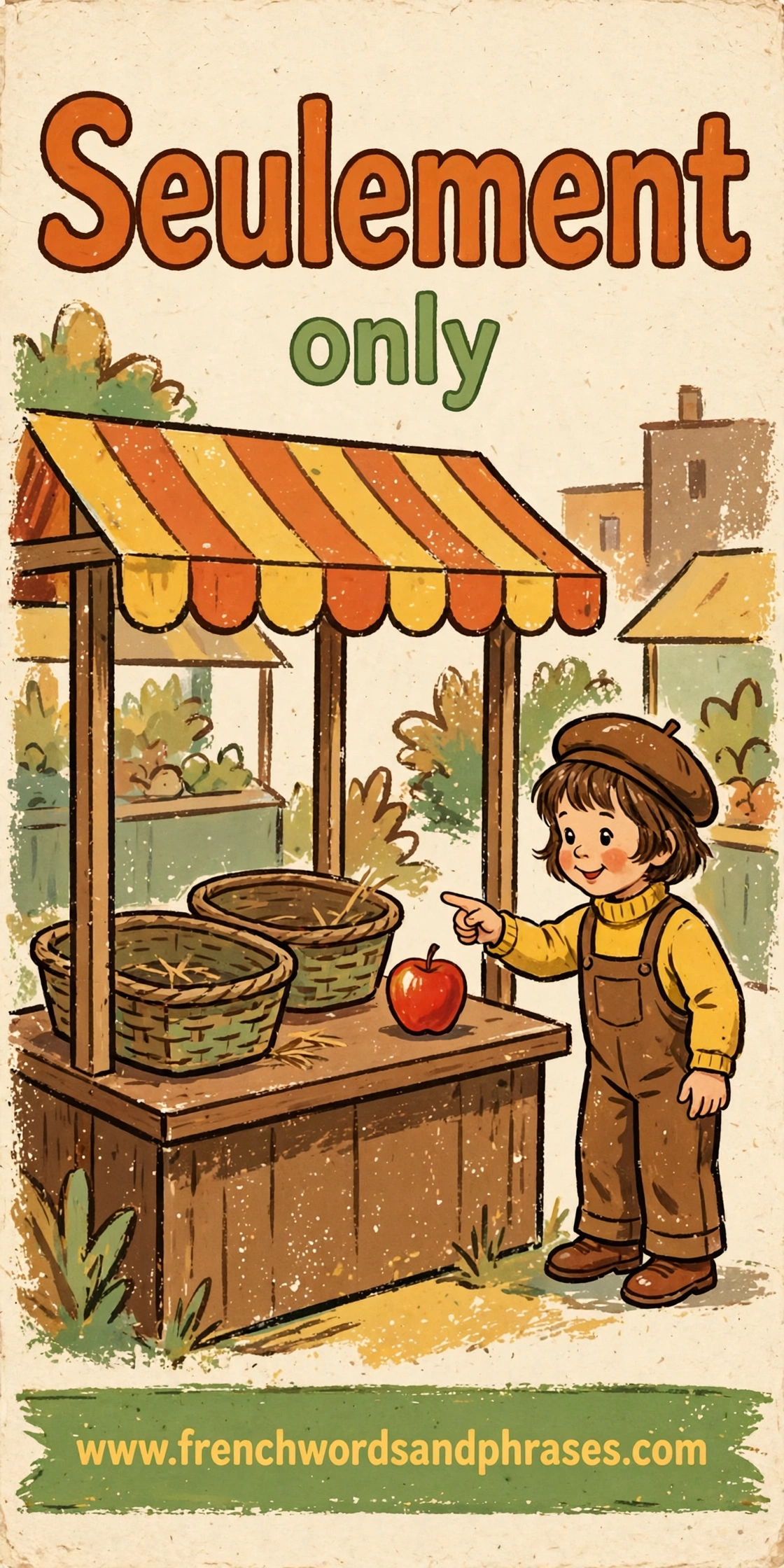
Seulement means only.
Seulement trois euros. Seulement cinq minutes. Seulement toi. Small word, small quantities: seulement is the word that shrinks the world down to the one thing that matters — and French loves it for exactly that.
In this guide, you’ll learn what seulement means in English, how it limits a word or a number, how it works beside ne… que and stars in non seulement… mais aussi, and why seulement at the start of a sentence can mean ‘but’. Explore French examples, English translations, and practice quizzes.
Understanding the French Conjunction Seulement
Seulement is a French adverb of limitation — the everyday word for only. It stands before the word, number or phrase it limits, and it can also open a sentence with a gentle ‘but, the thing is…’ in spoken French.
It means only. Il reste seulement deux places — there are only two seats left. Where English lets ‘only’ float loosely in the sentence, French sets seulement precisely, right in front of the thing being counted down.
Type: Adverb — limitation
Job: Limits a quantity, a person, an action — only
What follows it: The limited word — number, noun, pronoun, phrase
Mood after it: No clause of its own — verbs stay indicative
One important usage detail: for limiting a verb, French usually prefers ne… que — je ne bois que de l’eau, I only drink water. Seulement shines before numbers, nouns and pronouns. Speech sometimes doubles the two limiters, but careful writers choose one or the other.
Experience the Word
Seulement is the word of the small, precious remainder — what is left when everything else has been taken away.
Imagine the last slice of tart on the plate, two children watching it, and their mother smiling: « il en reste seulement une. » Only one left. The whole drama of fairness fits inside that adverb.
You have not just counted. You have pointed at the last one.
How to Use Seulement in French: Complete Guide
Let’s explore how seulement works in French, beginning with the whole word on one card.
Seulement at a Glance
Before the details, here is the whole word on one card.
The Whole Word on One Card
Meaning, job, pattern and mood — seulement in four lines.
| Point | Seulement |
|---|---|
| Meaning | only |
| Job | limits a number, noun, person or moment |
| What follows | the limited element, immediately after seulement |
| Mood | indicative — seulement changes quantities, not moods |
Example
Il reste seulement un billet.
There’s only one ticket left.
How Seulement Links: It Narrows, Not Joins
Seulement is not a clause-joiner like et or parce que; it links an idea to its limit. It stands before the element it narrows, and the rest of the sentence flows around it.
| Pattern | Example |
|---|---|
| seulement + number | seulement dix euros — only ten euros |
| seulement + noun phrase | seulement les membres — members only |
| seulement + pronoun group | seulement nous deux — just the two of us |
| seulement + time word | seulement maintenant — only now |
Example
Nous sommes seulement quatre à table ce soir.
There are only four of us at the table tonight.
Quick Quiz 1
‘Only three chairs’ — where does seulement go?
Reveal the answer
Right before the number — seulement narrows what follows it.
Seulement trois chaises.
Only three chairs.
The Mood Question: Quantities, Not Moods
Seulement never governs a clause, so it never triggers the subjunctive. Its partner structure ne… que also keeps the indicative. The one dreamy corner is a wish: si seulement (if only) uses the imperfect to imagine.
| Situation | Example |
|---|---|
| Plain limitation | elle a seulement lu la première page — she only read the first page |
| ne… que limitation | je ne veux que ça — that’s all I want (indicative) |
| si seulement + imperfect (a wish) | si seulement il faisait beau ! — if only the weather were nice! |
| non seulement… mais aussi | both halves keep the indicative: il chante, et il danse aussi |
Example
Si seulement je parlais couramment français !
If only I spoke French fluently!
Where Seulement Goes: Before the Limit — or First, as ‘But’
Inside the sentence, seulement precedes the element it limits. At the very start of a sentence in speech, it changes job and becomes a soft objection: ‘the only thing is…’.
| Position | Example |
|---|---|
| Before a number | il a seulement huit ans — he is only eight years old |
| Before the limited phrase | je viens seulement le dimanche — I only come on Sundays |
| Start of sentence (spoken ‘but’) | seulement, je n’ai pas le temps — the thing is, I don’t have time |
| In the great pairing | non seulement il chante, mais il danse aussi — not only does he sing, he dances too |
Example
J’aimerais venir ; seulement, je travaille samedi.
I’d like to come; only, I’m working on Saturday.
Quick Quiz 2
Seulement opens a sentence in conversation: ‘Seulement, je suis fatigué.’ What does it mean there?
Reveal the answer
‘The thing is / but’ — at the head of a sentence, seulement raises a gentle objection.
Seulement, je suis fatigué.
The thing is, I’m tired.
Everyday Expressions with Seulement
Seulement stars in one of the most useful pairings in French — and in the wistful si seulement of daydreams.
| Expression | In English |
|---|---|
| non seulement… mais aussi | not only… but also |
| si seulement… | if only… (a wish) |
| seulement voilà | the only thing is… / except that… |
| pas seulement | not only — pas seulement toi, not only you |
| seulement quand | only when |
Example
Non seulement il est gentil, mais il est aussi très drôle.
Not only is he kind, he is also very funny.
Close Cousins: Seulement, Ne… que, Uniquement, Juste
French has several ‘only’ tools. Seulement is the all-rounder; ne… que is the verb specialist; juste is the informal young cousin.
| Word | The difference |
|---|---|
| seulement | only — before numbers, nouns, pronouns; also starts non seulement… mais aussi |
| ne… que | only — wraps the verb: je ne bois que de l’eau; the classic choice for actions |
| uniquement | solely, exclusively — more formal, often on signs: réservé uniquement au personnel |
| juste | just — informal spoken ‘only’: juste un café, s’il vous plaît |
Example
Je ne bois que de l’eau — seulement de l’eau, jamais de vin.
I only drink water — only water, never wine.
Quick Quiz 3
‘I only drink water’ limits a verb. Which structure does French prefer?
Reveal the answer
ne… que — it wraps the verb.
Je ne bois que de l’eau.
I only drink water.
Seulement and Its Neighbours
Around seulement gather the words of small quantities and single things — and one generous opposite.
| French | In English |
|---|---|
| ne… que | only (around the verb) |
| uniquement | solely, exclusively |
| juste | just (informal) |
| un seul / une seule | a single one |
| tous / tout (opposite) | all, everything |
Example
Un seul mot suffit — seulement un mot.
A single word is enough — just one word.
Watch Out: The Traps Around Seulement
The traps: an ‘only’ floating too far from its word, a doubled limiter, and si seulement wearing the wrong tense.
| Trap | The truth |
|---|---|
| seulement far from its word | place seulement right before the element it limits, so the limit stays sharp: seulement dix euros — only ten euros |
| doubling ne… que + seulement | in careful writing choose one: il n’y a que trois places, or il y a seulement trois places |
| si seulement + future | wishes take the imperfect: si seulement je savais ! — not je saurai |
| seulement = ‘alone’ | ‘alone’ is seul: elle vit seule. Seulement never means alone |
Example
Elle vit seule, avec seulement un chat pour compagnie.
She lives alone, with only a cat for company.
Quick Quiz 4
‘If only I knew!’ — si seulement je saurai or si seulement je savais?
Reveal the answer
si seulement je savais — wishes use the imperfect.
Si seulement je savais la réponse !
If only I knew the answer!
Seulement in Everyday French: Real-Life Examples
Now that you know the word, let’s see how seulement appears in everyday French.
Example 1 — At the café
Un café seulement, merci.
Just a coffee, thanks.
Example 2 — At the station
Il reste seulement deux places dans le train.
There are only two seats left on the train.
Example 3 — At home
Les enfants ont seulement regardé le début du film.
The children only watched the start of the film.
Example 4 — A wish
Si seulement le soleil revenait demain !
If only the sun would come back tomorrow!
Example 5 — Shopping
Cette robe coûte seulement vingt euros aujourd’hui.
This dress costs only twenty euros today.
Example 6 — Praise
Non seulement tu as fini, mais tu as aussi tout rangé.
Not only did you finish, you also tidied everything away.
Beyond Translation: The Meaning of Seulement
English says only for the meaning of seulement — a word that can sound like a disappointment. In French, seulement often sounds like the opposite: a focusing, a choosing, the one thing picked out of the crowd.
Seulement teaches you the elegance of the limit: French delights in saying exactly how much, exactly who, exactly when — no more, and proudly no less.
And in its pairing non seulement… mais aussi, the little limiter turns generous: not only this, but also that — the sentence that begins by narrowing ends by overflowing.
How to Remember the French Conjunction Seulement
Remember it this way: Seulement is a narrowing lens — it stands before the one thing it keeps, and lets the rest go.
- You place it before the limited element — seulement trois, only three.
- You wrap verbs in ne… que instead — je ne bois que de l’eau.
- You dream with si seulement + imperfect — si seulement je savais !
The key idea is seulement limits what follows it — and verbs prefer ne… que.
Test Your Knowledge of Seulement
Let’s see how much you’ve learned. Try answering these questions before revealing the answers.
Question 1
What does seulement mean?
Reveal the answer
Only — it limits a number, person or thing.
Question 2
Translate: There are only five left.
Reveal the answer
Il en reste seulement cinq.
Question 3
What does si seulement express?
Reveal the answer
A wish — ‘if only’: si seulement je parlais français ! It takes the imperfect.
Question 4
Complete the pairing:
Non seulement il chante, ______ il danse aussi.
Reveal the answer
mais
Non seulement il chante, mais il danse aussi.
Not only does he sing, he dances too.
Question 5
Which structure limits a verb most naturally: seulement or ne… que?
Reveal the answer
ne… que — je ne bois que de l’eau, I only drink water.
Your Final Challenge
Can You Use It?
How would you say this in French?
“There are only two tickets left.”
Reveal the answer
Il reste seulement deux billets.
There are only two tickets left.
A little French. A little curiosity. A richer everyday life.
LEARN FRENCH ONE WORD AT A TIME